Colorado: Emergency vehicles and work zones — Part 1 Practice Test
Questions in this part include: “To which vehicles must you yield right of way when they are in use and showing flashing yellow and blue warning lights?” · “What can result from failing to follow the speed limit in a work or construction zone?”
Independent educational site · not affiliated with any government agency or DMV
Ready? Test yourself
- Instant feedback with an explanation
- Every answer cites its source in the manual
- Your best score is saved on this device
Questions are original and based on the official manual "Colorado Driver Handbook" (DR 2337, January 2025), Colorado Division of Motor Vehicles (DMV).
All 22 questions in this practice test
Take the test above first, then use this list to study. Tap “Show answer” to see the correct answer and explanation.
Show the questions and answersHide the questions
-
You must yield the right-of-way to emergency vehicles that are using which of these?
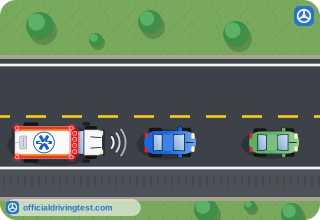
- Only a siren together with flashing red lights on the roof
- Only flashing red and blue lights when there is no sound
- A siren, air horn and/or flashing red, blue, white or yellow lights
- Only flashing white lights that are visible from the front
Show answer
Correct answer: A siren, air horn and/or flashing red, blue, white or yellow lights
The handbook lists a siren, air horn and/or flashing red, blue, white or yellow lights.
Source: Colorado Driver Handbook (DR 2337, January 2025), page 11 · Open this page in the manual (Manual page 11)
-
An emergency vehicle is approaching with its siren and lights on. Where possible, what must you do?
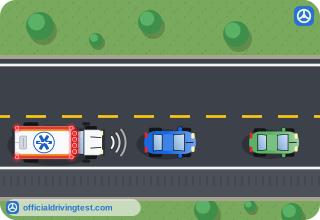
- Pull to the left edge of the road and keep moving slowly
- Pull to the right edge of the road and come to a stop
- Stop in your lane, even if you are in an intersection
- Speed up so that you clear the way ahead
Show answer
Correct answer: Pull to the right edge of the road and come to a stop
Where possible you must pull to the right edge of the road and stop.
Source: Colorado Driver Handbook (DR 2337, January 2025), page 11 · Open this page in the manual (Manual page 11)
-
An emergency vehicle approaches while you are in an intersection. What should you do?
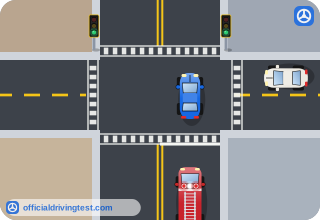
- Stop where you are in the middle of the intersection
- Back up to the stop line and pull over
- Turn left at once and pull over
- Drive through the intersection, then pull over
Show answer
Correct answer: Drive through the intersection, then pull over
If you are in an intersection, you drive through it and then pull over.
Source: Colorado Driver Handbook (DR 2337, January 2025), page 11 · Open this page in the manual (Manual page 11)
-
You are approaching an emergency vehicle stopped along the side of the road. What should you try to do?
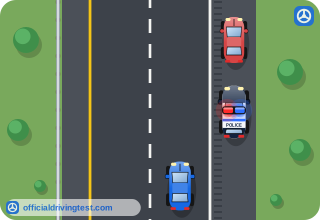
- Leave at least one lane between your vehicle and the emergency vehicle
- Stay in the lane next to the emergency vehicle and speed up
- Stop completely behind the emergency vehicle until it leaves
- Honk your horn to warn the emergency personnel
Show answer
Correct answer: Leave at least one lane between your vehicle and the emergency vehicle
The handbook says to try to leave at least one lane between your vehicle and the stopped emergency vehicle.
Source: Colorado Driver Handbook (DR 2337, January 2025), page 11 · Open this page in the manual (Manual page 11)
-
You approach a stopped emergency vehicle, but the road has only one lane on your side or you cannot change lanes. What should you do?
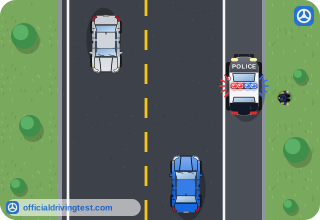
- Stop and wait until the emergency vehicle has left
- Pass at the posted speed limit and keep the lane
- Slow down to a safe speed and use care as you pass
- Move onto the shoulder and pass at a safe speed
Show answer
Correct answer: Slow down to a safe speed and use care as you pass
If you cannot change lanes you slow down to a safe speed and use care and caution as you pass.
Source: Colorado Driver Handbook (DR 2337, January 2025), page 11 · Open this page in the manual (Manual page 11)
-
You pass a stopped emergency vehicle where the posted speed limit is above 45 MPH. How much should you slow down, unless directed otherwise or conditions prohibit it?
- To 10 MPH under the posted speed limit
- To 30 MPH under the posted speed limit
- To 25 MPH, whatever the limit is
- To 20 MPH under the posted speed limit
Show answer
Correct answer: To 20 MPH under the posted speed limit
Above 45 MPH, you slow to 20 MPH under the posted speed limit.
Source: Colorado Driver Handbook (DR 2337, January 2025), page 11 · Open this page in the manual (Manual page 11)
-
To which vehicles must you yield right of way when they are in use and showing flashing yellow and blue warning lights?
- Service vehicles and maintenance equipment
- Only school buses and transit buses
- Only vehicles that are hauling trash
- Only snow plows that are in a formation
Show answer
Correct answer: Service vehicles and maintenance equipment
You must yield right of way to service vehicles and maintenance equipment when in use and flashing yellow and blue warning lights.
Source: Colorado Driver Handbook (DR 2337, January 2025), page 11 · Open this page in the manual (Manual page 11)
-
Why should you be especially cautious around snow plows?
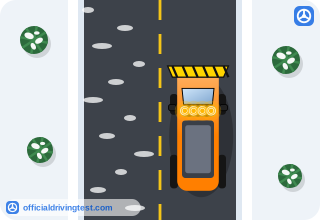
- Snow plows always travel faster than other traffic
- Snow plows may not have lights that flash
- Their size and speed can create clouds of blowing snow
- Snow plows may cross into your lane at any time
Show answer
Correct answer: Their size and speed can create clouds of blowing snow
The handbook says the size and speed of a snow plow can create clouds of blowing snow that conceal it.
Source: Colorado Driver Handbook (DR 2337, January 2025), page 11 · Open this page in the manual (Manual page 11)
-
When is it illegal to pass an authorized snow plow?
- When it is traveling slower than 25 mph
- When it is working in a staggered diagonal formation
- When it is plowing alone on the shoulder
- When it is plowing a road with only one lane
Show answer
Correct answer: When it is working in a staggered diagonal formation
It is illegal to pass an authorized snow plow working in a diagonally staggered formation.
Source: Colorado Driver Handbook (DR 2337, January 2025), page 11 · Open this page in the manual (Manual page 11)
-
A school bus is stopped with its red lights flashing. How far before reaching it must you stop your vehicle at the minimum?
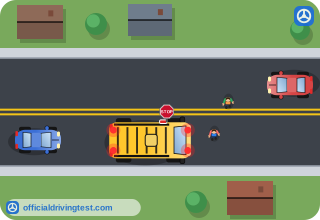
- 10 feet
- 30 feet
- 50 feet
- 20 feet
Show answer
Correct answer: 20 feet
You must stop at least 20 feet before reaching a school bus stopped with its red lights flashing.
Source: Colorado Driver Handbook (DR 2337, January 2025), page 11 · Open this page in the manual (Manual page 11)
-
When are you NOT required to stop for a school bus that is stopped with its red lights flashing?
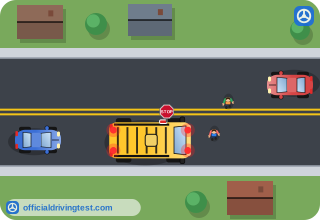
- When the bus is stopped on a two-lane road ahead of you
- When no children are visible near the bus
- When a median or physical barrier separates the bus
- When the bus is stopped at an intersection you are approaching
Show answer
Correct answer: When a median or physical barrier separates the bus
You are not required to stop if a median or other physical barrier separates the bus from your vehicle.
Source: Colorado Driver Handbook (DR 2337, January 2025), page 11 · Open this page in the manual (Manual page 11)
-
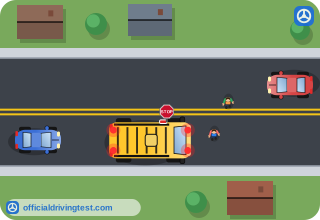
You must remain stopped for a school bus with flashing red lights until when?
- Until the bus driver waves you through
- Until the flashing red lights are no longer flashing
- Until 10 seconds have passed
- Until the children have crossed to your side of the road
Show answer
Correct answer: Until the flashing red lights are no longer flashing
You must remain stopped until the flashing red lights are no longer flashing.
Source: Colorado Driver Handbook (DR 2337, January 2025), page 11 · Open this page in the manual (Manual page 11)
-
When must you yield right-of-way to a transit bus?
- Whenever the bus is stopped at a bus stop with its doors open
- Whenever the bus has its hazard lights flashing in traffic
- Whenever the bus is carrying passengers on a city route
- When it signals to enter a lane and its rear yield sign is lit
Show answer
Correct answer: When it signals to enter a lane and its rear yield sign is lit
You must yield to a transit bus signaling to enter a traffic lane when the yield sign on the rear of the bus is illuminated.
Source: Colorado Driver Handbook (DR 2337, January 2025), page 11 · Open this page in the manual (Manual page 11)
-
What should you do in a work or construction zone to keep construction crews and road users safe?
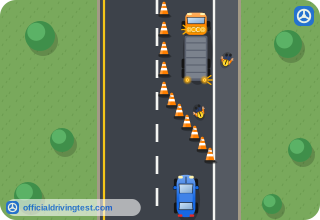
- Adjust your lane position away from workers and slow down
- Keep to the center of the roadway and maintain your speed
- Drive close to the workers so other vehicles can pass
- Use your horn to warn workers as you approach
Show answer
Correct answer: Adjust your lane position away from workers and slow down
The handbook says to adjust your lane position away from workers and slow down to navigate obstacles or changes in the flow of traffic.
Source: Colorado Driver Handbook (DR 2337, January 2025), page 11 · Open this page in the manual (Manual page 11)
-
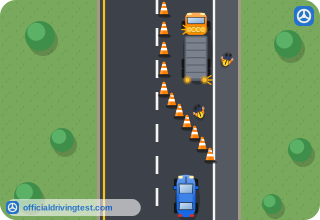
How are reduced speed limits in work or construction zones shown?
- They are not posted, so you must judge the speed
- They are shown only by flashing lights on workers' vehicles
- They are clearly marked
- They are shown only on the pavement
Show answer
Correct answer: They are clearly marked
Normal speed limits may be reduced in work zones, and any reduced limit is clearly marked.
Source: Colorado Driver Handbook (DR 2337, January 2025), page 12 · Open this page in the manual (Manual page 12)
-
What can result from failing to follow the speed limit in a work or construction zone?
- License suspension for a year
- Double fines
- A fine only if workers are present
- A warning only
Show answer
Correct answer: Double fines
Failure to follow the speed limit in a work or construction zone can result in double fines.
Source: Colorado Driver Handbook (DR 2337, January 2025), page 12 · Open this page in the manual (Manual page 12)
-
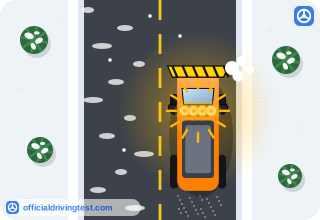
What should drivers do when approaching or passing a snowplow that is clearing snow and has flashing yellow lights?
- Pass it as quickly as possible
- Be extra careful
- Follow it closely to use the cleared lane
- Stay in your lane and speed up
Show answer
Correct answer: Be extra careful
Drivers should be extra careful when approaching or passing a snowplow clearing snow with flashing yellow lights.
Source: Colorado Driver Handbook (DR 2337, January 2025), page 17 · Open this page in the manual (Manual page 17)
-
When is it illegal to pass a city, county or state-operated snow plow?
- Only when it travels faster than the speed limit
- Only when it is on a road with three or more lanes
- Only when it is spreading sand or salt on the road
- While working in tandem with others, lights flashing
Show answer
Correct answer: While working in tandem with others, lights flashing
Passing is illegal while the plow is working with yellow lights flashing and driving in tandem with one or more other plows.
Source: Colorado Driver Handbook (DR 2337, January 2025), page 17 · Open this page in the manual (Manual page 17)
-
What colors of flashing lights do snow plows and sanding trucks use to warn you to use extreme caution?
- Red and white
- Yellow and blue
- Red and blue
- Green and yellow
Show answer
Correct answer: Yellow and blue
Snow plows and sanding trucks use flashing yellow and blue lights as a warning to use extreme caution.
Source: Colorado Driver Handbook (DR 2337, January 2025), page 17 · Open this page in the manual (Manual page 17)
-
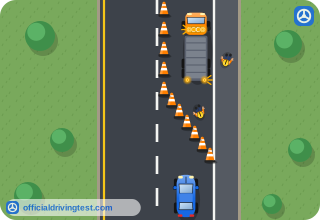
Because work zone conditions can change, what do drivers need to do?
- Drive in the center lane at all times
- Rely on their memory of the route
- Stay alert and focused at all times while driving
- Follow other vehicles closely to learn the route
Show answer
Correct answer: Stay alert and focused at all times while driving
Signs, cones and warning devices warn of changing conditions, which require you to stay alert and focused at all times.
Source: Colorado Driver Handbook (DR 2337, January 2025), page 18 · Open this page in the manual (Manual page 18)
-
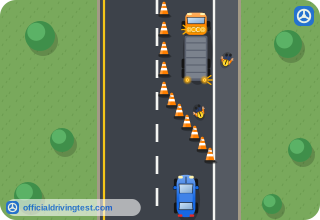
What should you be prepared to do in a work zone?
- Increase your speed
- Stop suddenly
- Pass slow vehicles
- Change lanes often
Show answer
Correct answer: Stop suddenly
The handbook says to be prepared to stop suddenly in a work zone.
Source: Colorado Driver Handbook (DR 2337, January 2025), page 18 · Open this page in the manual (Manual page 18)
-
What should you avoid doing in a work zone?
- Obeying flaggers
- Slowing down for workers
- Watching for pedestrians
- Following too closely
Show answer
Correct answer: Following too closely
The handbook says not to tailgate in a work zone.
Source: Colorado Driver Handbook (DR 2337, January 2025), page 18 · Open this page in the manual (Manual page 18)