Colorado: Emergencies — Part 1 Practice Test
Brake and tire failures, stuck accelerators, collisions with animals, crashes, the Move It law and helping the injured. — Part 1
Independent educational site · not affiliated with any government agency or DMV
Ready? Test yourself
- Instant feedback with an explanation
- Every answer cites its source in the manual
- Your best score is saved on this device
Questions are original and based on the official manual "Colorado Driver Handbook" (DR 2337, January 2025), Colorado Division of Motor Vehicles (DMV).
All 21 questions in this practice test
Take the test above first, then use this list to study. Tap “Show answer” to see the correct answer and explanation.
Show the questions and answersHide the questions
-
What should you do if you see a flooded roadway?
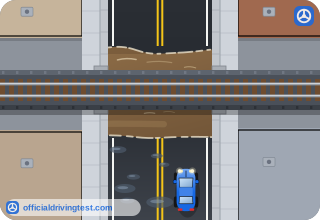
- Drive through slowly in a low gear
- Drive through quickly to avoid stalling
- Find another route to your destination
- Follow the vehicle ahead through the water
Show answer
Correct answer: Find another route to your destination
Do not drive through large bodies of standing water; find another route.
Source: Colorado Driver Handbook (DR 2337, January 2025), page 16 · Open this page in the manual (Manual page 16)
-
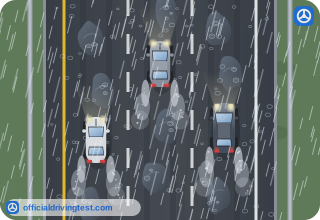
What is it called when your tires begin to ride on the water on top of the road pavement?
- Threshold braking
- Hydroplaning
- Washboarding
- Overcorrecting
Show answer
Correct answer: Hydroplaning
The handbook calls this hydroplaning; it can cause complete loss of traction and control of steering.
Source: Colorado Driver Handbook (DR 2337, January 2025), page 16 · Open this page in the manual (Manual page 16)
-
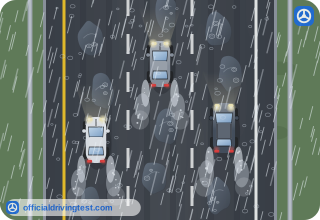
Hydroplaning can cause which of these?
- Better traction on the wet pavement
- Loss of braking only, with steering unaffected
- A stronger hold on the road for worn tires
- Complete loss of traction and control of steering
Show answer
Correct answer: Complete loss of traction and control of steering
Hydroplaning can cause complete loss of traction and control of steering.
Source: Colorado Driver Handbook (DR 2337, January 2025), page 16 · Open this page in the manual (Manual page 16)
-
Which tires are at increased risk of hydroplaning?
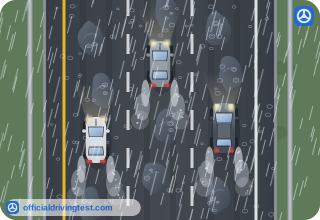
- Tires that have more wear
- Brand-new tires
- Tires with high tread depth
- Tires on four-wheel drive vehicles
Show answer
Correct answer: Tires that have more wear
Tires with more wear are at increased risk, so check your tread depth regularly.
Source: Colorado Driver Handbook (DR 2337, January 2025), page 16 · Open this page in the manual (Manual page 16)
-
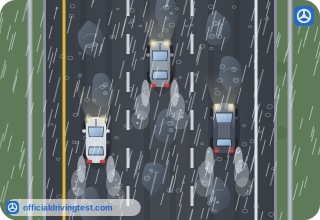
Your tires lose contact with the road surface in wet weather. Which is a correct response?
- Brake hard to stop as quickly as possible
- Accelerate to push through the water
- Take your foot off the gas pedal
- Turn the wheel sharply away from the skid
Show answer
Correct answer: Take your foot off the gas pedal
The first listed response is to take your foot off the gas pedal and let the vehicle slow down.
Source: Colorado Driver Handbook (DR 2337, January 2025), page 16 · Open this page in the manual (Manual page 16)
-
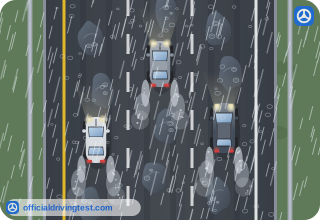
When your vehicle hydroplanes, which way should you slowly steer?
- Opposite to the direction you are hydroplaning
- In the direction you are hydroplaning
- Toward the shoulder of the road
- Straight into the nearest lane
Show answer
Correct answer: In the direction you are hydroplaning
Steering slowly in the direction of the hydroplane helps your tires realign with the vehicle.
Source: Colorado Driver Handbook (DR 2337, January 2025), page 16 · Open this page in the manual (Manual page 16)
-
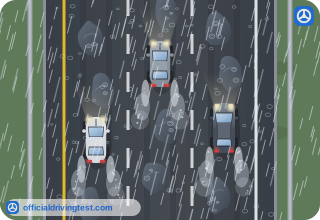
How should you steer while recovering from hydroplaning?
- With quick, sharp turns
- Hard, in one motion
- By letting go of the wheel
- Slowly and without jerking
Show answer
Correct answer: Slowly and without jerking
Steering needs to be slow; jerking the wheel could flip your car due to overcorrecting.
Source: Colorado Driver Handbook (DR 2337, January 2025), page 16 · Open this page in the manual (Manual page 16)
-
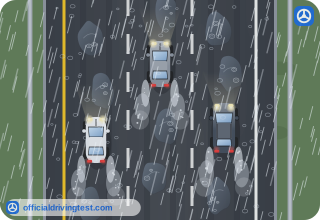
When should you try to stop or turn after your tires hydroplane?
- Only after your tires are gripping the road again
- Immediately, to get out of the skid quickly
- After you have traveled one more mile
- As soon as the windshield wipers clear the water
Show answer
Correct answer: Only after your tires are gripping the road again
Do not try to stop or turn until your tires are gripping the road again.
Source: Colorado Driver Handbook (DR 2337, January 2025), page 16 · Open this page in the manual (Manual page 16)
-
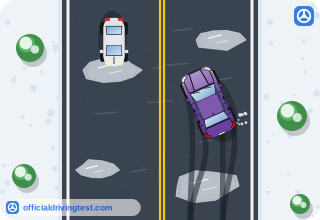
If your vehicle does not have anti-lock brakes, which technique should you use in slippery conditions?
- Anti-lock braking
- Hydroplaning
- Threshold braking
- Washboarding
Show answer
Correct answer: Threshold braking
Without anti-lock brakes, use threshold braking when skidding or in slippery conditions.
Source: Colorado Driver Handbook (DR 2337, January 2025), page 17 · Open this page in the manual (Manual page 17)
-
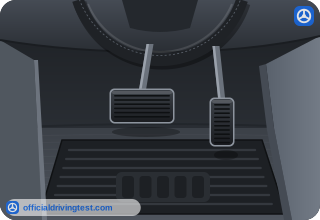
What is threshold braking?
- Pressing the brake pedal to the floor and holding it
- Braking just short of the point where the brakes lock up
- Pumping the brake pedal rapidly without pressing hard
- Braking only with the parking brake
Show answer
Correct answer: Braking just short of the point where the brakes lock up
Threshold braking means applying brake pressure to a point just short of locking up the brakes.
Source: Colorado Driver Handbook (DR 2337, January 2025), page 17 · Open this page in the manual (Manual page 17)
-
Which statement about threshold braking and anti-lock brakes is correct?
- You can use anti-lock braking techniques on a vehicle without ABS
- Threshold braking cannot be used on a vehicle with ABS
- Threshold braking is only for dry pavement
- You can use threshold braking on a vehicle with ABS
Show answer
Correct answer: You can use threshold braking on a vehicle with ABS
You can use threshold braking on a vehicle with ABS, but not anti-lock braking techniques on a vehicle without it.
Source: Colorado Driver Handbook (DR 2337, January 2025), page 17 · Open this page in the manual (Manual page 17)
-
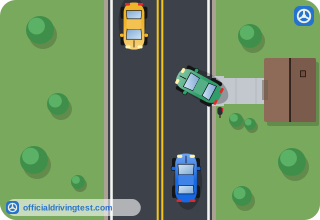
Which set lists the three options drivers have to avoid a collision?
- Slow down or stop, turn, or speed up
- Slow down or stop, honk, or turn
- Turn, flash your lights, or speed up
- Slow down or stop, back up, or turn
Show answer
Correct answer: Slow down or stop, turn, or speed up
The handbook names three options: slow down or stop, turn, and speed up.
Source: Colorado Driver Handbook (DR 2337, January 2025), page 25 · Open this page in the manual (Manual page 25)
-
In a vehicle with an Anti-lock Braking System (ABS), how should you stop quickly?
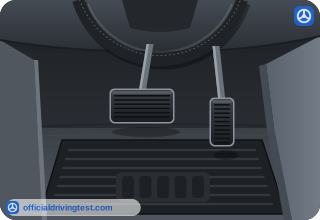
- Pump the brake pedal repeatedly until the vehicle stops
- Press the brake lightly and release it before pressing again
- Apply the brakes with hard, firm pressure and do not let up on the pedal
- Let up on the pedal when you feel it pushing back
Show answer
Correct answer: Apply the brakes with hard, firm pressure and do not let up on the pedal
With ABS, the handbook says to apply hard, firm pressure and not let up, because ABS works only with the pedal pushed down.
Source: Colorado Driver Handbook (DR 2337, January 2025), page 25 · Open this page in the manual (Manual page 25)
-
What might you feel through the brake pedal when ABS is working?
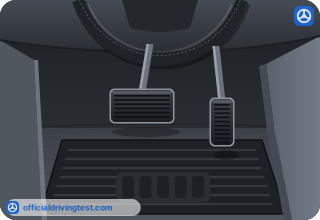
- The pedal sinking to the floor
- The pedal pushing back
- The pedal locking in place
- The pedal going completely soft
Show answer
Correct answer: The pedal pushing back
The handbook says you might feel the brake pedal pushing back when the ABS is working.
Source: Colorado Driver Handbook (DR 2337, January 2025), page 25 · Open this page in the manual (Manual page 25)
-
In a vehicle without ABS, how hard should you brake when you need to stop quickly?
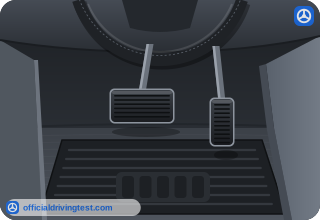
- With firm pressure and never let up
- Only with light taps on the pedal
- As hard as the pedal will go, even if the wheels lock
- As hard as you can without locking the brakes
Show answer
Correct answer: As hard as you can without locking the brakes
Without ABS, braking too hard can cause a skid, so you apply the brakes as hard as you can without locking them.
Source: Colorado Driver Handbook (DR 2337, January 2025), page 25 · Open this page in the manual (Manual page 25)
-
In most cases, which can you do more quickly when trying to avoid a collision?
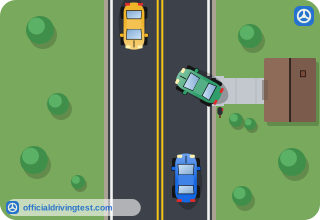
- Stop the vehicle rather than turn it
- Neither; turning and stopping take the same time
- Turn the vehicle rather than stop it
- Back the vehicle up rather than turn it
Show answer
Correct answer: Turn the vehicle rather than stop it
The handbook says that in most cases you can turn the vehicle quicker than you can stop it.
Source: Colorado Driver Handbook (DR 2337, January 2025), page 25 · Open this page in the manual (Manual page 25)
-
When should you consider turning in order to avoid a collision?
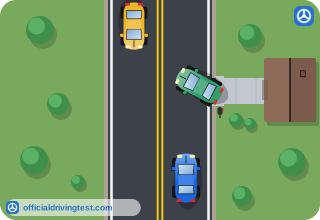
- Only when the road ahead is completely empty
- If doing so does not risk causing another collision
- Only when you are traveling below 25 mph
- Whenever you cannot sound the horn in time
Show answer
Correct answer: If doing so does not risk causing another collision
The handbook says to consider turning if it does not risk causing another collision.
Source: Colorado Driver Handbook (DR 2337, January 2025), page 25 · Open this page in the manual (Manual page 25)
-
After you have turned away or changed lanes to avoid a collision, what must you be ready to do?
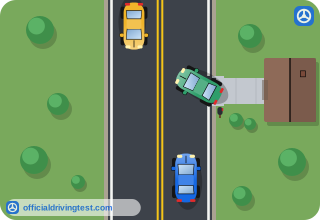
- Stop immediately in the new lane
- Return to your first lane right away
- Speed up to leave the area
- Keep the vehicle under control
Show answer
Correct answer: Keep the vehicle under control
The handbook says that once you have turned away or changed lanes, you must be ready to keep the vehicle under control.
Source: Colorado Driver Handbook (DR 2337, January 2025), page 25 · Open this page in the manual (Manual page 25)
-
What can you do in a vehicle with ABS that is very helpful if you must turn and stop or slow down?
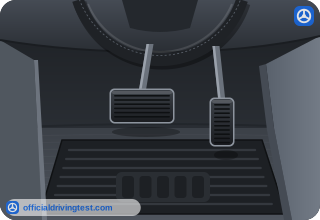
- Turn the vehicle while braking without skidding
- Brake without using the brake pedal
- Turn the steering wheel without gripping it
- Stop in a shorter distance by pumping the brake
Show answer
Correct answer: Turn the vehicle while braking without skidding
The handbook says ABS lets you turn your vehicle while braking without skidding.
Source: Colorado Driver Handbook (DR 2337, January 2025), page 25 · Open this page in the manual (Manual page 25)
-
In a vehicle without ABS, how do you turn quickly to avoid a collision?
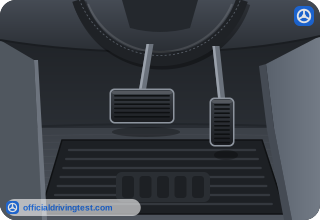
- Brake as hard as you can while turning the wheel sharply
- Lock the front wheels, then turn the wheel
- Step on the brake pedal, let up, and then turn the steering wheel
- Take your foot off the pedals and turn the wheel only
Show answer
Correct answer: Step on the brake pedal, let up, and then turn the steering wheel
Without ABS the handbook says to step on the brake, then let up and turn, because the brake should be released before an evasive turn.
Source: Colorado Driver Handbook (DR 2337, January 2025), page 26 · Open this page in the manual (Manual page 26)
-
Without ABS, what should you avoid doing when you brake and turn to avoid a collision?
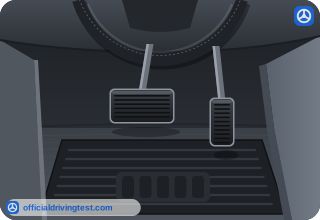
- Releasing the brake before you turn
- Locking up the front wheels while braking
- Gripping the steering wheel with both hands
- Looking ahead to where you want to go
Show answer
Correct answer: Locking up the front wheels while braking
The handbook says not to lock up the front wheels while braking or turn so sharply that the vehicle can only plow ahead.
Source: Colorado Driver Handbook (DR 2337, January 2025), page 26 · Open this page in the manual (Manual page 26)