Tank Vehicles: The tank endorsement and inspecting a tank vehicle
Which vehicles need a tank endorsement, checking a tank vehicle for leaks, its valves, covers and vents, and its special and emergency equipment.
Independent educational site · not affiliated with any government agency or DMV
Ready? Test yourself
Answer to start, or tap Start below:
Which cargo can make a tank endorsement necessary?
- Instant feedback with an explanation
- Every answer cites its source in the manual
- Your best score is saved on this device
- Keyboard: press 1 to 3 to answer and Enter for the next question
Questions are written in our own words from the CDL manual; they are not the real test's questions. With your state chosen, every answer gives its page in your state's CDL manual. Without a state, answers cite the CDL manual, national model as printed by New Jersey (July 2017).
All 17 questions in this practice test
Take the test above first, then use this list to study. Tap “Show answer” to see the correct answer and explanation.
Show the questions and answersHide the questions
-
Which cargo can make a tank endorsement necessary?
- A liquid or gas in qualifying tanks, hazardous or not
- Only liquids classed as hazardous materials
- Only liquefied gases moved under high pressure
Show answer
Correct answer: A liquid or gas in qualifying tanks, hazardous or not
For Class A or B vehicles, the endorsement depends on the tank size, not on whether the cargo is hazardous. A harmless liquid can still require it.
Source: CDL manual, national model as printed by New Jersey, Section 8 (July 2017)
-
For which vehicles does any liquid or liquefied gas, hazardous or not, in tanks of the rated size call for a tank endorsement?
- Vehicles needing a Class B CDL only
- Vehicles needing a Class A or B CDL
- Vehicles that need a Class C CDL only
Show answer
Correct answer: Vehicles needing a Class A or B CDL
A vehicle that needs a Class A or Class B CDL requires the endorsement for any liquid or liquefied gas in tanks of that size. A Class C vehicle needs it only when the liquid or gas is a hazardous material.
Source: CDL manual, national model as printed by New Jersey, Section 8 (July 2017)
-
A tank endorsement applies when a single tank's rated capacity is more than how many gallons?
- 119 gallons
- 150 gallons
- 500 gallons
Show answer
Correct answer: 119 gallons
A tank with a rated capacity above 119 gallons counts toward the endorsement, together with the aggregate capacity rule.
Source: CDL manual, national model as printed by New Jersey, Section 8 (July 2017)
-
Adding up all the tanks on the vehicle, what total rated capacity (at least) is part of the tank endorsement rule?
- 500 gallons
- 1,000 gallons
- 1,500 gallons
Show answer
Correct answer: 1,000 gallons
The tanks together must have a rated capacity of 1,000 gallons or more, along with the individual tank size condition.
Source: CDL manual, national model as printed by New Jersey, Section 8 (July 2017)
-
Which tanks count toward the endorsement's capacity rule?
- Tanks fixed to the vehicle or chassis, for good or for a time
- Only tanks permanently attached to the chassis
- Only tanks mounted on a trailer, not on a straight truck
Show answer
Correct answer: Tanks fixed to the vehicle or chassis, for good or for a time
A tank counts whether it is on the vehicle or chassis for good or only for a time.
Source: CDL manual, national model as printed by New Jersey, Section 8 (July 2017)
-
When does a Class C vehicle need a tank endorsement?
- When it hauls hazardous liquid or gas in tanks of the rated size
- Whenever it carries any liquid in a tank of any size
- Whenever it carries liquid or gas, hazardous or not, in large tanks
Show answer
Correct answer: When it hauls hazardous liquid or gas in tanks of the rated size
For Class C, the endorsement is tied to hazardous materials in liquid or gas form, carried in tanks of the rated size.
Source: CDL manual, national model as printed by New Jersey, Section 8 (July 2017)
-
At what point must a tanker be inspected?
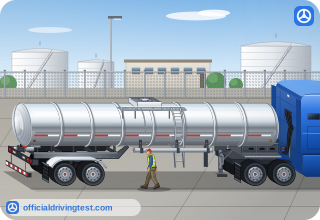
- Only right before you drive onto the public road
- Before loading, unloading or driving it
- Only after the unloading has been finished
Show answer
Correct answer: Before loading, unloading or driving it
The inspection confirms the vehicle can safely hold the cargo and is safe to drive, so it comes before each of these jobs.
Source: CDL manual, national model as printed by New Jersey, Section 8 (July 2017)
-
Tankers are built in many kinds and sizes. Where do you learn how to inspect your particular one?
- In the vehicle's operator manual
- In the shipper's loading paperwork
- On the plate showing the tank's rating
Show answer
Correct answer: In the vehicle's operator manual
Because tankers differ, the operator manual of your own vehicle tells you how to inspect it correctly.
Source: CDL manual, national model as printed by New Jersey, Section 8 (July 2017)
-
What is the most important thing to look for on any tank vehicle?
- Signs of leaking around the vehicle
- Tread depth on every single tire
- Wear on all of the brake linings
Show answer
Correct answer: Signs of leaking around the vehicle
Leaks come first on every tanker, so look under and around the vehicle for any sign of them.
Source: CDL manual, national model as printed by New Jersey, Section 8 (July 2017)
-
What can happen to a driver who hauls cargo in a leaking tank?
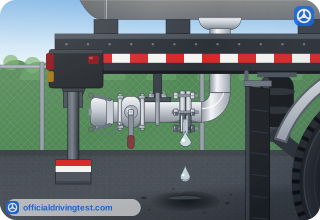
- A citation and being stopped from driving any further
- Only a warning, if the leak is small
- Nothing, if the driver goes straight to a repair shop
Show answer
Correct answer: A citation and being stopped from driving any further
Hauling in a leaking tank is a crime. The driver is cited and cannot continue.
Source: CDL manual, national model as printed by New Jersey, Section 8 (July 2017)
-
If a spill comes from the tank you were hauling in, who may have to pay for cleaning it up?
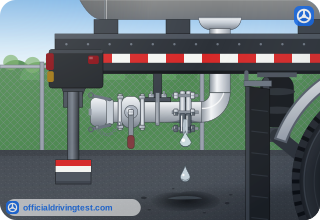
- The driver may be held responsible
- Only the company that loaded the tank
- Nobody, when the leak went unnoticed
Show answer
Correct answer: The driver may be held responsible
A driver can be held liable for the clean-up of a spill, besides being cited.
Source: CDL manual, national model as printed by New Jersey, Section 8 (July 2017)
-
What must you confirm about the intake, discharge and cut-off valves before loading, unloading or moving?
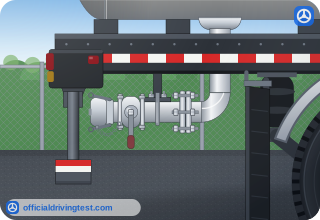
- That each one is fully open
- That each one is locked with a seal
- That each one is in its correct position
Show answer
Correct answer: That each one is in its correct position
Valves have to be set correctly before any loading, unloading or movement, not just left as they were.
Source: CDL manual, national model as printed by New Jersey, Section 8 (July 2017)
-
What condition should the manhole covers of a tank be in?
- They have gaskets and close correctly
- Propped slightly open to ease pressure
- Bolted shut, with no gasket needed
Show answer
Correct answer: They have gaskets and close correctly
Each cover needs a gasket and must close properly so the cargo stays in.
Source: CDL manual, national model as printed by New Jersey, Section 8 (July 2017)
-
How should the vents on a tank be kept?
- Capped while the vehicle is parked
- Clear, so that they can work correctly
- Sealed when liquid is on board
Show answer
Correct answer: Clear, so that they can work correctly
A blocked vent cannot do its job, so keep the vents free of obstruction.
Source: CDL manual, national model as printed by New Jersey, Section 8 (July 2017)
-
Which of these is special purpose equipment on a tank vehicle that you must check works, if the vehicle has it?
- Auxiliary cargo-heating system
- Tank-wash spray nozzles
- Grounding and bonding cables
Show answer
Correct answer: Grounding and bonding cables
Grounding and bonding cables belong with vapor recovery kits, emergency shut-off systems and built-in fire extinguishers: all must work if fitted.
Source: CDL manual, national model as printed by New Jersey, Section 8 (July 2017)
-
Which statement about driving with open valves or open manhole covers is correct?
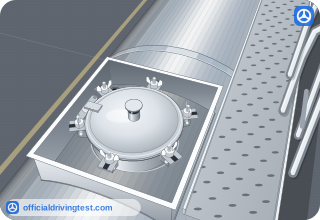
- It is fine for short trips at low speed
- It must never be done
- It is fine when the tank is empty
Show answer
Correct answer: It must never be done
A tank vehicle must not be driven with open valves or open manhole covers, whatever the trip.
Source: CDL manual, national model as printed by New Jersey, Section 8 (July 2017)
-
What should you do about the emergency equipment your vehicle is required to have?
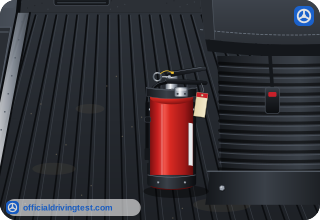
- Carry it only when hauling hazardous materials
- Test it only after a roadside inspection
- Learn what is required, carry it and see that it works
Show answer
Correct answer: Learn what is required, carry it and see that it works
Find out which emergency equipment applies to your vehicle, have it on board and make sure it works.
Source: CDL manual, national model as printed by New Jersey, Section 8 (July 2017)