Tank Vehicles: Driving with a liquid load
The high center of gravity, liquid surge, bulkheads, baffled and smooth bore tanks, outage and how much liquid to load.
Independent educational site · not affiliated with any government agency or DMV
Ready? Test yourself
Answer to start, or tap Start below:
What kind of tank load produces liquid surge?
- Instant feedback with an explanation
- Every answer cites its source in the manual
- Your best score is saved on this device
- Keyboard: press 1 to 3 to answer and Enter for the next question
Questions are written in our own words from the CDL manual; they are not the real test's questions. With your state chosen, every answer gives its page in your state's CDL manual. Without a state, answers cite the CDL manual, national model as printed by New Jersey (July 2017).
All 19 questions in this practice test
Take the test above first, then use this list to study. Tap “Show answer” to see the correct answer and explanation.
Show the questions and answersHide the questions
-
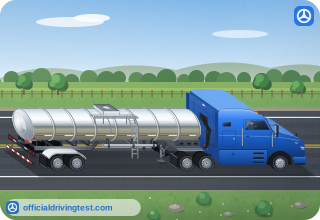
Which two things make driving a liquid tanker harder than driving other trucks?
- A long wheelbase and weak brakes
- A narrow body and heavy steering wheel
- A high center of gravity and moving liquid
Show answer
Correct answer: A high center of gravity and moving liquid
A liquid load rides high and it moves. Both effects call for special driving skills.
Source: CDL manual, national model as printed by New Jersey, Section 8 (July 2017)
-
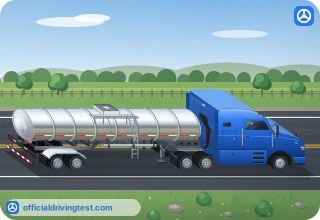
What does a high center of gravity do to a loaded tank vehicle?
- It makes the vehicle harder to steer at low speed
- It leaves the vehicle top-heavy, so it tips over easily
- It makes the vehicle take much longer to speed up
Show answer
Correct answer: It leaves the vehicle top-heavy, so it tips over easily
When the weight sits high above the road, the vehicle becomes top-heavy and can tip over easily.
Source: CDL manual, national model as printed by New Jersey, Section 8 (July 2017)
-
How fast should a tanker go through a highway curve or a ramp curve?

- At the posted curve speed
- A little above the posted speed
- Well below the posted speed
Show answer
Correct answer: Well below the posted speed
Tests show that tankers can roll over even at the speed posted for a curve, so the driver must go well below it.
Source: CDL manual, national model as printed by New Jersey, Section 8 (July 2017)
-
What kind of tank load produces liquid surge?
- A tank that is only partly filled
- A tank that is filled to the top
- A tank that is divided by many walls
Show answer
Correct answer: A tank that is only partly filled
Surge comes from liquid sloshing in a tank that is not full.
Source: CDL manual, national model as printed by New Jersey, Section 8 (July 2017)
-
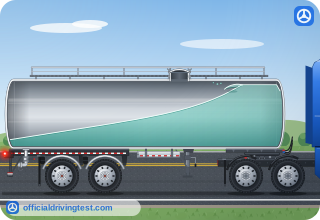
A truck is stopping and the liquid wave reaches the end of the tank. What does the wave do to the truck?
- It pulls the truck against the wave's direction
- It pushes the truck the way the wave is moving
- It has no effect on how the truck moves
Show answer
Correct answer: It pushes the truck the way the wave is moving
When the surging liquid hits the end of the tank, it shoves the truck along in the direction the wave travels.
Source: CDL manual, national model as printed by New Jersey, Section 8 (July 2017)
-
What danger does liquid surge bring when a tanker is stopped on an icy road?
- The liquid can freeze and block the tank vents
- The wave can push the truck out into an intersection
- The wave can lock the brakes and stall the engine
Show answer
Correct answer: The wave can push the truck out into an intersection
Even a stopped tanker can be pushed out into an intersection by the surge wave when the road is icy.
Source: CDL manual, national model as printed by New Jersey, Section 8 (July 2017)
-
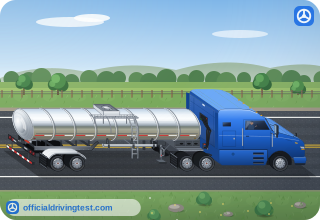
What must a driver of a liquid tanker know very well?
- The route, including every fuel stop
- The date of the tank's last pressure test
- How the vehicle handles with a liquid load
Show answer
Correct answer: How the vehicle handles with a liquid load
Surge changes how a tanker handles, so its driver has to know that vehicle very well.
Source: CDL manual, national model as printed by New Jersey, Section 8 (July 2017)
-
A tank is split into smaller compartments by bulkheads. What must the driver watch while loading or unloading them?
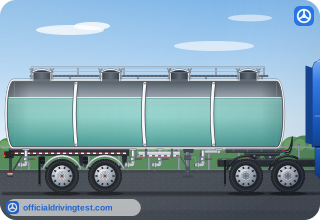
- How the weight is spread along the vehicle
- How warm each compartment is kept
- How quickly each compartment is filled
Show answer
Correct answer: How the weight is spread along the vehicle
Too much weight at the front or the rear is a problem, so the load has to be spread sensibly between the compartments.
Source: CDL manual, national model as printed by New Jersey, Section 8 (July 2017)
-
How is a baffle built inside a liquid tank?
- A solid wall with no openings at all
- A valve that closes off each compartment
- A wall with holes that let liquid flow through
Show answer
Correct answer: A wall with holes that let liquid flow through
Baffles are walls inside the tank that have openings, so the liquid can still flow through them.
Source: CDL manual, national model as printed by New Jersey, Section 8 (July 2017)
-
Even in a baffled tank, which surge remains a danger for rollover?
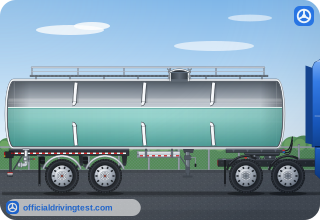
- Surge from front to back
- Surge from side to side
- Surge from top to bottom
Show answer
Correct answer: Surge from side to side
Baffles do not stop liquid from moving sideways, and that movement can cause a rollover.
Source: CDL manual, national model as printed by New Jersey, Section 8 (July 2017)
-
How is the forward-and-back surge in a smooth bore tank, compared with a baffled one?
- Weaker, because the tank is smooth
- Very strong, because nothing slows the liquid
- The same, because the liquid is the same
Show answer
Correct answer: Very strong, because nothing slows the liquid
A smooth bore tank has nothing inside to slow the liquid, so the surge from front to back is very strong.
Source: CDL manual, national model as printed by New Jersey, Section 8 (July 2017)
-
Which loads are usually hauled in tanks that have no baffles?
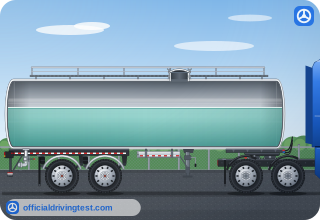
- Acids and other strong chemicals
- Gases kept under pressure
- Food products such as milk
Show answer
Correct answer: Food products such as milk
Tanks for food products are normally smooth bore, because baffles make the inside hard to clean.
Source: CDL manual, national model as printed by New Jersey, Section 8 (July 2017)
-
Why do food tankers not have baffles?
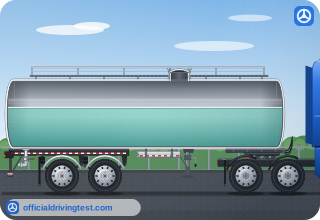
- Baffles would make the tank too heavy to haul
- Baffles would let the food spoil much sooner
- Sanitation rules forbid them; cleaning is hard
Show answer
Correct answer: Sanitation rules forbid them; cleaning is hard
Rules on sanitation do not allow baffles in food tanks, because the inside would be difficult to clean.
Source: CDL manual, national model as printed by New Jersey, Section 8 (July 2017)
-
When is a driver of a smooth bore tank most in need of extra care?
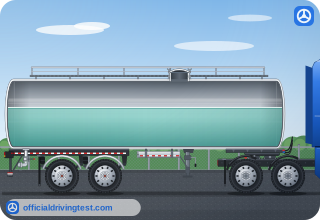
- When starting and stopping
- When crossing a long bridge or an overpass
- When passing a slower vehicle on a highway
Show answer
Correct answer: When starting and stopping
The manual calls for slow, careful driving of smooth bore tanks, above all when starting and stopping, because their forward-and-back surge is very strong.
Source: CDL manual, national model as printed by New Jersey, Section 8 (July 2017)
-
Why must a cargo tank never be filled completely?
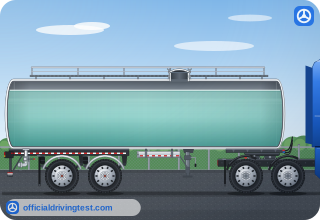
- Liquid grows lighter as it moves
- Liquid gets thicker while the truck drives
- Liquid grows in volume as it warms
Show answer
Correct answer: Liquid grows in volume as it warms
Warming makes liquid expand, so empty space must be left in the tank. That space is called outage.
Source: CDL manual, national model as printed by New Jersey, Section 8 (July 2017)
-
Does every liquid need the same amount of outage?
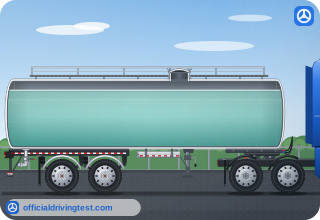
- Yes, every liquid needs the same room
- No, only heavy liquids need any outage
- No, liquids expand by different amounts
Show answer
Correct answer: No, liquids expand by different amounts
Each liquid expands by its own amount, so each needs its own outage, and the driver must know the requirement.
Source: CDL manual, national model as printed by New Jersey, Section 8 (July 2017)
-
What must a driver find out about a liquid before hauling it in bulk?
- How long it may stay in the tank
- How much outage it requires
- How fast it can be pumped
Show answer
Correct answer: How much outage it requires
Each liquid needs its own amount of empty space for expansion, so the driver must know that requirement.
Source: CDL manual, national model as printed by New Jersey, Section 8 (July 2017)
-
Why is a tank of a heavy liquid often filled only part of the way?
- A full tank could be over the legal weight limit
- A full tank could not be pumped out at all
- A full tank would freeze in cold weather
Show answer
Correct answer: A full tank could be over the legal weight limit
Dense liquids weigh a lot, so a full tank may go past the legal weight limits.
Source: CDL manual, national model as printed by New Jersey, Section 8 (July 2017)
-
Which three things decide how much liquid to load into a tank?
- The trip's distance, the road grades and the weather
- The tank's shape, the number of baffles and the pump rate
- The liquid's expansion, its weight and legal weight limits
Show answer
Correct answer: The liquid's expansion, its weight and legal weight limits
How much to load depends on how far the liquid will expand on the way, how heavy it is and the legal weight limits.
Source: CDL manual, national model as printed by New Jersey, Section 8 (July 2017)