Tank Vehicles: Safe driving rules for tank vehicles
Driving smoothly, controlling surge when braking, curves, stopping distance and skids.
Independent educational site · not affiliated with any government agency or DMV
Ready? Test yourself
Answer to start, or tap Start below:
Besides starting, slowing down and stopping, which moves must a tank driver also make smoothly?
- Instant feedback with an explanation
- Every answer cites its source in the manual
- Your best score is saved on this device
- Keyboard: press 1 to 3 to answer and Enter for the next question
Questions are written in our own words from the CDL manual; they are not the real test's questions. With your state chosen, every answer gives its page in your state's CDL manual. Without a state, answers cite the CDL manual, national model as printed by New Jersey (July 2017).
All 11 questions in this practice test
Take the test above first, then use this list to study. Tap “Show answer” to see the correct answer and explanation.
Show the questions and answersHide the questions
-
Besides starting, slowing down and stopping, which moves must a tank driver also make smoothly?
- Backing and parking
- Turns and lane changes
- Coupling and uncoupling
Show answer
Correct answer: Turns and lane changes
The high-riding load and the moving liquid call for gentle control, so turns and lane changes must be smooth too.
Source: CDL manual, national model as printed by New Jersey, Section 8 (July 2017)
-
While bringing a tanker to a stop, how should you use the brake pedal to control liquid surge?
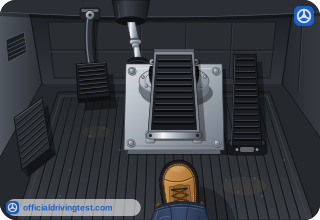
- Ease off the pedal as the truck nears the stop line
- Press hard at first, then let up bit by bit
- Hold steady pressure and do not let off early
Show answer
Correct answer: Hold steady pressure and do not let off early
To control surge, keep steady pressure on the brakes and do not release them too soon when stopping.
Source: CDL manual, national model as printed by New Jersey, Section 8 (July 2017)
-
What should a tank driver do about the timing of braking and the gap behind the vehicle ahead?
- Brake late and smoothly, keeping the usual gap
- Use the engine brake only and keep the usual gap
- Start braking far ahead and leave a bigger gap
Show answer
Correct answer: Start braking far ahead and leave a bigger gap
To control surge, begin braking well before the stop and leave a larger gap behind the vehicle ahead.
Source: CDL manual, national model as printed by New Jersey, Section 8 (July 2017)
-
How should you brake for a quick stop in a tank vehicle to avoid a crash?
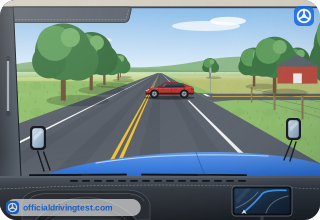
- Use controlled braking or stab braking
- Brake hard and keep the wheels locked
- Swerve sharply while braking firmly
Show answer
Correct answer: Use controlled braking or stab braking
For a quick stop to avoid a crash, the manual tells tank drivers to use controlled braking or stab braking.
Source: CDL manual, national model as printed by New Jersey, Section 8 (July 2017)
-
In a tank vehicle, what can happen if you turn the wheel quickly while you are braking?
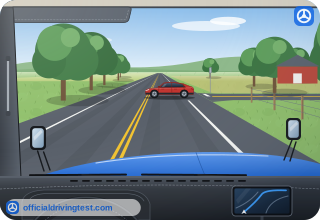
- The brakes may fade away
- The vehicle may roll over
- The engine may stall out
Show answer
Correct answer: The vehicle may roll over
A sharp steering move during braking can tip a top-heavy tanker onto its side.
Source: CDL manual, national model as printed by New Jersey, Section 8 (July 2017)
-
What is the correct way to drive a tank vehicle through a curve?
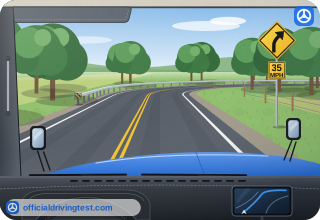
- Slow down first, then add a little power in the curve
- Keep your speed even and brake in the middle
- Enter at the posted speed and ease off halfway
Show answer
Correct answer: Slow down first, then add a little power in the curve
Do your slowing before the curve starts, then apply light acceleration while going through it.
Source: CDL manual, national model as printed by New Jersey, Section 8 (July 2017)
-
Compared with dry pavement, how much farther does a vehicle need to stop on a wet road?
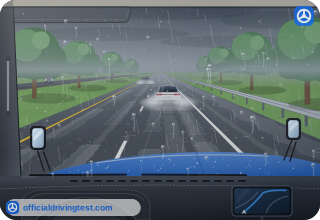
- About 10 percent more
- Twice as far
- About one and a half times
Show answer
Correct answer: Twice as far
A wet road doubles the normal stopping distance, so a tank driver must allow much more room.
Source: CDL manual, national model as printed by New Jersey, Section 8 (July 2017)
-
How does the stopping of an empty tank vehicle compare with that of a full one?
- Stopping is usually shorter
- Stopping may take longer
- Stopping takes the same distance
Show answer
Correct answer: Stopping may take longer
An empty tanker can need more time to stop than a loaded one, so do not assume less cargo means a shorter stop.
Source: CDL manual, national model as printed by New Jersey, Section 8 (July 2017)
-
Which driving actions can make a tank vehicle skid?
- Driving too slowly in a high gear with a full load
- Steering, accelerating or braking too gently
- Oversteering, overaccelerating or overbraking
Show answer
Correct answer: Oversteering, overaccelerating or overbraking
Using too much steering, power or braking can break traction and start a skid.
Source: CDL manual, national model as printed by New Jersey, Section 8 (July 2017)
-
What may happen to a tank trailer rig if its drive wheels or trailer wheels start to skid?
- It may jackknife
- The coupling may break
- The tank may split
Show answer
Correct answer: It may jackknife
A skid on the drive wheels or trailer wheels can fold the tractor and trailer against each other in a jackknife.
Source: CDL manual, national model as printed by New Jersey, Section 8 (July 2017)
-
What must the driver do when a vehicle begins to skid?
- Brake harder to slow down sooner
- Wait for the vehicle to slow by itself
- Act to get traction back to the wheels
Show answer
Correct answer: Act to get traction back to the wheels
A skid does not fix itself, so the driver must act right away to give the wheels grip again.
Source: CDL manual, national model as printed by New Jersey, Section 8 (July 2017)