Passenger: Loading the bus and starting the trip
Baggage and freight, hazardous materials a bus may and may not carry, the standee line, and what to announce at a stop or destination.
Independent educational site · not affiliated with any government agency or DMV
Ready? Test yourself
Answer to start, or tap Start below:
Where must passengers never put their carry-on bags?
- Instant feedback with an explanation
- Every answer cites its source in the manual
- Your best score is saved on this device
- Keyboard: press 1 to 3 to answer and Enter for the next question
Questions are written in our own words from the CDL manual; they are not the real test's questions. With your state chosen, every answer gives its page in your state's CDL manual. Without a state, answers cite the CDL manual, national model as printed by New Jersey (July 2017).
All 28 questions in this practice test
Take the test above first, then use this list to study. Tap “Show answer” to see the correct answer and explanation.
Show the questions and answersHide the questions
-
Where must passengers never put their carry-on bags?
- In the overhead rack above the seats
- In a doorway or in the aisle
- Under the seat in front of them
Show answer
Correct answer: In a doorway or in the aisle
Bags in a doorway or aisle block the way out and can trip other riders, so the driver must not allow them there.
Source: CDL manual, national model as printed by New Jersey, Section 4 (July 2017)
-
After baggage and freight are secured, what must be true for the driver?
- The driver can watch the bags from the seat
- The driver can move around easily
- The driver can see every bag in the mirror
Show answer
Correct answer: The driver can move around easily
Baggage and freight must be placed so that the driver has room to move without difficulty.
Source: CDL manual, national model as printed by New Jersey, Section 4 (July 2017)
-
When you secure baggage and freight on a bus, what must still be possible for the riders in an emergency?
- Reaching the baggage before leaving
- Leaving only through the front door
- Leaving through any window or door
Show answer
Correct answer: Leaving through any window or door
Baggage must be placed so it never blocks any window or door that riders might need to use to get out in an emergency.
Source: CDL manual, national model as printed by New Jersey, Section 4 (July 2017)
-
Why should baggage be placed so that it cannot easily fall or move around?
- So the bus stays balanced on curves
- So the driver can count the bags quickly
- So riders are not hurt if it falls or shifts
Show answer
Correct answer: So riders are not hurt if it falls or shifts
Loose bags that fall or slide can hit riders. Secure placement keeps them from being injured.
Source: CDL manual, national model as printed by New Jersey, Section 4 (July 2017)
-
How are most hazardous materials treated when it comes to buses?
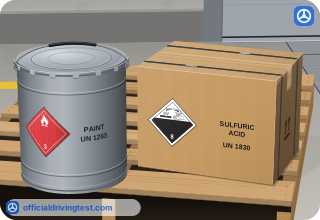
- They cannot be carried on a bus
- They may ride in the baggage space only
- They may ride if the shipper pays extra
Show answer
Correct answer: They cannot be carried on a bus
Only a few exceptions exist. For most hazardous materials the answer is that a bus may not carry them.
Source: CDL manual, national model as printed by New Jersey, Section 4 (July 2017)
-
Which reference tells a driver which materials are dangerous cargo?
- The Federal Cargo Hazard Register
- The National Hazard Class Index
- The Federal Hazardous Materials Table
Show answer
Correct answer: The Federal Hazardous Materials Table
The Federal Hazardous Materials Table lists the materials that are classed as hazardous.
Source: CDL manual, national model as printed by New Jersey, Section 4 (July 2017)
-
What three things must a shipper put on a container of hazardous material?
- Weight, owner's name, and date
- Hazard label, price, and delivery address
- Name, identification number, and hazard label
Show answer
Correct answer: Name, identification number, and hazard label
The material's name, its identification number and the hazard label let a driver recognize what is inside the container.
Source: CDL manual, national model as printed by New Jersey, Section 4 (July 2017)
-
How many different hazard labels are there?
- Six
- Nine
- Twelve
Show answer
Correct answer: Nine
There are nine different hazard labels. Each one is a diamond shape that measures four inches.
Source: CDL manual, national model as printed by New Jersey, Section 4 (July 2017)
-
You see a diamond-shaped label on a package. When may you carry it on your bus?
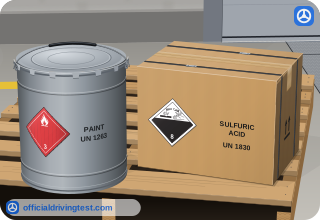
- Only after the rider signs for it
- Only if you are sure the rules allow it
- Whenever it is stored in the baggage space
Show answer
Correct answer: Only if you are sure the rules allow it
A driver may carry hazardous material only when sure the rules permit it. Any doubt means it stays off the bus.
Source: CDL manual, national model as printed by New Jersey, Section 4 (July 2017)
-
Which hazard class number is used for explosives?
- Class 4
- Class 2
- Class 1
Show answer
Correct answer: Class 1
Explosives belong to hazard class 1.
Source: CDL manual, national model as printed by New Jersey, Section 4 (July 2017)
-
Which hazard class number is used for radioactive material?
- Class 6
- Class 8
- Class 7
Show answer
Correct answer: Class 7
Radioactive material belongs to hazard class 7.
Source: CDL manual, national model as printed by New Jersey, Section 4 (July 2017)
-
Which hazard class number is used for corrosives?
- Class 5
- Class 8
- Class 9
Show answer
Correct answer: Class 8
Corrosives belong to hazard class 8.
Source: CDL manual, national model as printed by New Jersey, Section 4 (July 2017)
-
Which of these is a bus allowed to carry?
- Division 2.3 poison gas
- Labeled radioactive material in the seating area
- Small-arms ammunition labeled ORM-D
Show answer
Correct answer: Small-arms ammunition labeled ORM-D
A bus may carry small-arms ammunition that carries the ORM-D label, besides emergency hospital supplies and drugs.
Source: CDL manual, national model as printed by New Jersey, Section 4 (July 2017)
-
When can a bus carry a small amount of some other hazardous materials?
- When the shipper cannot send them otherwise
- When the passengers agree to it
- When the trip is shorter than 50 miles
Show answer
Correct answer: When the shipper cannot send them otherwise
Small amounts of some other hazardous materials may ride on a bus only when the shipper has no other way to send them.
Source: CDL manual, national model as printed by New Jersey, Section 4 (July 2017)
-
Which of these may a bus never carry?
- Tear gas
- Drugs
- Emergency hospital supplies
Show answer
Correct answer: Tear gas
Tear gas is on the list of items a bus must never carry, along with poison gas, liquid Class 6 poison and irritating material.
Source: CDL manual, national model as printed by New Jersey, Section 4 (July 2017)
-
What is the greatest weight of solid Class 6 poison a bus may carry?
- 100 pounds
- 50 pounds
- 200 pounds
Show answer
Correct answer: 100 pounds
The limit for solid Class 6 poisons on a bus is 100 pounds. Going over that weight is never allowed.
Source: CDL manual, national model as printed by New Jersey, Section 4 (July 2017)
-
Where is a bus never allowed to carry explosives, apart from small arms ammunition?
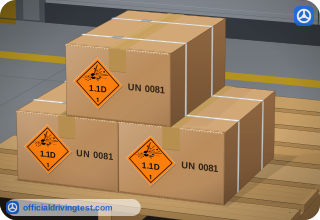
- In the compartment below the floor
- In the space where people sit or stand
- On a rack fastened to the bus roof
Show answer
Correct answer: In the space where people sit or stand
Explosives, other than small arms ammunition, must stay out of any space that people occupy.
Source: CDL manual, national model as printed by New Jersey, Section 4 (July 2017)
-
A package carries a radioactive label. Where can it never be placed on a bus?
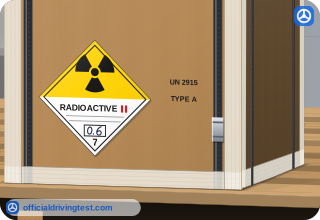
- Inside the passenger area
- Next to the spare tire
- In the outside baggage bay
Show answer
Correct answer: Inside the passenger area
Labeled radioactive material may not be in the space where people ride.
Source: CDL manual, national model as printed by New Jersey, Section 4 (July 2017)
-
What is the greatest total weight of allowed hazardous materials that a bus may carry?
- 500 pounds
- 300 pounds
- 1,000 pounds
Show answer
Correct answer: 500 pounds
The total of all allowed hazardous materials on a bus may not go over 500 pounds, and any single class is limited to 100 pounds.
Source: CDL manual, national model as printed by New Jersey, Section 4 (July 2017)
-
A bus carries allowed hazardous materials of several classes. What is the most it may carry of any single class?
- 100 pounds
- 250 pounds
- 400 pounds
Show answer
Correct answer: 100 pounds
Even when the total stays within its limit, a single hazard class alone may not go over 100 pounds on a bus.
Source: CDL manual, national model as printed by New Jersey, Section 4 (July 2017)
-
A rider boards carrying a can of gasoline. What should you do?
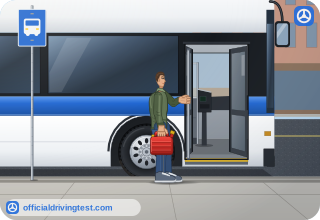
- Let it ride in the aisle
- Not allow it on the bus
- Let it ride under the rider's seat
Show answer
Correct answer: Not allow it on the bus
Riders may bring unlabeled hazards without knowing it. Common ones such as car batteries and gasoline must not be allowed on board.
Source: CDL manual, national model as printed by New Jersey, Section 4 (July 2017)
-
Where is a rider never allowed to stand on a bus?
- Ahead of the rear of the driver's seat
- Beside the rear door
- In the aisle behind the driver's seat
Show answer
Correct answer: Ahead of the rear of the driver's seat
Standing riders must stay behind the rear of the driver's seat. Nobody may stand forward of that point.
Source: CDL manual, national model as printed by New Jersey, Section 4 (July 2017)
-
A bus built to carry standing riders needs a floor line to show where riders may not stand. What size of line must it have?
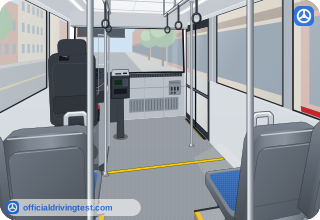
- A two-inch line
- A one-inch line
- A three-inch line
Show answer
Correct answer: A two-inch line
The line, called the standee line, is a two-inch line on the floor. Another marker may be used if it shows riders where they cannot stand.
Source: CDL manual, national model as printed by New Jersey, Section 4 (July 2017)
-
When the bus arrives at a stop, which of these should the driver announce?
- The time of the next departure
- The driver's name
- The fare for the next stop
Show answer
Correct answer: The time of the next departure
At the destination or any stop, riders should be told the location, the reason for stopping, the next departure time and the bus number.
Source: CDL manual, national model as printed by New Jersey, Section 4 (July 2017)
-
Riders are about to get off at a stop. What should the driver remind them to do?
- Keep their tickets ready
- Wait until every other rider is off
- Take their carry-on bags with them
Show answer
Correct answer: Take their carry-on bags with them
Reminding riders to take their carry-ons keeps bags from being left on the bus.
Source: CDL manual, national model as printed by New Jersey, Section 4 (July 2017)
-
On some buses the aisle sits lower than the seats. What should you tell riders?
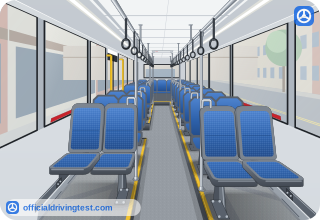
- To stay seated until the bus is empty
- To watch the step down
- To use only the front door
Show answer
Correct answer: To watch the step down
When the aisle is lower than the seats, riders can trip. A reminder about the step-down helps them avoid a fall.
Source: CDL manual, national model as printed by New Jersey, Section 4 (July 2017)
-
When is the best time to give riders the reminder to take their carry-ons and watch the step-down?
- After the bus has stopped completely
- Once the doors have swung fully open
- Before the bus has fully stopped
Show answer
Correct answer: Before the bus has fully stopped
Riders should hear the reminders ahead of time, before the bus completely stops, so they are ready to get off.
Source: CDL manual, national model as printed by New Jersey, Section 4 (July 2017)
-
When should a charter bus driver let riders board?
- When departure time comes
- As soon as the bus arrives at the stop
- Whenever the first rider asks
Show answer
Correct answer: When departure time comes
Keeping riders off until departure time helps prevent theft or damage to the bus.
Source: CDL manual, national model as printed by New Jersey, Section 4 (July 2017)