General Knowledge: Seeing hazards
Roads, road users and situations that signal danger, and always having a plan. Split into 2 shorter tests so you're not stuck in one long quiz.
Independent educational site · not affiliated with any government agency or DMV
Choose a part
Seeing hazards — Part 1
Questions in this part include: “What makes a road condition or another road user a hazard?”
Seeing hazards — Part 2
Questions in this part include: “Why might pedestrians fail to see your vehicle on a rainy day?”
Questions are written in our own words from the CDL manual; they are not the real test's questions. With your state chosen, every answer gives its page in your state's CDL manual. Without a state, answers cite the CDL manual, national model as printed by New Jersey (July 2017).
All 44 Seeing hazards questions with answers
Choose a part above to take a practice test, or study every question and answer here.
Show the questions and answersHide the questions
1Part 122 questions
-
What makes a road condition or another road user a hazard?
- It is already causing a crash
- It is breaking a traffic law
- It is a possible danger to you
Show answer
Correct answer: It is a possible danger to you
A hazard is anything on the road that could become a danger. It does not have to be causing harm yet.
Source: CDL manual, national model as printed by New Jersey, Sections 1 to 3 (July 2017)
-
A car ahead brakes hard near a freeway exit. When does this hazard become an emergency?
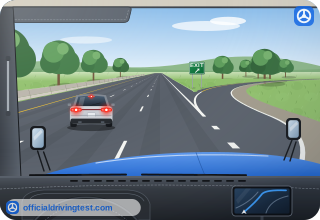
- When that driver cuts in front of you
- As soon as its brake lights come on
- When you first slow down to prepare
Show answer
Correct answer: When that driver cuts in front of you
The braking car is a hazard because it might do something sudden. It becomes an emergency only when the driver actually cuts in front of you.
Source: CDL manual, national model as printed by New Jersey, Sections 1 to 3 (July 2017)
-
What is the main benefit of spotting a hazard before it turns into an emergency?
- You will have more time to act
- Other drivers will give you more room
- You can skip checking your mirrors
Show answer
Correct answer: You will have more time to act
Early notice gives you time to slow down, check mirrors and signal a lane change, so being prepared reduces the danger.
Source: CDL manual, national model as printed by New Jersey, Sections 1 to 3 (July 2017)
-
Compared with a prepared move, which reaction is more likely to end in a crash?
- Checking mirrors and signaling a lane change
- Sudden braking or a quick lane change
- Slowing down early
Show answer
Correct answer: Sudden braking or a quick lane change
Noticing a hazard late forces an abrupt reaction, and abrupt braking or swerving into another lane leads to crashes far more often.
Source: CDL manual, national model as printed by New Jersey, Sections 1 to 3 (July 2017)
-
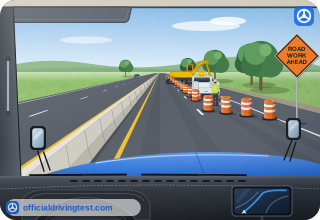
You approach an emergency vehicle stopped at the roadside, and a lane change is safe. What should you do?
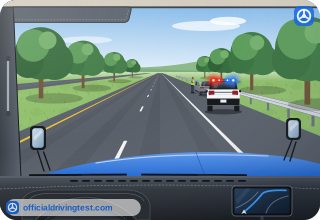
- Keep your speed and stay in your lane
- Move to the lane beside it and pass quickly
- Slow down and move to a lane not next to it
Show answer
Correct answer: Slow down and move to a lane not next to it
When conditions allow, slow down and move away from the emergency vehicle or work zone by using a lane that is not next to it.
Source: CDL manual, national model as printed by New Jersey, Sections 1 to 3 (July 2017)
-
You approach a stopped emergency vehicle but cannot change lanes safely. What should you do?
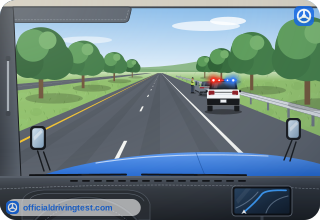
- Stop in your lane until the vehicle leaves
- Slow down and proceed with caution at a safe speed
- Hold your speed so traffic behind you is not delayed
Show answer
Correct answer: Slow down and proceed with caution at a safe speed
If moving over is unsafe, you still slow down and pass carefully, keeping a speed that suits the traffic.
Source: CDL manual, national model as printed by New Jersey, Sections 1 to 3 (July 2017)
-
How do other drivers often behave near a work zone?
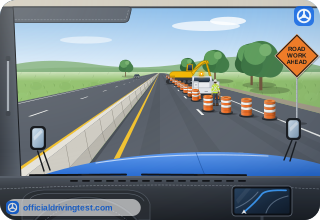
- They usually slow down well before the zone begins
- They are often distracted and drive unsafely
- They usually merge early and keep a steady gap
Show answer
Correct answer: They are often distracted and drive unsafely
Drivers near work zones are often not paying full attention, and the zone itself may have narrow lanes, sharp turns or uneven surfaces.
Source: CDL manual, national model as printed by New Jersey, Sections 1 to 3 (July 2017)
-
When you slow down near a work zone, how can you warn the drivers behind you?
- Turn on the interior cab light
- Signal with your hand out of the window
- Flash your hazard lights or tap the brakes
Show answer
Correct answer: Flash your hazard lights or tap the brakes
Flashers or brake lights tell following drivers that you are slowing, which matters because drivers near work zones are often distracted.
Source: CDL manual, national model as printed by New Jersey, Sections 1 to 3 (July 2017)
-
Why is driving too close to a sharp pavement drop-off dangerous?
- Your load may shift forward and lock the brakes
- Your tires may lose air pressure from the road edge
- Your vehicle may tilt and its top may hit signs or tree limbs
Show answer
Correct answer: Your vehicle may tilt and its top may hit signs or tree limbs
At a drop-off the vehicle leans toward the roadside, so the top can strike objects like signs or tree limbs. Steering also gets hard when you cross the drop-off.
Source: CDL manual, national model as printed by New Jersey, Sections 1 to 3 (July 2017)
-
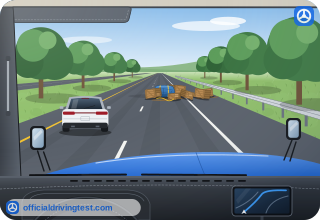
Where can an object that fell onto the road get caught and cause severe damage?
- Between dual tires
- Between the brake shoes and the drum
- Between the trailer and the fifth wheel
Show answer
Correct answer: Between dual tires
Fallen objects can lodge between dual tires. They can also damage tires, wheel rims, and electrical and brake lines.
Source: CDL manual, national model as printed by New Jersey, Sections 1 to 3 (July 2017)
-
Why should you avoid running over a cardboard box lying in the road?
- It may be filled with something solid or heavy
- It may be wet and make the road slippery
- It may blow up into your windshield
Show answer
Correct answer: It may be filled with something solid or heavy
An apparently harmless box can hold something solid or heavy that damages your vehicle, and paper or cloth sacks can too.
Source: CDL manual, national model as printed by New Jersey, Sections 1 to 3 (July 2017)
-
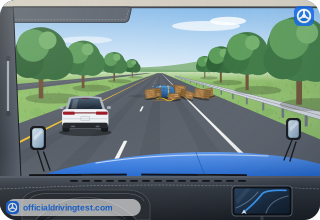
Why should you stay alert for objects of every kind lying on the road?
- To spot them in time to steer around them smoothly
- To report them to the road agency right away
- To judge whether they are light enough to drive over
Show answer
Correct answer: To spot them in time to steer around them smoothly
Seeing an object early lets you go around it without a sudden, unsafe move.
Source: CDL manual, national model as printed by New Jersey, Sections 1 to 3 (July 2017)
-
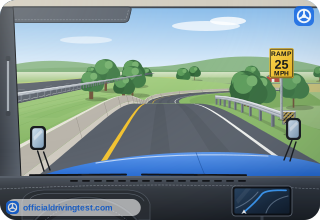
A speed limit sign is posted on a freeway ramp. What should a commercial driver remember about it?
- It may suit cars but be too fast for a loaded truck
- It is the lowest speed allowed on the ramp
- It applies only to buses and trucks over a set weight
Show answer
Correct answer: It may suit cars but be too fast for a loaded truck
Ramp speeds are often chosen with cars in mind. A large or heavily loaded vehicle may need to go slower.
Source: CDL manual, national model as printed by New Jersey, Sections 1 to 3 (July 2017)
-
Why is an exit that goes downhill and curves at the same time especially dangerous?
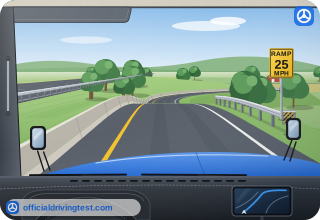
- Ramp signs are often placed too late to read
- The downgrade makes it hard to reduce speed
- Brakes work less well when the load is lighter
Show answer
Correct answer: The downgrade makes it hard to reduce speed
On a downgrade it is hard to lose speed, and braking while turning is risky, so the curve can be too fast to handle.
Source: CDL manual, national model as printed by New Jersey, Sections 1 to 3 (July 2017)
-
When should your speed already be low enough for an off ramp or on ramp curve?
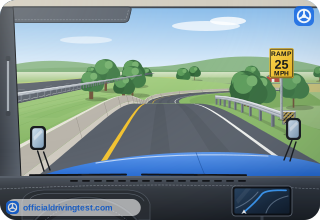
- Before you get on the curved part
- Halfway through the curve
- Once you can see the end of the curve
Show answer
Correct answer: Before you get on the curved part
Doing both braking and turning together is dangerous, so get your speed down before the curve starts.
Source: CDL manual, national model as printed by New Jersey, Sections 1 to 3 (July 2017)
-
Why should you watch rental trucks carefully?
- Their drivers are unused to the poor view to the sides
- Their drivers often go faster than the posted speed limit
- Their drivers rarely use turn signals when changing lanes
Show answer
Correct answer: Their drivers are unused to the poor view to the sides
Rental truck drivers may not be used to how little they can see to the sides and rear, so they may not notice you.
Source: CDL manual, national model as printed by New Jersey, Sections 1 to 3 (July 2017)
-
In winter, which vehicles are hazards?
- Vehicles with tire chains fitted
- Vehicles with frosted or snowy windows
- Vehicles with their heaters running
Show answer
Correct answer: Vehicles with frosted or snowy windows
A driver whose windows are covered with frost, ice or snow cannot see others, so that driver may pull out or change lanes into your path.
Source: CDL manual, national model as printed by New Jersey, Sections 1 to 3 (July 2017)
-
At an alley you can see only the front end of a vehicle, not its driver. What does this tell you?
- The driver is waiting for you to pass
- The driver cannot see you and may pull out
- The driver is probably stopped for you
Show answer
Correct answer: The driver cannot see you and may pull out
If you cannot see the driver, the driver cannot see you. Be ready to stop in case the vehicle backs out or enters your lane.
Source: CDL manual, national model as printed by New Jersey, Sections 1 to 3 (July 2017)
-
What makes drivers of step vans and local delivery vehicles a hazard?
- They often stop in the middle of the road to load boxes
- They often drive far below the normal speed on streets
- They hurry and may step out or pull into your lane
Show answer
Correct answer: They hurry and may step out or pull into your lane
Delivery drivers hurry, and packages or doors often block their view, so they may suddenly step out or pull into traffic.
Source: CDL manual, national model as printed by New Jersey, Sections 1 to 3 (July 2017)
-
Which of these is a clue that a parked vehicle is about to move into your path?
- Its front wheels turned toward the curb
- Backup lights or exhaust
- A closed and locked door
Show answer
Correct answer: Backup lights or exhaust
Brake lights, backup lights, exhaust, or movement inside the vehicle show that someone is in it and may drive away.
Source: CDL manual, national model as printed by New Jersey, Sections 1 to 3 (July 2017)
-
Why should you be careful near a stopped bus?
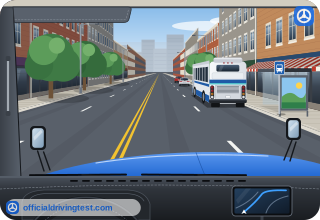
- The bus may roll backward onto your vehicle
- Passengers may walk out in front or behind it
- The bus driver may flash lights that blind you
Show answer
Correct answer: Passengers may walk out in front or behind it
People leaving a bus may walk out from in front of or behind it without seeing your vehicle.
Source: CDL manual, national model as printed by New Jersey, Sections 1 to 3 (July 2017)
-
Why may a walker or jogger on the road not notice your vehicle?
- Bright low sun and engine noise
- Dark clothes and fog
- Back to traffic and wearing headsets
Show answer
Correct answer: Back to traffic and wearing headsets
With the back to traffic the person cannot see you, and headsets stop them from hearing you, so you must be extra careful.
Source: CDL manual, national model as printed by New Jersey, Sections 1 to 3 (July 2017)
2Part 222 questions
-
Why might pedestrians fail to see your vehicle on a rainy day?
- Rain makes your headlights look dim to them
- They assume all drivers will stop
- Hats or umbrellas block their view
Show answer
Correct answer: Hats or umbrellas block their view
In the rain pedestrians may wear hats or hold umbrellas, and they may hurry to get out of the rain without watching traffic.
Source: CDL manual, national model as printed by New Jersey, Sections 1 to 3 (July 2017)
-
A distracted pedestrian is looking right at you. Why should you still stay alert?
- Looking at you means they will wait
- They cannot judge your speed from far away
- They may think they have priority over you
Show answer
Correct answer: They may think they have priority over you
Eye contact does not mean they will yield. They may think they can go first.
Source: CDL manual, national model as printed by New Jersey, Sections 1 to 3 (July 2017)
-
How do children tend to behave around traffic?
- They mostly move slowly and in groups
- They watch large trucks more closely than cars
- They act quickly without checking for traffic
Show answer
Correct answer: They act quickly without checking for traffic
Children playing together may not look for traffic, which makes them a serious hazard.
Source: CDL manual, national model as printed by New Jersey, Sections 1 to 3 (July 2017)
-
Why is an ice cream truck a clue to a hazard?
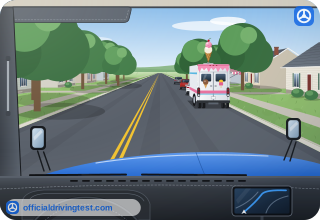
- Its driver will not be looking for traffic
- Kids may be close by and fail to see you
- Its body usually blocks the whole lane
Show answer
Correct answer: Kids may be close by and fail to see you
Children drawn to an ice cream truck may run out without noticing your vehicle.
Source: CDL manual, national model as printed by New Jersey, Sections 1 to 3 (July 2017)
-
Which of these is a clue that a driver ahead may be working on a disabled vehicle and not watching traffic?
- Fresh tire marks on the shoulder
- A raised hood
- A dusty windshield
Show answer
Correct answer: A raised hood
Someone fixing a flat or an engine at the roadside often ignores the danger of traffic. A raised hood or a jacked up wheel is a sign of this.
Source: CDL manual, national model as printed by New Jersey, Sections 1 to 3 (July 2017)
-
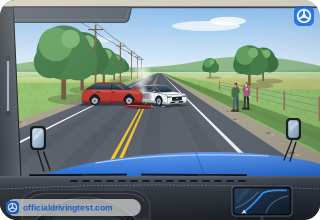
What do passing drivers tend to do at an accident scene?
- Speed up to leave the scene
- Keep their eyes fixed on the road ahead
- Often stare at the scene
Show answer
Correct answer: Often stare at the scene
Drivers going by tend to watch the crash. People may dash across the road without looking, and vehicles may slow down or stop suddenly.
Source: CDL manual, national model as printed by New Jersey, Sections 1 to 3 (July 2017)
-
Why are people in shopping areas a hazard to a driver?
- Their eyes are on stores and shop windows, not on traffic
- They are mostly standing still beside the road
- They tend to hurry across the road at crosswalks
Show answer
Correct answer: Their eyes are on stores and shop windows, not on traffic
Shoppers often pay attention to the stores around them instead of the traffic.
Source: CDL manual, national model as printed by New Jersey, Sections 1 to 3 (July 2017)
-
Where is driver confusion especially common?
- On long straight rural roads
- In residential streets with little traffic
- Near freeway interchanges and major intersections
Show answer
Correct answer: Near freeway interchanges and major intersections
People who are lost may swerve or stop without warning, mostly around interchanges and big intersections.
Source: CDL manual, national model as printed by New Jersey, Sections 1 to 3 (July 2017)
-
Which of these is a clue that a driver may be a confused tourist?
- Tinted windows and a loud engine
- A dirty car with a cracked taillight
- Luggage on the roof and out-of-state plates
Show answer
Correct answer: Luggage on the roof and out-of-state plates
Tourists who do not know the area may stop or turn suddenly.
Source: CDL manual, national model as printed by New Jersey, Sections 1 to 3 (July 2017)
-
Which behavior is a clue that a driver is confused?
- Braking often or halting inside an intersection
- Flashing the headlights at oncoming traffic
- Driving close to the center line
Show answer
Correct answer: Braking often or halting inside an intersection
Hesitation such as driving very slowly, braking often or stopping in an intersection suggests a driver who does not know where to go.
Source: CDL manual, national model as printed by New Jersey, Sections 1 to 3 (July 2017)
-
What does the warning symbol on a slow moving vehicle look like?
- An orange triangle with a red center
- A yellow circle with a black border
- A red triangle with an orange center
Show answer
Correct answer: A red triangle with an orange center
Farm and construction machinery and similar slow vehicles may carry a red triangle with an orange center, which warns you to watch for them.
Source: CDL manual, national model as printed by New Jersey, Sections 1 to 3 (July 2017)
-
A driver ahead signals a turn into a driveway. What might this driver do?
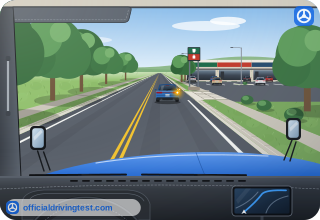
- Slow more than you expect or stop
- Speed up to clear the lane
- Keep a steady speed until the turn
Show answer
Correct answer: Slow more than you expect or stop
A tight turn may be made very slowly, and pedestrians or other vehicles in the way may make the driver stop on the road.
Source: CDL manual, national model as printed by New Jersey, Sections 1 to 3 (July 2017)
-
How may a driver in a hurry behave around your commercial vehicle?
- Follow you at a safe distance
- Stay in the lane behind you to avoid risk
- Pass you and cut in front without a safe gap
Show answer
Correct answer: Pass you and cut in front without a safe gap
Drivers who feel you are slowing them may pass unsafely or pull in front of you, forcing you to brake.
Source: CDL manual, national model as printed by New Jersey, Sections 1 to 3 (July 2017)
-
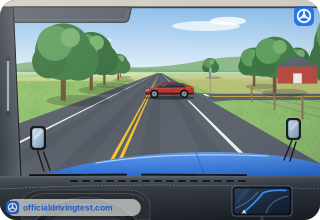
Why may a driver entering the road pull in front of your truck?
- To reach a turn lane just ahead of you
- To get ahead before the road narrows
- To avoid being stuck behind you
Show answer
Correct answer: To avoid being stuck behind you
A driver may cut in to avoid following a slow commercial vehicle, which can force you to brake.
Source: CDL manual, national model as printed by New Jersey, Sections 1 to 3 (July 2017)
-
Which behavior may be a clue that a driver is impaired?
- Slowing gently before a yellow light
- Stopping at a green light
- Using a turn signal well before a turn
Show answer
Correct answer: Stopping at a green light
Stopping at the wrong time, such as at a green light, can show that a driver is sleepy, drunk, on drugs or ill.
Source: CDL manual, national model as printed by New Jersey, Sections 1 to 3 (July 2017)
-
Which of these may be a clue that a driver is impaired?
- Fog lights on in clear weather
- An open window in cold weather
- Driving with the radio very loud
Show answer
Correct answer: An open window in cold weather
An open window in cold weather is one of the listed clues to a driver who is sleepy, drunk, on drugs or ill.
Source: CDL manual, national model as printed by New Jersey, Sections 1 to 3 (July 2017)
-
When should you be especially alert for drunk and sleepy drivers?
- Early on weekend mornings
- Late at night
- Right after a holiday rush hour
Show answer
Correct answer: Late at night
Impaired and sleepy drivers are a particular concern in the late-night hours.
Source: CDL manual, national model as printed by New Jersey, Sections 1 to 3 (July 2017)
-
A driver ahead makes an over-the-shoulder check. What may the driver be about to do?
- Park at the curb
- Change lanes
- Stop at the next light
Show answer
Correct answer: Change lanes
Head and body movements can warn of a lane change or a turn even when no signal is on.
Source: CDL manual, national model as printed by New Jersey, Sections 1 to 3 (July 2017)
-
In which road users are head and body movement clues most easily seen?
- Drivers of heavy trucks
- Motorcyclists and bicyclists
- Drivers of vans and buses
Show answer
Correct answer: Motorcyclists and bicyclists
Head and body movements are easiest to see in motorcyclists and bicyclists, and they can warn of a turn or lane change.
Source: CDL manual, national model as printed by New Jersey, Sections 1 to 3 (July 2017)
-
What does it mean to be in conflict with another road user?
- You must change speed or direction to avoid hitting them
- Both of you want the same parking space
- You are following closer than the safe distance
Show answer
Correct answer: You must change speed or direction to avoid hitting them
A conflict happens when you have to adjust your speed or direction to avoid a collision, such as at merges and intersections.
Source: CDL manual, national model as printed by New Jersey, Sections 1 to 3 (July 2017)
-
Where do conflicts occur between road users?
- At intersections, merges and needed lane changes
- On steep downgrades and in long, narrow tunnels
- In busy parking lots and at toll plazas on highways
Show answer
Correct answer: At intersections, merges and needed lane changes
Conflicts happen where vehicles meet, merge or must change lanes, so watch other drivers in conflict because their reaction may put them in conflict with you.
Source: CDL manual, national model as printed by New Jersey, Sections 1 to 3 (July 2017)
-
Why should a driver keep looking for hazards?
- To find safe places to stop and rest
- To learn which drivers deserve the right of way
- To gain time to work out an escape from an emergency
Show answer
Correct answer: To gain time to work out an escape from an emergency
Hazards may turn into emergencies. Seeing them early gives you time to decide what you would do.
Source: CDL manual, national model as printed by New Jersey, Sections 1 to 3 (July 2017)
-
Only in Arizona's manual
Which choice about medicine helps prevent drowsiness before a long drive?
- Avoid medicines that make you sleepy
- Take a cold tablet before you set out
- Take an antihistamine to clear your head
Show answer
Correct answer: Avoid medicines that make you sleepy
Some medicines, such as cold tablets and antihistamines, can make you sleepy. Avoid them when you plan to drive.
Source: CDL manual, national model as printed by New Jersey, Sections 1 to 3 (July 2017)
-
Only in Arizona's manual
What can you do with the air in the cab to help you stay alert while driving?
- Keep it warm by turning the heater up
- Keep it cool with a window or the A/C
- Keep the windows shut and the fan off
Show answer
Correct answer: Keep it cool with a window or the A/C
A cool cab helps you stay awake. Open a window or run the air conditioner.
Source: CDL manual, national model as printed by New Jersey, Sections 1 to 3 (July 2017)