Arkansas: Sharing the road — Part 3 Practice Test
Questions in this part include: “Where are bicycles required to travel on the road?” · “From where should drivers watch for bikes to appear in residential areas?”
Independent educational site · not affiliated with any government agency or DMV
Ready? Test yourself
- Instant feedback with an explanation
- Every answer cites its source in the manual
- Your best score is saved on this device
Questions are original and based on the official manual "Arkansas Driver License Study Guide" (Volume 1, Edition 10, October 2026), Arkansas State Police (ASP).
All 19 questions in this practice test
Take the test above first, then use this list to study. Tap “Show answer” to see the correct answer and explanation.
Show the questions and answersHide the questions
-
Where are bicycles required to travel on the road?
- On the left-hand side, facing oncoming traffic
- On whichever side the rider prefers
- In the center of the road at all times
- On the right-hand side, with other traffic
Show answer
Correct answer: On the right-hand side, with other traffic
Bicycles must travel on the right-hand side of the road with other traffic, and may not travel facing oncoming traffic.
Source: Arkansas Driver License Study Guide (Volume 1, Edition 10, October 2026), page 67 · Open this page in the manual (Manual page 67)
-
What should you always expect when you share the road with bicycles?
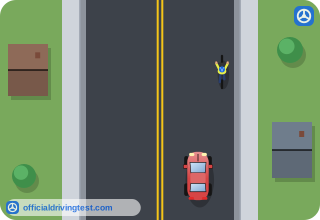
- The rider to make sudden moves
- The rider to stay in a straight line
- The rider to stop at every driveway
- The rider to use a horn before swerving
Show answer
Correct answer: The rider to make sudden moves
The manual says you should always expect the rider to make sudden moves, such as swerving around trash, a pothole or a car door.
Source: Arkansas Driver License Study Guide (Volume 1, Edition 10, October 2026), page 67 · Open this page in the manual (Manual page 67)
-
Why do cyclists passing parked cars tend to move toward the center of the lane?
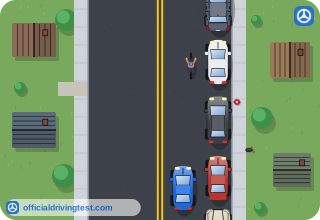
- To signal the driver behind to pass on the right side of the lane
- To avoid the wind created by cars passing close beside them
- To avoid injuring, or being injured by, people getting out of cars
- Because the right edge of the road is closed to bicycles
Show answer
Correct answer: To avoid injuring, or being injured by, people getting out of cars
Cyclists move toward the center to avoid injuring, or being injured by, people getting out of cars, and this is proper operation.
Source: Arkansas Driver License Study Guide (Volume 1, Edition 10, October 2026), page 67 · Open this page in the manual (Manual page 67)
-
When a cyclist moves toward the center of the lane to pass parked cars, what should drivers do if possible?
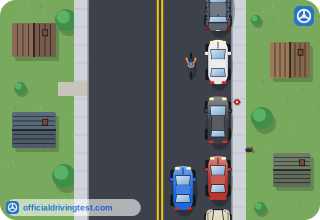
- Pass within the same lane beside the cyclist
- Give the cyclist the entire lane
- Honk to make the cyclist move over
- Follow closely and flash the headlights
Show answer
Correct answer: Give the cyclist the entire lane
The manual says drivers should give the cyclist the entire lane, if possible, and pass with extreme caution when they cannot.
Source: Arkansas Driver License Study Guide (Volume 1, Edition 10, October 2026), page 67 · Open this page in the manual (Manual page 67)
-
What does the manual say about cyclists who are not riding on the right side of the lane?
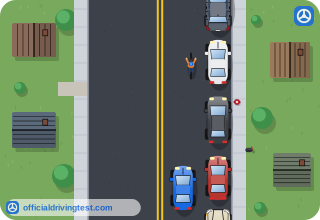
- They are being careless and breaking the rules of the road
- They are deliberately trying to block cars behind them
- They are signaling that drivers should honk and pass
- They are accounting for traffic conditions or preparing to turn left
Show answer
Correct answer: They are accounting for traffic conditions or preparing to turn left
They are not being careless but attempting to account for traffic conditions and/or preparing to make a left turn.
Source: Arkansas Driver License Study Guide (Volume 1, Edition 10, October 2026), page 67 · Open this page in the manual (Manual page 67)
-
What is the most common cause of a collision between a car and a bicycle?
- A driver turning left in front of an oncoming bicycle or right across its path
- A driver passing a bicycle too closely on a long straight stretch of road
- A driver backing out of a parking space without checking behind the car
- A bicyclist riding through a stop sign at high speed on the sidewalk
Show answer
Correct answer: A driver turning left in front of an oncoming bicycle or right across its path
The manual says the most common cause is a driver turning left in front of an oncoming bicycle or turning right across the bicycle's path.
Source: Arkansas Driver License Study Guide (Volume 1, Edition 10, October 2026), page 67 · Open this page in the manual (Manual page 67)
-
After overtaking a bicyclist, what should you do before turning right in front of the cyclist?
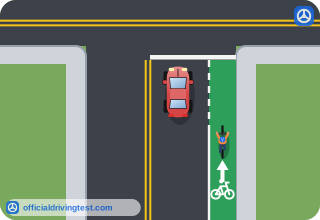
- Look right twice, then turn
- Look only in your rear-view mirror
- Look left, then right and left again
- Sound your horn, then turn
Show answer
Correct answer: Look left, then right and left again
The manual says to look left, then right and left again to see the cyclist and know his speed before you turn.
Source: Arkansas Driver License Study Guide (Volume 1, Edition 10, October 2026), page 67 · Open this page in the manual (Manual page 67)
-
How should you prepare for a right turn when bicycle traffic is beside you?
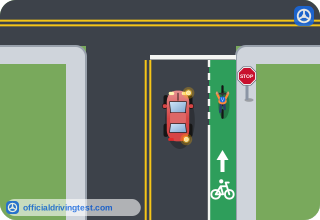
- Turn directly across the cyclist's path
- Merge with the bicycle traffic
- Speed up to get ahead of the cyclist
- Pull far to the left before turning
Show answer
Correct answer: Merge with the bicycle traffic
The manual says to merge with bicycle traffic when preparing for a right turn and not to turn directly across a cyclist's path.
Source: Arkansas Driver License Study Guide (Volume 1, Edition 10, October 2026), page 67 · Open this page in the manual (Manual page 67)
-
Which bicycle riders may turn in front of you without looking or signaling?
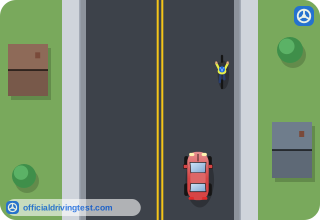
- Riders on racing bikes
- Riders who are using a bike lane
- Adult riders wearing helmets
- Young riders, especially children
Show answer
Correct answer: Young riders, especially children
The manual says to watch for young bicycle riders turning in front of you, who may not look or signal, especially children.
Source: Arkansas Driver License Study Guide (Volume 1, Edition 10, October 2026), page 67 · Open this page in the manual (Manual page 67)
-
Before turning near a cyclist, what should a driver attempt to do?
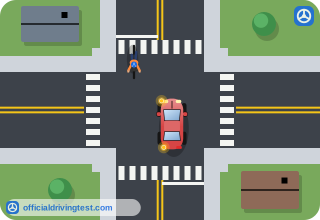
- Gain and maintain eye contact with the cyclist
- Flash the headlights to get the cyclist's attention
- Wave the cyclist through ahead of you at the corner
- Tap the horn to warn the cyclist of the turn
Show answer
Correct answer: Gain and maintain eye contact with the cyclist
Most bicyclists keep eye contact with drivers when turning, so the driver should gain and keep eye contact for a safer turn.
Source: Arkansas Driver License Study Guide (Volume 1, Edition 10, October 2026), page 67 · Open this page in the manual (Manual page 67)
-
You are overtaking a bicycle on a two-lane road and an oncoming car is approaching. What should you do?
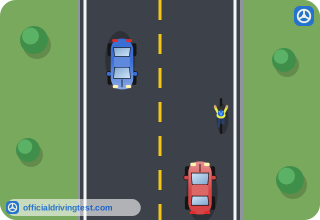
- Pass between the bicyclist and the oncoming car
- Speed up to pass before the oncoming car arrives
- Slow down and let the oncoming car pass first
- Sound your horn so the bicyclist pulls off the road
Show answer
Correct answer: Slow down and let the oncoming car pass first
A driver should never pass between a bicyclist and oncoming vehicles on a two-lane road; slow down and let the vehicle pass first.
Source: Arkansas Driver License Study Guide (Volume 1, Edition 10, October 2026), page 67 · Open this page in the manual (Manual page 67)
-
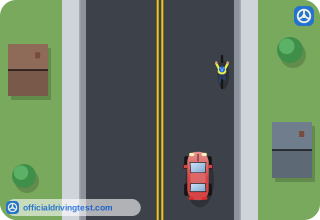
When should you never pass a bicycle?
- If the bicyclist is riding on the right side of the road
- If it could force the bicyclist too close to parked vehicles
- If the bicyclist is wearing a helmet or bright clothing
- If the bicycle is traveling slower than other traffic
Show answer
Correct answer: If it could force the bicyclist too close to parked vehicles
The manual says never to pass a bicycle if the street is too narrow or you could force the bicyclist too close to parked vehicles.
Source: Arkansas Driver License Study Guide (Volume 1, Edition 10, October 2026), page 67 · Open this page in the manual (Manual page 67)
-
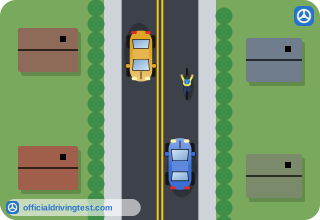
How should you use your horn to signal a bicyclist on a narrow road who may not know you are coming?
- Sound it long and loud
- Hold it down until the rider moves
- Do not use it at all
- Tap it gently and briefly
Show answer
Correct answer: Tap it gently and briefly
The manual says to tap your horn gently and briefly, and not to blast it or otherwise startle or intimidate the rider.
Source: Arkansas Driver License Study Guide (Volume 1, Edition 10, October 2026), page 67 · Open this page in the manual (Manual page 67)
-
What may bicyclists do in neighborhood streets that makes residential areas danger zones?
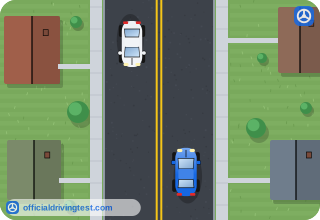
- Ride in the middle of the street and disregard stop signs and traffic signals
- Ride only on the left edge of the street and ignore turn signals
- Ride on the sidewalk and cross streets without stopping at corners
- Ride in large groups across several lanes and ignore bike lanes
Show answer
Correct answer: Ride in the middle of the street and disregard stop signs and traffic signals
The manual warns that in residential areas bicyclists may ride in the middle of the street and disregard stop signs and traffic signals.
Source: Arkansas Driver License Study Guide (Volume 1, Edition 10, October 2026), page 68 · Open this page in the manual (Manual page 68)
-
Why should drivers be alert to sudden movement and changes in direction when children are riding bicycles?
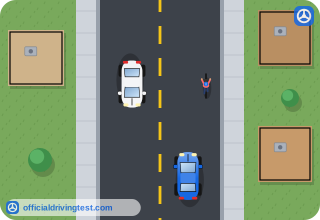
- Children's bicycles cannot be steered in a straight line at any speed
- Children are required to ride in the middle of the lane at all times
- Children are not capable of proper judgment in determining traffic conditions
- Children always ride faster than adult bicyclists on residential streets
Show answer
Correct answer: Children are not capable of proper judgment in determining traffic conditions
The manual says children are not capable of proper judgment in determining traffic conditions.
Source: Arkansas Driver License Study Guide (Volume 1, Edition 10, October 2026), page 68 · Open this page in the manual (Manual page 68)
-
From where should drivers watch for bikes to appear in residential areas?
- Bike lanes, crosswalks, and railroad crossings
- Driveways, behind parked cars, or other obstructions
- Overpasses, tunnels, and freeway ramps
- School zones, bus stops, and rest areas
Show answer
Correct answer: Driveways, behind parked cars, or other obstructions
The manual says to watch out for bikes coming out of driveways, behind parked cars, or from other obstructions.
Source: Arkansas Driver License Study Guide (Volume 1, Edition 10, October 2026), page 68 · Open this page in the manual (Manual page 68)
-
What are bicyclists required to have when riding at night?
- A bell, a reflective vest, and a rear warning flag
- A horn, a mirror, and two red lights on the rear
- A flag on the bike, a helmet, and a loud bell
- Proper illumination, a front light, and a rear reflector
Show answer
Correct answer: Proper illumination, a front light, and a rear reflector
The manual says bicyclists are required to have proper illumination, a front light, and a rear reflector.
Source: Arkansas Driver License Study Guide (Volume 1, Edition 10, October 2026), page 68 · Open this page in the manual (Manual page 68)
-
What does a red or orange pennant flag attached to a bicycle indicate?
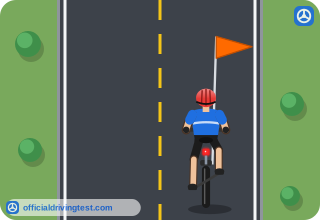
- The rider has impaired hearing
- The rider has impaired vision
- The rider is a beginner
- The rider is carrying a child
Show answer
Correct answer: The rider has impaired hearing
The manual says the flag is a symbol that the rider has impaired hearing, and drivers should slow down.
Source: Arkansas Driver License Study Guide (Volume 1, Edition 10, October 2026), page 68 · Open this page in the manual (Manual page 68)
-
In which situation should a bicyclist be allowed full use of the lane?
- When riding downhill at a higher speed than traffic
- When overtaking and passing another vehicle going the same way
- When riding in a group of two or more other bicyclists
- When riding at night with a front light and rear reflector
Show answer
Correct answer: When overtaking and passing another vehicle going the same way
A bicyclist should be allowed the full lane when overtaking and passing another vehicle going in the same direction.
Source: Arkansas Driver License Study Guide (Volume 1, Edition 10, October 2026), page 68 · Open this page in the manual (Manual page 68)