Arkansas: Sharing the road — Part 2 Practice Test
Questions in this part include: “How far in front of the cab can a car disappear from a tractor-trailer driver's view?” · “How do trucks differ from cars in stopping, acceleration and turning?”
Independent educational site · not affiliated with any government agency or DMV
Ready? Test yourself
- Instant feedback with an explanation
- Every answer cites its source in the manual
- Your best score is saved on this device
Questions are original and based on the official manual "Arkansas Driver License Study Guide" (Volume 1, Edition 10, October 2026), Arkansas State Police (ASP).
All 20 questions in this practice test
Take the test above first, then use this list to study. Tap “Show answer” to see the correct answer and explanation.
Show the questions and answersHide the questions
-
You are overtaking a bicycle and an oncoming vehicle is approaching. What does the manual say to do?
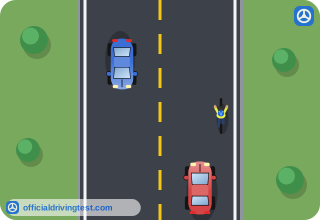
- Speed up to pass the bicycle before the vehicle arrives
- Pass the bicycle and the vehicle together
- Honk to warn the bicyclist and pass anyway
- Slow down and let the vehicle pass before you pass the bicycle
Show answer
Correct answer: Slow down and let the vehicle pass before you pass the bicycle
The manual says to take potential hazards one at a time, so let the oncoming vehicle pass before you pass the bicycle.
Source: Arkansas Driver License Study Guide (Volume 1, Edition 10, October 2026), page 60 · Open this page in the manual (Manual page 60)
-
How do the rear wheels of a turning vehicle travel compared with its front wheels?
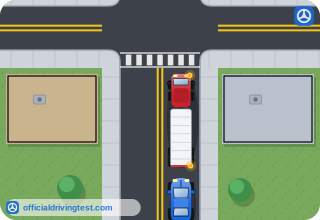
- They follow a longer path than the front wheels
- They follow a shorter path than the front wheels
- They follow exactly the same path as the front wheels
- They swing wider than the front wheels on every turn
Show answer
Correct answer: They follow a shorter path than the front wheels
Any turning vehicle's rear wheels follow a shorter path, and the longer the vehicle the greater the difference.
Source: Arkansas Driver License Study Guide (Volume 1, Edition 10, October 2026), page 64 · Open this page in the manual (Manual page 64)
-
What do tractor-trailer drivers often do as the first step in making a right turn?
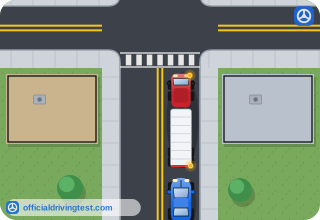
- Move over to the far right
- Stop and wait in the lane
- Back up a short distance
- Swing out to the left
Show answer
Correct answer: Swing out to the left
Because the rear wheels follow a shorter path, tractor-trailer drivers must often swing out to the left first.
Source: Arkansas Driver License Study Guide (Volume 1, Edition 10, October 2026), page 64 · Open this page in the manual (Manual page 64)
-
When following a tractor-trailer, what should you do before trying to pass?
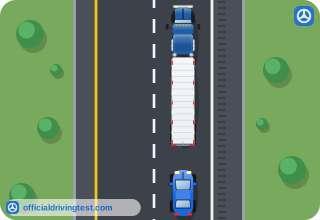
- Watch the turn signals
- Sound your horn twice
- Flash your headlights
- Pass without waiting
Show answer
Correct answer: Watch the turn signals
The manual says to watch the turn signals before trying to pass, and to check which way the driver is signaling if a left turn is imminent.
Source: Arkansas Driver License Study Guide (Volume 1, Edition 10, October 2026), page 64 · Open this page in the manual (Manual page 64)
-
How far in front of the cab can a car disappear from a tractor-trailer driver's view?
- Up to 5 feet
- Up to 50 feet
- Up to 20 feet
- Up to 100 feet
Show answer
Correct answer: Up to 20 feet
The manual says a car can disappear up to 20 feet in front of the cab.
Source: Arkansas Driver License Study Guide (Volume 1, Edition 10, October 2026), page 65 · Open this page in the manual (Manual page 65)
-
How far behind a truck can a car disappear from the truck driver's view?
- Up to 20 feet
- Up to 200 feet
- Up to 100 feet
- Up to 500 feet
Show answer
Correct answer: Up to 200 feet
The manual says a car can disappear up to 200 feet in the rear of the truck.
Source: Arkansas Driver License Study Guide (Volume 1, Edition 10, October 2026), page 65 · Open this page in the manual (Manual page 65)
-
What does the manual say about tractor-trailer drivers, who have a better forward view and bigger mirrors than car drivers?
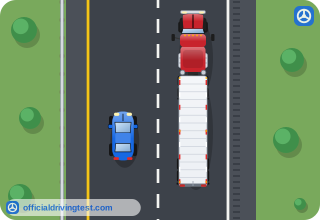
- They have no blind spots on either side
- They can easily see cars right behind the trailer
- They can see a car alongside the cab
- They still have serious blind spots
Show answer
Correct answer: They still have serious blind spots
Despite their view from the cab and bigger mirrors, tractor-trailer drivers still have serious blind spots.
Source: Arkansas Driver License Study Guide (Volume 1, Edition 10, October 2026), page 65 · Open this page in the manual (Manual page 65)
-
According to the manual, what is an excellent rule for sharing the road with a tractor-trailer?
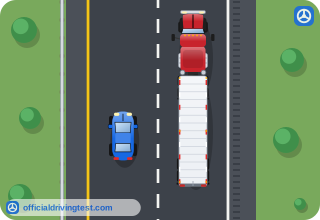
- If you can't see the truck driver in the side mirror, the driver can't see you
- Stay beside the cab so the truck driver always knows where you are
- If the truck driver can see your car, you can stay as close as you like
- Stay in the blind spot so the truck driver cannot pull in front of you
Show answer
Correct answer: If you can't see the truck driver in the side mirror, the driver can't see you
The manual's rule is that if you cannot see the truck driver in the tractor side mirror, the driver cannot see you.
Source: Arkansas Driver License Study Guide (Volume 1, Edition 10, October 2026), page 66 · Open this page in the manual (Manual page 66)
-
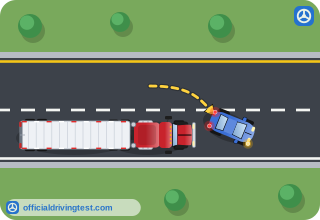
Why is cutting into the open space in front of a truck dangerous?
- It makes the truck's brakes lock up suddenly
- It forces the truck onto the road shoulder
- It removes the truck driver's cushion of safety
- It makes the trailer swing out to the right
Show answer
Correct answer: It removes the truck driver's cushion of safety
Cutting into the open space in front of a truck removes the truck driver's cushion of safety.
Source: Arkansas Driver License Study Guide (Volume 1, Edition 10, October 2026), page 66 · Open this page in the manual (Manual page 66)
-
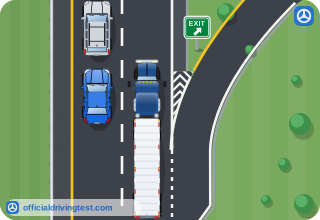
Instead of cutting off a truck to reach an exit or turn, what does the manual advise?
- Speed up and pass it on the right
- Slow down and exit behind the truck
- Flash your lights so the truck slows
- Stay beside the truck until the exit
Show answer
Correct answer: Slow down and exit behind the truck
The manual says to take a moment to slow down and exit behind the truck, which only takes a few extra seconds.
Source: Arkansas Driver License Study Guide (Volume 1, Edition 10, October 2026), page 66 · Open this page in the manual (Manual page 66)
-
How should you pass a tractor-trailer?
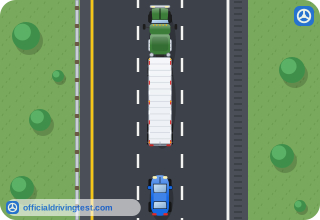
- On the right side, to stay out of its path
- Slowly, staying beside the cab
- Partly, then stay alongside the trailer
- Completely, and on the left side
Show answer
Correct answer: Completely, and on the left side
The manual says to always pass a tractor-trailer completely and on the left side.
Source: Arkansas Driver License Study Guide (Volume 1, Edition 10, October 2026), page 66 · Open this page in the manual (Manual page 66)
-
Why should you not linger alongside a truck when passing?
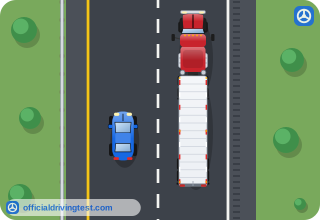
- The truck driver cannot take evasive action if an obstacle appears
- The truck's air brakes may be damaged by the side draft
- The truck's turn signals will stop working correctly
- The truck driver is required by law to slow down for you
Show answer
Correct answer: The truck driver cannot take evasive action if an obstacle appears
If you linger, the truck driver cannot take evasive action if an obstacle appears in the road ahead.
Source: Arkansas Driver License Study Guide (Volume 1, Edition 10, October 2026), page 66 · Open this page in the manual (Manual page 66)
-
When you are following behind a truck and cannot see the truck driver's rear-view mirrors, what is true?
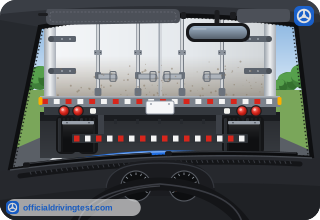
- The truck driver can see you with the larger mirrors
- You are in the safest following position
- The truck driver has no way to see you
- You may safely follow closer than usual
Show answer
Correct answer: The truck driver has no way to see you
If you can't see the truck driver's rear-view mirrors, there is no way the truck driver can see you.
Source: Arkansas Driver License Study Guide (Volume 1, Edition 10, October 2026), page 66 · Open this page in the manual (Manual page 66)
-
Because of its size, how can an approaching tractor-trailer appear to a driver?
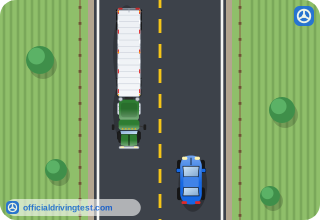
- To be traveling faster than it really is
- To be stopped when it is moving
- To be smaller than it really is
- To be traveling slower than it really is
Show answer
Correct answer: To be traveling slower than it really is
The size of a tractor-trailer can make it appear to be traveling at a slower speed than reality.
Source: Arkansas Driver License Study Guide (Volume 1, Edition 10, October 2026), page 66 · Open this page in the manual (Manual page 66)
-
Why do a large number of car-truck collisions take place at intersections?
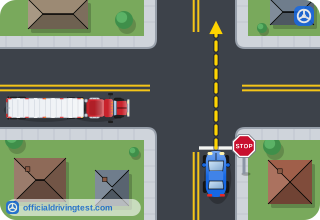
- The car driver does not realize how close the truck is or how fast it comes
- The truck driver cannot see traffic signals from the cab at intersections
- Trucks are required to stop twice at every intersection they enter
- Car drivers cannot see trucks that are waiting to make a turn there
Show answer
Correct answer: The car driver does not realize how close the truck is or how fast it comes
The manual says the car driver does not realize how close the truck is or how quickly it is approaching.
Source: Arkansas Driver License Study Guide (Volume 1, Edition 10, October 2026), page 66 · Open this page in the manual (Manual page 66)
-
How do trucks differ from cars in stopping, acceleration and turning?
- They have shorter stopped distances but need wider areas to turn
- They have longer stopped distances but need narrower areas to turn
- They have longer stopped and acceleration distances and turn wider
- They accelerate faster and weigh about the same as cars do
Show answer
Correct answer: They have longer stopped and acceleration distances and turn wider
Trucks have longer stopped and acceleration distances, take wider areas to turn, and weigh much more than cars.
Source: Arkansas Driver License Study Guide (Volume 1, Edition 10, October 2026), page 66 · Open this page in the manual (Manual page 66)
-
In the Chapter 6 picture of a tractor-trailer rig, what maximum overall length limit is shown?
- 45 feet
- 65 feet
- 55 feet
- 75 feet
Show answer
Correct answer: 65 feet
The picture at the top of Chapter 6 labels a 65 ft maximum overall length limit for a tractor-trailer rig.
Source: Arkansas Driver License Study Guide (Volume 1, Edition 10, October 2026), page 64 · Open this page in the manual (Manual page 64)
-
What does the No-Zone graphic say never to do behind a truck that is backing up?
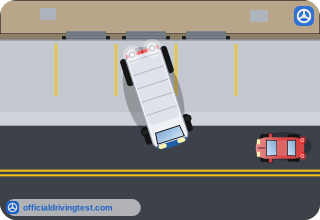
- Sound your horn
- Wait in the right lane
- Flash your headlights
- Cross behind it
Show answer
Correct answer: Cross behind it
The graphic says never to cross behind a truck that is backing up, because the driver may not see you.
Source: Arkansas Driver License Study Guide (Volume 1, Edition 10, October 2026), page 65 · Open this page in the manual (Manual page 65)
-
According to the No-Zone graphic, what should you look for before pulling in front of a truck after passing?
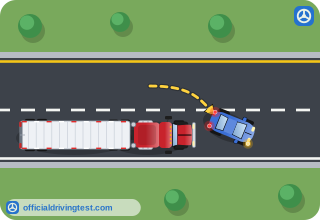
- The truck's headlights in your side mirror
- The truck driver waving you on ahead of him
- The whole front of the truck in your mirror
- The truck's turn signal in your rear-view mirror
Show answer
Correct answer: The whole front of the truck in your mirror
The graphic says to look for the whole front of the truck in your rear-view mirror before pulling in front, and then not to slow down.
Source: Arkansas Driver License Study Guide (Volume 1, Edition 10, October 2026), page 65 · Open this page in the manual (Manual page 65)
-
How do the rights and responsibilities of bicycles on the street compare with those of other vehicles?
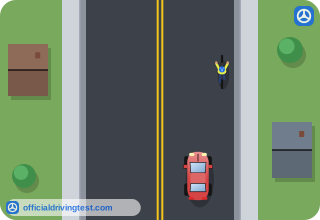
- Bicycles have fewer rights
- They are the same
- Bicycles have more rights
- Bicycles have no responsibilities
Show answer
Correct answer: They are the same
The manual says bicycles have the same rights and responsibilities on the streets as other vehicles.
Source: Arkansas Driver License Study Guide (Volume 1, Edition 10, October 2026), page 67 · Open this page in the manual (Manual page 67)