Arizona: Speed and following distance — Part 4 Practice Test
Questions in this part include: “What may you need to do when driving into a strong head wind?” · “How long after rain begins should you be extra careful because grime and oil mix with water on the road?”
Independent educational site · not affiliated with any government agency or DMV
Ready? Test yourself
- Instant feedback with an explanation
- Every answer cites its source in the manual
- Your best score is saved on this device
Questions are original and based on the official manual "Arizona Driver License Manual and Customer Service Guide" (Revised March 2026), Arizona Department of Transportation Motor Vehicle Division (ADOT MVD).
All 17 questions in this practice test
Take the test above first, then use this list to study. Tap “Show answer” to see the correct answer and explanation.
Show the questions and answersHide the questions
-
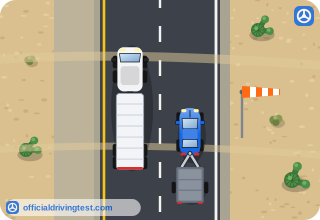
If you are pulling a trailer in a strong wind, what may the wind cause your vehicle to do?
- Stall
- Stop suddenly
- Lose its brakes
- Sway
Show answer
Correct answer: Sway
The manual says the wind may cause a vehicle pulling a trailer to sway.
Source: Arizona Driver License Manual and Customer Service Guide (Revised March 2026), page 54
-
If you are pulling a trailer, what can the wind currents from large trucks or buses cause your vehicle to do?
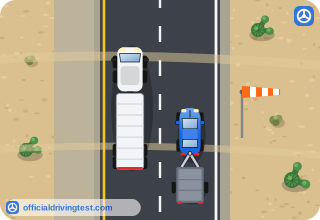
- Jackknife
- Roll backward
- Lose all braking power
- Hydroplane
Show answer
Correct answer: Jackknife
The manual warns that wind currents can cause a vehicle pulling a trailer to jackknife.
Source: Arizona Driver License Manual and Customer Service Guide (Revised March 2026), page 55
-
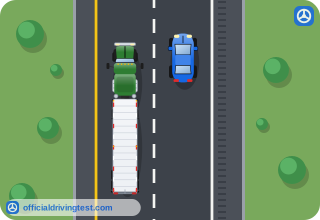
What should you do when a truck or bus is passing you on the left?
- Move toward the left side of your lane and hold speed
- Speed up so that you stay beside the vehicle
- Move as far right in your lane as possible and slow down
- Brake hard and stop in your lane
Show answer
Correct answer: Move as far right in your lane as possible and slow down
You move as far as possible to the right of your lane and slow down while the truck or bus passes.
Source: Arizona Driver License Manual and Customer Service Guide (Revised March 2026), page 55
-
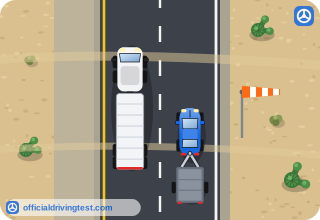
While pulling a trailer, how should you accelerate as a truck or bus passes you?
- Quickly, to pull away from the gusts
- Slowly, to keep the trailer in a straight path
- Not at all, until the vehicle is far ahead
- Gradually at first and then hard
Show answer
Correct answer: Slowly, to keep the trailer in a straight path
As the vehicle passes, you accelerate slowly to keep the trailer pulling in a straight path.
Source: Arizona Driver License Manual and Customer Service Guide (Revised March 2026), page 55
-
What may you need to do when driving into a strong head wind?
- Brake earlier before every stop
- Drive in the center of the road
- Turn on your high beams
- Accelerate more
Show answer
Correct answer: Accelerate more
Driving into a strong head wind may require more acceleration, and steering is more difficult.
Source: Arizona Driver License Manual and Customer Service Guide (Revised March 2026), page 55
-
A tailwind increases your speed. What does the manual say you will have to do?
- Decelerate and begin braking earlier to stop
- Accelerate more to keep a steady speed
- Brake later because the tires grip better
- Steer more firmly toward the road center
Show answer
Correct answer: Decelerate and begin braking earlier to stop
With a tailwind you must decelerate and begin braking earlier to stop.
Source: Arizona Driver License Manual and Customer Service Guide (Revised March 2026), page 55
-
Why should you wait a short time after rain begins before using your wipers?
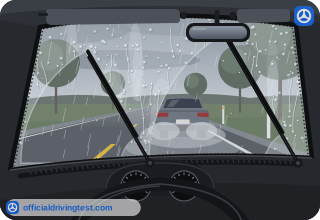
- The blades may freeze to a cold windshield
- The blades may smear a dirty windshield
- The wiper motor may overheat when dry
- Water on the glass makes your lights dim
Show answer
Correct answer: The blades may smear a dirty windshield
The blades may cause smearing if you have a dirty windshield.
Source: Arizona Driver License Manual and Customer Service Guide (Revised March 2026), page 55
-
How long after rain begins should you be extra careful because grime and oil mix with water on the road?
- 30 minutes
- 5 minutes
- 10 minutes
- 2 hours
Show answer
Correct answer: 30 minutes
Grime and oil on the road mix with water and make it slippery during the first 30 minutes after rain begins.
Source: Arizona Driver License Manual and Customer Service Guide (Revised March 2026), page 55
-
In a heavy rain, at what speed can your tires lose all contact with the road?
- 30 mph
- 40 mph
- 50 mph
- 70 mph
Show answer
Correct answer: 50 mph
At 50 mph in heavy rain your tires can lose all contact with the road.
Source: Arizona Driver License Manual and Customer Service Guide (Revised March 2026), page 55
-
How do under-inflated, worn or bald tires behave when the road is wet?
- They lose contact only above 70 mph
- They lose contact with the road at much lower speeds
- They grip as well as properly inflated tires
- They keep better contact because of more friction
Show answer
Correct answer: They lose contact with the road at much lower speeds
Under-inflated, worn or bald tires lose contact with the road at much lower speeds.
Source: Arizona Driver License Manual and Customer Service Guide (Revised March 2026), page 55
-
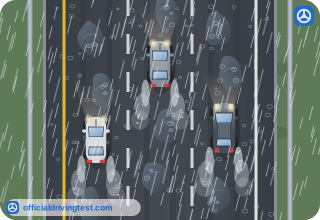
What is the best way to prevent hydroplaning?
- Speed up
- Brake hard in every turn
- Steer firmly from side to side
- Slow down
Show answer
Correct answer: Slow down
The manual says the best way to prevent hydroplaning is to slow down.
Source: Arizona Driver License Manual and Customer Service Guide (Revised March 2026), page 55
-
At what speed must you drive through water?
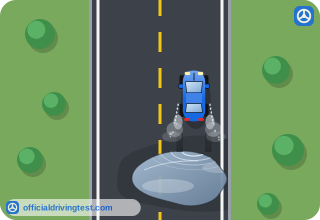
- At a slow and steady speed
- As fast as you can to avoid stalling
- Slowly at first, then faster in the middle
- At the speed of nearby traffic
Show answer
Correct answer: At a slow and steady speed
The manual says driving through water must be done at a slow and steady speed.
Source: Arizona Driver License Manual and Customer Service Guide (Revised March 2026), page 56
-
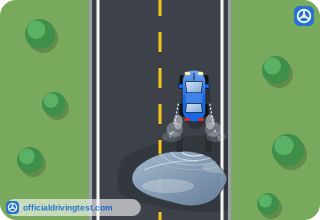
What may help keep your brakes dry while you drive through water?
- Keeping your feet completely off the pedals
- Applying the parking brake lightly
- Applying the brakes gently with your left foot
- Pumping the brakes hard with your right foot
Show answer
Correct answer: Applying the brakes gently with your left foot
Applying the brakes gently with your left foot may help keep them dry.
Source: Arizona Driver License Manual and Customer Service Guide (Revised March 2026), page 56
-
What should you do after you leave the water?
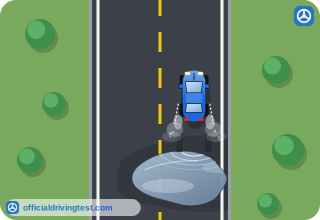
- Turn off the engine for a minute
- Check that your brakes will stop the car
- Speed up to dry the tires
- Turn on the wipers to dry the windshield
Show answer
Correct answer: Check that your brakes will stop the car
The manual says to check your brakes after leaving the water to see if they will stop the car.
Source: Arizona Driver License Manual and Customer Service Guide (Revised March 2026), page 56
-
What may wet brakes do?
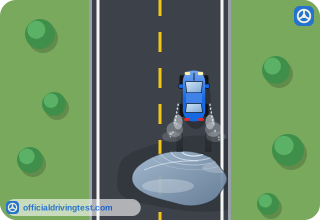
- Stay locked until the car has stopped
- Make the engine stall at once
- Wear the tires out evenly
- Suddenly grab or pull to one side
Show answer
Correct answer: Suddenly grab or pull to one side
If the brakes are wet, they may suddenly grab or pull to one side.
Source: Arizona Driver License Manual and Customer Service Guide (Revised March 2026), page 56
-
How do you dry wet brakes?
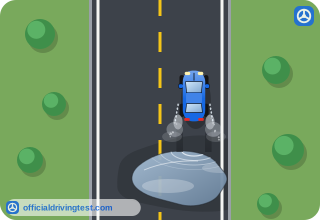
- Accelerate slowly while gently holding down the brake pedal
- Stop and wait with the engine off for an hour or more
- Press the brake pedal hard several times in a row
- Drive at high speed with your foot off both pedals
Show answer
Correct answer: Accelerate slowly while gently holding down the brake pedal
You dry them by accelerating slowly while gently holding down the brake pedal.
Source: Arizona Driver License Manual and Customer Service Guide (Revised March 2026), page 56
-
Which headlight setting should you use when driving in fog?

- High beams only
- Parking lights only
- Hazard flashers only
- Low beams only
Show answer
Correct answer: Low beams only
In fog you use low beams only and look for road edge markings to guide you.
Source: Arizona Driver License Manual and Customer Service Guide (Revised March 2026), page 56