Arizona: Speed and following distance — Part 3 Practice Test
Questions in this part include: “What should you do when you are driving slower than the traffic around you?” · “A driver behind you wishes to pass. What does the manual say reducing your speed will do?”
Independent educational site · not affiliated with any government agency or DMV
Ready? Test yourself
- Instant feedback with an explanation
- Every answer cites its source in the manual
- Your best score is saved on this device
Questions are original and based on the official manual "Arizona Driver License Manual and Customer Service Guide" (Revised March 2026), Arizona Department of Transportation Motor Vehicle Division (ADOT MVD).
All 17 questions in this practice test
Take the test above first, then use this list to study. Tap “Show answer” to see the correct answer and explanation.
Show the questions and answersHide the questions
-
What should you do when you are driving slower than the traffic around you?
- Stay in the left lane with your hazard lights on
- Drive in the right lane and allow faster vehicles to pass
- Drive in the center of the road
- Speed up to the limit whatever the conditions
Show answer
Correct answer: Drive in the right lane and allow faster vehicles to pass
Remember to drive in the right lane and allow faster moving vehicles to pass whenever you are driving slower than traffic around you.
Source: Arizona Driver License Manual and Customer Service Guide (Revised March 2026), page 40
-
What is the maximum speed from the first portable school crossing sign to past the school crossing sign?
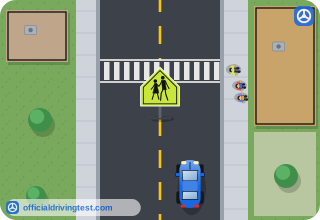
- 10 mph
- 15 mph
- 20 mph
- 30 mph
Show answer
Correct answer: 15 mph
The maximum speed from the first portable sign to past the school crossing sign is 15 mph.
Source: Arizona Driver License Manual and Customer Service Guide (Revised March 2026), page 42
-
Why should you follow trucks at a safe distance?
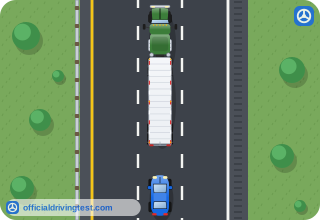
- A truck’s load may fall on a car that follows at any distance
- Following too closely leaves too little time to react to changes
- A truck’s brake lights cannot be seen from a safe distance
- Trucks must be passed within a few seconds
Show answer
Correct answer: Following too closely leaves too little time to react to changes
Trucks are almost as wide as some lanes of travel. If you follow too closely behind, you won't be able to react quickly enough to changing traffic conditions.
Source: Arizona Driver License Manual and Customer Service Guide (Revised March 2026), page 52
-
According to the manual, what is the average driver reaction time (the time from perception of danger to the start of braking)?
- 0.75 seconds
- 0.25 seconds
- 1.5 seconds
- 3 seconds
Show answer
Correct answer: 0.75 seconds
The manual gives 0.75 seconds as the average driver reaction time.
Source: Arizona Driver License Manual and Customer Service Guide (Revised March 2026), page 53
-
On average, how long does it take a person to perceive a threat in the roadway and react to that threat?
- 0.75 seconds
- 3 seconds
- 1.5 seconds
- 6 seconds
Show answer
Correct answer: 1.5 seconds
The manual says it takes an average of 1.5 seconds to perceive a threat and react to it.
Source: Arizona Driver License Manual and Customer Service Guide (Revised March 2026), page 53
-
Which of these is listed in the manual as something braking distance is directly related to?
- The color and age of the vehicle
- Vehicle weight, including when loaded or towing
- The number of passengers wearing seat belts
- The brand of the vehicle's headlights
Show answer
Correct answer: Vehicle weight, including when loaded or towing
Braking distance depends on vehicle weight, including when the vehicle is loaded or towing.
Source: Arizona Driver License Manual and Customer Service Guide (Revised March 2026), page 53
-
What following distance does the manual say to allow for most driving situations?
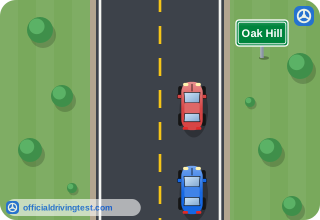
- At least 1 second
- At least 2 seconds
- At least 5 seconds
- At least 3 seconds
Show answer
Correct answer: At least 3 seconds
The manual says to allow at least a 3-second following distance for most driving situations.
Source: Arizona Driver License Manual and Customer Service Guide (Revised March 2026), page 53
-
A driver behind you wishes to pass. What does the manual say reducing your speed will do?
- Make the passing driver slow down too
- Warn the driver that you plan to turn
- Let that driver pass more quickly
- Raise the chance of being hit from behind
Show answer
Correct answer: Let that driver pass more quickly
Reducing your speed allows the driver behind you to pass more quickly.
Source: Arizona Driver License Manual and Customer Service Guide (Revised March 2026), page 53
-
Why do you need extra following distance behind a tractor-trailer that blocks your view of the road ahead?
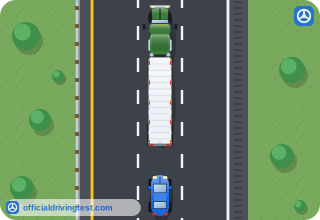
- To leave room in case it backs up
- To see around the vehicle ahead
- To stay clear of debris from its tires
- Because its brake lights are hard to see
Show answer
Correct answer: To see around the vehicle ahead
A large vehicle that blocks your field of vision means you need extra distance to see around it.
Source: Arizona Driver License Manual and Customer Service Guide (Revised March 2026), page 54
-
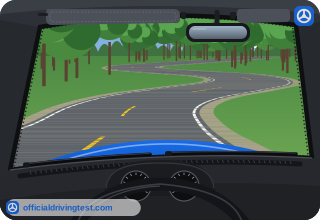
What should you do when approaching curves or hills that block your view of the roadway ahead on a rural highway?
- Keep your speed up so you clear the hill quickly
- Move to the center of the road for a better view
- Sound your horn and keep the same speed
- Stay alert, watch for warning signs, and slow down
Show answer
Correct answer: Stay alert, watch for warning signs, and slow down
The manual says to stay alert, watch for warning signs and slow down when curves or hills block your view.
Source: Arizona Driver License Manual and Customer Service Guide (Revised March 2026), page 54
-
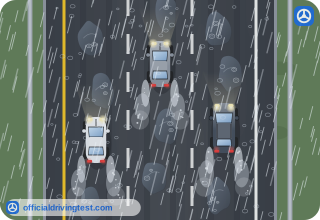
What is the first rule of driving when bad weather reduces visibility and traction?
- Slow down
- Turn on your hazard lights
- Pull off the road at once
- Switch to high beams
Show answer
Correct answer: Slow down
The first rule is to slow down to make up for reduced visibility and reaction time.
Source: Arizona Driver License Manual and Customer Service Guide (Revised March 2026), page 54
-
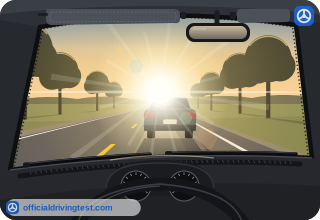
Which of these helps reduce sun glare when you drive into the sun?
- Turning on your high beams
- Driving with the windows down
- Keeping your windows clean
- Using your parking lights
Show answer
Correct answer: Keeping your windows clean
Glare can be reduced by wearing sunglasses, keeping windows clean and using sun visors.
Source: Arizona Driver License Manual and Customer Service Guide (Revised March 2026), page 54
-
When the sun is behind you, what problem may oncoming drivers have?
- Their headlights may not switch to low beam
- Glare that may hide your signals and your car
- Their windshields may fog up from the heat
- They may mistake your car for a parked one
Show answer
Correct answer: Glare that may hide your signals and your car
Oncoming drivers may have the glare problem and may not be able to see your signals or your car.
Source: Arizona Driver License Manual and Customer Service Guide (Revised March 2026), page 54
-
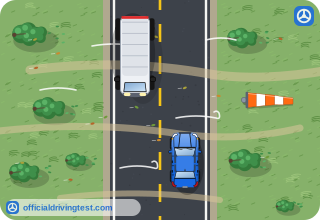
What should you do to gain more control over your vehicle in a strong wind?
- Speed up
- Drive near the center line
- Turn on your hazard flashers
- Slow down
Show answer
Correct answer: Slow down
The manual says to slow down to gain more control in a strong wind.
Source: Arizona Driver License Manual and Customer Service Guide (Revised March 2026), page 54
-
Which of these is very dangerous in strong winds, especially crosswinds?
- Driving a camper or large recreational vehicle
- Driving a car with new tires and a full tank
- Driving a vehicle with the windows closed
- Driving in the right lane of a highway
Show answer
Correct answer: Driving a camper or large recreational vehicle
Wind is very dangerous if you drive a camper or large recreational vehicle, or tow a trailer.
Source: Arizona Driver License Manual and Customer Service Guide (Revised March 2026), page 54
-
Which vehicles does the manual say are also more difficult to control in strong winds?
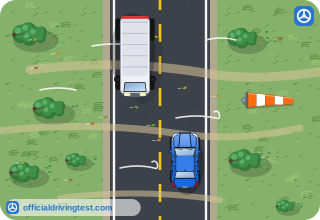
- Vehicles with four-wheel drive
- Vehicles with new tires
- Lightweight vehicles
- Vehicles with automatic gearboxes
Show answer
Correct answer: Lightweight vehicles
The manual says lightweight vehicles are more difficult to control in strong winds.
Source: Arizona Driver License Manual and Customer Service Guide (Revised March 2026), page 54
-
You drive from a protected area into an open space in a strong wind. What should you be alert for?
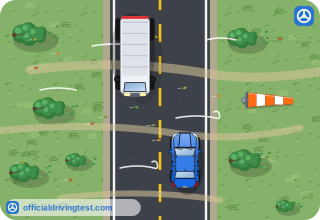
- Gusts that push your vehicle only toward the shoulder
- Crosswinds that push you to the side or middle of the road
- Dust that covers the lane markings on the road
- A sudden calm that makes the vehicle drift forward
Show answer
Correct answer: Crosswinds that push you to the side or middle of the road
After a protected area, crosswinds can push you to the side or middle of the road.
Source: Arizona Driver License Manual and Customer Service Guide (Revised March 2026), page 54