Arizona: Speed and following distance — Part 2 Practice Test
Questions in this part include: “What causes most rear end crashes?” · “When no speed limit is posted, what is the speed limit in any business or residential district?”
Independent educational site · not affiliated with any government agency or DMV
Ready? Test yourself
- Instant feedback with an explanation
- Every answer cites its source in the manual
- Your best score is saved on this device
Questions are original and based on the official manual "Arizona Driver License Manual and Customer Service Guide" (Revised March 2026), Arizona Department of Transportation Motor Vehicle Division (ADOT MVD).
All 17 questions in this practice test
Take the test above first, then use this list to study. Tap “Show answer” to see the correct answer and explanation.
Show the questions and answersHide the questions
-
What causes most rear end crashes?
- Sudden lane changes
- Following too closely
- Poor road conditions
- Brake failure
Show answer
Correct answer: Following too closely
The manual states that most rear end crashes are caused by following too closely.
Source: Arizona Driver License Manual and Customer Service Guide (Revised March 2026), page 25
-
At high speeds, what happens to the distance your vehicle travels while you are reacting to a problem?
- It is shorter, so your margin for error is greater
- It is greater, and your margin for error is less
- It stays the same at every speed
- It is greater, but your margin for error is also greater
Show answer
Correct answer: It is greater, and your margin for error is less
At high speeds the distance traveled while reacting is greater and the margin for error is less.
Source: Arizona Driver License Manual and Customer Service Guide (Revised March 2026), page 25
-
At faster speeds, how should your following distance compare with your distance at slower speeds?
- It should be the same
- It should be smaller
- It should be shorter on freeways
- It should be greater
Show answer
Correct answer: It should be greater
The manual says that at faster speeds the following distance should be greater.
Source: Arizona Driver License Manual and Customer Service Guide (Revised March 2026), page 25
-
How can you help the driver behind you maintain a safe following distance?
- Tap your brakes repeatedly to warn the driver to drop back
- Drive at the lowest speed that traffic conditions allow
- Drive at a constant speed and signal before slowing
- Stay in the left lane so the driver can pass you easily
Show answer
Correct answer: Drive at a constant speed and signal before slowing
The manual says to drive at a constant speed and signal in advance whenever you are slowing or stopping.
Source: Arizona Driver License Manual and Customer Service Guide (Revised March 2026), page 25
-
If another driver is following you too closely, what should you do first?
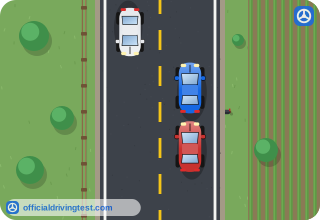
- Gradually slow down and increase the space in front of you
- Speed up quickly to open a gap between you and the driver
- Brake hard for a moment to warn the driver to back off
- Stay at the same speed and ignore the driver behind you
Show answer
Correct answer: Gradually slow down and increase the space in front of you
The manual says to gradually slow down and give additional cushion between you and the vehicle in front.
Source: Arizona Driver License Manual and Customer Service Guide (Revised March 2026), page 25
-
When it is safe, what can you do to encourage a tailgater to pass?
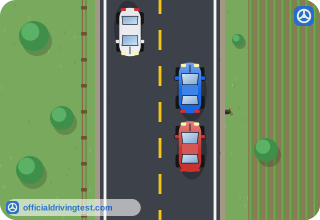
- Flash your brake lights repeatedly
- Speed up until you leave the driver behind
- Move to another lane
- Stop on the shoulder until the driver passes
Show answer
Correct answer: Move to another lane
The manual says that when safe you can move to another lane to encourage the tailgater to pass.
Source: Arizona Driver License Manual and Customer Service Guide (Revised March 2026), page 26
-
What are blind spots?
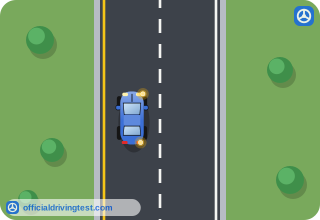
- Areas directly in front of your vehicle hidden by the hood
- Areas to the left and right of your vehicle not visible in your mirror
- Areas behind your vehicle that cannot be seen through the rear window
- Areas on the road ahead that are hidden by curves or hills
Show answer
Correct answer: Areas to the left and right of your vehicle not visible in your mirror
Blind spots are areas on the left and right sides of your vehicle that are not visible in your mirror.
Source: Arizona Driver License Manual and Customer Service Guide (Revised March 2026), page 26
-
Vehicles parked too close to an intersection block your view. What should you do?
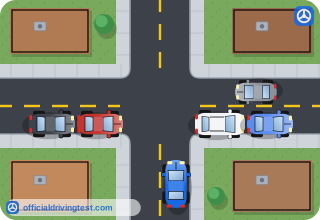
- Sound your horn and cross the intersection quickly
- Accelerate through the intersection before traffic arrives
- Back up and turn onto a different street
- Slowly inch your vehicle forward until you have a clear view
Show answer
Correct answer: Slowly inch your vehicle forward until you have a clear view
In situations where parked vehicles, bushes, trees or buildings block your view, slowly inch forward until you have a clear view, then proceed when the way is clear.
Source: Arizona Driver License Manual and Customer Service Guide (Revised March 2026), page 26
-
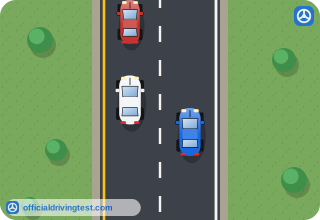
What should you do if you find yourself in another driver's blind spot?
- Stay alongside and match the speed of the other vehicle
- Flash your headlights while staying next to the vehicle
- Speed up or drop back; never stay there for an extended time
- Stay in place and sound your horn until the driver sees you
Show answer
Correct answer: Speed up or drop back; never stay there for an extended time
The manual says to speed up or drop back and never stay in a blind spot area for an extended time.
Source: Arizona Driver License Manual and Customer Service Guide (Revised March 2026), page 26
-
What is “tailgating”?
- Driving too slowly in the left lane
- Merging without signaling
- Following the car ahead of you too closely
- Passing on the right
Show answer
Correct answer: Following the car ahead of you too closely
The manual defines tailgating as following the car ahead of you too closely.
Source: Arizona Driver License Manual and Customer Service Guide (Revised March 2026), page 32
-
When no speed limit is posted, what is the speed limit in any business or residential district?
- 20 mph
- 30 mph
- 25 mph
- 35 mph
Show answer
Correct answer: 25 mph
The manual lists 25 mph in any business or residential district when no limit is posted.
Source: Arizona Driver License Manual and Customer Service Guide (Revised March 2026), page 40
-
When no speed limit is posted, what is the speed limit on open highways or city freeways?
- 45 mph
- 55 mph
- 50 mph
- 60 mph
Show answer
Correct answer: 55 mph
The manual lists 55 mph on open highways or city freeways when no limit is posted.
Source: Arizona Driver License Manual and Customer Service Guide (Revised March 2026), page 40
-
When no speed limit is posted, what is the speed limit on designated open highways?
- 50 mph
- 60 mph
- 70 mph
- 65 mph
Show answer
Correct answer: 65 mph
The manual lists 65 mph on designated open highways when no limit is posted.
Source: Arizona Driver License Manual and Customer Service Guide (Revised March 2026), page 40
-
When no speed limit is posted, what is the speed limit on rural freeways?
- 75 mph
- 60 mph
- 70 mph
- 80 mph
Show answer
Correct answer: 75 mph
The manual lists 75 mph on rural freeways when no limit is posted.
Source: Arizona Driver License Manual and Customer Service Guide (Revised March 2026), page 40
-
How long should you stay slowed down at a place marked with an orange recommended-speed sign?
- Until you pass the next white speed limit sign
- For one mile after the sign
- Until the vehicles behind you pass
- Until you are assured of safely navigating the location
Show answer
Correct answer: Until you are assured of safely navigating the location
The manual says to slow down until you are assured of safely navigating the location.
Source: Arizona Driver License Manual and Customer Service Guide (Revised March 2026), page 40
-
For which driving conditions are speed limits set?
- The best driving conditions
- Average traffic and weather conditions
- Heavy rain and fog
- Nighttime driving on open roads
Show answer
Correct answer: The best driving conditions
Speed limits are set for the best driving conditions, so you must reduce your speed to a reasonable level in bad weather.
Source: Arizona Driver License Manual and Customer Service Guide (Revised March 2026), page 40
-
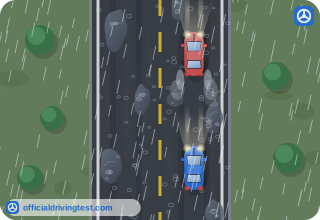
What should you do about the distance between you and the vehicle in front when driving in bad weather?
- Keep the same distance and use your headlights
- Increase it by one car length only
- Double the following distance and reduce speed
- Reduce it so you can see the road better
Show answer
Correct answer: Double the following distance and reduce speed
When driving in bad weather, double the following distance from the vehicle in front of you and reduce speed appropriately.
Source: Arizona Driver License Manual and Customer Service Guide (Revised March 2026), page 40