Arizona: Signals and vehicle controls — Part 3 Practice Test
Questions in this part include: “In the hand signals shown in the manual, how does a driver show a right turn?” · “As the light begins to fade in the late afternoon, what should you turn on?”
Independent educational site · not affiliated with any government agency or DMV
Ready? Test yourself
- Instant feedback with an explanation
- Every answer cites its source in the manual
- Your best score is saved on this device
Questions are original and based on the official manual "Arizona Driver License Manual and Customer Service Guide" (Revised March 2026), Arizona Department of Transportation Motor Vehicle Division (ADOT MVD).
All 16 questions in this practice test
Take the test above first, then use this list to study. Tap “Show answer” to see the correct answer and explanation.
Show the questions and answersHide the questions
-
In the hand signals shown in the manual, how does a driver show a right turn?
- The arm extended straight out to the side
- The arm angled downward
- The arm moving in a circle
- The arm bent with the hand pointing upward
Show answer
Correct answer: The arm bent with the hand pointing upward
The manual's hand-signal picture labeled RIGHT TURN shows the driver's arm bent upward.
Source: Arizona Driver License Manual and Customer Service Guide (Revised March 2026), page 27
-
In the hand signals shown in the manual, how does a driver show a left turn?
- The arm bent with the hand pointing upward
- The arm angled downward
- The arm extended straight out to the side
- The arm moving in a circle
Show answer
Correct answer: The arm extended straight out to the side
The manual's hand-signal picture labeled LEFT TURN shows the driver's arm held straight out.
Source: Arizona Driver License Manual and Customer Service Guide (Revised March 2026), page 27
-
In the hand signals shown in the manual, how does a driver show slow down or stop?
- The arm angled downward
- The arm extended straight out to the side
- The arm bent with the hand pointing upward
- The arm moving in a circle
Show answer
Correct answer: The arm angled downward
The manual's hand-signal picture labeled SLOW DOWN/ STOP shows the driver's arm pointing downward.
Source: Arizona Driver License Manual and Customer Service Guide (Revised March 2026), page 27
-
Why is backing up or reversing your car dangerous?
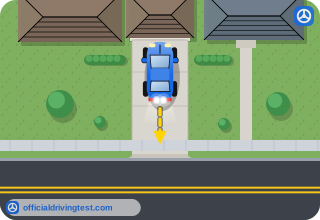
- Cars have less steering control in reverse
- Brake lights do not work in reverse
- Other drivers expect you to move forward only
- It is hard for you to see behind you
Show answer
Correct answer: It is hard for you to see behind you
The manual says backing up is dangerous because it is hard for you to see behind you.
Source: Arizona Driver License Manual and Customer Service Guide (Revised March 2026), page 30
-
Before you get into your car to back it up, what should you do?
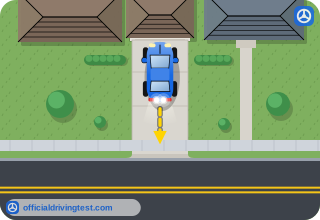
- Check behind the car, since children or small objects are hard to see
- Check that the engine is warm and that the parking brake is already on
- Make sure the rear window is clean and that both mirrors are adjusted
- Check the tire pressure on the rear wheels and the lights on the trunk
Show answer
Correct answer: Check behind the car, since children or small objects are hard to see
The manual says to check behind your car before you get in because children or small objects are hard to see from the driver’s seat.
Source: Arizona Driver License Manual and Customer Service Guide (Revised March 2026), page 30
-
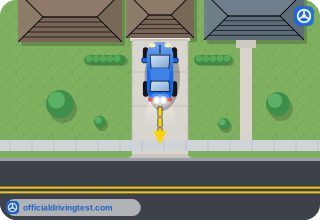
How should you look when you back your car?
- Rely mainly on your mirrors and your backup camera, without turning around
- Watch only the side mirror on the driver’s side while you back up
- Look directly through the rear window instead of depending on mirrors or backup cameras
- Look at the backup camera first and then glance at the mirrors for a moment
Show answer
Correct answer: Look directly through the rear window instead of depending on mirrors or backup cameras
The manual tells you to turn around and look directly through the rear window instead of depending on mirrors or backup cameras.
Source: Arizona Driver License Manual and Customer Service Guide (Revised March 2026), page 30
-
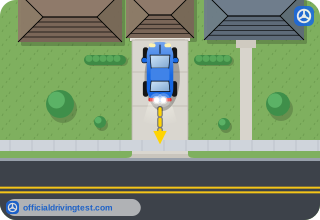
At what speed should you back your car?
- Quickly, to clear the lane sooner
- At the speed of the traffic behind you
- Slowly
- At a speed that depends on the backup camera
Show answer
Correct answer: Slowly
One of the backing rules is to back up slowly.
Source: Arizona Driver License Manual and Customer Service Guide (Revised March 2026), page 30
-
When there is sun glare, rain, dust or any other condition that makes your vehicle hard to see, what should you do with your headlights?
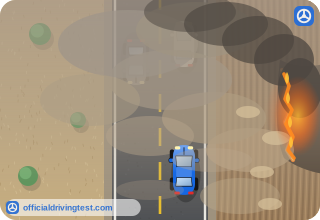
- Turn on your high beams
- Use only your parking lights
- Turn them on, using low beam
- Leave them off in daylight
Show answer
Correct answer: Turn them on, using low beam
You turn on your headlights on low beam so other drivers can see you.
Source: Arizona Driver License Manual and Customer Service Guide (Revised March 2026), page 57
-
How do your headlights help on rural roads in low visibility?
- They show you the road edge much farther ahead
- They help drivers who may pass in your lane see you
- They let you see animals sooner than in daylight
- They warn slow farm equipment ahead to move over
Show answer
Correct answer: They help drivers who may pass in your lane see you
On rural roads, headlights help drivers who may consider passing in your lane see that you are approaching.
Source: Arizona Driver License Manual and Customer Service Guide (Revised March 2026), page 57
-
As the light begins to fade in the late afternoon, what should you turn on?
- Your parking lights only, to save the battery
- Your high beams, to see farther
- Your hazard flashers, to warn others
- Your headlights, not your parking lights
Show answer
Correct answer: Your headlights, not your parking lights
You turn on your headlights, not parking lights, to make your vehicle more visible to others.
Source: Arizona Driver License Manual and Customer Service Guide (Revised March 2026), page 57
-
When must you use headlights?
- From sunset to sunrise
- From sunset to midnight
- From one hour after sunset to sunrise
- Only when there are no street lights
Show answer
Correct answer: From sunset to sunrise
The manual says you must use headlights from sunset to sunrise.
Source: Arizona Driver License Manual and Customer Service Guide (Revised March 2026), page 57
-
Which beams should you use when driving on city or town streets?
- High beams
- Low beams
- Parking lights
- Fog lights
Show answer
Correct answer: Low beams
The manual says to use low beams on city or town streets.
Source: Arizona Driver License Manual and Customer Service Guide (Revised March 2026), page 57
-
You may use high beams on highways when no other vehicle is coming toward you within what distance?
- 200 feet
- 300 feet
- 1,000 feet
- 500 feet
Show answer
Correct answer: 500 feet
Use high beams on highways when no other vehicle is coming toward you within 500 feet.
Source: Arizona Driver License Manual and Customer Service Guide (Revised March 2026), page 57
-
Why should you switch to low beams when you meet oncoming traffic?
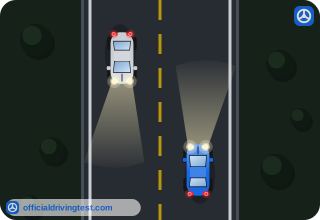
- To avoid blinding the other driver
- To see the road edge better
- To save headlight bulbs
- To signal the other driver to dim
Show answer
Correct answer: To avoid blinding the other driver
You switch to low beams whenever you meet oncoming traffic to avoid blinding the other driver.
Source: Arizona Driver License Manual and Customer Service Guide (Revised March 2026), page 57
-
When following another car, you should use low beams whenever you are within what distance?
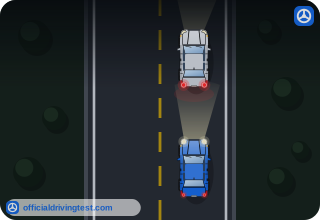
- 100 feet
- 300 feet
- 200 feet
- 500 feet
Show answer
Correct answer: 200 feet
When following another car, use low beams whenever you are within 200 feet.
Source: Arizona Driver License Manual and Customer Service Guide (Revised March 2026), page 57
-
If the high beams of an oncoming car are not dimmed, where should you glance?
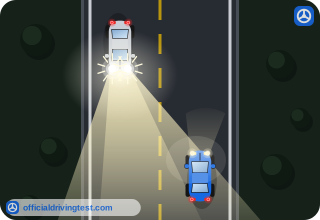
- Toward the center line
- Toward the right side of the road
- Directly at the bright lights
- Toward the left shoulder
Show answer
Correct answer: Toward the right side of the road
You avoid looking directly at the bright lights and glance toward the right side of the road.
Source: Arizona Driver License Manual and Customer Service Guide (Revised March 2026), page 57