Arizona: Signals and vehicle controls — Part 1 Practice Test
Questions in this part include: “Which of these must be in working order before you drive?” · “What brakes must cars and trucks have?”
Independent educational site · not affiliated with any government agency or DMV
Ready? Test yourself
- Instant feedback with an explanation
- Every answer cites its source in the manual
- Your best score is saved on this device
Questions are original and based on the official manual "Arizona Driver License Manual and Customer Service Guide" (Revised March 2026), Arizona Department of Transportation Motor Vehicle Division (ADOT MVD).
All 16 questions in this practice test
Take the test above first, then use this list to study. Tap “Show answer” to see the correct answer and explanation.
Show the questions and answersHide the questions
-
Which of these must be in working order before you drive?
- Speedometer
- Air conditioning
- Cruise control
- Radio
Show answer
Correct answer: Speedometer
The manual lists the speedometer among the equipment that must be in working order.
Source: Arizona Driver License Manual and Customer Service Guide (Revised March 2026), page 19
-
Before putting the vehicle in motion, what should you check to make sure they are in working order?
- Your radio and air conditioning
- Your cruise control and clock
- Your turn signals and brakes
- Your heater and washer fluid
Show answer
Correct answer: Your turn signals and brakes
The manual says to check your turn signals and brakes before the vehicle is put in motion.
Source: Arizona Driver License Manual and Customer Service Guide (Revised March 2026), page 19
-
Prior to starting your vehicle, what should you adjust?
- Your seat, headlights, windshield wipers and horn
- Your seat, steering wheel, rear view and outside mirrors
- Your seat belt, tire pressure and engine idle speed
- Your seat, the radio volume and the cruise control
Show answer
Correct answer: Your seat, steering wheel, rear view and outside mirrors
The manual says to adjust your seat, steering wheel, rear view and outside mirrors before starting the vehicle.
Source: Arizona Driver License Manual and Customer Service Guide (Revised March 2026), page 19
-
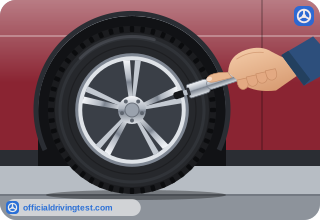
Where is the recommended tire pressure (psi) for your vehicle typically found?
- Under the hood on the battery
- On the back of the rear license plate
- Inside the glove box lid
- On the door jamb
Show answer
Correct answer: On the door jamb
The manual says the recommended psi is typically on the door jamb.
Source: Arizona Driver License Manual and Customer Service Guide (Revised March 2026), page 19
-
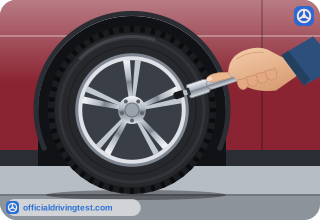
After you check your tire pressure with a gauge, what should you do if the reading is not the recommended one?
- Replace the tire right away
- Leave it until the next free inspection
- Only add air, never let air out
- Add air or let it out as needed
Show answer
Correct answer: Add air or let it out as needed
The manual says to use a gauge and either add air or let it out as needed.
Source: Arizona Driver License Manual and Customer Service Guide (Revised March 2026), page 19
-
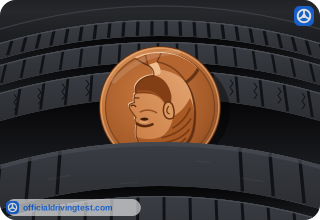
For the penny test of your tire tread, where on the tire should you place the penny?
- Where the tread appears to be highest
- Where the tread appears to be lowest
- On the sidewall of the tire
- Beside the tire valve stem
Show answer
Correct answer: Where the tread appears to be lowest
The manual says to select a point where the tread appears lowest and place Lincoln's head in a groove.
Source: Arizona Driver License Manual and Customer Service Guide (Revised March 2026), page 19
-
In the penny test, what should you see if your tire tread is still good?
- Part of Lincoln's head covered by the tread
- All of Lincoln's head showing above the tread
- Only the edge of the penny touching the tread
- The tread worn flat against the penny
Show answer
Correct answer: Part of Lincoln's head covered by the tread
The manual says part of Lincoln's head should be covered by the tread; if not, it may be time to replace your tires.
Source: Arizona Driver License Manual and Customer Service Guide (Revised March 2026), page 19
-
If a vehicle does not pass an emission inspection, how long are you given to have the problem fixed and have a follow-up emission test re-check?
- 10 days
- 60 days
- 90 days
- 30 days
Show answer
Correct answer: 30 days
The manual gives 30 days to fix the problem and have a follow-up emission test re-check.
Source: Arizona Driver License Manual and Customer Service Guide (Revised March 2026), page 21
-
Who is responsible for making certain that a vehicle is safe to operate?
- The vehicle's registered owner only
- The driver
- The emission inspection station
- The Motor Vehicle Division
Show answer
Correct answer: The driver
The manual says it is the responsibility of drivers to make certain the vehicles they drive are safe to operate.
Source: Arizona Driver License Manual and Customer Service Guide (Revised March 2026), page 21
-
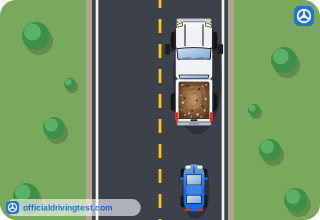
What does Arizona law require about the load of a vehicle driven on a highway, street or roadway?
- The vehicle must be built or loaded so no load can escape from it
- Only trailers, not trucks, must secure their load
- Loads must be secured only on highways, not on streets
- Loads only need to be covered when carrying loose dirt or sand
Show answer
Correct answer: The vehicle must be built or loaded so no load can escape from it
The law quoted in the manual requires the vehicle to be constructed or loaded to prevent any of its load from dropping, sifting, leaking or otherwise escaping.
Source: Arizona Driver License Manual and Customer Service Guide (Revised March 2026), page 21
-
What brakes must cars and trucks have?
- A foot brake only
- A parking brake only
- Both a foot brake and a parking brake
- A foot brake and a hand-operated air brake
Show answer
Correct answer: Both a foot brake and a parking brake
The manual says cars and trucks must have both a foot brake and a parking brake.
Source: Arizona Driver License Manual and Customer Service Guide (Revised March 2026), page 21
-
Each set of brakes on a motor vehicle must apply to at least how many wheels?
- One
- Three
- Two
- Four
Show answer
Correct answer: Two
The manual says each set of brakes must apply to at least two wheels.
Source: Arizona Driver License Manual and Customer Service Guide (Revised March 2026), page 21
-
What is the minimum brake requirement for a motorcycle?
- At least one brake, applied by hand or foot
- A foot brake and a separate parking brake, like a car
- At least two brakes, with one applied to each wheel
- One brake, and it must be applied by foot only
Show answer
Correct answer: At least one brake, applied by hand or foot
The manual says a motorcycle must have at least one brake that may be applied by hand or foot.
Source: Arizona Driver License Manual and Customer Service Guide (Revised March 2026), page 21
-
What is a motor vehicle's muffler required to prevent?
- Engine overheating and oil leaks
- Fuel from evaporating in hot weather
- Tire wear and brake fade
- Excessive pollution or unusual noise
Show answer
Correct answer: Excessive pollution or unusual noise
The manual says the muffler must be in good working condition and in constant operation to prevent excessive pollution or unusual noise.
Source: Arizona Driver License Manual and Customer Service Guide (Revised March 2026), page 22
-
What does the manual say about using a muffler "cut-out," bypass or similar device?
- It is against the law
- It is legal if it is switched off in town
- It is legal when used only on motorcycles
- It is legal if the vehicle passes inspection
Show answer
Correct answer: It is against the law
The manual states it is against the law to use a muffler cut-out, bypass or similar device.
Source: Arizona Driver License Manual and Customer Service Guide (Revised March 2026), page 22
-
Motor vehicles of what model year and newer must be equipped with an exhaust emissions system?
- 1972
- 1975
- 1967
- 1980
Show answer
Correct answer: 1967
The manual says motor vehicles of 1967 model year and newer must have an exhaust emissions system.
Source: Arizona Driver License Manual and Customer Service Guide (Revised March 2026), page 22