Arizona: Seat belts and child safety Practice Test
Seat belt rules, child safety seats, booster seats and air bags.
Independent educational site · not affiliated with any government agency or DMV
Ready? Test yourself
- Instant feedback with an explanation
- Every answer cites its source in the manual
- Your best score is saved on this device
Questions are original and based on the official manual "Arizona Driver License Manual and Customer Service Guide" (Revised March 2026), Arizona Department of Transportation Motor Vehicle Division (ADOT MVD).
All 15 questions in this practice test
Take the test above first, then use this list to study. Tap “Show answer” to see the correct answer and explanation.
Show the questions and answersHide the questions
-
If only a lap belt is installed where a front seat occupant sits, what does the law require?
- No belt is required because that seat has no shoulder belt installed
- The occupant must move to a seat that has a lap and shoulder belt
- The lap belt must be properly adjusted and fastened while moving
- The belt is required only when the vehicle is traveling on a highway
Show answer
Correct answer: The lap belt must be properly adjusted and fastened while moving
The manual requires the lap belt to be properly adjusted and fastened while the vehicle is in motion.
Source: Arizona Driver License Manual and Customer Service Guide (Revised March 2026), page 19
-
Who must the operator of a motor vehicle require to buckle up?
- All passengers under the age of 18
- Only the passengers sitting in the front seat
- All passengers under the age of 16
- Only passengers under the age of 12
Show answer
Correct answer: All passengers under the age of 16
The operator must require all passengers under the age of 16 to buckle up.
Source: Arizona Driver License Manual and Customer Service Guide (Revised March 2026), page 19
-
What does the lap belt of a combination lap/shoulder belt do in a crash?
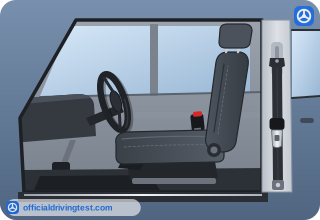
- It prevents ejection and protects your lower body
- It keeps your head and chest from striking the windshield
- It reduces whiplash injury in rear-end crashes
- It keeps the air bag from opening too hard
Show answer
Correct answer: It prevents ejection and protects your lower body
The manual says the lap belt prevents ejection and protects your lower body.
Source: Arizona Driver License Manual and Customer Service Guide (Revised March 2026), page 19
-
What does the shoulder belt of a combination lap/shoulder belt do in a crash?
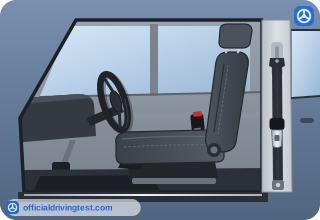
- It prevents ejection and protects your lower body and legs
- It reduces whiplash injury to the neck in rear-end crashes
- It makes wearing the lap belt completely unnecessary
- It keeps your head and chest from striking the dashboard
Show answer
Correct answer: It keeps your head and chest from striking the dashboard
The manual says the shoulder belt keeps your head and chest from striking the dashboard or windshield.
Source: Arizona Driver License Manual and Customer Service Guide (Revised March 2026), page 20
-
In vehicles with automatic shoulder belts and manual lap belts, what is extremely important?
- Adjusting the shoulder belt higher
- Buckling the lap belt
- Turning off the front air bag
- Keeping the shoulder belt loose
Show answer
Correct answer: Buckling the lap belt
The manual says it is extremely important to buckle the lap belt in such vehicles.
Source: Arizona Driver License Manual and Customer Service Guide (Revised March 2026), page 20
-
In the "4 Steps for Kids" picture with four seats (infant, toddler, booster, safety belt), which step is shown for kids age 5 to 8?
- Booster seat
- Infant seat
- Toddler seat
- Safety belt
Show answer
Correct answer: Booster seat
The picture states that kids age 5 to 8 need booster seats.
Source: Arizona Driver License Manual and Customer Service Guide (Revised March 2026), page 20
-
When a driver transports more than one child under eight years of age, how many of them must be secured in child restraint systems?
- Only the youngest child, no matter how many are riding
- Every child, even if some must be held by an adult
- As many as reasonable given the passenger area and passengers
- Only the children who are riding in the back seat of the car
Show answer
Correct answer: As many as reasonable given the passenger area and passengers
The manual says as many children as reasonable given the size of the passenger area and number of passengers.
Source: Arizona Driver License Manual and Customer Service Guide (Revised March 2026), page 20
-
What safety standards must child restraint systems meet?
- U.S. Department of Transportation safety standards
- ADOT MVD vehicle inspection standards
- Standards set by each car dealer
- Governor's Office of Highway Safety standards
Show answer
Correct answer: U.S. Department of Transportation safety standards
The manual says child restraint systems must meet U.S. Department of Transportation safety standards.
Source: Arizona Driver License Manual and Customer Service Guide (Revised March 2026), page 20
-
How must child restraint systems be used?
- By following only the instructions printed in this manual
- By following the instructions of the vehicle's front passenger
- By following the manufacturer's and automobile manufacturer's instructions
- By adjusting them to whatever position seems most comfortable
Show answer
Correct answer: By following the manufacturer's and automobile manufacturer's instructions
The manual says they must be used by following the manufacturer's and the automobile manufacturer's instructions.
Source: Arizona Driver License Manual and Customer Service Guide (Revised March 2026), page 20
-
If a child must ride in the front seat of a car, what should you do with the front passenger-side air bag?
- Leave it on
- Turn it off
- Disconnect the battery
- Move the seat all the way forward
Show answer
Correct answer: Turn it off
The manual says to turn the front passenger-side air bag off if a child must ride in the front seat.
Source: Arizona Driver License Manual and Customer Service Guide (Revised March 2026), page 20
-
Up to what age should children never ride in the front seat of a car?
- 5 years and under
- 8 years and under
- 16 years and under
- 12 years and under
Show answer
Correct answer: 12 years and under
The manual says children age 12 years and under should never ride in the front seat of a car.
Source: Arizona Driver License Manual and Customer Service Guide (Revised March 2026), page 20
-
How should adjustable seat-back head restraints be positioned?
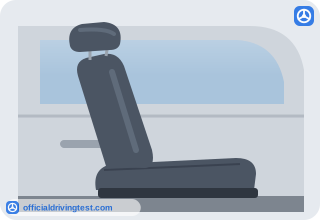
- Fully lowered so they rest against your shoulders
- Against the back of your head, level with mid-ear
- Raised above your head so they line up with its top
- Tilted forward and lined up with the base of your neck
Show answer
Correct answer: Against the back of your head, level with mid-ear
The manual says adjustable head restraints should fit against the back of your head and line up with the middle of the ear.
Source: Arizona Driver License Manual and Customer Service Guide (Revised March 2026), page 22
-
What are seat-back head restraints designed to reduce?
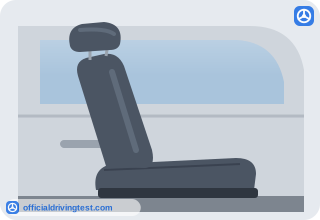
- The chance of ejection in a rollover crash
- The chance of whiplash injury in rear-end crashes
- The glare of headlights from vehicles behind you
- The strain on your neck during sharp turns
Show answer
Correct answer: The chance of whiplash injury in rear-end crashes
The manual says seat-back head restraints are designed to reduce the chance of whiplash injury in rear-end crashes.
Source: Arizona Driver License Manual and Customer Service Guide (Revised March 2026), page 22
-
Which of these is listed as a habit of defensive driving?
- Follow the vehicle ahead closely to keep pace
- Keep your eyes on the vehicle directly ahead only
- Always wear your safety belt
- Use your horn to clear traffic ahead
Show answer
Correct answer: Always wear your safety belt
Always wearing your safety belt is one of the defensive driving habits the manual lists.
Source: Arizona Driver License Manual and Customer Service Guide (Revised March 2026), page 23
-
What is the best thing you can do to protect yourself from injury in a crash?
- Keep your windows closed and doors locked
- Always wear your safety belt
- Hold the steering wheel with both hands
- Drive at night only when traffic is light
Show answer
Correct answer: Always wear your safety belt
The manual says always wearing your safety belts is the best protection from injury in a crash.
Source: Arizona Driver License Manual and Customer Service Guide (Revised March 2026), page 69