Arizona: Parking rules Practice Test
Where parking is illegal, parking on hills, disability parking and emergency parking.
Independent educational site · not affiliated with any government agency or DMV
Ready? Test yourself
- Instant feedback with an explanation
- Every answer cites its source in the manual
- Your best score is saved on this device
Questions are original and based on the official manual "Arizona Driver License Manual and Customer Service Guide" (Revised March 2026), Arizona Department of Transportation Motor Vehicle Division (ADOT MVD).
All 28 questions in this practice test
Take the test above first, then use this list to study. Tap “Show answer” to see the correct answer and explanation.
Show the questions and answersHide the questions
-
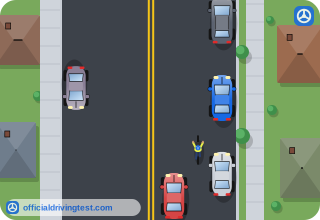
What must you be sure of when you park on a public roadway?
- That your engine is left running and your hazard lights are on while you are away
- That your vehicle is facing the oncoming traffic on the left side of the street
- That you are not in the way of traffic, obstructing visibility or in an illegal parking zone
- That your front wheels are turned out into the traffic lane in case you need to leave
Show answer
Correct answer: That you are not in the way of traffic, obstructing visibility or in an illegal parking zone
The manual says to be sure you are not in the way of traffic, obstructing visibility or in an illegal parking zone.
Source: Arizona Driver License Manual and Customer Service Guide (Revised March 2026), page 29
-
Who may use a parking space marked with the international symbol of access?
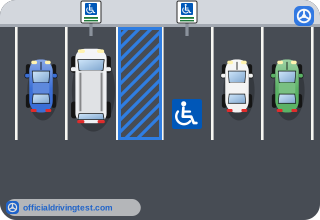
- Only a vehicle displaying a valid placard or plate with the symbol, and only when transporting the person it was issued to
- Any vehicle displaying a valid placard or plate with the symbol, even when the person it was issued to is not being transported
- Any vehicle, as long as the driver stays with the vehicle at all times
- Any vehicle carrying a passenger who is an older adult, with or without a placard
Show answer
Correct answer: Only a vehicle displaying a valid placard or plate with the symbol, and only when transporting the person it was issued to
These spaces are only for a vehicle displaying a valid placard or plate with the symbol, and only when transporting the person who was issued it.
Source: Arizona Driver License Manual and Customer Service Guide (Revised March 2026), page 30
-
What may result if someone who is not entitled to use it parks in a space marked with the international symbol of access?
- A written warning only
- A fine
- Suspension of the vehicle registration
- Required attendance at Traffic Survival School
Show answer
Correct answer: A fine
The manual says it is illegal for anyone else to park in these spaces and it may result in a fine.
Source: Arizona Driver License Manual and Customer Service Guide (Revised March 2026), page 30
-
What is the key to completing the parallel parking maneuver?
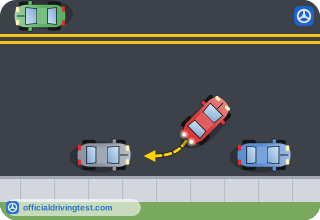
- Your ability to judge distances while controlling the speed of your vehicle
- Turning the steering wheel as sharply as possible at every stage
- Keeping your hazard lights on throughout the whole maneuver
- Leaving as much space as possible behind the parked car and the curb
Show answer
Correct answer: Your ability to judge distances while controlling the speed of your vehicle
The manual says judging distances while controlling vehicle speed is the key to parallel parking.
Source: Arizona Driver License Manual and Customer Service Guide (Revised March 2026), page 30
-
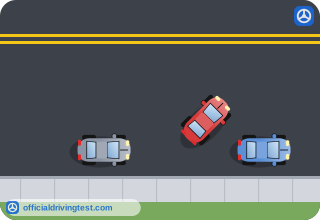
When parallel parking, what should you continually check for?
- Pedestrians on the sidewalk only
- The distance to the curb ahead of the forward car
- Overhead clearance
- Oncoming traffic
Show answer
Correct answer: Oncoming traffic
The manual says to be sure to continually check for oncoming traffic when parallel parking.
Source: Arizona Driver License Manual and Customer Service Guide (Revised March 2026), page 30
-
What is the first step to parallel park correctly?
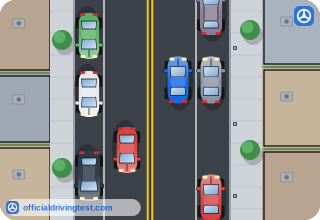
- Shift into reverse and turn the wheel to the right
- Check traffic behind you and signal that you are stopping
- Turn the wheels toward the curb and set the parking brake
- Pull up directly behind the space and straighten the wheels
Show answer
Correct answer: Check traffic behind you and signal that you are stopping
The first step is to check traffic behind you and signal that you are stopping.
Source: Arizona Driver License Manual and Customer Service Guide (Revised March 2026), page 30
-
When you stop alongside the forward car to parallel park, how much space should you leave between you and that car?
- Approximately two feet
- Approximately six inches
- Approximately five feet
- Approximately ten feet
Show answer
Correct answer: Approximately two feet
The manual says to leave approximately two feet between you and the forward car.
Source: Arizona Driver License Manual and Customer Service Guide (Revised March 2026), page 30
-
When you stop alongside the forward car to parallel park, where should your car’s back bumper line up?
- With the front bumper of the parked vehicle
- With the rear wheel of the parked vehicle
- With the back bumper of the parked vehicle
- A full car length behind the parked vehicle
Show answer
Correct answer: With the back bumper of the parked vehicle
You stop when your car’s back bumper lines up with the back bumper of the parked vehicle.
Source: Arizona Driver License Manual and Customer Service Guide (Revised March 2026), page 30
-
After shifting into reverse to parallel park, how do you begin backing up?
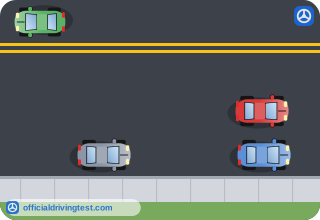
- Look over your left shoulder and back up slowly while turning the wheel sharply to the left
- Look over your right shoulder and back up slowly while turning the wheel sharply to the right
- Back up with the wheels straight until your front bumper passes the forward car
- Look in your mirrors only and back up at a moderate speed with the wheel turned left
Show answer
Correct answer: Look over your right shoulder and back up slowly while turning the wheel sharply to the right
You look over your right shoulder and back up slowly while turning the wheel sharply to the right.
Source: Arizona Driver License Manual and Customer Service Guide (Revised March 2026), page 30
-
In parallel parking, when do you turn the wheel sharply to the left?
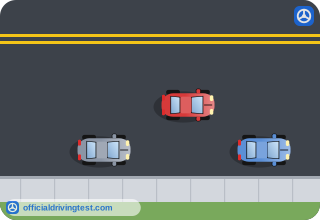
- When your back bumper touches the curb behind the space
- As soon as you shift into reverse and begin to back up
- When your car is about two feet from the curb
- When your front bumper passes the rear bumper of the forward car
Show answer
Correct answer: When your front bumper passes the rear bumper of the forward car
Once your front bumper passes the rear bumper of the forward car, you turn the wheel sharply to the left and keep backing until parallel to the curb.
Source: Arizona Driver License Manual and Customer Service Guide (Revised March 2026), page 30
-
After you are parallel to the curb in parallel parking, what is the last step?
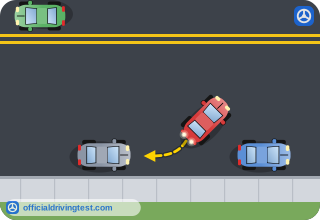
- Turn the wheels sharply to the right and pull forward
- Leave the wheels turned to the left and shift to park
- Back up another car length
- Straighten the wheels and slowly pull forward
Show answer
Correct answer: Straighten the wheels and slowly pull forward
The final step is to straighten the wheels and slowly pull forward.
Source: Arizona Driver License Manual and Customer Service Guide (Revised March 2026), page 30
-
When you park on a downhill grade, what should you do?
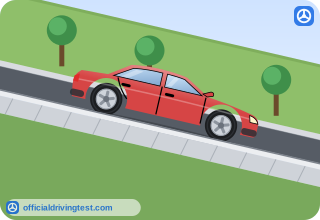
- Turn your wheels away from the curb and set your parking brake
- Turn your wheels toward the curb and set your parking brake
- Turn your wheels to the left and shift into neutral
- Leave your wheels straight and set your parking brake
Show answer
Correct answer: Turn your wheels toward the curb and set your parking brake
On a downhill grade you turn your wheels toward the curb and set your parking brake.
Source: Arizona Driver License Manual and Customer Service Guide (Revised March 2026), page 30
-
When you park on an uphill grade with a curb, what should you do?
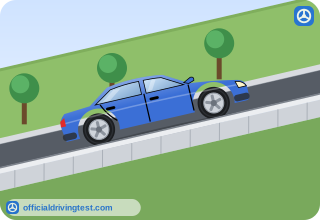
- Turn your wheels to the right and let the car roll forward until the left front wheel touches the curb
- Turn your wheels toward the curb and leave the car in neutral
- Turn your wheels to the left and let the car roll back until the right front wheel rests against the curb
- Leave your wheels straight and set the parking brake
Show answer
Correct answer: Turn your wheels to the left and let the car roll back until the right front wheel rests against the curb
On an uphill grade you turn your wheels to the left and let the car roll back until the right front wheel rests against the curb and stops.
Source: Arizona Driver License Manual and Customer Service Guide (Revised March 2026), page 30
-
When you park on a hill and there is no curb, which way should you turn the wheels?
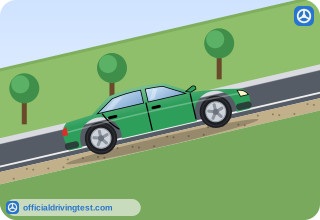
- To the right, so the car rolls away from the center of the road if the brakes fail
- To the left, so the car rolls toward the center of the road if the brakes fail
- Straight ahead, so the car will not roll at all
- Toward the curb line, whichever side that is
Show answer
Correct answer: To the right, so the car rolls away from the center of the road if the brakes fail
With no curb, you turn the wheels to the right so the car will roll away from the center of the road if the brakes fail.
Source: Arizona Driver License Manual and Customer Service Guide (Revised March 2026), page 30
-
When you park on a hill, which step must you always take?
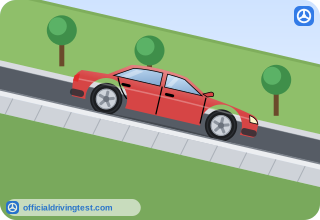
- Leave the car in neutral
- Set your parking brake
- Turn the wheels to the left
- Leave your hazard lights on
Show answer
Correct answer: Set your parking brake
The manual says to always set your parking brake when parking on a hill.
Source: Arizona Driver License Manual and Customer Service Guide (Revised March 2026), page 30
-
Which of these is a place where it is illegal to park?
- In a legal space along an unpainted curb, clear of driveways and hydrants
- On a sidewalk
- In a marked space in a parking lot
- On a street 30 feet from a crosswalk
Show answer
Correct answer: On a sidewalk
Parking on a sidewalk is on the manual’s list of illegal parking places.
Source: Arizona Driver License Manual and Customer Service Guide (Revised March 2026), page 31
-
Which of these is a place where it is illegal to park?
- In front of a private or public driveway
- At a curb 25 feet from a fire hydrant
- Beside a curb 60 feet from a railroad crossing
- In a legal space along an unpainted curb with no hazard to others
Show answer
Correct answer: In front of a private or public driveway
Parking in front of a private or public driveway is illegal.
Source: Arizona Driver License Manual and Customer Service Guide (Revised March 2026), page 31
-
Which of these is a place where it is illegal to park?
- At a curb 30 feet from a crosswalk at an intersection
- In a marked space in a parking lot
- Within the boundaries of an intersection
- In a legal space beside a curb clear of any hazard
Show answer
Correct answer: Within the boundaries of an intersection
Parking within the boundaries of an intersection is illegal.
Source: Arizona Driver License Manual and Customer Service Guide (Revised March 2026), page 31
-
It is illegal to park on a crosswalk or within how many feet of a crosswalk at an intersection?
- 5 feet
- 20 feet
- 10 feet
- 30 feet
Show answer
Correct answer: 20 feet
The manual says it is illegal to park on a crosswalk or within 20 feet of a crosswalk at an intersection.
Source: Arizona Driver License Manual and Customer Service Guide (Revised March 2026), page 31
-
On which roads is it illegal to park, except for an emergency?
- Any two-lane rural highway
- Any street with a posted limit over 35 mph
- Any road with a paved shoulder
- Any freeway or interstate highway
Show answer
Correct answer: Any freeway or interstate highway
It is illegal to park on any freeway or interstate highway except for an emergency.
Source: Arizona Driver License Manual and Customer Service Guide (Revised March 2026), page 31
-
It is illegal to park within how many feet of a fire hydrant?
- 5 feet
- 10 feet
- 25 feet
- 15 feet
Show answer
Correct answer: 15 feet
The manual says it is illegal to park within 15 feet of a fire hydrant.
Source: Arizona Driver License Manual and Customer Service Guide (Revised March 2026), page 31
-
It is illegal to park within how many feet of a railroad crossing?
- 25 feet
- 50 feet
- 75 feet
- 150 feet
Show answer
Correct answer: 50 feet
The manual says it is illegal to park within 50 feet of a railroad crossing.
Source: Arizona Driver License Manual and Customer Service Guide (Revised March 2026), page 31
-
Which of these is a place where it is illegal to park?
- Beside an unpainted curb 30 feet from a fire hydrant
- In a legal space beside a curb with no signs
- On a bridge or within a tunnel
- Beside a curb 60 feet from a railroad crossing
Show answer
Correct answer: On a bridge or within a tunnel
Parking on a bridge or within a tunnel is illegal.
Source: Arizona Driver License Manual and Customer Service Guide (Revised March 2026), page 31
-
Which of these is a place where it is illegal to park?
- In such a way that you create a hazard for other vehicles
- In a legal space beside a curb where no signs prohibit parking
- Next to a curb that is 25 feet from a fire hydrant
- In a parking lot space that does not block any traffic at all
Show answer
Correct answer: In such a way that you create a hazard for other vehicles
It is illegal to park in such a way that you create a hazard for other vehicles.
Source: Arizona Driver License Manual and Customer Service Guide (Revised March 2026), page 31
-
What does a painted curb mean?
- Parking is free there at all times
- Special rules apply to parking there
- Parking there is allowed only at night
- The curb belongs to a private owner
Show answer
Correct answer: Special rules apply to parking there
A painted curb means special parking rules apply.
Source: Arizona Driver License Manual and Customer Service Guide (Revised March 2026), page 45
-
What does a white painted curb allow?
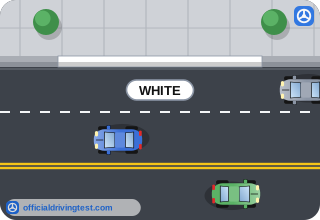
- Parking for up to one hour at a time
- Stopping only long enough to load or unload cargo
- No stopping, standing or parking of any kind
- Stopping only to pick up or drop off passengers
Show answer
Correct answer: Stopping only to pick up or drop off passengers
White curbs permit stopping only to pick up or drop off passengers.
Source: Arizona Driver License Manual and Customer Service Guide (Revised March 2026), page 46
-
What does a yellow painted curb allow?
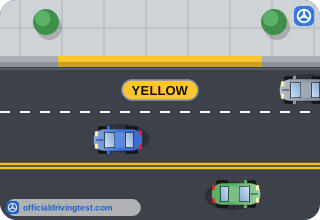
- Stopping only to load or unload, staying with your car
- Stopping only to pick up or drop off passengers
- Parking as long as you leave the vehicle locked
- No stopping, standing or parking of any kind
Show answer
Correct answer: Stopping only to load or unload, staying with your car
Yellow curbs permit stopping only long enough to load or unload, and the driver stays with the car.
Source: Arizona Driver License Manual and Customer Service Guide (Revised March 2026), page 46
-
What does a red painted curb mean?
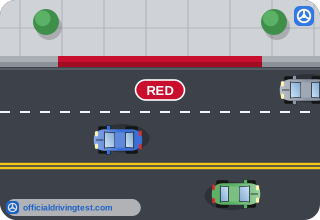
- You may stop only to load or unload
- You may stop only to pick up passengers
- You may not stop, stand or park
- You may park for a short time
Show answer
Correct answer: You may not stop, stand or park
Red curbs allow no stopping, standing or parking.
Source: Arizona Driver License Manual and Customer Service Guide (Revised March 2026), page 46