Arizona: Emergencies — Part 4 Practice Test
Questions in this part include: “If pumping does not stop a vehicle without antilock brakes, how should you apply the parking brake?”
Independent educational site · not affiliated with any government agency or DMV
Ready? Test yourself
- Instant feedback with an explanation
- Every answer cites its source in the manual
- Your best score is saved on this device
Questions are original and based on the official manual "Arizona Driver License Manual and Customer Service Guide" (Revised March 2026), Arizona Department of Transportation Motor Vehicle Division (ADOT MVD).
All 17 questions in this practice test
Take the test above first, then use this list to study. Tap “Show answer” to see the correct answer and explanation.
Show the questions and answersHide the questions
-
If your power steering fails and your vehicle has power brakes, how hard should you push the brakes to stop the car?
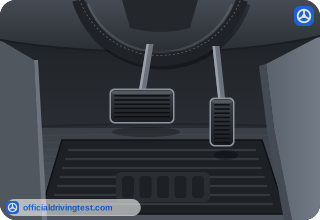
- Very lightly
- In short, quick taps
- Extra hard
- Only after shifting to neutral
Show answer
Correct answer: Extra hard
The manual says to push the brakes extra hard if your vehicle has power brakes.
Source: Arizona Driver License Manual and Customer Service Guide (Revised March 2026), page 69
-
What can you try first if your headlights fail?
- Turn on the interior dome light
- Try the high beam/low beam switch
- Pull off immediately and turn the engine off
- Tap the headlight lenses with your hand
Show answer
Correct answer: Try the high beam/low beam switch
The first step the manual gives is the high beam/low beam switch, which may restore normal function.
Source: Arizona Driver License Manual and Customer Service Guide (Revised March 2026), page 69
-
If your headlights fail and the high beam/low beam switch does not help, what else should you try?
- Hold the headlight switch in the on position
- Switch between the headlights and the fog lights
- Keep driving slowly with the high beams on
- Turn the headlight switch on and off several times
Show answer
Correct answer: Turn the headlight switch on and off several times
The manual lists turning the headlight switch on and off several times as the next step.
Source: Arizona Driver License Manual and Customer Service Guide (Revised March 2026), page 69
-
If your headlights fail and nothing restores them, what should you do?
- Use parking lights, emergency flashers or turn signals, pull to the side and stop
- Follow the taillights of the vehicle ahead until you find a safe place
- Turn on the interior dome light and keep driving at a reduced speed
- Keep driving to the next exit with only your brake lights working
Show answer
Correct answer: Use parking lights, emergency flashers or turn signals, pull to the side and stop
The manual says to put on the parking lights, emergency flashers or turn signals, pull to the side of the road and stop.
Source: Arizona Driver License Manual and Customer Service Guide (Revised March 2026), page 69
-
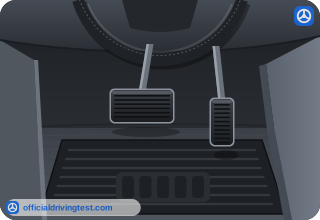
Which rule applies to vehicles equipped with antilock braking systems (ABS) when braking?
- Pump the brakes rapidly
- Apply the parking brake first
- Do not pump the brakes
- Shift to neutral before braking
Show answer
Correct answer: Do not pump the brakes
The manual states that anti-lock brakes must not be pumped.
Source: Arizona Driver License Manual and Customer Service Guide (Revised March 2026), page 69
-
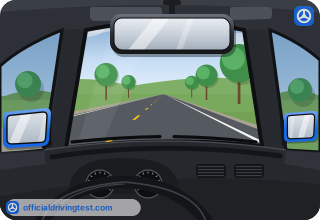
If the brakes fail on a vehicle without antilock brakes, what should you do first?
- Shift to a higher gear
- Pump the brakes rapidly
- Turn off the engine and coast
- Apply the parking brake as hard as you can
Show answer
Correct answer: Pump the brakes rapidly
The manual says to pump the brakes rapidly, which may build up enough pressure to stop the vehicle.
Source: Arizona Driver License Manual and Customer Service Guide (Revised March 2026), page 69
-
If pumping does not stop a vehicle without antilock brakes, how should you apply the parking brake?
- Quickly and fully, keeping it pulled up until the vehicle comes to a stop
- Gradually, but only after you have shifted into park or neutral gear
- Lightly, in short taps, and only while you are still in top gear
- Slowly, holding the brake release so you can ease off if the rear wheels lock
Show answer
Correct answer: Slowly, holding the brake release so you can ease off if the rear wheels lock
The manual says to apply the parking brake slowly and hold the release so you can ease off if the rear wheels lock and the car skids.
Source: Arizona Driver License Manual and Customer Service Guide (Revised March 2026), page 69
-
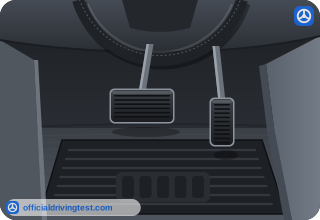
In a brake failure without antilock brakes, what should you do with the gears while looking for a safe place to stop?
- Shift to a lower gear
- Shift to a higher gear
- Shift into park
- Shift into reverse
Show answer
Correct answer: Shift to a lower gear
The manual says to shift to lower gear and look for a safe place to stop.
Source: Arizona Driver License Manual and Customer Service Guide (Revised March 2026), page 69
-
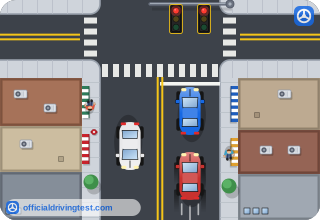
You are stopped at a traffic light and a vehicle is approaching from behind at a high rate of speed. What should you do if possible?
- Stay where you are with your foot hard on the brake
- Back up slightly so the other driver sees your reverse lights
- Pull your vehicle forward to give it more room to stop
- Turn on your hazard flashers and step out of the vehicle
Show answer
Correct answer: Pull your vehicle forward to give it more room to stop
The manual says to pull forward, if possible, to give the approaching vehicle more room to stop.
Source: Arizona Driver License Manual and Customer Service Guide (Revised March 2026), page 69
-
A vehicle is coming up fast behind you while you are stopped and the crash cannot be avoided. What should you do?
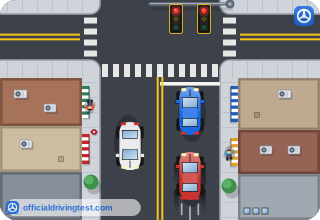
- Brace yourself and press the brake pedal as hard as you can
- Brace yourself and release your brake an instant before impact
- Keep your foot hard on the brake and look in your mirror
- Let go of the steering wheel and cover your face
Show answer
Correct answer: Brace yourself and release your brake an instant before impact
The manual says to brace yourself between the steering wheel and seat back and release your brake an instant before impact to lessen the impact.
Source: Arizona Driver License Manual and Customer Service Guide (Revised March 2026), page 69
-
If you are in danger of a potential head-on crash, how can you try to warn the other driver?
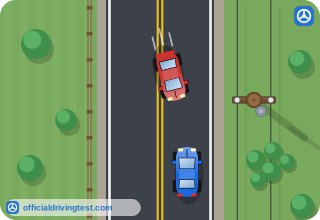
- Turn on your hazard flashers and stop in your lane
- Speed up and pull toward the center line
- Turn off your headlights and slow down
- Flash your headlights and use your horn
Show answer
Correct answer: Flash your headlights and use your horn
The manual says to reduce speed and flash your headlights and use your horn to warn the other driver.
Source: Arizona Driver License Manual and Customer Service Guide (Revised March 2026), page 69
-
In danger of a potential head-on crash, where should you steer if you can?
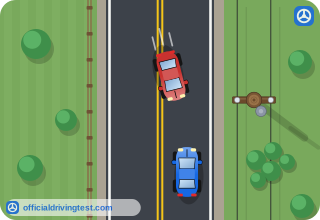
- Toward the shoulder and away from the oncoming driver
- Toward the center line to pass the oncoming driver
- Straight ahead, holding your lane
- Into the oncoming driver’s lane to go around them
Show answer
Correct answer: Toward the shoulder and away from the oncoming driver
One option the manual gives is to head for the shoulder and get off the road away from the oncoming driver.
Source: Arizona Driver License Manual and Customer Service Guide (Revised March 2026), page 69
-
If you cannot avoid a head-on crash, what should you try to do?
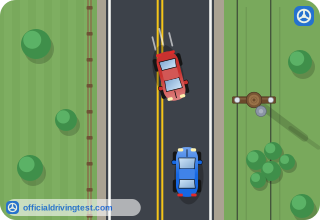
- Brake as hard as possible and hold your lane until impact
- Steer toward the center of the road
- Maneuver your vehicle to lessen the severity of the impact
- Turn off the engine and cover your face
Show answer
Correct answer: Maneuver your vehicle to lessen the severity of the impact
The manual says to try to maneuver your vehicle in such a way as to lessen the severity of impact.
Source: Arizona Driver License Manual and Customer Service Guide (Revised March 2026), page 69
-
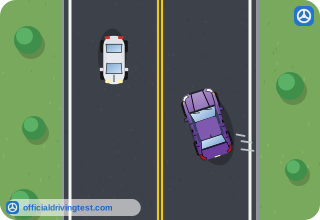
What can throw your vehicle into a skid?
- Driving on dry pavement at a slow and steady speed
- Easing off the gas pedal gradually while going straight
- Driving on a slippery surface or braking too sharply
- Using the parking lights while driving on a curve
Show answer
Correct answer: Driving on a slippery surface or braking too sharply
The manual says a slippery roadway surface or braking too sharply can throw your vehicle into a skid.
Source: Arizona Driver License Manual and Customer Service Guide (Revised March 2026), page 70
-
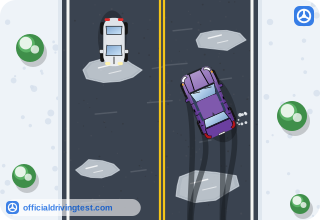
What should you do with the brake pedal when your vehicle starts to skid?
- Press it harder to regain traction
- Do not press it any further
- Press it firmly and hold it until you stop
- Release it and press the gas pedal firmly
Show answer
Correct answer: Do not press it any further
The manual says pressing the brake any further will only make the skid worse.
Source: Arizona Driver License Manual and Customer Service Guide (Revised March 2026), page 70
-
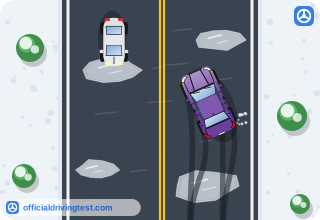
To recover from a skid, which way should you first turn the wheel?
- Slowly, away from the direction you want to go
- Quickly, away from the direction you want to go
- Hold it straight and do not turn it
- Quickly, in the direction you want your vehicle to go
Show answer
Correct answer: Quickly, in the direction you want your vehicle to go
The manual says to turn the wheel quickly in the direction you want your vehicle to follow, the direction of the skid.
Source: Arizona Driver License Manual and Customer Service Guide (Revised March 2026), page 70
-
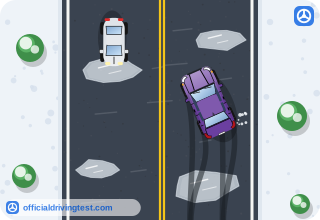
During skid recovery, why do you turn the wheel quickly back the other way as the car begins to straighten out?
- So your vehicle does not skid in the opposite direction
- So the tires can cool down while you are steering
- So the vehicle will turn around and face the other way
- So the brakes can grip the pavement again quickly
Show answer
Correct answer: So your vehicle does not skid in the opposite direction
The manual says this keeps the vehicle from skidding in the opposite direction.
Source: Arizona Driver License Manual and Customer Service Guide (Revised March 2026), page 70