Arizona: Emergencies — Part 3 Practice Test
Questions in this part include: “What can you do to reduce your chances of a tire blowout?” · “If your engine dies as you pull around a corner and you lose power steering, what should you do with the wheel?”
Independent educational site · not affiliated with any government agency or DMV
Ready? Test yourself
- Instant feedback with an explanation
- Every answer cites its source in the manual
- Your best score is saved on this device
Questions are original and based on the official manual "Arizona Driver License Manual and Customer Service Guide" (Revised March 2026), Arizona Department of Transportation Motor Vehicle Division (ADOT MVD).
All 17 questions in this practice test
Take the test above first, then use this list to study. Tap “Show answer” to see the correct answer and explanation.
Show the questions and answersHide the questions
-
What does the manual say to have in mind so you will not waste a moment if you meet a wrong-way driver?
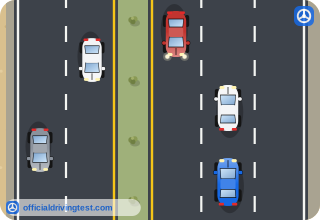
- A plan for taking emergency evasive action
- A list of nearby exits to follow the driver
- A plan to stop your vehicle in the travel lane
- A habit of driving close to the vehicle ahead
Show answer
Correct answer: A plan for taking emergency evasive action
The manual says to have a plan in mind so you can take emergency evasive action that could save your life.
Source: Arizona Driver License Manual and Customer Service Guide (Revised March 2026), page 59
-
What can you do to reduce your chances of a tire blowout?
- Rotate your tires before every trip
- Keep your tires slightly overinflated
- Check your tire pressure regularly
- Replace your tires every year
Show answer
Correct answer: Check your tire pressure regularly
The manual says you reduce your chances of a blowout by checking your tire pressure regularly.
Source: Arizona Driver License Manual and Customer Service Guide (Revised March 2026), page 68
-
If a tire blows out, how should you hold the steering wheel?
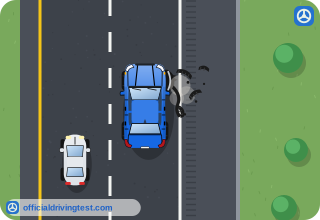
- Loosely, letting the vehicle drift to the shoulder
- Tightly, keeping the vehicle going straight
- Tightly, turning sharply toward the side of the road
- With one hand, keeping the other free for the signal
Show answer
Correct answer: Tightly, keeping the vehicle going straight
The manual says to hold the steering wheel tightly and keep your vehicle going straight.
Source: Arizona Driver License Manual and Customer Service Guide (Revised March 2026), page 68
-
After a tire blowout, what should you do with the pedals at first?
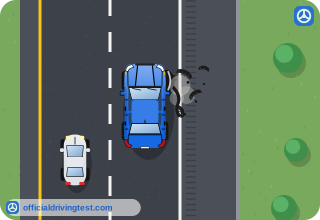
- Brake firmly to stop as soon as you possibly can
- Press the gas pedal to keep control
- Pump the brake pedal rapidly
- Ease off the gas pedal and do not apply the brakes
Show answer
Correct answer: Ease off the gas pedal and do not apply the brakes
The manual says to ease off the gas pedal and not to apply the brakes, letting the vehicle slow down.
Source: Arizona Driver License Manual and Customer Service Guide (Revised March 2026), page 68
-
When should you apply the brakes after a tire blowout?
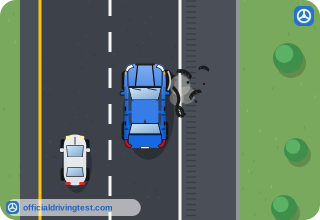
- Only after you have pulled off the roadway
- Immediately, as soon as the tire blows out
- As soon as you feel the vehicle begin to slow
- Before you activate your turn signal
Show answer
Correct answer: Only after you have pulled off the roadway
You let the vehicle slow almost to a stop, signal, pull off the roadway and only then apply the brakes.
Source: Arizona Driver License Manual and Customer Service Guide (Revised March 2026), page 68
-
Just before your vehicle stops after a tire blowout, why do you activate your turn signal?
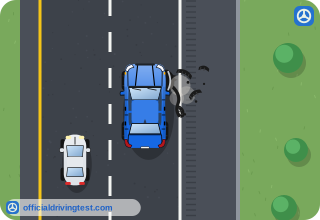
- To warn drivers behind you that you are braking hard
- To show that you plan to turn at the next intersection
- To let other drivers know you are moving to the side of the road
- To tell other drivers you are changing lanes
Show answer
Correct answer: To let other drivers know you are moving to the side of the road
The signal tells other drivers you are moving to the side of the road before you pull off.
Source: Arizona Driver License Manual and Customer Service Guide (Revised March 2026), page 68
-
What usually causes vehicle fires, according to the manual?
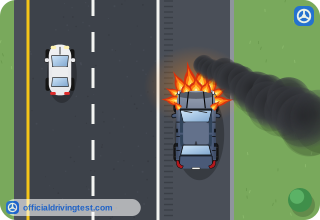
- An overfilled fuel tank that leaks gasoline
- A short circuit in the electrical system
- Worn brake pads overheating the wheels
- Tires that have overheated on the highway
Show answer
Correct answer: A short circuit in the electrical system
The manual states that fires are usually caused by a short circuit in the electrical system.
Source: Arizona Driver License Manual and Customer Service Guide (Revised March 2026), page 68
-
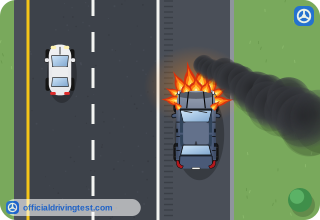
If your vehicle is on fire, what should you do with the ignition?
- Leave it on to run the cooling fan
- Leave it on so the hazard flashers keep working
- Restart it to see whether the fire goes out
- Shut it off to cut electrical power
Show answer
Correct answer: Shut it off to cut electrical power
The manual says to pull off the road and shut off the ignition to cut electrical power.
Source: Arizona Driver License Manual and Customer Service Guide (Revised March 2026), page 68
-
Which type of extinguisher does the manual say is best for vehicle fires?
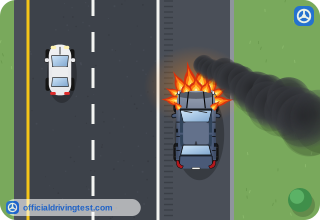
- An ABC rated dry chemical extinguisher
- A water-based pressurized extinguisher
- A foam extinguisher for kitchen fires
- A carbon dioxide extinguisher
Show answer
Correct answer: An ABC rated dry chemical extinguisher
The manual states an ABC rated dry chemical extinguisher is best for vehicle fires.
Source: Arizona Driver License Manual and Customer Service Guide (Revised March 2026), page 68
-
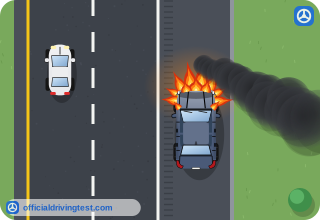
Why should you not use water on a vehicle fire if gasoline is burning?
- It will damage the electrical system
- It will cause the fuel tank to explode
- It will spread the flames
- It will make the smoke toxic
Show answer
Correct answer: It will spread the flames
The manual says water will spread the flames when gasoline is burning.
Source: Arizona Driver License Manual and Customer Service Guide (Revised March 2026), page 68
-
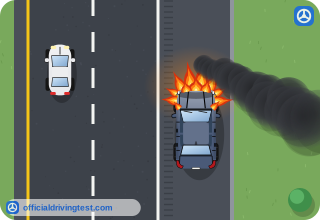
If you have no fire extinguisher, what can help smother the flames of a vehicle fire?
- A floor mat, a spare tire or gravel
- A heavy blanket, a heavy coat or sand
- A seat cushion or a rolled-up newspaper
- Opening all the doors and windows
Show answer
Correct answer: A heavy blanket, a heavy coat or sand
The manual lists a heavy blanket, a heavy coat or sand as ways to smother flames without an extinguisher.
Source: Arizona Driver License Manual and Customer Service Guide (Revised March 2026), page 68
-
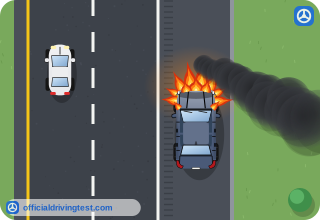
If you have any indication that a vehicle fire may be beyond your control, what should you do?
- Open the hood to let the heat escape
- Drive to the nearest service station
- Try to put it out with floor mats
- Get away from the vehicle
Show answer
Correct answer: Get away from the vehicle
The manual says fires are dangerous and you should get away from the vehicle if it may be beyond your control.
Source: Arizona Driver License Manual and Customer Service Guide (Revised March 2026), page 68
-
Steam coming from under your hood may mean what?
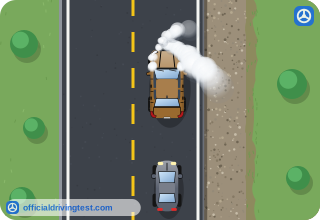
- Your cooling system has overheated
- Your brakes have completely failed
- Your battery is being overcharged
- Your tires are badly overinflated
Show answer
Correct answer: Your cooling system has overheated
The manual says steam from under the hood may mean the cooling system has overheated.
Source: Arizona Driver License Manual and Customer Service Guide (Revised March 2026), page 68
-
If steam comes from under your hood, what should you do first?
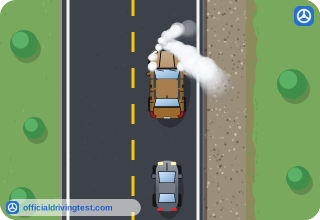
- Drive slowly to the nearest service station and ask for help
- Open the radiator cap right away to let the steam out
- Pull to the side of the road and turn off your engine immediately
- Turn off the engine only after the temperature drops
Show answer
Correct answer: Pull to the side of the road and turn off your engine immediately
The manual says to pull to the side of the road and turn off the engine immediately.
Source: Arizona Driver License Manual and Customer Service Guide (Revised March 2026), page 68
-
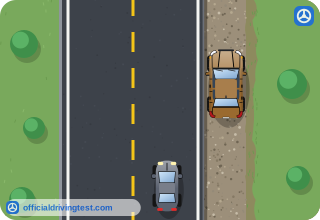
Why should you not open the radiator cap while the engine is hot?
- The coolant may freeze solid
- Steam may escape and cause severe burns
- The cooling fan may start and injure you
- The hood may fall shut on you
Show answer
Correct answer: Steam may escape and cause severe burns
The manual says opening the radiator cap on a hot engine may let steam escape and cause severe burns.
Source: Arizona Driver License Manual and Customer Service Guide (Revised March 2026), page 68
-
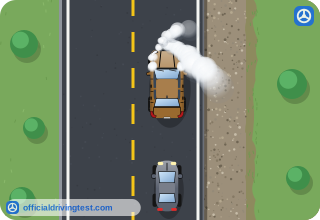
When should you add water to the radiator of an overheated engine?
- While the engine is running, to cool it faster
- Immediately after you turn the engine off
- While the engine is hot, a little at a time
- Only after the engine has cooled
Show answer
Correct answer: Only after the engine has cooled
The manual says to add water only after the engine has cooled and never while it is hot.
Source: Arizona Driver License Manual and Customer Service Guide (Revised March 2026), page 68
-
If your engine dies as you pull around a corner and you lose power steering, what should you do with the wheel?
- Grip it firmly with both hands to complete the turn
- Let go of the wheel so the vehicle can straighten itself
- Grip it with one hand and steer gently toward the left
- Straighten the wheel and coast through the corner
Show answer
Correct answer: Grip it firmly with both hands to complete the turn
The manual says to firmly grip the steering wheel with both hands to complete the turn and move to the right side of the road.
Source: Arizona Driver License Manual and Customer Service Guide (Revised March 2026), page 69