Alaska: Seat belts and child safety
Alaska safety belt and child restraint laws, car seats and booster seats. Split into 2 shorter tests so you're not stuck in one long quiz.
Independent educational site · not affiliated with any government agency or DMV
Choose a part
All 43 Seat belts and child safety questions with answers
Choose a part above to take a practice test, or study every question and answer here.
Show the questions and answersHide the questions
-
According to the manual, what share of all traffic collisions involve fire or submersion?
- Less than 1/2 of 1%
- About 5%
- About 10%
- About 25%
Show answer
Correct answer: Less than 1/2 of 1%
The manual states that collisions involving fire or submersion make up less than 1/2 of 1% of all traffic collisions.
Source: Alaska Driver Manual (Revised October 2025), page 20 · Open this page in the manual (Manual page 20)
-
Why are your chances of survival in a burning or submerged vehicle far greater if you wear your safety belt?
- The belt keeps the vehicle doors from jamming shut in the crash
- The belt makes the vehicle float longer before it sinks
- You are most likely to stay conscious and able to escape the vehicle
- The belt lets rescuers locate you more quickly after the crash
Show answer
Correct answer: You are most likely to stay conscious and able to escape the vehicle
The manual says a belted person is most likely to remain conscious and therefore more able to escape the vehicle.
Source: Alaska Driver Manual (Revised October 2025), page 20 · Open this page in the manual (Manual page 20)
-
More than 80% of all collisions occur at speeds below what speed?
- 25 miles per hour
- 40 miles per hour
- 55 miles per hour
- 65 miles per hour
Show answer
Correct answer: 40 miles per hour
The manual says more than 80% of all collisions occur at speeds less than 40 miles per hour.
Source: Alaska Driver Manual (Revised October 2025), page 20 · Open this page in the manual (Manual page 20)
-
Three out of four collisions causing death occur within how far of home?
- 5 miles
- 10 miles
- 50 miles
- 25 miles
Show answer
Correct answer: 25 miles
The manual states that three out of four collisions causing death occur within 25 miles of home.
Source: Alaska Driver Manual (Revised October 2025), page 20 · Open this page in the manual (Manual page 20)
-
Which kind of safety belt offers you the best possible protection in the event of a crash?
- A lap and shoulder belt
- A lap belt alone
- A shoulder belt alone
- A lap belt worn loosely
Show answer
Correct answer: A lap and shoulder belt
The manual says a lap belt alone will not prevent serious injury, while a lap and shoulder belt offer the best possible protection.
Source: Alaska Driver Manual (Revised October 2025), page 20 · Open this page in the manual (Manual page 20)
-
According to the manual, motor vehicle crashes are a significant killer and crippler of which group?
- Teenagers aged 16 to 19
- Adults over the age of 65
- Children under the age of five
- Motorcycle riders
Show answer
Correct answer: Children under the age of five
The manual lists crashes as a significant killer and crippler of children under the age of five.
Source: Alaska Driver Manual (Revised October 2025), page 20 · Open this page in the manual (Manual page 20)
-
How much greater are your chances of being killed if you are thrown from the car?
- About 2 times greater
- Almost 25 times greater
- About 10 times greater
- About 50 times greater
Show answer
Correct answer: Almost 25 times greater
The manual states the chances of being killed are almost 25 times greater if you are thrown from the car.
Source: Alaska Driver Manual (Revised October 2025), page 20 · Open this page in the manual (Manual page 20)
-
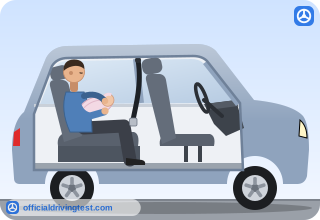
In just a 30-mph collision, a 15-pound infant held in your arms will suddenly weigh about how much?
- 150 pounds
- 300 pounds
- 900 pounds
- 450 pounds
Show answer
Correct answer: 450 pounds
The manual says the forces in a 30-mph collision make a 15-pound infant suddenly weigh 450 pounds, so holding a child will not protect it.
Source: Alaska Driver Manual (Revised October 2025), page 21 · Open this page in the manual (Manual page 21)
-
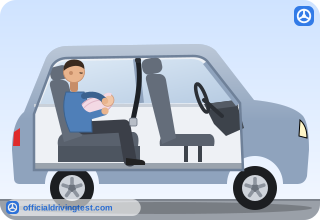
What can happen to a child held in the arms of an adult who is not wearing a restraint when a collision occurs?
- The adult can crush the child
- The adult's body absorbs most of the crash force for the child
- The child is protected as long as the adult holds on tightly
- The child is thrown clear of the car and is usually unhurt
Show answer
Correct answer: The adult can crush the child
The manual states that an unrestricted adult can crush a child held in the arms during a collision.
Source: Alaska Driver Manual (Revised October 2025), page 21 · Open this page in the manual (Manual page 21)
-
What does the manual say about safety belts that feel loose?
- Loose belts are inoperative until they are tightened
- Loose belts protect you only at speeds over 40 mph
- Loose belts do not mean the belts are inoperative
- Loose belts must be replaced before you drive
Show answer
Correct answer: Loose belts do not mean the belts are inoperative
The manual says loose belts do not indicate that the belts are inoperative.
Source: Alaska Driver Manual (Revised October 2025), page 21 · Open this page in the manual (Manual page 21)
-
Belts manufactured after 1974 use an inertia reel that makes the belt system "car sensitive." What does the belt do?
- It stays tight against your body at all times
- It locks when the car slows down too quickly
- It releases when the car comes to a stop
- It adjusts itself to the height of the driver
Show answer
Correct answer: It locks when the car slows down too quickly
The manual explains that these belts lock when the car slows down too quickly.
Source: Alaska Driver Manual (Revised October 2025), page 21 · Open this page in the manual (Manual page 21)
-
According to the manual, what is your best defense against the drunk driver?
- Driving only during daylight hours
- Staying in the right-hand lane
- Driving well below the speed limit
- Your safety belt
Show answer
Correct answer: Your safety belt
The manual says safety belts offer the best possible protection in a car crash and are your best defense against the drunk driver.
Source: Alaska Driver Manual (Revised October 2025), page 21 · Open this page in the manual (Manual page 21)
-
A 30-mph head-on collision unleashes forces approximately how many times the force of gravity?
- 20 times (20 G's)
- 10 times (10 G's)
- 40 times (40 G's)
- 50 times (50 G's)
Show answer
Correct answer: 20 times (20 G's)
The manual states that a 30-mph head-on collision unleashes forces about 20 times the force of gravity.
Source: Alaska Driver Manual (Revised October 2025), page 21 · Open this page in the manual (Manual page 21)
-
In a 30-mph head-on collision, objects including passengers can be thrown forward with a force equal to how many times their own weight?
- 10 times
- 15 times
- 30 times
- 50 times
Show answer
Correct answer: 30 times
The manual says passengers can be thrown forward with a force equal to 30 times their own weight.
Source: Alaska Driver Manual (Revised October 2025), page 21 · Open this page in the manual (Manual page 21)
-
Why can a lap belt be harmful to a small child in a collision?
- It may cut off the child's view of the road ahead
- It may put too much pressure on the child's hips and abdomen
- It may slide up over the shoulders and neck of the child
- It may keep the child from sitting up straight in the seat
Show answer
Correct answer: It may put too much pressure on the child's hips and abdomen
The manual says a lap belt may put too much pressure on a small child's hips and abdomen.
Source: Alaska Driver Manual (Revised October 2025), page 21 · Open this page in the manual (Manual page 21)
-
What are car safety seats designed to do for small children in a collision?
- Concentrate crash forces on the hips and abdomen
- Let the child move freely around inside the seat
- Reduce the speed of the vehicle during a crash
- Distribute crash forces over a large area of the body
Show answer
Correct answer: Distribute crash forces over a large area of the body
The manual says car safety seats are designed to distribute crash forces over a large area of the body.
Source: Alaska Driver Manual (Revised October 2025), page 21 · Open this page in the manual (Manual page 21)
-
Which Federal Standard do approved, dynamically crash tested child car seats conform to?
- Federal Standard 213-80
- Federal Standard 112-65
- Federal Standard 150-60
- Federal Standard 301-90
Show answer
Correct answer: Federal Standard 213-80
The manual states that all such approved child car seats conform to Federal Standard 213-80.
Source: Alaska Driver Manual (Revised October 2025), page 21 · Open this page in the manual (Manual page 21)
-
How does restraining a child in a car safety seat affect the driver?
- The child sits still but distracts the driver more often
- The driver may then skip wearing a safety belt
- The child is better behaved and less likely to distract the driver
- The driver must stop more often to check the seat
Show answer
Correct answer: The child is better behaved and less likely to distract the driver
The manual says a child restrained in a car safety seat is better behaved and less likely to distract the driver.
Source: Alaska Driver Manual (Revised October 2025), page 21 · Open this page in the manual (Manual page 21)
-
Under Alaska law, which passengers will be issued a citation for failure to wear a seat belt?
- Passengers 21 and older
- Passengers 18 and older
- Passengers 25 and older
- Only passengers in the front seat
Show answer
Correct answer: Passengers 18 and older
The manual says passengers 18 and older will be issued a citation for failure to wear a seat belt.
Source: Alaska Driver Manual (Revised October 2025), page 21 · Open this page in the manual (Manual page 21)
-
Who is responsible for all passengers under the age of 16 years in the vehicle?
- The vehicle's owner
- The oldest passenger in the vehicle
- The front-seat passenger
- The driver
Show answer
Correct answer: The driver
The manual says the driver is responsible for all passengers under the age of 16 years.
Source: Alaska Driver Manual (Revised October 2025), page 21 · Open this page in the manual (Manual page 21)
-
Under Alaska law, how must a child under one year old, or a child one year or older who weighs less than 20 pounds, be secured?
- In a rear-facing child safety seat
- In a forward-facing child safety seat
- In a booster seat secured by a seat belt
- In a seat belt with the shoulder strap adjusted
Show answer
Correct answer: In a rear-facing child safety seat
The law requires such a child to be properly secured in a rear-facing child safety seat that meets U.S. Department of Transportation standards.
Source: Alaska Driver Manual (Revised October 2025), page 21 · Open this page in the manual (Manual page 21)
-
Under Alaska law, a two-year-old child who weighs 30 pounds must be properly secured in what?
- A regular seat belt
- A rear-facing seat only
- A child restraint device
- Any device the driver chooses
Show answer
Correct answer: A child restraint device
The law requires such a child to be secured in a child restraint device that meets U.S. Department of Transportation standards.
Source: Alaska Driver Manual (Revised October 2025), page 21 · Open this page in the manual (Manual page 21)
-
Under Alaska law, a child over four but under eight years old who is less than 57 inches tall and weighs 20 to under 65 pounds must be secured in what?
- A lap belt only
- A booster seat
- A rear-facing seat
- A regular seat belt
Show answer
Correct answer: A booster seat
The law requires a booster seat secured by a seat belt system or another approved child passenger restraint system for a child of that age, height and weight.
Source: Alaska Driver Manual (Revised October 2025), page 21 · Open this page in the manual (Manual page 21)
-
Under Alaska law, a child over four years old who exceeds the height or weight requirements for a booster seat must be secured in what?
- A rear-facing seat
- A booster seat
- No restraint at all, if seated in the back
- A seat belt
Show answer
Correct answer: A seat belt
The law says such a child shall be properly secured in a seat belt.
Source: Alaska Driver Manual (Revised October 2025), page 21 · Open this page in the manual (Manual page 21)
-
For a child aged eight to under 16 who does not exceed the booster seat height and weight limits, who decides whether a child safety device or a safety belt is appropriate?
- The driver alone
- The child's parent
- A police officer
- The vehicle manufacturer
Show answer
Correct answer: The driver alone
The law says the choice is determined solely by the driver.
Source: Alaska Driver Manual (Revised October 2025), page 21 · Open this page in the manual (Manual page 21)
-
Which vehicle is exempt from the Alaska seat belt law?
- A vehicle built before 1980 whose original safety belts the owner has since removed
- A pickup truck used only for hauling cargo on gravel roads in rural areas
- A pre-1965 vehicle with no original belts that is not a custom collector vehicle
- A vehicle driven only at low speeds on short trips around town
Show answer
Correct answer: A pre-1965 vehicle with no original belts that is not a custom collector vehicle
The manual lists vehicles built prior to 1965 that had no safety belts as original equipment, and are not custom collector vehicles, as an exception.
Source: Alaska Driver Manual (Revised October 2025), page 22 · Open this page in the manual (Manual page 22)
-
Which vehicle operator is exempt from the Alaska seat belt law?
- An employee delivering packages or groceries to customers' front doors
- An employee delivering mail or newspapers to roadside boxes from inside the vehicle
- A driver running a short errand at low speed on a quiet street
- A taxi driver carrying paying passengers across town
Show answer
Correct answer: An employee delivering mail or newspapers to roadside boxes from inside the vehicle
The manual lists operators delivering mail or newspapers from inside the vehicle to roadside boxes in the course of employment as an exception.
Source: Alaska Driver Manual (Revised October 2025), page 22 · Open this page in the manual (Manual page 22)
-
Passengers in a school bus are exempt from the seat belt law unless what applies?
- The bus is carrying more than 20 students
- The bus is traveling on a highway
- The bus driver asks them to buckle up
- The bus must be equipped with safety belts
Show answer
Correct answer: The bus must be equipped with safety belts
The exception covers school bus passengers unless the bus is required to be equipped with safety belts.
Source: Alaska Driver Manual (Revised October 2025), page 22 · Open this page in the manual (Manual page 22)
-
Which passengers are exempt from the Alaska seat belt law?
- Passengers in an emergency vehicle
- Passengers in a commercial truck
- Passengers in a rental car
- Passengers on a short trip near home
Show answer
Correct answer: Passengers in an emergency vehicle
The manual lists passengers in an emergency vehicle as an exception to the seat belt law.
Source: Alaska Driver Manual (Revised October 2025), page 22 · Open this page in the manual (Manual page 22)
-
Who may exempt a person or class of people from the seat belt law by regulation?
- The Governor
- The Commissioner of Transportation
- The Commissioner of Public Safety
- The Alaska courts
Show answer
Correct answer: The Commissioner of Public Safety
The manual lists people or a class of people exempt by the Commissioner of Public Safety, as defined by regulations.
Source: Alaska Driver Manual (Revised October 2025), page 22 · Open this page in the manual (Manual page 22)
-
A driver who fails to restrain passengers under age 16 may be fined up to how much and may receive how many demerit points?
- Up to $15 and no demerit points
- Up to $50 and two demerit points
- Up to $100 and three demerit points
- Up to $50 and no demerit points
Show answer
Correct answer: Up to $50 and two demerit points
The manual says such a driver may be fined up to $50 and may receive two demerit points on the operator's license.
Source: Alaska Driver Manual (Revised October 2025), page 22 · Open this page in the manual (Manual page 22)
-
What fine applies to adult seat belt violations?
- $5
- $25
- $100
- $15
Show answer
Correct answer: $15
The manual says adult violations are subject to a $15 fine.
Source: Alaska Driver Manual (Revised October 2025), page 22 · Open this page in the manual (Manual page 22)
-
How can the court waive the $15 seat belt fine for a person convicted under the law?
- The person donates $15 to an EMS organization
- The person completes a safe-driving course
- The person pays the fine within 30 days
- The person performs community service
Show answer
Correct answer: The person donates $15 to an EMS organization
A provision of the law lets the court waive the $15 fine if the person donates $15 to the EMS organization.
Source: Alaska Driver Manual (Revised October 2025), page 22 · Open this page in the manual (Manual page 22)
-
A convicted driver who donates to an EMS organization in place of the $15 fine sends what to the court?
- A signed statement that the donation to the EMS organization was made
- A copy of the citation and a letter from an insurer
- A copy of the citation and the receipt from the EMS organization
- A copy of the receipt only, without the citation
Show answer
Correct answer: A copy of the citation and the receipt from the EMS organization
The manual says drivers send a copy of the citation along with the receipt from the EMS organization to the court.
Source: Alaska Driver Manual (Revised October 2025), page 22 · Open this page in the manual (Manual page 22)
-
What does Alaska law require of ALL passengers, regardless of age?
- To ride in the rear seat only, whatever their age
- To use a seat belt or appropriate restraint device
- To use a booster seat until they reach the age of 16
- To sit directly behind the driver
Show answer
Correct answer: To use a seat belt or appropriate restraint device
The manual says Alaska law requires all passengers, regardless of age, to use a seat belt or appropriate restraint device (car seat or booster seat).
Source: Alaska Driver Manual (Revised October 2025), page 22 · Open this page in the manual (Manual page 22)
-
What are Child Passenger Safety Technicians (CPSTs)?
- Police officers who write seat belt citations
- Mechanics who install seat belts in older vehicles
- DMV examiners who test child car seats
- Trained educators in occupant protection in motor vehicles
Show answer
Correct answer: Trained educators in occupant protection in motor vehicles
The manual describes CPSTs as trained educators in occupant protection in motor vehicles.
Source: Alaska Driver Manual (Revised October 2025), page 22 · Open this page in the manual (Manual page 22)
-
When car seats, booster seats and seat belts are used correctly, what happens to the risk of injury, hospitalization and death for children?
- It is greatly reduced
- It is slightly reduced
- It stays the same
- It is eliminated
Show answer
Correct answer: It is greatly reduced
The manual says the risk is greatly reduced when these restraints are used correctly.
Source: Alaska Driver Manual (Revised October 2025), page 22 · Open this page in the manual (Manual page 22)
-
The American Academy of Pediatrics recommends (it is not Alaska law) that infants and toddlers ride in a rear-facing car seat for how long?
- Only until they turn one year old or reach a weight of 20 pounds
- Until they can sit up on their own and hold up their heads
- As long as possible, up to the car seat's highest weight or height limit
- Until they are two years old, no matter how big they are
Show answer
Correct answer: As long as possible, up to the car seat's highest weight or height limit
The recommendation is to ride rear-facing as long as possible until reaching the highest weight or height the car seat manufacturer allows.
Source: Alaska Driver Manual (Revised October 2025), page 23 · Open this page in the manual (Manual page 23)
-
Under the best practice recommendations, what should children who have outgrown the rear-facing limit for their car seat use?
- A booster seat right away, with no harness
- A forward-facing car seat with a harness
- A lap and shoulder seat belt on its own
- A lap belt only, with no shoulder strap
Show answer
Correct answer: A forward-facing car seat with a harness
The recommendation is a forward-facing car seat with a harness for as long as possible, up to the manufacturer's highest weight or height.
Source: Alaska Driver Manual (Revised October 2025), page 23 · Open this page in the manual (Manual page 23)
-
Under the best practice recommendations, children should use a booster seat until the lap and shoulder belt fits properly, typically at what height?
- 4 feet 0 inches
- 3 feet 6 inches
- 5 feet 2 inches
- 4 feet 9 inches
Show answer
Correct answer: 4 feet 9 inches
The recommendation says a booster seat is used until the belt fits properly, typically at 4 feet 9 inches in height and between 8 and 12 years of age.
Source: Alaska Driver Manual (Revised October 2025), page 23 · Open this page in the manual (Manual page 23)
-
Under the best practice recommendations, what should children who are old and large enough to use the vehicle seat belt alone always use?
- Lap and shoulder seat belts
- A lap belt alone
- A booster seat
- A forward-facing harness
Show answer
Correct answer: Lap and shoulder seat belts
The recommendation is that they should always use lap and shoulder seat belts for optimal protection.
Source: Alaska Driver Manual (Revised October 2025), page 23 · Open this page in the manual (Manual page 23)
-
Under the best practice recommendations, all children younger than what age should be restrained in the rear seats of vehicles?
- 8 years old
- 10 years old
- 13 years old
- 16 years old
Show answer
Correct answer: 13 years old
The recommendation is that all children younger than 13 years old be restrained in the rear seats for optimal protection.
Source: Alaska Driver Manual (Revised October 2025), page 23 · Open this page in the manual (Manual page 23)
-
What does the manual's closing page say about wearing seat belts in Alaska?
- It is mandatory only on highways
- It is mandatory only for drivers under 18
- It is optional for adult drivers
- It is mandatory
Show answer
Correct answer: It is mandatory
The manual states that wearing seat belts is mandatory in Alaska.
Source: Alaska Driver Manual (Revised October 2025), page 89 · Open this page in the manual (Manual page 89)