Alaska: Seat belts and child safety — Part 1 Practice Test
Questions in this part include: “According to the manual, what share of all traffic collisions involve fire or submersion?” · “According to the manual, what is your best defense against the drunk driver?”
Independent educational site · not affiliated with any government agency or DMV
Ready? Test yourself
- Instant feedback with an explanation
- Every answer cites its source in the manual
- Your best score is saved on this device
Questions are original and based on the official manual "Alaska Driver Manual" (Revised October 2025), Alaska Department of Administration, Division of Motor Vehicles (DMV).
All 22 questions in this practice test
Take the test above first, then use this list to study. Tap “Show answer” to see the correct answer and explanation.
Show the questions and answersHide the questions
-
According to the manual, what share of all traffic collisions involve fire or submersion?
- Less than 1/2 of 1%
- About 5%
- About 10%
- About 25%
Show answer
Correct answer: Less than 1/2 of 1%
The manual states that collisions involving fire or submersion make up less than 1/2 of 1% of all traffic collisions.
Source: Alaska Driver Manual (Revised October 2025), page 20 · Open this page in the manual (Manual page 20)
-
Why are your chances of survival in a burning or submerged vehicle far greater if you wear your safety belt?
- The belt keeps the vehicle doors from jamming shut in the crash
- The belt makes the vehicle float longer before it sinks
- You are most likely to stay conscious and able to escape the vehicle
- The belt lets rescuers locate you more quickly after the crash
Show answer
Correct answer: You are most likely to stay conscious and able to escape the vehicle
The manual says a belted person is most likely to remain conscious and therefore more able to escape the vehicle.
Source: Alaska Driver Manual (Revised October 2025), page 20 · Open this page in the manual (Manual page 20)
-
More than 80% of all collisions occur at speeds below what speed?
- 25 miles per hour
- 40 miles per hour
- 55 miles per hour
- 65 miles per hour
Show answer
Correct answer: 40 miles per hour
The manual says more than 80% of all collisions occur at speeds less than 40 miles per hour.
Source: Alaska Driver Manual (Revised October 2025), page 20 · Open this page in the manual (Manual page 20)
-
Three out of four collisions causing death occur within how far of home?
- 5 miles
- 10 miles
- 50 miles
- 25 miles
Show answer
Correct answer: 25 miles
The manual states that three out of four collisions causing death occur within 25 miles of home.
Source: Alaska Driver Manual (Revised October 2025), page 20 · Open this page in the manual (Manual page 20)
-
Which kind of safety belt offers you the best possible protection in the event of a crash?
- A lap and shoulder belt
- A lap belt alone
- A shoulder belt alone
- A lap belt worn loosely
Show answer
Correct answer: A lap and shoulder belt
The manual says a lap belt alone will not prevent serious injury, while a lap and shoulder belt offer the best possible protection.
Source: Alaska Driver Manual (Revised October 2025), page 20 · Open this page in the manual (Manual page 20)
-
According to the manual, motor vehicle crashes are a significant killer and crippler of which group?
- Teenagers aged 16 to 19
- Adults over the age of 65
- Children under the age of five
- Motorcycle riders
Show answer
Correct answer: Children under the age of five
The manual lists crashes as a significant killer and crippler of children under the age of five.
Source: Alaska Driver Manual (Revised October 2025), page 20 · Open this page in the manual (Manual page 20)
-
How much greater are your chances of being killed if you are thrown from the car?
- About 2 times greater
- Almost 25 times greater
- About 10 times greater
- About 50 times greater
Show answer
Correct answer: Almost 25 times greater
The manual states the chances of being killed are almost 25 times greater if you are thrown from the car.
Source: Alaska Driver Manual (Revised October 2025), page 20 · Open this page in the manual (Manual page 20)
-
In just a 30-mph collision, a 15-pound infant held in your arms will suddenly weigh about how much?
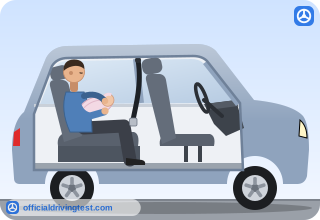
- 150 pounds
- 300 pounds
- 900 pounds
- 450 pounds
Show answer
Correct answer: 450 pounds
The manual says the forces in a 30-mph collision make a 15-pound infant suddenly weigh 450 pounds, so holding a child will not protect it.
Source: Alaska Driver Manual (Revised October 2025), page 21 · Open this page in the manual (Manual page 21)
-
What can happen to a child held in the arms of an adult who is not wearing a restraint when a collision occurs?
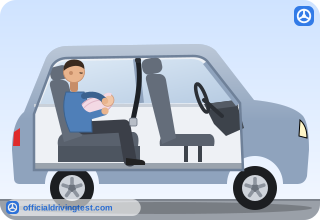
- The adult can crush the child
- The adult's body absorbs most of the crash force for the child
- The child is protected as long as the adult holds on tightly
- The child is thrown clear of the car and is usually unhurt
Show answer
Correct answer: The adult can crush the child
The manual states that an unrestricted adult can crush a child held in the arms during a collision.
Source: Alaska Driver Manual (Revised October 2025), page 21 · Open this page in the manual (Manual page 21)
-
What does the manual say about safety belts that feel loose?
- Loose belts are inoperative until they are tightened
- Loose belts protect you only at speeds over 40 mph
- Loose belts do not mean the belts are inoperative
- Loose belts must be replaced before you drive
Show answer
Correct answer: Loose belts do not mean the belts are inoperative
The manual says loose belts do not indicate that the belts are inoperative.
Source: Alaska Driver Manual (Revised October 2025), page 21 · Open this page in the manual (Manual page 21)
-
Belts manufactured after 1974 use an inertia reel that makes the belt system "car sensitive." What does the belt do?
- It stays tight against your body at all times
- It locks when the car slows down too quickly
- It releases when the car comes to a stop
- It adjusts itself to the height of the driver
Show answer
Correct answer: It locks when the car slows down too quickly
The manual explains that these belts lock when the car slows down too quickly.
Source: Alaska Driver Manual (Revised October 2025), page 21 · Open this page in the manual (Manual page 21)
-
According to the manual, what is your best defense against the drunk driver?
- Driving only during daylight hours
- Staying in the right-hand lane
- Driving well below the speed limit
- Your safety belt
Show answer
Correct answer: Your safety belt
The manual says safety belts offer the best possible protection in a car crash and are your best defense against the drunk driver.
Source: Alaska Driver Manual (Revised October 2025), page 21 · Open this page in the manual (Manual page 21)
-
A 30-mph head-on collision unleashes forces approximately how many times the force of gravity?
- 20 times (20 G's)
- 10 times (10 G's)
- 40 times (40 G's)
- 50 times (50 G's)
Show answer
Correct answer: 20 times (20 G's)
The manual states that a 30-mph head-on collision unleashes forces about 20 times the force of gravity.
Source: Alaska Driver Manual (Revised October 2025), page 21 · Open this page in the manual (Manual page 21)
-
In a 30-mph head-on collision, objects including passengers can be thrown forward with a force equal to how many times their own weight?
- 10 times
- 15 times
- 30 times
- 50 times
Show answer
Correct answer: 30 times
The manual says passengers can be thrown forward with a force equal to 30 times their own weight.
Source: Alaska Driver Manual (Revised October 2025), page 21 · Open this page in the manual (Manual page 21)
-
Why can a lap belt be harmful to a small child in a collision?
- It may cut off the child's view of the road ahead
- It may put too much pressure on the child's hips and abdomen
- It may slide up over the shoulders and neck of the child
- It may keep the child from sitting up straight in the seat
Show answer
Correct answer: It may put too much pressure on the child's hips and abdomen
The manual says a lap belt may put too much pressure on a small child's hips and abdomen.
Source: Alaska Driver Manual (Revised October 2025), page 21 · Open this page in the manual (Manual page 21)
-
What are car safety seats designed to do for small children in a collision?
- Concentrate crash forces on the hips and abdomen
- Let the child move freely around inside the seat
- Reduce the speed of the vehicle during a crash
- Distribute crash forces over a large area of the body
Show answer
Correct answer: Distribute crash forces over a large area of the body
The manual says car safety seats are designed to distribute crash forces over a large area of the body.
Source: Alaska Driver Manual (Revised October 2025), page 21 · Open this page in the manual (Manual page 21)
-
Which Federal Standard do approved, dynamically crash tested child car seats conform to?
- Federal Standard 213-80
- Federal Standard 112-65
- Federal Standard 150-60
- Federal Standard 301-90
Show answer
Correct answer: Federal Standard 213-80
The manual states that all such approved child car seats conform to Federal Standard 213-80.
Source: Alaska Driver Manual (Revised October 2025), page 21 · Open this page in the manual (Manual page 21)
-
How does restraining a child in a car safety seat affect the driver?
- The child sits still but distracts the driver more often
- The driver may then skip wearing a safety belt
- The child is better behaved and less likely to distract the driver
- The driver must stop more often to check the seat
Show answer
Correct answer: The child is better behaved and less likely to distract the driver
The manual says a child restrained in a car safety seat is better behaved and less likely to distract the driver.
Source: Alaska Driver Manual (Revised October 2025), page 21 · Open this page in the manual (Manual page 21)
-
Under Alaska law, which passengers will be issued a citation for failure to wear a seat belt?
- Passengers 21 and older
- Passengers 18 and older
- Passengers 25 and older
- Only passengers in the front seat
Show answer
Correct answer: Passengers 18 and older
The manual says passengers 18 and older will be issued a citation for failure to wear a seat belt.
Source: Alaska Driver Manual (Revised October 2025), page 21 · Open this page in the manual (Manual page 21)
-
Who is responsible for all passengers under the age of 16 years in the vehicle?
- The vehicle's owner
- The oldest passenger in the vehicle
- The front-seat passenger
- The driver
Show answer
Correct answer: The driver
The manual says the driver is responsible for all passengers under the age of 16 years.
Source: Alaska Driver Manual (Revised October 2025), page 21 · Open this page in the manual (Manual page 21)
-
Under Alaska law, how must a child under one year old, or a child one year or older who weighs less than 20 pounds, be secured?
- In a rear-facing child safety seat
- In a forward-facing child safety seat
- In a booster seat secured by a seat belt
- In a seat belt with the shoulder strap adjusted
Show answer
Correct answer: In a rear-facing child safety seat
The law requires such a child to be properly secured in a rear-facing child safety seat that meets U.S. Department of Transportation standards.
Source: Alaska Driver Manual (Revised October 2025), page 21 · Open this page in the manual (Manual page 21)
-
Under Alaska law, a two-year-old child who weighs 30 pounds must be properly secured in what?
- A regular seat belt
- A rear-facing seat only
- A child restraint device
- Any device the driver chooses
Show answer
Correct answer: A child restraint device
The law requires such a child to be secured in a child restraint device that meets U.S. Department of Transportation standards.
Source: Alaska Driver Manual (Revised October 2025), page 21 · Open this page in the manual (Manual page 21)