Virginia: Pavement markings Practice Test
Yellow and white lines, arrows, yield lines, center turn lanes, bicycle lanes and boxes, bus and HOV lanes.
Independent educational site · not affiliated with any government agency or DMV
Ready? Test yourself
- Instant feedback with an explanation
- Every answer cites its source in the manual
- Your best score is saved on this device
- Keyboard: press 1 to 4 to answer and Enter for the next question
Questions are original and based on the official manual "Virginia Driver's Manual" (DMV 39 (April 27, 2026)), Virginia Department of Motor Vehicles (DMV).
All 31 questions in this practice test
Take the test above first, then use this list to study. Tap “Show answer” to see the correct answer and explanation.
Show the questions and answersHide the questions
-
Which three colors does the manual say road markings may be?
- Red, yellow or white
- Yellow, white or blue
- Red, white or blue
- Orange, yellow or white
Show answer
Correct answer: Red, yellow or white
The manual says markings may be red, yellow or white, used alone or in combinations, and each color has its own meaning.
Source: Virginia Driver's Manual (DMV 39 (April 27, 2026)), page 11 · Open this page in the manual (Manual page 11)
-
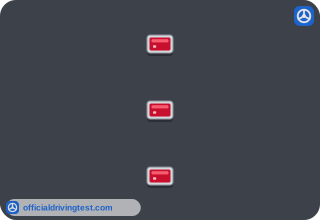
What do red reflectors on the pavement show?
- Lanes that are reserved for buses
- The edge of a work zone ahead
- Areas not to be entered or used
- A lane that ends ahead
Show answer
Correct answer: Areas not to be entered or used
Red reflectors mark areas that must not be entered or used.
Source: Virginia Driver's Manual (DMV 39 (April 27, 2026)), page 11 · Open this page in the manual (Manual page 11)
-
Who can see red reflectors on the pavement?
- Only traffic in the lane next to them
- Only traffic in the center turn lane
- Only traffic flowing in the wrong direction
- Only traffic leaving a toll plaza
Show answer
Correct answer: Only traffic flowing in the wrong direction
Red reflectors are positioned so that only drivers going the wrong way see them.
Source: Virginia Driver's Manual (DMV 39 (April 27, 2026)), page 11 · Open this page in the manual (Manual page 11)
-
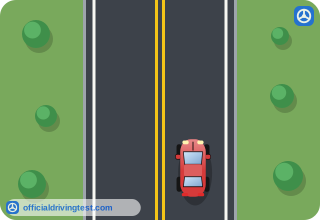
What do yellow center lines mean?
- Two-way traffic, flowing in opposite directions
- One-way traffic with passing allowed
- Traffic flowing in the same direction in both lanes
- A lane reserved for left turns only
Show answer
Correct answer: Two-way traffic, flowing in opposite directions
Yellow center lines separate two-way traffic that flows in opposite directions.
Source: Virginia Driver's Manual (DMV 39 (April 27, 2026)), page 11 · Open this page in the manual (Manual page 11)
-
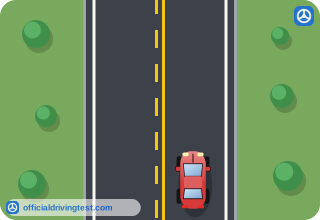
A broken yellow line is next to a solid yellow line. From which side is passing allowed?
- The solid line side
- Either side
- Neither side
- The broken line side
Show answer
Correct answer: The broken line side
Passing is allowed from the side of the broken line, but not from the side of the solid line.
Source: Virginia Driver's Manual (DMV 39 (April 27, 2026)), page 11 · Open this page in the manual (Manual page 11)
-
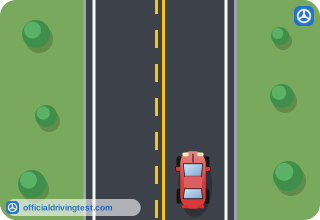
Vehicles on the solid yellow line side of a broken and solid yellow line may cross the line only to pass whom, when the opposite lane is clear?
- Slow moving farm equipment and horse-drawn vehicles
- Pedestrians, bicyclists, and riders of scooters or skateboards
- Any vehicle that is traveling below the posted speed limit
- Parked vehicles and stopped delivery vehicles
Show answer
Correct answer: Pedestrians, bicyclists, and riders of scooters or skateboards
From the solid line side, you may cross only to pass pedestrians, bicyclists, and scooter or skateboard riders when the opposite lane is clear and you can pass safely.
Source: Virginia Driver's Manual (DMV 39 (April 27, 2026)), page 11 · Open this page in the manual (Manual page 11)
-
What do double solid yellow lines mean for passing?
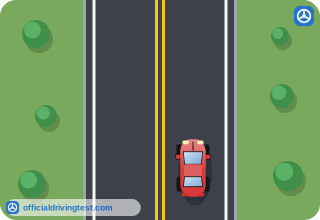
- Passing is not allowed in either direction
- Passing is allowed in either direction when clear
- Passing is allowed only on the left side
- Passing is allowed only for faster vehicles
Show answer
Correct answer: Passing is not allowed in either direction
Double solid yellow lines mark the center of the road and separate traffic going in opposite directions, with no passing either way.
Source: Virginia Driver's Manual (DMV 39 (April 27, 2026)), page 11 · Open this page in the manual (Manual page 11)
-
Apart from passing pedestrians, bicyclists and riders of scooters or skateboards, when may you cross double solid yellow lines?
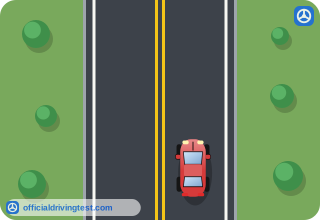
- When you are passing a slow moving vehicle
- When you are entering a highway
- When you are making a left turn
- When the opposite lane is clear
Show answer
Correct answer: When you are making a left turn
You may cross double solid yellow lines only to make a left turn or to pass pedestrians, bicyclists and scooter or skateboard riders when the opposite lane is clear and safe.
Source: Virginia Driver's Manual (DMV 39 (April 27, 2026)), page 11 · Open this page in the manual (Manual page 11)
-
What do broken white lines do?
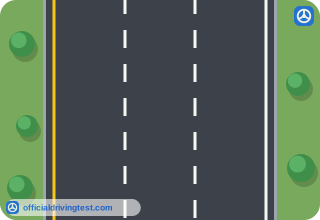
- Separate traffic traveling in opposite directions
- Separate lanes of traffic going in the same direction
- Mark the right edge of the pavement
- Show where passing is never allowed
Show answer
Correct answer: Separate lanes of traffic going in the same direction
Broken white lines separate lanes going the same way, and you may change lanes with caution.
Source: Virginia Driver's Manual (DMV 39 (April 27, 2026)), page 11 · Open this page in the manual (Manual page 11)
-
What do broken yellow center lines allow when the way ahead is clear?
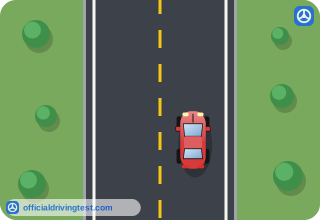
- Passing on the left from one side only
- Passing on the right in either direction
- Crossing only to make a left turn
- Passing on the left in either direction
Show answer
Correct answer: Passing on the left in either direction
Broken yellow center lines mean passing on the left is allowed in either direction when the way is clear.
Source: Virginia Driver's Manual (DMV 39 (April 27, 2026)), page 11 · Open this page in the manual (Manual page 11)
-
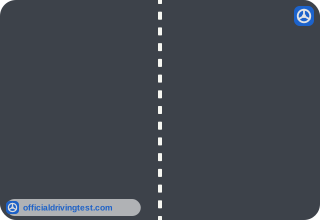
What are dotted white lines used to show?
- The right edge of the pavement and shoulder
- Where lane changes might be dangerous
- Lanes reserved for buses
- Lane assignment in intersections and interchanges
Show answer
Correct answer: Lane assignment in intersections and interchanges
Dotted white lines, which are small closely spaced rectangles, show lane assignment where a driver might otherwise drift out of a lane.
Source: Virginia Driver's Manual (DMV 39 (April 27, 2026)), page 11 · Open this page in the manual (Manual page 11)
-
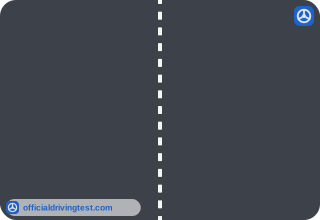
Dotted white lines are also used to denote what at an intersection?
- The end of a no passing zone
- The opening of a turn lane
- The location of a school crossing
- The beginning of a bus stop
Show answer
Correct answer: The opening of a turn lane
The manual says dotted white lines also denote the opening of a turn lane at an intersection and entrance and exit lanes at interchanges.
Source: Virginia Driver's Manual (DMV 39 (April 27, 2026)), page 11 · Open this page in the manual (Manual page 11)
-
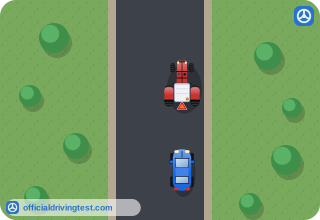
On an unmarked two-lane road, when may you pass a slow moving vehicle on the left?
- Never, since there are no lane markings
- Only if the vehicle ahead signals you to pass
- If no signs prohibit passing and the way is clear
- Only during daylight hours
Show answer
Correct answer: If no signs prohibit passing and the way is clear
Many Virginia two-lane roads lack lane markings; you may pass on the left if no signs prohibit it and the way is clear.
Source: Virginia Driver's Manual (DMV 39 (April 27, 2026)), page 11 · Open this page in the manual (Manual page 11)
-
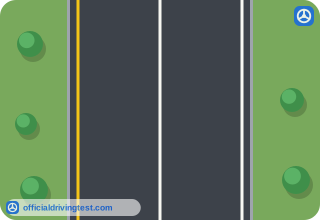
What do solid white lines discourage near intersections and on- and off-ramps?
- Lane changes
- Right turns
- Passing on the right
- Parking
Show answer
Correct answer: Lane changes
Solid white lines show turn lanes and discourage lane changes where changing lanes might be dangerous.
Source: Virginia Driver's Manual (DMV 39 (April 27, 2026)), page 12 · Open this page in the manual (Manual page 12)
-
Which marking is used to mark the right edge of the pavement?
- A solid yellow line
- A solid white line
- A broken white line
- A double solid yellow line
Show answer
Correct answer: A solid white line
Solid white lines also mark the right edge of the pavement.
Source: Virginia Driver's Manual (DMV 39 (April 27, 2026)), page 12 · Open this page in the manual (Manual page 12)
-
What color are stop lines, crosswalks and parking spaces marked?
- Yellow
- Red
- Green
- White
Show answer
Correct answer: White
The manual says stop lines, crosswalks and parking spaces are marked by white lines.
Source: Virginia Driver's Manual (DMV 39 (April 27, 2026)), page 12 · Open this page in the manual (Manual page 12)
-
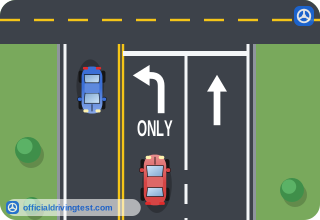
You are in a lane marked with a curved arrow and the word ONLY. What must you do?
- Turn in the direction of the arrow
- Turn or go straight
- Go straight
- Change lanes before the intersection
Show answer
Correct answer: Turn in the direction of the arrow
A lane marked with a curved arrow, or a curved arrow and ONLY, requires you to turn in the arrow’s direction.
Source: Virginia Driver's Manual (DMV 39 (April 27, 2026)), page 12 · Open this page in the manual (Manual page 12)
-
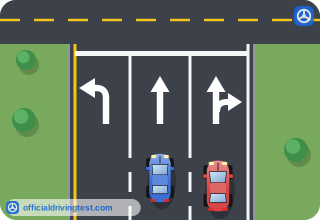
Your lane is marked with both a curved arrow and a straight arrow. What may you do?
- Only turn
- Only go straight
- Turn or go straight
- Turn only after stopping
Show answer
Correct answer: Turn or go straight
A lane marked with both arrows lets you either turn or go straight.
Source: Virginia Driver's Manual (DMV 39 (April 27, 2026)), page 12 · Open this page in the manual (Manual page 12)
-
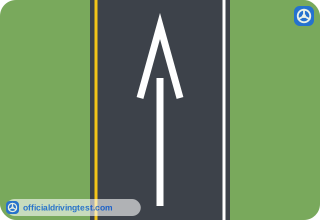
What do wrong-way arrows on the pavement indicate?
- Traffic may move in either direction in that lane
- The lane is reserved for turning vehicles
- Traffic only moves in the direction indicated by the arrow
- The lane ends within the next mile
Show answer
Correct answer: Traffic only moves in the direction indicated by the arrow
Wrong-way arrows show the one direction of travel allowed in that lane.
Source: Virginia Driver's Manual (DMV 39 (April 27, 2026)), page 12 · Open this page in the manual (Manual page 12)
-
You realize you are driving against the direction of wrong-way arrows. What should you do?
- Immediately slow down and pull over
- Make a U-turn right away
- Stop in your lane and turn on your hazard lights
- Speed up to leave the road quickly
Show answer
Correct answer: Immediately slow down and pull over
Driving against wrong-way arrows could cause a head-on crash, so you should immediately slow down and pull over.
Source: Virginia Driver's Manual (DMV 39 (April 27, 2026)), page 12 · Open this page in the manual (Manual page 12)
-
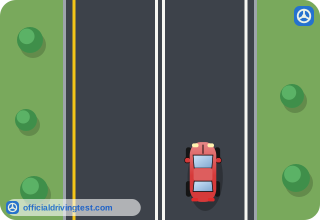
What are double solid white lines most often used for?
- To separate traffic traveling in opposite directions on a two-lane road
- To mark the right edge of the pavement
- To show where a right turn lane begins
- To separate a special use lane, such as an HOV lane, from the conventional lanes
Show answer
Correct answer: To separate a special use lane, such as an HOV lane, from the conventional lanes
Double solid white lines separate lanes going the same direction, most often a special use lane such as an HOV lane from the other lanes.
Source: Virginia Driver's Manual (DMV 39 (April 27, 2026)), page 12 · Open this page in the manual (Manual page 12)
-
Where may you enter a special use lane that is separated by double solid white lines?
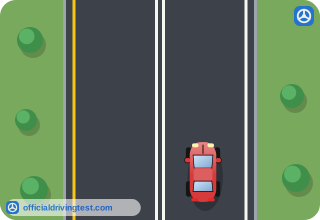
- Anywhere if the way is clear
- Only where signs and markings allow
- Only at the beginning of the lane
- Anywhere after signaling
Show answer
Correct answer: Only where signs and markings allow
You may not cross double solid white lines and may enter the special use lane only where signs and markings allow.
Source: Virginia Driver's Manual (DMV 39 (April 27, 2026)), page 12 · Open this page in the manual (Manual page 12)
-
What does a line of triangles extending across the roadway show?
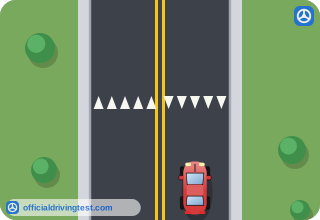
- The point at which you must yield or stop, if necessary
- The start of a crosswalk reserved for pedestrians only
- The point where a no passing zone ends
- The beginning of a reserved lane
Show answer
Correct answer: The point at which you must yield or stop, if necessary
A yield line may be used with a yield sign to show where you must yield or stop, if necessary.
Source: Virginia Driver's Manual (DMV 39 (April 27, 2026)), page 12 · Open this page in the manual (Manual page 12)
-
Where is a yield line often seen?
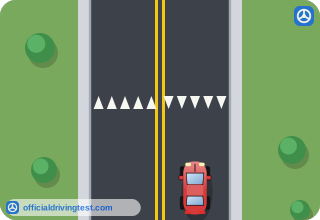
- At the entrance of a toll plaza
- At the start of a work zone
- At the entrance of a roundabout
- At the exit of a parking lot
Show answer
Correct answer: At the entrance of a roundabout
The manual says a yield line is often seen at the entrance of a roundabout.
Source: Virginia Driver's Manual (DMV 39 (April 27, 2026)), page 12 · Open this page in the manual (Manual page 12)
-
On a three-lane road with a center lane marked by a single broken yellow line on both sides, drivers going in either direction may use the center lane for what?
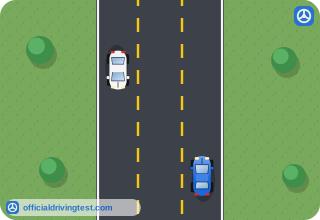
- Making left turns only
- Passing
- Stopping to load passengers
- Parking during rush hours
Show answer
Correct answer: Passing
A center lane with a single broken yellow line on both sides may be used by traffic in either direction for passing.
Source: Virginia Driver's Manual (DMV 39 (April 27, 2026)), page 12 · Open this page in the manual (Manual page 12)
-
On a three-lane road, both sides of the center lane are marked by a solid yellow line and a broken yellow line. What may drivers use that lane for?
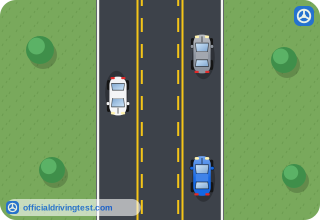
- Passing in either direction
- Driving in the same direction as a bus
- Waiting to merge onto a highway
- Making left turns
Show answer
Correct answer: Making left turns
With a solid and a broken yellow line on both sides, the center lane is for left turns, and drivers may not travel more than 150 feet in it.
Source: Virginia Driver's Manual (DMV 39 (April 27, 2026)), page 12 · Open this page in the manual (Manual page 12)
-
How far may drivers travel in a center lane marked with a solid and a broken yellow line on both sides?
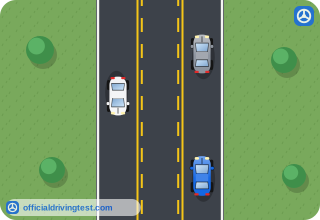
- No more than 50 feet
- No more than 250 feet
- No more than 500 feet
- No more than 150 feet
Show answer
Correct answer: No more than 150 feet
The manual says drivers using this center lane for left turns may not go further than 150 feet in it.
Source: Virginia Driver's Manual (DMV 39 (April 27, 2026)), page 12 · Open this page in the manual (Manual page 12)
-
A pavement marking shows a bicycle symbol with a double chevron arrow above it. What is it called?
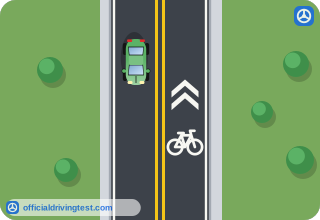
- A bicycle box at an intersection
- A shared lane marking, or sharrow
- A bicycle lane marking
- A bus lane marking
Show answer
Correct answer: A shared lane marking, or sharrow
A shared lane marking, or sharrow, consists of a bicycle symbol with a double chevron arrow above it.
Source: Virginia Driver's Manual (DMV 39 (April 27, 2026)), page 12 · Open this page in the manual (Manual page 12)
-
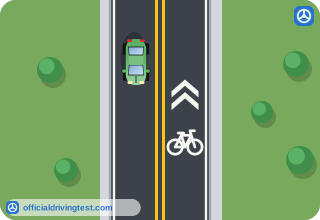
On which kind of travel lanes is a shared lane marking, or sharrow, used?
- Lanes that are reserved for buses and bicycles, not for cars
- Lanes where bicycles are not allowed
- Lanes too narrow for motor vehicles and bicycles to share side-by-side
- Lanes that lead to a toll plaza
Show answer
Correct answer: Lanes too narrow for motor vehicles and bicycles to share side-by-side
Sharrows are used on travel lanes that are too narrow for a car and a bicycle to travel side-by-side.
Source: Virginia Driver's Manual (DMV 39 (April 27, 2026)), page 12 · Open this page in the manual (Manual page 12)
-
How are bicycle lanes indicated?
- By a solid yellow line, red pavement markings, and a bicyclist symbol only
- By a solid or dashed white line or green pavement markings, and a bicyclist symbol
- By red pavement and the words BICYCLE ONLY
- By a double white line and a diamond symbol
Show answer
Correct answer: By a solid or dashed white line or green pavement markings, and a bicyclist symbol
A bicycle lane has a solid or dashed white line or green pavement markings plus a bicyclist symbol, and is for the preferential use of bicyclists.
Source: Virginia Driver's Manual (DMV 39 (April 27, 2026)), page 12 · Open this page in the manual (Manual page 12)
-
How are bus-only lanes indicated?
- By a double solid white line and a bicycle symbol
- By BUS ONLY markings and/or red-colored pavement
- By green pavement and a bicycle symbol
- By BUS ONLY markings and blue-colored pavement
Show answer
Correct answer: By BUS ONLY markings and/or red-colored pavement
Bus-only lanes are shown by BUS ONLY markings and/or red-colored pavement.
Source: Virginia Driver's Manual (DMV 39 (April 27, 2026)), page 13 · Open this page in the manual (Manual page 13)