Virginia: Parking rules Practice Test
Parking at the curb and on hills, painted curbs, and the places and distances where you may not park.
Independent educational site · not affiliated with any government agency or DMV
Ready? Test yourself
- Instant feedback with an explanation
- Every answer cites its source in the manual
- Your best score is saved on this device
- Keyboard: press 1 to 4 to answer and Enter for the next question
Questions are original and based on the official manual "Virginia Driver's Manual" (DMV 39 (April 27, 2026)), Virginia Department of Motor Vehicles (DMV).
All 31 questions in this practice test
Take the test above first, then use this list to study. Tap “Show answer” to see the correct answer and explanation.
Show the questions and answersHide the questions
-
Who may use parking spaces marked with disabled parking signs?
- Anyone who is parking for less than 15 minutes
- Only drivers over a certain age
- People with disabled parking permits
- Anyone with a valid driver’s license
Show answer
Correct answer: People with disabled parking permits
These spaces are reserved for people who hold disabled parking permits.
Source: Virginia Driver's Manual (DMV 39 (April 27, 2026)), page 7 · Open this page in the manual (Manual page 7)
-
What should you do to learn the specific meaning of a painted curb?
- Check with the Department of Motor Vehicles
- Check the color chart in the driver’s manual
- Check with the locality
- Ask the nearest law enforcement officer
Show answer
Correct answer: Check with the locality
A painted curb means special parking rules apply, and the manual says to check with the locality for specific meanings.
Source: Virginia Driver's Manual (DMV 39 (April 27, 2026)), page 13 · Open this page in the manual (Manual page 13)
-
What does a white painted curb generally mean?
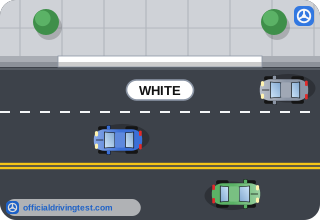
- Stop only long enough to load or unload; stay with your car
- Do not stop, stand or park
- Stop only long enough to pick up or drop off passengers
- Parking is allowed for as long as you wish
Show answer
Correct answer: Stop only long enough to pick up or drop off passengers
A white curb generally allows stopping only to pick up or drop off passengers.
Source: Virginia Driver's Manual (DMV 39 (April 27, 2026)), page 13 · Open this page in the manual (Manual page 13)
-
What does a yellow painted curb generally mean?
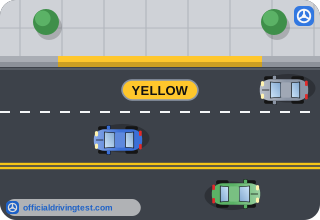
- Stop only long enough to load or unload; stay with your car
- Stop only long enough to pick up or drop off passengers
- Do not stop, stand or park
- Parking is allowed for as long as you wish
Show answer
Correct answer: Stop only long enough to load or unload; stay with your car
A yellow curb generally allows stopping only to load or unload, and you should stay with your car.
Source: Virginia Driver's Manual (DMV 39 (April 27, 2026)), page 13 · Open this page in the manual (Manual page 13)
-
What does a red painted curb generally mean?
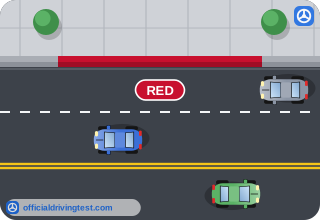
- Stop only long enough to pick up or drop off passengers
- Stop only long enough to load or unload; stay with your car
- Parking is allowed for up to 15 minutes
- Do not stop, stand or park
Show answer
Correct answer: Do not stop, stand or park
A red curb generally means you may not stop, stand or park there.
Source: Virginia Driver's Manual (DMV 39 (April 27, 2026)), page 13 · Open this page in the manual (Manual page 13)
-
When parking on a public road, where should you place your vehicle?
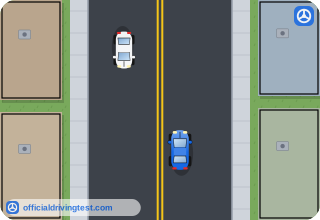
- As close to traffic as possible
- Close to the center line of the road
- Close to the nearest intersection
- As far from traffic as possible
Show answer
Correct answer: As far from traffic as possible
On a public road you should move as far from traffic as possible when you park.
Source: Virginia Driver's Manual (DMV 39 (April 27, 2026)), page 22 · Open this page in the manual (Manual page 22)
-
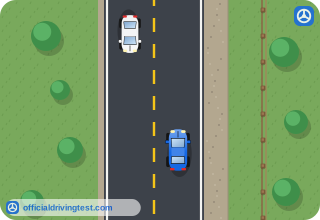
If you park on a shoulder, how far should you pull over?
- Only far enough to clear the traffic lane
- Halfway onto the shoulder
- Exactly one foot from the edge of the road
- As far onto the shoulder as possible
Show answer
Correct answer: As far onto the shoulder as possible
When parking on a shoulder, you pull over as far on the shoulder as possible.
Source: Virginia Driver's Manual (DMV 39 (April 27, 2026)), page 22 · Open this page in the manual (Manual page 22)
-
What is the greatest distance from the curb at which you may park?
- Two feet
- One foot
- Three feet
- Four feet
Show answer
Correct answer: One foot
You may not park more than one foot from the curb.
Source: Virginia Driver's Manual (DMV 39 (April 27, 2026)), page 22 · Open this page in the manual (Manual page 22)
-
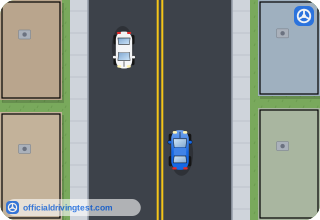
On a two-way street, which side of the road should you park on?
- The left side
- Either side
- The right side
- The side with fewer parked cars
Show answer
Correct answer: The right side
On a two-way street you park on the right side of the road.
Source: Virginia Driver's Manual (DMV 39 (April 27, 2026)), page 22 · Open this page in the manual (Manual page 22)
-
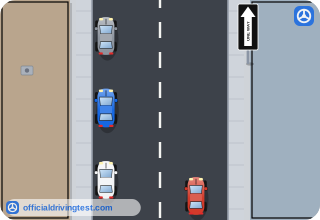
On a one-way road, where may you park?
- On either side of the road
- Only on the right side
- Only on the left side
- Only in marked parking spaces
Show answer
Correct answer: On either side of the road
On a one-way road you may park on either side.
Source: Virginia Driver's Manual (DMV 39 (April 27, 2026)), page 22 · Open this page in the manual (Manual page 22)
-
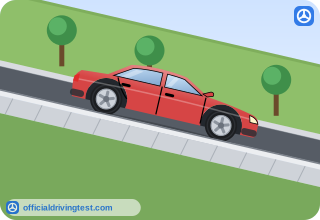
You are parked facing downhill next to a curb. Which way should you turn the front wheels?
- To the left
- To the right
- Straight ahead
- Either direction, as long as the parking brake is set
Show answer
Correct answer: To the right
With a curb, a vehicle parked downhill has its front wheels turned right.
Source: Virginia Driver's Manual (DMV 39 (April 27, 2026)), page 22 · Open this page in the manual (Manual page 22)
-
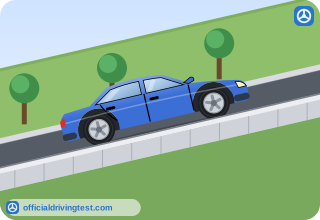
You are parked facing uphill next to a curb. Which way should you turn the front wheels?
- To the right
- Straight ahead
- Either direction, as long as the parking brake is set
- To the left
Show answer
Correct answer: To the left
With a curb, a vehicle parked uphill has its front wheels turned left.
Source: Virginia Driver's Manual (DMV 39 (April 27, 2026)), page 22 · Open this page in the manual (Manual page 22)
-
You are parked facing uphill on a road with no curb. Which way should you turn the front wheels?
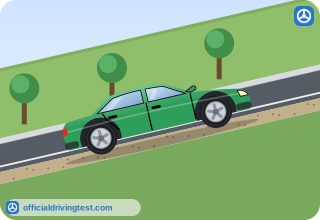
- To the right
- To the left
- Straight ahead
- Either direction, as long as the parking brake is set
Show answer
Correct answer: To the right
Without a curb, a vehicle parked uphill has its front wheels turned right.
Source: Virginia Driver's Manual (DMV 39 (April 27, 2026)), page 22 · Open this page in the manual (Manual page 22)
-
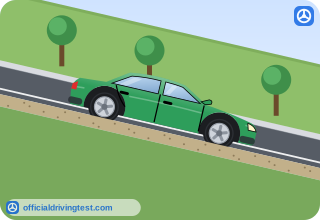
You are parked facing downhill on a road with no curb. Which way should you turn the front wheels?
- To the left
- Straight ahead
- To the right
- Either direction, as long as the parking brake is set
Show answer
Correct answer: To the right
Without a curb, a vehicle parked downhill has its front wheels turned right.
Source: Virginia Driver's Manual (DMV 39 (April 27, 2026)), page 22 · Open this page in the manual (Manual page 22)
-
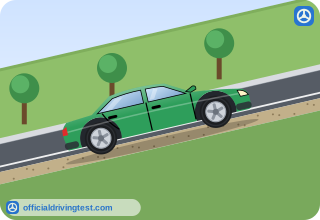
When you park on a hill without a curb, the front wheels should be turned so that if the vehicle rolls, what happens?
- The front of the vehicle rolls into the street
- The rear of the vehicle rolls toward traffic
- The rear of the vehicle rolls away from traffic
- The vehicle rolls back toward the center of the road
Show answer
Correct answer: The rear of the vehicle rolls away from traffic
Without a curb, the wheels are turned so that a rolling vehicle sends its rear away from traffic.
Source: Virginia Driver's Manual (DMV 39 (April 27, 2026)), page 22 · Open this page in the manual (Manual page 22)
-
Why do you turn the front wheels when you park on a hill with a curb?
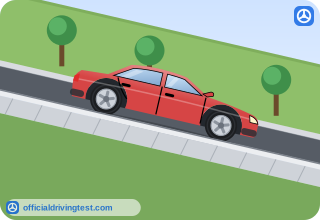
- To prevent the vehicle from rolling into the street
- To keep the tires from wearing unevenly
- To make it easier to pull out of the space later
- To keep the steering wheel from locking
Show answer
Correct answer: To prevent the vehicle from rolling into the street
With a curb, the wheels are turned to stop the vehicle from rolling into the street.
Source: Virginia Driver's Manual (DMV 39 (April 27, 2026)), page 22 · Open this page in the manual (Manual page 22)
-
What should you do before opening your door when you exit your vehicle?
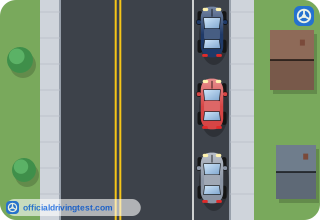
- Sound your horn to warn any people nearby
- Turn on your hazard lights
- Wait for the engine to cool down
- Look for other cars, bicyclists and pedestrians
Show answer
Correct answer: Look for other cars, bicyclists and pedestrians
Other traffic may be close, so look for cars, bicyclists and pedestrians before you open the door.
Source: Virginia Driver's Manual (DMV 39 (April 27, 2026)), page 22 · Open this page in the manual (Manual page 22)
-
Within how many feet of a fire hydrant may you not park?
- 5 feet
- 15 feet
- 10 feet
- 25 feet
Show answer
Correct answer: 15 feet
Parking within 15 feet of a fire hydrant is not allowed.
Source: Virginia Driver's Manual (DMV 39 (April 27, 2026)), page 22 · Open this page in the manual (Manual page 22)
-
Within how many feet of an intersection may you not park?
- 20 feet
- 10 feet
- 30 feet
- 40 feet
Show answer
Correct answer: 20 feet
You may not park within 20 feet of an intersection.
Source: Virginia Driver's Manual (DMV 39 (April 27, 2026)), page 22 · Open this page in the manual (Manual page 22)
-
Within how many feet of the entrance to a fire, ambulance or rescue squad station may you not park?
- 5 feet
- 25 feet
- 15 feet
- 30 feet
Show answer
Correct answer: 15 feet
Parking within 15 feet of the entrance to a fire, ambulance or rescue squad station is not allowed.
Source: Virginia Driver's Manual (DMV 39 (April 27, 2026)), page 22 · Open this page in the manual (Manual page 22)
-
Within how many feet of where fire trucks or equipment are stopped answering an alarm may you not park?
- 100 feet
- 500 feet
- 250 feet
- 1,000 feet
Show answer
Correct answer: 500 feet
You may not park within 500 feet of fire trucks or equipment that are stopped to answer an alarm.
Source: Virginia Driver's Manual (DMV 39 (April 27, 2026)), page 22 · Open this page in the manual (Manual page 22)
-
Within how many feet of a railroad crossing may you not park?
- 15 feet
- 30 feet
- 100 feet
- 50 feet
Show answer
Correct answer: 50 feet
Parking within 50 feet of a railroad crossing is not allowed.
Source: Virginia Driver's Manual (DMV 39 (April 27, 2026)), page 22 · Open this page in the manual (Manual page 22)
-
Which of these is a place where you may not park?
- On the right side of a two-way street
- On either side of a one-way road
- Next to a curb, no more than one foot from it
- Beside another parked vehicle (double parking)
Show answer
Correct answer: Beside another parked vehicle (double parking)
Parking beside another parked vehicle, called double parking, is not allowed.
Source: Virginia Driver's Manual (DMV 39 (April 27, 2026)), page 22 · Open this page in the manual (Manual page 22)
-
Which of these is a place where you may not park?
- On either side of a one-way road
- On a crosswalk or a sidewalk
- On a shoulder, as far off the road as possible
- Next to a curb, no more than one foot from it
Show answer
Correct answer: On a crosswalk or a sidewalk
Crosswalks and sidewalks are places where you may not park.
Source: Virginia Driver's Manual (DMV 39 (April 27, 2026)), page 22 · Open this page in the manual (Manual page 22)
-
Which of these is a place where you may not park?
- On the right side of a two-way street
- On a shoulder, as far off the road as possible
- In front of a driveway
- Next to a curb, no more than one foot from it
Show answer
Correct answer: In front of a driveway
Parking in front of driveways is not allowed.
Source: Virginia Driver's Manual (DMV 39 (April 27, 2026)), page 22 · Open this page in the manual (Manual page 22)
-
A curb is painted yellow, or a No Parking sign is posted. What does the manual say about parking there?
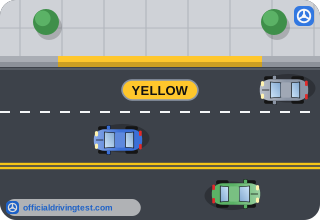
- You may not park there
- You may park there on weekends only
- You may park there with your hazard lights on
- You may park there only at night
Show answer
Correct answer: You may not park there
Curbs painted yellow and No Parking signs mark areas where parking is prohibited.
Source: Virginia Driver's Manual (DMV 39 (April 27, 2026)), page 22 · Open this page in the manual (Manual page 22)
-
Which of these is a place where you may not park?
- On the right side of a two-way street
- In a space reserved for disabled persons
- On either side of a one-way road
- On a shoulder, as far off the road as possible
Show answer
Correct answer: In a space reserved for disabled persons
A parking space reserved for disabled persons is off limits to others.
Source: Virginia Driver's Manual (DMV 39 (April 27, 2026)), page 22 · Open this page in the manual (Manual page 22)
-
Which of these is a place where you may not park?
- On the right side of a two-way street
- On either side of a one-way road
- Next to a curb, no more than one foot from it
- In a striped aisle next to a disabled space
Show answer
Correct answer: In a striped aisle next to a disabled space
The striped access aisles next to spaces reserved for disabled persons may not be used for parking.
Source: Virginia Driver's Manual (DMV 39 (April 27, 2026)), page 22 · Open this page in the manual (Manual page 22)
-
Which of these is a place where you may not park?
- On the hard surface of a road with no curb
- On the right side of a two-way street
- On either side of a one-way road
- On a shoulder, as far off the road as possible
Show answer
Correct answer: On the hard surface of a road with no curb
When no curb is present you may not park on the hard surface of the road.
Source: Virginia Driver's Manual (DMV 39 (April 27, 2026)), page 22 · Open this page in the manual (Manual page 22)
-
Which of these is a place where you may not park?
- On the right side of a two-way street
- On a shoulder, as far off the road as possible
- In a bike lane
- Next to a curb, no more than one foot from it
Show answer
Correct answer: In a bike lane
A bike lane is a place where parking is not allowed.
Source: Virginia Driver's Manual (DMV 39 (April 27, 2026)), page 22 · Open this page in the manual (Manual page 22)
-
Which of these is a place where you may not park?
- On either side of a one-way road
- On a shoulder, as far off the road as possible
- Where you create a hazard in a traffic lane
- Next to a curb, no more than one foot from it
Show answer
Correct answer: Where you create a hazard in a traffic lane
You may not park in a way that blocks other vehicles or creates a hazard for them in a designated traffic lane.
Source: Virginia Driver's Manual (DMV 39 (April 27, 2026)), page 22 · Open this page in the manual (Manual page 22)