Virginia: Emergency vehicles and work zones
Yielding to vehicles with flashing lights, the move-over rules, police traffic stops, flaggers and work zone fines. Split into 2 shorter tests so you're not stuck in one long quiz.
Independent educational site · not affiliated with any government agency or DMV
All 46 Emergency vehicles and work zones questions with answers
Choose a part above to take a practice test, or study every question and answer here.
Show the questions and answersHide the questions
-
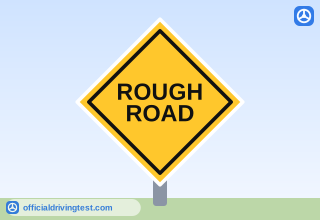
Which road conditions may a rough road warning sign refer to?
- Conditions such as flooding or ice that cover most of the road surface
- Conditions such as falling rocks that block the travel lanes
- Conditions such as heavy fog that make the road surface hard to see
- Conditions such as loose gravel or road construction that affect the road surface
Show answer
Correct answer: Conditions such as loose gravel or road construction that affect the road surface
Rough road, bump and uneven lanes signs warn that loose gravel or construction has affected the surface, which is difficult especially for motorcyclists.
Source: Virginia Driver's Manual (DMV 39 (April 27, 2026)), page 10 · Open this page in the manual (Manual page 10)
-
What do road construction ahead and detour signs indicate?
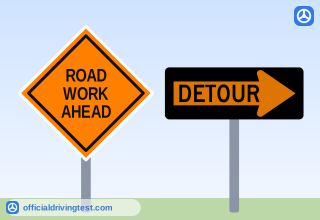
- A change in the traffic pattern or route ahead
- That the work zone speed limit has ended
- That the road ahead is permanently closed
- That flaggers will direct traffic for the next mile
Show answer
Correct answer: A change in the traffic pattern or route ahead
These signs indicate a change in the traffic pattern or route, so you should slow down because conditions ahead may be unusual or dangerous.
Source: Virginia Driver's Manual (DMV 39 (April 27, 2026)), page 10 · Open this page in the manual (Manual page 10)
-
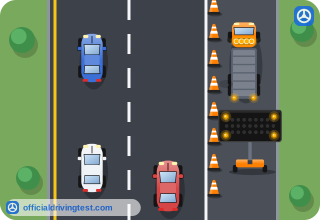
What do large flashing arrow boards or flashing message signs in work zones tell drivers?
- To stop completely and wait until a flagger gives a signal to proceed
- To reduce speed to 25 MPH through the work zone
- To proceed into different traffic lanes because part of the road ahead is closed
- To leave the road and use the nearest shoulder
Show answer
Correct answer: To proceed into different traffic lanes because part of the road ahead is closed
Flashing arrow boards direct drivers into different lanes and inform them that part of the road ahead is closed.
Source: Virginia Driver's Manual (DMV 39 (April 27, 2026)), page 10 · Open this page in the manual (Manual page 10)
-
What do flaggers normally wear?
- Red or blue vests, or white shirts or jackets with stripes
- White coveralls and red helmets
- Orange or yellow vests, or yellow-green shirts or jackets
- Black shirts with white stripes
Show answer
Correct answer: Orange or yellow vests, or yellow-green shirts or jackets
Flaggers are highway workers who normally wear orange or yellow vests, or yellow-green shirts or jackets.
Source: Virginia Driver's Manual (DMV 39 (April 27, 2026)), page 10 · Open this page in the manual (Manual page 10)
-
What do flaggers use to stop or direct traffic through a work zone?
- STOP/SLOW paddles or red flags
- Green flags or flashlights
- Blue flags or lanterns
- Whistles or orange cones
Show answer
Correct answer: STOP/SLOW paddles or red flags
Flaggers use STOP/SLOW paddles or red flags to stop or direct traffic and to let workers or construction vehicles cross the road.
Source: Virginia Driver's Manual (DMV 39 (April 27, 2026)), page 10 · Open this page in the manual (Manual page 10)
-
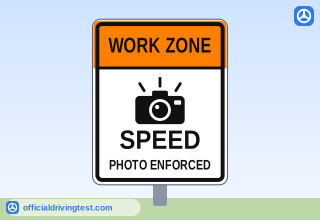
You see a sign in a work zone with a camera symbol. What does it indicate?
- Cameras are counting vehicles to plan future road work
- Cameras are recording the flaggers’ signals for training
- Cameras are watching for drivers who change lanes in the work zone
- Automated photo enforcement is in place for speeding in the work zone
Show answer
Correct answer: Automated photo enforcement is in place for speeding in the work zone
The photo speed enforcement sign means automated photo enforcement for speeding is in place, so always obey the posted work zone speed limit.
Source: Virginia Driver's Manual (DMV 39 (April 27, 2026)), page 10 · Open this page in the manual (Manual page 10)
-
When driving near traffic control devices such as barricades, drums and cones in a work zone, where should you keep your vehicle?
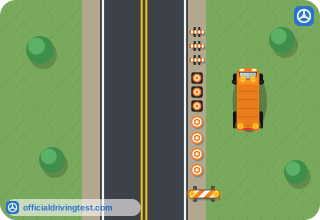
- Close to the devices for a better view
- In the middle of the lane
- As far toward the left as possible
- On the shoulder of the road
Show answer
Correct answer: In the middle of the lane
The manual says to keep your vehicle in the middle of the lane and obey the posted speed limit near the devices.
Source: Virginia Driver's Manual (DMV 39 (April 27, 2026)), page 10 · Open this page in the manual (Manual page 10)
-
As you leave a work zone, when may you change lanes?
- Only when you are completely clear of the work zone
- As soon as you have passed the last cone or drum
- As soon as the work zone speed limit ends
- As soon as the lane ahead looks open
Show answer
Correct answer: Only when you are completely clear of the work zone
You should stay in your lane and keep your speed until you are completely clear of the work zone.
Source: Virginia Driver's Manual (DMV 39 (April 27, 2026)), page 10 · Open this page in the manual (Manual page 10)
-
Which of these is one of the most common devices used to guide drivers safely through work zones?
- Speed humps
- Toll booths
- Concrete barriers
- Yield lines
Show answer
Correct answer: Concrete barriers
The manual lists barricades, vertical signs, concrete barriers, drums and cones as the most common devices for guiding drivers through work zones.
Source: Virginia Driver's Manual (DMV 39 (April 27, 2026)), page 10 · Open this page in the manual (Manual page 10)
-
If you are convicted of exceeding the speed limit in a highway work zone, what penalty may you face?
- A fine of up to $100
- A fine of up to $500
- A fine of up to $300
- A fine of up to $750
Show answer
Correct answer: A fine of up to $500
The manual says a conviction for speeding in a highway work zone can bring a fine of up to $500.
Source: Virginia Driver's Manual (DMV 39 (April 27, 2026)), page 10 · Open this page in the manual (Manual page 10)
-
If you are convicted of using a handheld communications device in a highway work zone, what penalty will you face?
- A fine of $100
- A fine of $150
- A fine of $350
- A fine of $250
Show answer
Correct answer: A fine of $250
The manual states that using a handheld communications device in a highway work zone results in a $250 fine.
Source: Virginia Driver's Manual (DMV 39 (April 27, 2026)), page 10 · Open this page in the manual (Manual page 10)
-
What kind of information do portable or permanent message boards along roadways provide?
- Information about nearby rest areas, fuel stops and restaurants
- Information about local speed limits in school zones
- Information about toll rates and transponder accounts
- Information about traffic, road, weather or other hazardous conditions
Show answer
Correct answer: Information about traffic, road, weather or other hazardous conditions
Message boards provide information about traffic, road, weather or other hazardous conditions.
Source: Virginia Driver's Manual (DMV 39 (April 27, 2026)), page 11 · Open this page in the manual (Manual page 11)
-
What should you do about directions posted on a message board along the road?
- Obey them only in work zones
- Always obey them
- Treat them as advice only
- Obey them only if a flagger is present
Show answer
Correct answer: Always obey them
The manual says to always obey any directions posted on message boards.
Source: Virginia Driver's Manual (DMV 39 (April 27, 2026)), page 11 · Open this page in the manual (Manual page 11)
-
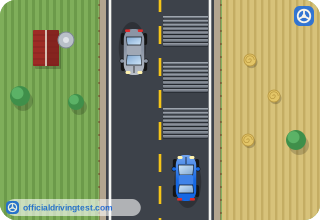
How should you drive over rumble strips placed in advance of a work zone?
- Drive over them quickly to reduce the vibration
- Swerve around them into the next lane
- Slowly drive over them, and do not swerve around them
- Stop completely before driving over them
Show answer
Correct answer: Slowly drive over them, and do not swerve around them
Rumble strips should be driven over slowly and never swerved around.
Source: Virginia Driver's Manual (DMV 39 (April 27, 2026)), page 11 · Open this page in the manual (Manual page 11)
-
What color are the strips that a Rumble Strips Ahead sign warns of?
- Black or orange
- Red or white
- Yellow or green
- Blue or white
Show answer
Correct answer: Black or orange
The sign warns of black or orange strips across the travel lanes in advance of work zones.
Source: Virginia Driver's Manual (DMV 39 (April 27, 2026)), page 11 · Open this page in the manual (Manual page 11)
-
For which of these must you always stop your vehicle?
- A speed limit sign
- A curve warning sign ahead
- A flagger signaling you to stop
- A green traffic light
Show answer
Correct answer: A flagger signaling you to stop
You must always stop when signaled by flaggers directing traffic.
Source: Virginia Driver's Manual (DMV 39 (April 27, 2026)), page 15 · Open this page in the manual (Manual page 15)
-
If you don’t obey a law enforcement officer’s signal to stop and the officer pursues you and is killed as a direct result of the pursuit, what are you guilty of?
- A Class 4 felony
- A Class 2 misdemeanor
- A Class 1 felony
- A Class 3 misdemeanor
Show answer
Correct answer: A Class 4 felony
Causing an officer’s death in a pursuit after ignoring a stop signal is a Class 4 felony.
Source: Virginia Driver's Manual (DMV 39 (April 27, 2026)), page 15 · Open this page in the manual (Manual page 15)
-
Which colors of flashing or blinking lights on a vehicle require drivers to take specific actions?
- Blue, red, amber (yellow) or white
- Red, green, amber (yellow) or white
- Blue, green, purple or white
- Red, amber (yellow) or green only
Show answer
Correct answer: Blue, red, amber (yellow) or white
The manual lists flashing or blinking blue, red, amber (yellow) or white lights.
Source: Virginia Driver's Manual (DMV 39 (April 27, 2026)), page 16 · Open this page in the manual (Manual page 16)
-
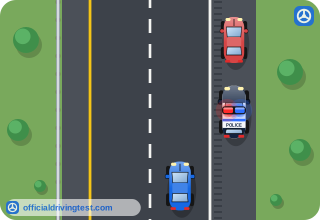
When approaching a stationary emergency vehicle or tow truck with flashing lights on a highway, what should you do, if reasonable and safe?
- Stop behind it until its lights turn off
- Move into the lane next to it so you can pass quickly
- Sound your horn to warn the driver
- Change to a lane not next to the vehicle
Show answer
Correct answer: Change to a lane not next to the vehicle
You should proceed with caution and, if reasonable, move to a lane not next to the vehicle.
Source: Virginia Driver's Manual (DMV 39 (April 27, 2026)), page 16 · Open this page in the manual (Manual page 16)
-
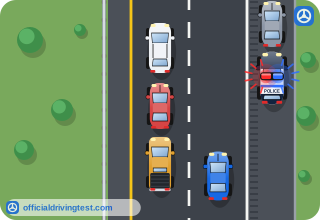
You are approaching a stationary emergency vehicle with flashing lights and cannot safely change lanes. What should you do?
- Stop until the vehicle leaves
- Reduce your speed and proceed with caution
- Maintain your speed and pass quickly
- Pull onto the shoulder and wait
Show answer
Correct answer: Reduce your speed and proceed with caution
If you cannot change lanes safely, reduce your speed and proceed with caution.
Source: Virginia Driver's Manual (DMV 39 (April 27, 2026)), page 16 · Open this page in the manual (Manual page 16)
-
What can result from violating the rules for approaching a stationary emergency vehicle or tow truck with flashing lights?
- A written warning and a required driver education course
- Court suspension of your driver’s license and demerit points
- Cancellation of your vehicle registration
- Permanent loss of your learner’s permit only
Show answer
Correct answer: Court suspension of your driver’s license and demerit points
Violations can lead to court suspension of your license and demerit points.
Source: Virginia Driver's Manual (DMV 39 (April 27, 2026)), page 16 · Open this page in the manual (Manual page 16)
-
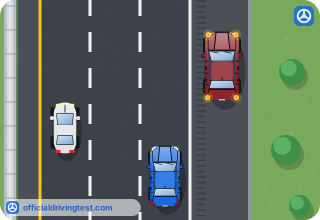
What are you required to do when passing stationary vehicles that have activated hazard flashers, displayed caution signs, or been marked with properly lit flares or torches?
- Stop and wait for the vehicle to move
- Sound your horn and pass on the right
- Slow to a crawl and stay in your lane
- Make a lane change and proceed with caution
Show answer
Correct answer: Make a lane change and proceed with caution
You are required to change lanes and proceed with caution.
Source: Virginia Driver's Manual (DMV 39 (April 27, 2026)), page 16 · Open this page in the manual (Manual page 16)
-
When passing a stationary vehicle collecting trash on a highway of at least four lanes, what should you do if you can change lanes safely?
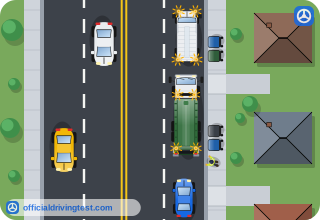
- Change to a lane not next to the vehicle
- Stop until the trash collection is finished
- Pass on the right shoulder
- Sound your horn and pass quickly
Show answer
Correct answer: Change to a lane not next to the vehicle
On a highway of at least four lanes, you change to a lane not next to the trash vehicle if you can do so safely.
Source: Virginia Driver's Manual (DMV 39 (April 27, 2026)), page 16 · Open this page in the manual (Manual page 16)
-
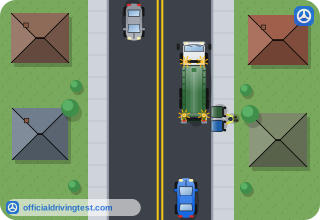
On a highway of fewer than four lanes, you cannot change lanes to pass a stationary trash collection vehicle. By how much must you slow below the posted speed limit?
- 5 MPH
- 15 MPH
- 10 MPH
- 20 MPH
Show answer
Correct answer: 10 MPH
You must slow down to 10 MPH below the posted speed limit.
Source: Virginia Driver's Manual (DMV 39 (April 27, 2026)), page 16 · Open this page in the manual (Manual page 16)
-
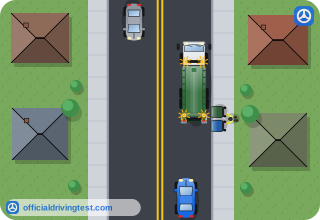
On a highway of fewer than four lanes, how far to the left of a stationary trash collection vehicle must you pass?
- At least one foot
- At least four feet
- At least five feet
- At least two feet
Show answer
Correct answer: At least two feet
You must pass at least two feet to the left of the trash collection vehicle.
Source: Virginia Driver's Manual (DMV 39 (April 27, 2026)), page 16 · Open this page in the manual (Manual page 16)
-
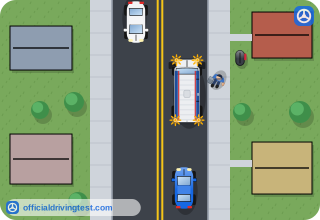
What should you do when passing a stationary mail vehicle?
- Change lanes and slow to 10 MPH below the limit
- Proceed with caution at a safe speed for highway conditions
- Stop and wait until the mail carrier returns to the vehicle
- Pass at least two feet to the left of the vehicle
Show answer
Correct answer: Proceed with caution at a safe speed for highway conditions
For a stationary mail vehicle, you proceed with caution at a safe speed for the highway conditions.
Source: Virginia Driver's Manual (DMV 39 (April 27, 2026)), page 16 · Open this page in the manual (Manual page 16)
-
How close may you follow an emergency vehicle when its lights are flashing?
- No closer than 500 feet
- No closer than 100 feet
- No closer than 200 feet
- No closer than 300 feet
Show answer
Correct answer: No closer than 500 feet
You must never follow an emergency vehicle closer than 500 feet when its lights are flashing.
Source: Virginia Driver's Manual (DMV 39 (April 27, 2026)), page 16 · Open this page in the manual (Manual page 16)
-
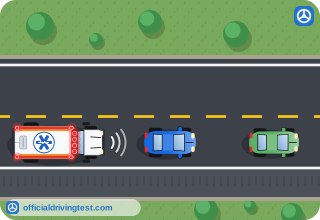
A police, fire or rescue vehicle or an ambulance approaches from behind using a siren, flashing lights or both. What must you do?
- Immediately yield, pull over to the right edge and stop until it passes
- Slow down and stay in your current lane until it has passed
- Pull over to the left edge of the road and stop until it passes
- Pull over only if it is directly behind you
Show answer
Correct answer: Immediately yield, pull over to the right edge and stop until it passes
You must yield right away, pull to the right edge of the road and stop until the emergency vehicle has passed.
Source: Virginia Driver's Manual (DMV 39 (April 27, 2026)), page 16 · Open this page in the manual (Manual page 16)
-
An emergency vehicle approaches you in the opposite lane on an undivided highway. What must you do?
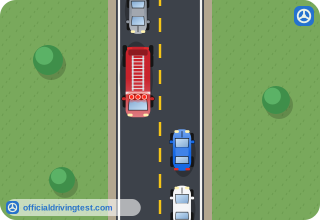
- Continue driving in your lane at a reduced speed while it passes
- Stop where you are in your lane
- Pull over to the edge of the road and stop until it passes
- Move to the left shoulder and wait
Show answer
Correct answer: Pull over to the edge of the road and stop until it passes
You must pull over to the edge of the road and stop until the emergency vehicle passes.
Source: Virginia Driver's Manual (DMV 39 (April 27, 2026)), page 16 · Open this page in the manual (Manual page 16)
-
Where do the requirements for yielding to vehicles with flashing lights not apply?
- In school zones
- In highway work zones
- In residential areas
- On toll roads
Show answer
Correct answer: In highway work zones
The manual’s rules for vehicles with flashing lights do not apply in highway work zones.
Source: Virginia Driver's Manual (DMV 39 (April 27, 2026)), page 16 · Open this page in the manual (Manual page 16)
-
When a police officer signals you to stop, what should you do with your vehicle?
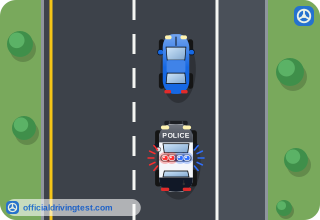
- Pull to the side of the road in a safe location and park
- Stop in your lane of travel and wait for the officer
- Keep driving until you reach a police station
- Pull over only if the officer follows you for a mile
Show answer
Correct answer: Pull to the side of the road in a safe location and park
The manual says to pull your vehicle to the side of the road in a safe location and park.
Source: Virginia Driver's Manual (DMV 39 (April 27, 2026)), page 26 · Open this page in the manual (Manual page 26)
-
During a traffic stop, what should you do about getting out of your vehicle?
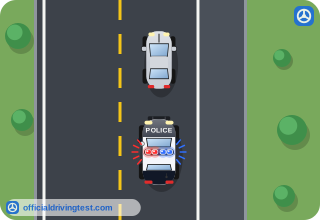
- Get out and walk toward the officer’s car
- Get out and stand beside your vehicle
- Stay in it unless the officer asks you to get out
- Get out to show the officer your documents
Show answer
Correct answer: Stay in it unless the officer asks you to get out
You should stay in your vehicle and get out only if the officer asks you to.
Source: Virginia Driver's Manual (DMV 39 (April 27, 2026)), page 26 · Open this page in the manual (Manual page 26)
-
What should you turn on when you are stopped by a police officer?
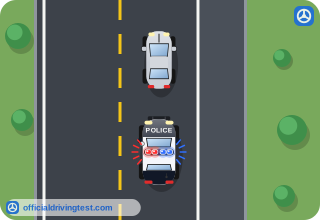
- Your high beams
- Your flashers
- Your windshield wipers
- Your radio
Show answer
Correct answer: Your flashers
The manual tells drivers stopped by an officer to turn on their flashers.
Source: Virginia Driver's Manual (DMV 39 (April 27, 2026)), page 26 · Open this page in the manual (Manual page 26)
-
If you are pulled over by a police officer at night, what should you turn on?
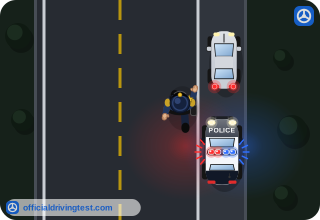
- Your high beam headlights
- Your fog lights
- Your radio and cabin fan
- Your vehicle’s interior lights
Show answer
Correct answer: Your vehicle’s interior lights
The manual says that if you are pulled over at night, you should turn on your vehicle’s interior lights.
Source: Virginia Driver's Manual (DMV 39 (April 27, 2026)), page 26 · Open this page in the manual (Manual page 26)
-
What should you turn off when a police officer stops you?
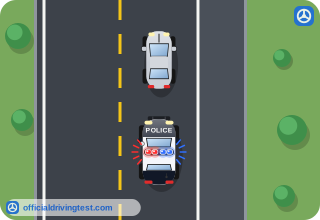
- Engine, radio and any device that could block communication
- Only the engine, leaving the radio and phone on
- Only your headlights and your flashers
- Nothing, so that you are ready to drive away quickly
Show answer
Correct answer: Engine, radio and any device that could block communication
You should turn off the engine, radio and any other device that could block communication with the officer.
Source: Virginia Driver's Manual (DMV 39 (April 27, 2026)), page 26 · Open this page in the manual (Manual page 26)
-
During a traffic stop, what should you do with your window?
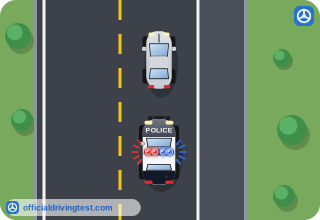
- Leave it up and hold your license against the glass
- Leave it up until the officer opens the door
- Roll it down so you can communicate with the officer
- Roll it down only if the officer asks twice
Show answer
Correct answer: Roll it down so you can communicate with the officer
Rolling down your window lets you communicate with the officer.
Source: Virginia Driver's Manual (DMV 39 (April 27, 2026)), page 26 · Open this page in the manual (Manual page 26)
-
From which side of your vehicle may an officer approach you during a traffic stop?
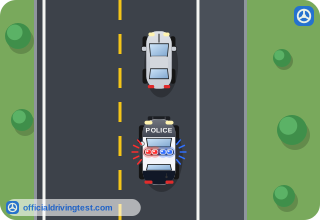
- Only the driver side, never the passenger side
- Either the driver side or the passenger side
- Only the passenger side, never the driver side
- Only the side away from passing traffic
Show answer
Correct answer: Either the driver side or the passenger side
The manual says an officer may approach on the driver or passenger side for safety reasons.
Source: Virginia Driver's Manual (DMV 39 (April 27, 2026)), page 26 · Open this page in the manual (Manual page 26)
-
During a traffic stop, what should you do about safety belts?
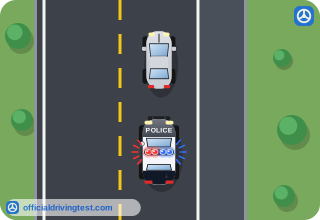
- Unfasten yours so you can reach your documents
- Unfasten yours, but ask passengers to stay buckled
- Unfasten all belts once the vehicle is parked
- Keep yours and your passengers’ belts fastened
Show answer
Correct answer: Keep yours and your passengers’ belts fastened
You should keep your own belt fastened and ask your passengers to keep theirs fastened.
Source: Virginia Driver's Manual (DMV 39 (April 27, 2026)), page 26 · Open this page in the manual (Manual page 26)
-
Where should you keep your hands during a traffic stop?
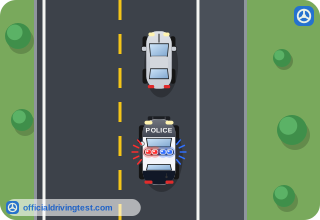
- In plain view, preferably on the steering wheel
- Out of sight in your lap until asked
- In your pockets until the officer speaks
- Inside the glove box with your documents
Show answer
Correct answer: In plain view, preferably on the steering wheel
Keep your hands in plain view, preferably on the steering wheel, and ask your passengers to keep their hands in plain view too.
Source: Virginia Driver's Manual (DMV 39 (April 27, 2026)), page 26 · Open this page in the manual (Manual page 26)
-
Which movement should you avoid during a traffic stop?
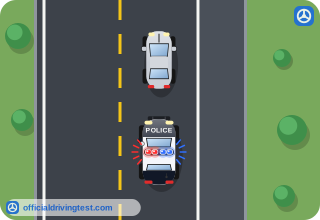
- Placing your hands on the steering wheel
- Slowly rolling down your window
- Reaching or moving as if hiding something
- Turning off your engine
Show answer
Correct answer: Reaching or moving as if hiding something
Any movement that makes the officer think you are hiding or reaching for something should be avoided.
Source: Virginia Driver's Manual (DMV 39 (April 27, 2026)), page 26 · Open this page in the manual (Manual page 26)
-
Which documents should you carry in case an officer asks for identification during a traffic stop?
- Driver’s license, vehicle title and a birth certificate
- Valid driver’s license, proof of registration and proof of insurance
- Driver’s license, proof of inspection and Social Security card
- Registration, proof of insurance and a copy of your vehicle title
Show answer
Correct answer: Valid driver’s license, proof of registration and proof of insurance
The manual lists a valid driver’s license, proof of vehicle registration and proof of insurance.
Source: Virginia Driver's Manual (DMV 39 (April 27, 2026)), page 26 · Open this page in the manual (Manual page 26)
-
When an officer asks for your documents during a traffic stop, what should you do?
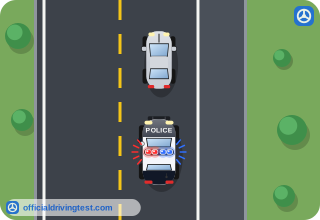
- Reach into the glove box right away without saying anything
- Quickly reach under the seat while keeping both hands moving
- Step out of the vehicle to look for them in the trunk
- Say where they are, then reach slowly with one hand on the wheel
Show answer
Correct answer: Say where they are, then reach slowly with one hand on the wheel
You should tell the officer where the documents are and reach for them slowly, keeping one hand on the steering wheel.
Source: Virginia Driver's Manual (DMV 39 (April 27, 2026)), page 26 · Open this page in the manual (Manual page 26)
-
If the officer who stops you is driving an unmarked car or is not in uniform, what may you do?
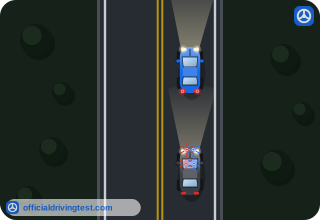
- Ask to see his or her identification
- Continue driving to a police station
- Refuse to show your driver’s license
- Stay silent until a marked car arrives
Show answer
Correct answer: Ask to see his or her identification
The manual says you may ask to see the officer’s identification in that case.
Source: Virginia Driver's Manual (DMV 39 (April 27, 2026)), page 26 · Open this page in the manual (Manual page 26)
-
If you disagree with the officer during a traffic stop, what should you do?
- Explain your point of view clearly before signing
- Argue calmly until the officer changes the citation
- Not discuss your view then; you can make your case in court
- Ask the officer to cancel the citation on the spot
Show answer
Correct answer: Not discuss your view then; you can make your case in court
You should not argue your point of view at the stop; you will have your chance to make your case in court.
Source: Virginia Driver's Manual (DMV 39 (April 27, 2026)), page 26 · Open this page in the manual (Manual page 26)
-
What does signing a citation mean?
- It is an admission that you committed the violation
- It is not an admission of guilt
- It is a promise to pay without going to court
- It waives your right to appear in court
Show answer
Correct answer: It is not an admission of guilt
The manual says signing the citation is not an admission of guilt.
Source: Virginia Driver's Manual (DMV 39 (April 27, 2026)), page 26 · Open this page in the manual (Manual page 26)
-
What may happen if you refuse to sign a citation?
- Your vehicle will be towed at once
- The citation will be cancelled
- Your permit will be suspended for a month
- You may be arrested
Show answer
Correct answer: You may be arrested
Refusing to sign the citation may result in your arrest or a required trip to the police station.
Source: Virginia Driver's Manual (DMV 39 (April 27, 2026)), page 26 · Open this page in the manual (Manual page 26)