Virginia: Hazardous conditions and crashes Practice Test
Night, fog, rain and snow, over-correcting, deer and large animals, and what to do after a crash.
Independent educational site · not affiliated with any government agency or DMV
Ready? Test yourself
- Instant feedback with an explanation
- Every answer cites its source in the manual
- Your best score is saved on this device
- Keyboard: press 1 to 4 to answer and Enter for the next question
Questions are original and based on the official manual "Virginia Driver's Manual" (DMV 39 (April 27, 2026)), Virginia Department of Motor Vehicles (DMV).
All 25 questions in this practice test
Take the test above first, then use this list to study. Tap “Show answer” to see the correct answer and explanation.
Show the questions and answersHide the questions
-
At which of these places must you always stop your vehicle?
- At every school you drive past
- At every driveway you pass on the road
- At the scene of a crash in which you are involved
- At every intersection, even with a green light
Show answer
Correct answer: At the scene of a crash in which you are involved
You must always stop at the scene of a crash you are involved in.
Source: Virginia Driver's Manual (DMV 39 (April 27, 2026)), page 15 · Open this page in the manual (Manual page 15)
-
What is over-correcting?
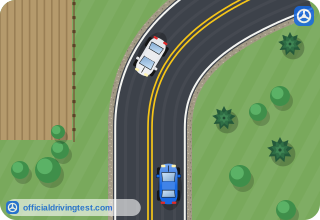
- Turning the wheel more sharply than expected, which can make the rear wheels slide toward the outside of the turn
- Braking so hard in a curve that the front wheels lock up and the vehicle slides straight ahead instead of following it
- Steering too gently in a curve so that the vehicle drifts toward the shoulder of the road
- Accelerating so quickly out of a turn that the tires lose their grip on the pavement
Show answer
Correct answer: Turning the wheel more sharply than expected, which can make the rear wheels slide toward the outside of the turn
Over-correcting is turning the wheel more sharply than expected, which can send the rear wheels sliding toward the outside of the turn and cause loss of control.
Source: Virginia Driver's Manual (DMV 39 (April 27, 2026)), page 18 · Open this page in the manual (Manual page 18)
-
What should you do if you veer off the road, whether it is curved or straight?
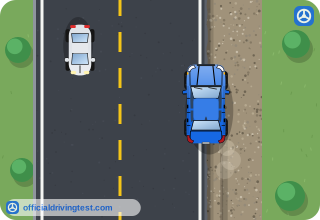
- Brake as hard as you can and turn sharply back onto the pavement at once
- Look down at the edge of the pavement you left and steer sharply back onto the road at once
- Do not panic; gradually reduce your speed, look where you want to go, and slowly steer back onto the road
- Accelerate to regain control and steer back onto the road as fast as you can
Show answer
Correct answer: Do not panic; gradually reduce your speed, look where you want to go, and slowly steer back onto the road
If you veer off the road, do not panic: gradually reduce your speed, look in the direction you want to go and slowly steer back onto the roadway.
Source: Virginia Driver's Manual (DMV 39 (April 27, 2026)), page 18 · Open this page in the manual (Manual page 18)
-
What should a driver do while driving on curved roads to help prevent over-correction crashes?
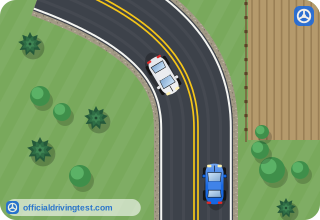
- Keep the same speed and stay close to the edge
- Reduce speed and use extra caution
- Move to the center of the road
- Speed up to keep control of the vehicle
Show answer
Correct answer: Reduce speed and use extra caution
The manual advises reducing speed and using extra caution on curved roads, and staying alert at all times.
Source: Virginia Driver's Manual (DMV 39 (April 27, 2026)), page 18 · Open this page in the manual (Manual page 18)
-
If you are involved in a traffic crash, where must you stop?
- At the nearest police station, after you leave the scene
- At the next exit, where you may call the police
- At the scene, or as close as possible without blocking traffic
- Anywhere you prefer, as long as you report it within an hour
Show answer
Correct answer: At the scene, or as close as possible without blocking traffic
You must stop at the crash scene, or as close to it as possible without blocking traffic.
Source: Virginia Driver's Manual (DMV 39 (April 27, 2026)), page 25 · Open this page in the manual (Manual page 25)
-
When must drivers move their vehicles from the road immediately after a crash?
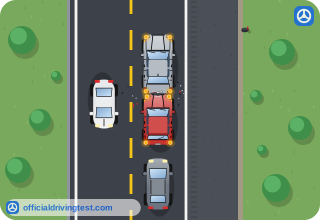
- If the damage to the vehicles is less than $3,000
- If they can be moved, no one is hurt and it is safe to do so
- Only if police have arrived and given permission
- Only if the crash happened on a highway or interstate
Show answer
Correct answer: If they can be moved, no one is hurt and it is safe to do so
Vehicles must be moved at once if they can be moved, no one is injured and the driver can do it safely.
Source: Virginia Driver's Manual (DMV 39 (April 27, 2026)), page 25 · Open this page in the manual (Manual page 25)
-
When you exit your vehicle after a crash, what should you try to do?
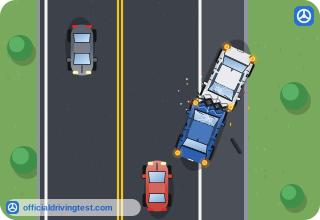
- Stand on the traffic side of your vehicle so drivers see you
- Stand in the lane to warn approaching drivers
- Walk along the road to check the other vehicles
- Keep your vehicle between you and moving traffic
Show answer
Correct answer: Keep your vehicle between you and moving traffic
If possible, keep your vehicle between you and moving traffic when you get out.
Source: Virginia Driver's Manual (DMV 39 (April 27, 2026)), page 25 · Open this page in the manual (Manual page 25)
-
When may you move an injured person from a wrecked vehicle?
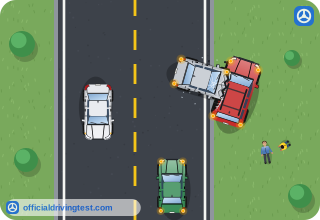
- If the injured person asks to be moved out of the wrecked vehicle
- If more than five minutes have passed since the crash happened
- If a witness at the scene says that it is safe to do so
- If you have medical training or there is immediate danger such as fire
Show answer
Correct answer: If you have medical training or there is immediate danger such as fire
You should not move an injured person unless you have the necessary medical training or there is immediate danger, such as fire.
Source: Virginia Driver's Manual (DMV 39 (April 27, 2026)), page 25 · Open this page in the manual (Manual page 25)
-
Which crashes must be reported to the police?
- Only those in which someone is injured or killed
- Those involving property damage, personal injury or death
- Only those in which an ambulance is called
- Only those that happen on highways or interstates
Show answer
Correct answer: Those involving property damage, personal injury or death
Crashes with property damage, injury or death must be reported to the police as quickly as possible.
Source: Virginia Driver's Manual (DMV 39 (April 27, 2026)), page 25 · Open this page in the manual (Manual page 25)
-
After a crash, what information should you get from the other drivers?
- Name, address and Social Security number
- Name, address and date of birth
- Name, address and driver’s license number
- Name, address and employer
Show answer
Correct answer: Name, address and driver’s license number
You should get each other driver’s name, address and driver’s license number.
Source: Virginia Driver's Manual (DMV 39 (April 27, 2026)), page 25 · Open this page in the manual (Manual page 25)
-
After a crash, what should you get for the other vehicles?
- License plate numbers
- Engine numbers
- Registration numbers
- Inspection sticker numbers
Show answer
Correct answer: License plate numbers
The manual lists the license plate numbers of other vehicles among the information to collect.
Source: Virginia Driver's Manual (DMV 39 (April 27, 2026)), page 25 · Open this page in the manual (Manual page 25)
-
After a crash, what information should you get from the owners of other vehicles?
- Name, address and insurance policy number
- Name, address and registration number
- Name, address and date of birth
- Name, address and employer
Show answer
Correct answer: Name, address and insurance policy number
For other vehicle owners, you should get the name, address and insurance policy number.
Source: Virginia Driver's Manual (DMV 39 (April 27, 2026)), page 25 · Open this page in the manual (Manual page 25)
-
Besides reporting a crash to the police, whom must you notify immediately?
- Your employer
- The county clerk
- Your insurance company
- Your driver education school
Show answer
Correct answer: Your insurance company
The manual lists notifying your insurance company immediately as one of your duties after a crash.
Source: Virginia Driver's Manual (DMV 39 (April 27, 2026)), page 25 · Open this page in the manual (Manual page 25)
-
Law enforcement must forward a written crash report to DMV when a crash causes injury or death, or total property damage of more than what amount?
- $500
- $1,500
- $3,000
- $5,000
Show answer
Correct answer: $3,000
Officers must forward a written report to DMV when someone is hurt or killed or total property damage is in excess of $3,000.
Source: Virginia Driver's Manual (DMV 39 (April 27, 2026)), page 25 · Open this page in the manual (Manual page 25)
-
Where is crash information recorded?
- On the DMV records of each driver involved
- Only on the record of the driver who caused the crash
- Only on the registration of the vehicle that was damaged
- Only on the record of the driver who was injured
Show answer
Correct answer: On the DMV records of each driver involved
All crash information is recorded on the DMV records of each driver involved.
Source: Virginia Driver's Manual (DMV 39 (April 27, 2026)), page 25 · Open this page in the manual (Manual page 25)
-
If you damage an unattended vehicle or other property in a crash, what must you make a reasonable effort to do?
- Repair the damage
- Move the vehicle off the road
- Pay for the damage at the scene
- Find the owner
Show answer
Correct answer: Find the owner
You must make a reasonable effort to find the owner of an unattended vehicle or other damaged property.
Source: Virginia Driver's Manual (DMV 39 (April 27, 2026)), page 25 · Open this page in the manual (Manual page 25)
-
If you cannot find the owner of damaged property, where should you leave a note?
- At the nearest police station
- At the scene, where it can be found easily
- With a nearby resident
- Mailed to the owner’s address later
Show answer
Correct answer: At the scene, where it can be found easily
You should leave a note that can be found easily at the scene of the crash.
Source: Virginia Driver's Manual (DMV 39 (April 27, 2026)), page 25 · Open this page in the manual (Manual page 25)
-
What should the note you leave at the scene of a crash include?
- Your name, phone number, date and time, and a description of the damage
- Your name, address, license number and insurance policy number
- Your name, license plate number and the name of your insurer
- Your name, driver’s license number and a description of your vehicle
Show answer
Correct answer: Your name, phone number, date and time, and a description of the damage
The note should have your name, telephone number, the date and time, and a description of the damage.
Source: Virginia Driver's Manual (DMV 39 (April 27, 2026)), page 25 · Open this page in the manual (Manual page 25)
-
If you cannot locate the owner of damaged property, within how long must you report the crash to the police?
- 1 hour
- 12 hours
- 24 hours
- 48 hours
Show answer
Correct answer: 24 hours
After leaving a note, you must also report the crash to the police within 24 hours.
Source: Virginia Driver's Manual (DMV 39 (April 27, 2026)), page 25 · Open this page in the manual (Manual page 25)
-
When should you be especially alert for deer and other large animals?
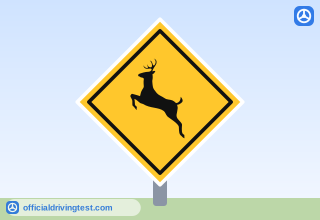
- At midday, especially in the summer
- At dusk and dawn, especially in the fall
- At night only, especially in the winter
- In the afternoon, especially in the spring
Show answer
Correct answer: At dusk and dawn, especially in the fall
The manual says to be alert at dusk and dawn, especially in the fall.
Source: Virginia Driver's Manual (DMV 39 (April 27, 2026)), page 25 · Open this page in the manual (Manual page 25)
-
If you see a large animal near or crossing the road, what should you do?
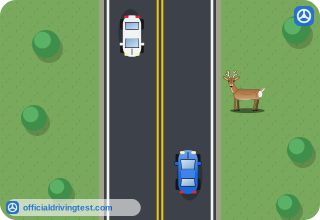
- Speed up to pass it
- Swerve onto the shoulder
- Flash your high beams at it
- Slow down
Show answer
Correct answer: Slow down
Slow down when a large animal is near or crossing the road; large animals often travel in groups, so others are likely nearby.
Source: Virginia Driver's Manual (DMV 39 (April 27, 2026)), page 25 · Open this page in the manual (Manual page 25)
-
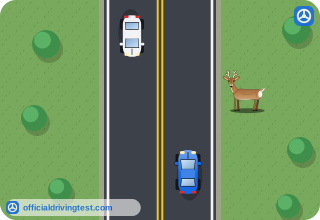
Why should you expect more animals after you see one large animal near the road?
- Large animals always cross roads in pairs
- Large animals are drawn to car headlights
- Large animals follow vehicles on highways
- Large animals frequently travel in groups
Show answer
Correct answer: Large animals frequently travel in groups
Large animals frequently travel in groups, so others are likely nearby.
Source: Virginia Driver's Manual (DMV 39 (April 27, 2026)), page 25 · Open this page in the manual (Manual page 25)
-
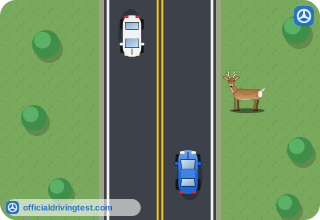
What can you use to scare a large animal away from the road?
- Your high beams
- The horn
- Your hazard lights
- Your windshield washer
Show answer
Correct answer: The horn
The manual says to use the horn to scare the animal away.
Source: Virginia Driver's Manual (DMV 39 (April 27, 2026)), page 25 · Open this page in the manual (Manual page 25)
-
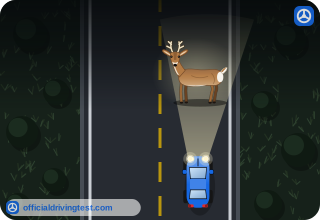
If a collision with a deer or other animal is unavoidable, what should you do?
- Swerve sharply to the shoulder and brake hard once there
- Speed up and steer around the animal before it moves
- Brake firmly, stay in your lane and come to a controlled stop
- Swerve into the next lane and stop quickly there
Show answer
Correct answer: Brake firmly, stay in your lane and come to a controlled stop
Do not swerve; brake firmly, stay in your lane and stop in a controlled way.
Source: Virginia Driver's Manual (DMV 39 (April 27, 2026)), page 25 · Open this page in the manual (Manual page 25)
-
What should you do if you hit a large animal?
- Report it to law enforcement
- Move the animal off the road yourself
- Wait 24 hours before reporting it
- Report it only if the vehicle cannot be driven
Show answer
Correct answer: Report it to law enforcement
If you hit a large animal, you should report it to law enforcement.
Source: Virginia Driver's Manual (DMV 39 (April 27, 2026)), page 25 · Open this page in the manual (Manual page 25)