Utah: Parking rules Practice Test
Where parking is illegal and the distances to keep, parallel and angle parking, and parking on hills.
Independent educational site · not affiliated with any government agency or DMV
Ready? Test yourself
- Instant feedback with an explanation
- Every answer cites its source in the manual
- Your best score is saved on this device
- Keyboard: press 1 to 4 to answer and Enter for the next question
Questions are original and based on the official manual "Utah Driver Handbook" (2026 edition (new 2026 laws effective May 6, 2026)), Utah Department of Public Safety, Driver License Division.
All 30 questions in this practice test
Take the test above first, then use this list to study. Tap “Show answer” to see the correct answer and explanation.
Show the questions and answersHide the questions
-
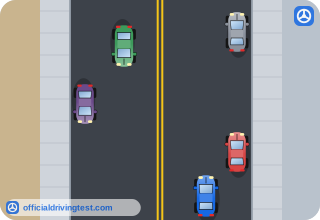
When parking along the road, how should you park?
- In the middle of the travel lane, with your hazard lights flashing
- Near the center line, so that you can pull back out easily
- As far from traffic as possible, and close to the curb if there is one
- Several feet from the curb, to leave room to open doors
Show answer
Correct answer: As far from traffic as possible, and close to the curb if there is one
Park as far from traffic as possible, and close to the curb when there is one.
Source: Utah Driver Handbook (2026 edition (new 2026 laws effective May 6, 2026)), page 32 · Open this page in the manual (Manual page 32)
-
Which of these is a place where you are not allowed to park?
- In a marked parking area
- In front of a public or private driveway
- Next to a curb with your wheels turned correctly
- In a marked space farther than 50 feet from a crosswalk
Show answer
Correct answer: In front of a public or private driveway
You may not park in front of a public or private driveway.
Source: Utah Driver Handbook (2026 edition (new 2026 laws effective May 6, 2026)), page 32 · Open this page in the manual (Manual page 32)
-
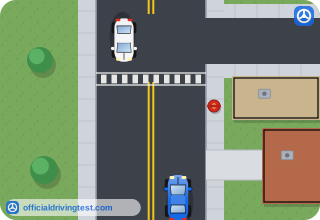
Within how many feet of a fire hydrant are you not allowed to park?
- 5 feet
- 10 feet
- 30 feet
- 15 feet
Show answer
Correct answer: 15 feet
Parking within 15 feet of a fire hydrant is not allowed.
Source: Utah Driver Handbook (2026 edition (new 2026 laws effective May 6, 2026)), page 32 · Open this page in the manual (Manual page 32)
-
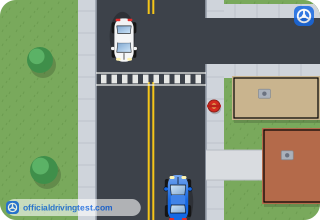
Within how many feet of a crosswalk are you not allowed to park?
- 20 feet
- 10 feet
- 15 feet
- 50 feet
Show answer
Correct answer: 20 feet
You may not park on a crosswalk or within 20 feet of one.
Source: Utah Driver Handbook (2026 edition (new 2026 laws effective May 6, 2026)), page 32 · Open this page in the manual (Manual page 32)
-
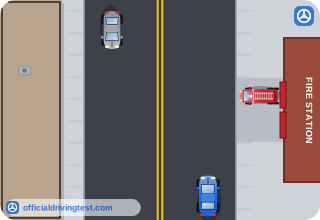
If signs are posted, how close to a fire station entrance may you not park on the opposite side of the road?
- Within 50 feet
- Within 30 feet
- Within 75 feet
- Within 100 feet
Show answer
Correct answer: Within 75 feet
Where signs are posted, you may not park on the opposite side of the road within 75 feet of the fire station entrance.
Source: Utah Driver Handbook (2026 edition (new 2026 laws effective May 6, 2026)), page 32 · Open this page in the manual (Manual page 32)
-
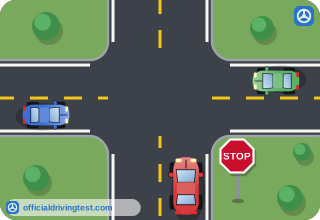
Within how many feet of a flashing beacon, stop sign, yield sign, or traffic control signal are you not allowed to park?
- 15 feet
- 30 feet
- 20 feet
- 50 feet
Show answer
Correct answer: 30 feet
You may not park within 30 feet of a flashing beacon, stop sign, yield sign, or traffic control signal.
Source: Utah Driver Handbook (2026 edition (new 2026 laws effective May 6, 2026)), page 32 · Open this page in the manual (Manual page 32)
-
How close to the edges of an area posted for pedestrian use are you not allowed to park?
- Within 10 feet
- Within 15 feet
- Within 50 feet
- Within 30 feet
Show answer
Correct answer: Within 30 feet
Parking is not allowed in a posted pedestrian area or within 30 feet of its edges.
Source: Utah Driver Handbook (2026 edition (new 2026 laws effective May 6, 2026)), page 32 · Open this page in the manual (Manual page 32)
-
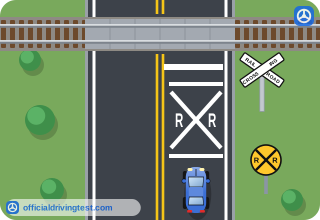
How close to the nearest rail of a railroad crossing are you not allowed to park?
- Within 50 feet
- Within 15 feet
- Within 20 feet
- Within 30 feet
Show answer
Correct answer: Within 50 feet
You may not park on a railroad track or within 50 feet of the nearest rail of a crossing.
Source: Utah Driver Handbook (2026 edition (new 2026 laws effective May 6, 2026)), page 32 · Open this page in the manual (Manual page 32)
-
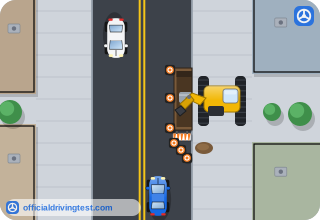
When are you not allowed to park alongside or opposite a street excavation or obstruction?
- Never, if you have your hazard lights on
- Only on weekends
- When stopping or parking would block traffic
- Only when the excavation is more than a foot deep
Show answer
Correct answer: When stopping or parking would block traffic
Parking alongside or opposite an excavation or obstruction is prohibited when it would block traffic.
Source: Utah Driver Handbook (2026 edition (new 2026 laws effective May 6, 2026)), page 32 · Open this page in the manual (Manual page 32)
-
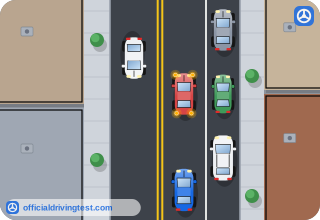
What is the rule about parking on the roadway side of a vehicle parked at the edge or curb of a street?
- It blocks the view of the vehicle's license plate
- It is double parking, which is not allowed
- It is allowed only for deliveries
- It is allowed for up to five minutes
Show answer
Correct answer: It is double parking, which is not allowed
Parking on the roadway side of a parked vehicle is double parking and is not allowed.
Source: Utah Driver Handbook (2026 edition (new 2026 laws effective May 6, 2026)), page 32 · Open this page in the manual (Manual page 32)
-
Where is parking not allowed because of the type of road structure?
- On any residential street that has a curb and no posted signs
- On a two-lane paved road that has a marked parking lane beside it
- In front of a school that has no driveway entrance nearby
- On any bridge or other elevated highway structure, or in a highway tunnel
Show answer
Correct answer: On any bridge or other elevated highway structure, or in a highway tunnel
You may not park on a bridge, elevated highway structure, or in a highway tunnel.
Source: Utah Driver Handbook (2026 edition (new 2026 laws effective May 6, 2026)), page 32 · Open this page in the manual (Manual page 32)
-
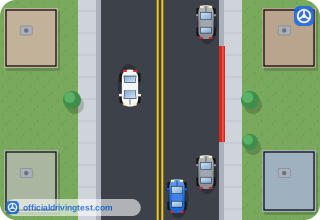
What is the rule about parking at a red-painted curb or red zone?
- You may park there for up to 15 minutes
- You may park there if you stay with your vehicle
- You are not allowed to park there
- You may park there if you display hazard lights
Show answer
Correct answer: You are not allowed to park there
Red-painted curbs and red zones are places where parking is not allowed.
Source: Utah Driver Handbook (2026 edition (new 2026 laws effective May 6, 2026)), page 32 · Open this page in the manual (Manual page 32)
-
When parking downhill next to a curb, which way should you turn your wheel?
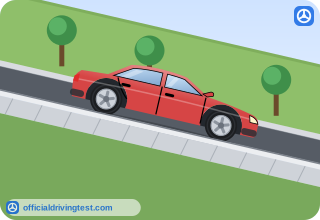
- Away from the curb
- Toward the curb
- Straight ahead
- To the left
Show answer
Correct answer: Toward the curb
For downhill parking you turn the wheel toward the curb so the front tire touches the curb.
Source: Utah Driver Handbook (2026 edition (new 2026 laws effective May 6, 2026)), page 32 · Open this page in the manual (Manual page 32)
-
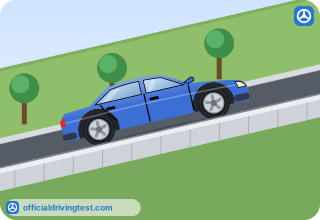
When parking uphill next to a curb, which way should you turn your wheel?
- Toward the curb
- Straight ahead
- Toward the curb, only if you are on a steep hill
- Away from the curb
Show answer
Correct answer: Away from the curb
For uphill parking with a curb you turn the wheel away from the curb.
Source: Utah Driver Handbook (2026 edition (new 2026 laws effective May 6, 2026)), page 32 · Open this page in the manual (Manual page 32)
-
When parking uphill without a curb, which way should you turn the wheel?
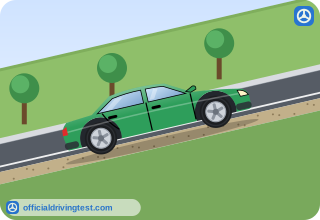
- To the right
- To the left
- Straight ahead
- Toward the road
Show answer
Correct answer: To the right
Without a curb, you turn the wheel to the right when parking uphill.
Source: Utah Driver Handbook (2026 edition (new 2026 laws effective May 6, 2026)), page 33 · Open this page in the manual (Manual page 33)
-
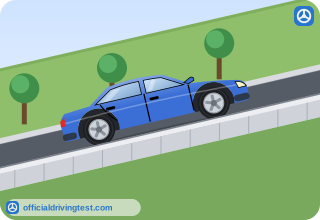
When hill parking next to a curb, what should your front tire do?
- Stay about a foot away from the curb to leave room
- Stay several feet from the curb for safety
- Touch the curb to secure the vehicle's position
- Roll up over the curb slightly
Show answer
Correct answer: Touch the curb to secure the vehicle's position
The front tire touches the curb to secure the vehicle's position.
Source: Utah Driver Handbook (2026 edition (new 2026 laws effective May 6, 2026)), page 32 · Open this page in the manual (Manual page 32)
-
When you approach the curb to park on a hill, which way should you signal and which shoulder should you check?
- Signal to the right and check over your left shoulder
- Signal to the right and check over your right shoulder
- Signal to the left and check over your left shoulder
- Signal to the left and check over your right shoulder
Show answer
Correct answer: Signal to the right and check over your right shoulder
The steps say to signal to the right and perform a head check over your right shoulder.
Source: Utah Driver Handbook (2026 edition (new 2026 laws effective May 6, 2026)), page 32 · Open this page in the manual (Manual page 32)
-
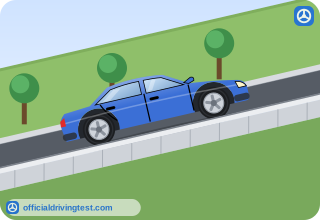
After you park on a hill and turn your wheels, what should you do next?
- Turn off the parking brake and release the brake pedal
- Leave the vehicle in neutral
- Turn the wheels straight again
- Put the vehicle in park and set the parking brake
Show answer
Correct answer: Put the vehicle in park and set the parking brake
The final steps for hill parking are putting the vehicle in park and setting the parking brake.
Source: Utah Driver Handbook (2026 edition (new 2026 laws effective May 6, 2026)), page 32 · Open this page in the manual (Manual page 32)
-
When leaving your vehicle, what should you do?
- Stop the motor, set the parking brake, and lock your doors
- Leave the motor running and lock your doors
- Leave the doors unlocked in case someone needs the vehicle
- Turn on your hazard lights and leave the parking brake off
Show answer
Correct answer: Stop the motor, set the parking brake, and lock your doors
Before you walk away you stop the motor, set the parking brake, and lock the doors.
Source: Utah Driver Handbook (2026 edition (new 2026 laws effective May 6, 2026)), page 33 · Open this page in the manual (Manual page 33)
-
If you park next to a curb, how far may the back wheel of your car be from the curb?
- No further than 6 inches
- No further than 24 inches
- No further than 12 inches
- No further than 36 inches
Show answer
Correct answer: No further than 12 inches
The back wheel must be no further than 12 inches from the curb.
Source: Utah Driver Handbook (2026 edition (new 2026 laws effective May 6, 2026)), page 33 · Open this page in the manual (Manual page 33)
-
What should you do if parking would block the flow of traffic?
- Park and turn on your hazard lights
- Find another place to park
- Park and leave a note
- Park for a short time only
Show answer
Correct answer: Find another place to park
If parking would block traffic, the handbook says to find another place to park.
Source: Utah Driver Handbook (2026 edition (new 2026 laws effective May 6, 2026)), page 33 · Open this page in the manual (Manual page 33)
-
When starting to parallel park, how should you position your vehicle first?
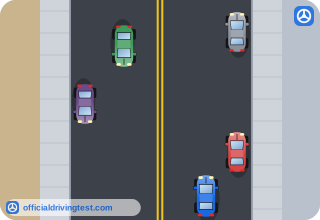
- Pull up parallel to the vehicle you are parking behind
- Pull up at an angle to the curb behind the space
- Stop in the middle of the empty parking space ahead
- Stop one lane away from the parked vehicles
Show answer
Correct answer: Pull up parallel to the vehicle you are parking behind
You begin by pulling up parallel to the vehicle you are parking behind.
Source: Utah Driver Handbook (2026 edition (new 2026 laws effective May 6, 2026)), page 33 · Open this page in the manual (Manual page 33)
-
When you shift to reverse for parallel parking, where do you look?
- At the vehicle ahead of you
- At your right-side mirror only
- At your back window
- At the curb through the front windshield
Show answer
Correct answer: At your back window
Once traffic is clear you shift to reverse and look at your back window.
Source: Utah Driver Handbook (2026 edition (new 2026 laws effective May 6, 2026)), page 33 · Open this page in the manual (Manual page 33)
-
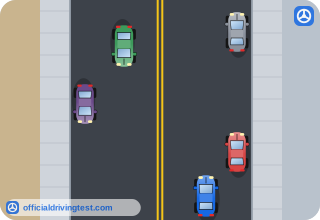
In parallel parking, you continue backing until your front bumper is in line with what?
- The front bumper of the vehicle behind the space
- The rear bumper of the vehicle you are parking behind
- The curb at the end of the space
- The rear bumper of the vehicle ahead of the space
Show answer
Correct answer: The rear bumper of the vehicle you are parking behind
You back until your front bumper lines up with the rear bumper of the vehicle you are parking behind.
Source: Utah Driver Handbook (2026 edition (new 2026 laws effective May 6, 2026)), page 33 · Open this page in the manual (Manual page 33)
-
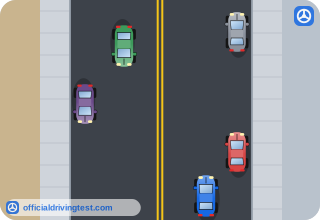
In parallel parking, what should you ensure after centering your vehicle?
- That your hazard lights are flashing for other drivers
- That your wheels are turned fully toward the street
- That your vehicle is touching the bumper of the car behind
- That your vehicle's front bumper will clear the vehicle ahead
Show answer
Correct answer: That your vehicle's front bumper will clear the vehicle ahead
You make sure the front bumper will clear the vehicle ahead and adjust in reverse if not.
Source: Utah Driver Handbook (2026 edition (new 2026 laws effective May 6, 2026)), page 33 · Open this page in the manual (Manual page 33)
-
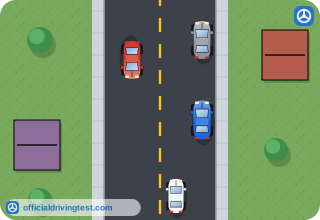
When exiting a parallel park, what should you do after checking traffic and applying the brake?
- Shift to reverse and back up close to the vehicle parked behind you
- Shift to drive and turn out into the traffic lane immediately
- Turn the wheels toward the curb and roll back into the space
- Shift to neutral and wait for the traffic around you to clear
Show answer
Correct answer: Shift to reverse and back up close to the vehicle parked behind you
You back up close to the vehicle behind, then check traffic, signal, and move forward slowly.
Source: Utah Driver Handbook (2026 edition (new 2026 laws effective May 6, 2026)), page 33 · Open this page in the manual (Manual page 33)
-
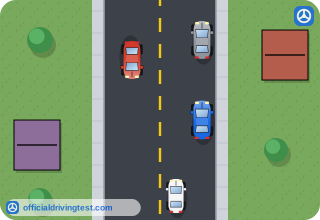
When exiting a parallel park, when should you move into the traffic lane?
- As soon as you shift to drive and release the brake pedal
- Before you have checked traffic and have signaled to leave
- When your vehicle clears the rear bumper of the vehicle ahead of you
- When your front bumper is even with the vehicle ahead of you
Show answer
Correct answer: When your vehicle clears the rear bumper of the vehicle ahead of you
You move into the lane only after your vehicle clears the rear bumper of the vehicle ahead.
Source: Utah Driver Handbook (2026 edition (new 2026 laws effective May 6, 2026)), page 33 · Open this page in the manual (Manual page 33)
-
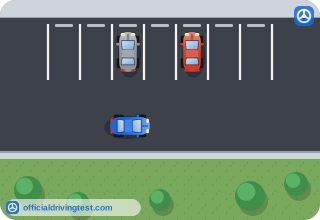
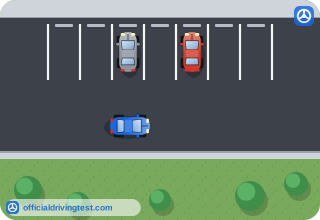
When entering a perpendicular or angle parking space, how should you move?
- Backward quickly, turning the steering wheel sharply until the vehicle is in the space
- Forward slowly, turning the steering wheel until the vehicle reaches the middle of the space
- Forward quickly, then brake hard once the front of the vehicle reaches the end of the space
- Forward slowly, with the steering wheel held straight until the vehicle is in the space
Show answer
Correct answer: Forward slowly, turning the steering wheel until the vehicle reaches the middle of the space
You move forward slowly, steering left or right until the vehicle reaches the middle of the space.
Source: Utah Driver Handbook (2026 edition (new 2026 laws effective May 6, 2026)), page 33 · Open this page in the manual (Manual page 33)
-
After centering your vehicle in a perpendicular or angle parking space, what do you do?
- Back out of the space to check your position
- Stop at the middle and turn off your lights
- Leave the rear of the vehicle sticking out into the lane
- Move to the front of the space, stop, and secure the vehicle
Show answer
Correct answer: Move to the front of the space, stop, and secure the vehicle
After centering, you move to the front of the space, stop, and secure the vehicle.
Source: Utah Driver Handbook (2026 edition (new 2026 laws effective May 6, 2026)), page 33 · Open this page in the manual (Manual page 33)
-
You may not park closer than how many feet from a railroad crossing, unless signs indicate that you may or it is allowed by local law?
- 15 feet
- 50 feet
- 25 feet
- 100 feet
Show answer
Correct answer: 50 feet
Parking within 50 feet of a railroad crossing is not allowed unless signs or local law permit it.
Source: Utah Driver Handbook (2026 edition (new 2026 laws effective May 6, 2026)), page 86 · Open this page in the manual (Manual page 86)