Utah: Emergency vehicles and work zones
Pulling over for emergency vehicles, moving over for stopped vehicles, snowplows, flaggers and highway work zones. Split into 2 shorter tests so you're not stuck in one long quiz.
Independent educational site · not affiliated with any government agency or DMV
Choose a part
All 43 Emergency vehicles and work zones questions with answers
Choose a part above to take a practice test, or study every question and answer here.
Show the questions and answersHide the questions
-
What is the zipper method of merging?
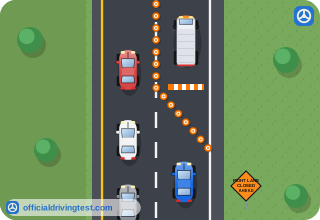
- Merging early and staying in a single lane
- Merging only after a vehicle behind you flashes its lights
- Speeding up to merge ahead of the other lane
- Alternating when merging at a congested merge point
Show answer
Correct answer: Alternating when merging at a congested merge point
The zipper method means alternating at a congested merge point, such as a construction zone.
Source: Utah Driver Handbook (2026 edition (new 2026 laws effective May 6, 2026)), page 31 · Open this page in the manual (Manual page 31)
-
When using the zipper method, when do you begin to alternate?
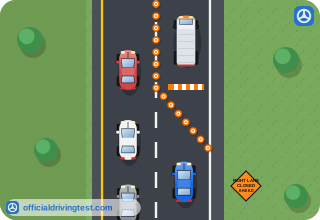
- Once the vehicles reach the merge point
- As soon as you see the first warning sign
- When the vehicle ahead brakes
- After you have driven past the merge point
Show answer
Correct answer: Once the vehicles reach the merge point
You use both lanes of traffic until the vehicles reach the merge point, then alternate.
Source: Utah Driver Handbook (2026 edition (new 2026 laws effective May 6, 2026)), page 31 · Open this page in the manual (Manual page 31)
-
A snowplow is displaying flashing yellow lights. On which side may you not pass it?
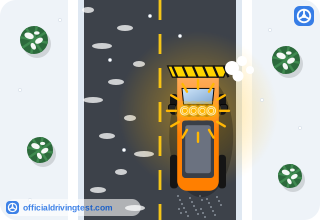
- The side that is opposite the plow blade
- The side where the plow blade is deployed
- The right side of the snowplow only
- The left side of the snowplow only
Show answer
Correct answer: The side where the plow blade is deployed
Near a snowplow with flashing yellow lights, you may not pass on the side where its blade is deployed.
Source: Utah Driver Handbook (2026 edition (new 2026 laws effective May 6, 2026)), page 34 · Open this page in the manual (Manual page 34)
-
Three or more snowplows are operating in echelon formation. What may you do about passing them?
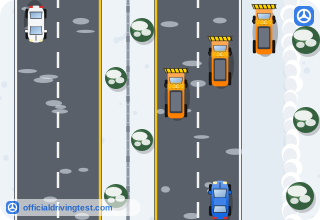
- You may not pass on either side
- You may pass on the side where no blade is deployed
- You may pass on the left only
- You may pass on the right only
Show answer
Correct answer: You may not pass on either side
With three or more snowplows in echelon formation, you may not pass or overtake them on either side.
Source: Utah Driver Handbook (2026 edition (new 2026 laws effective May 6, 2026)), page 34 · Open this page in the manual (Manual page 34)
-
You are in an express lane and an emergency or police vehicle with flashing lights is following you. What is permissible when it is safe?
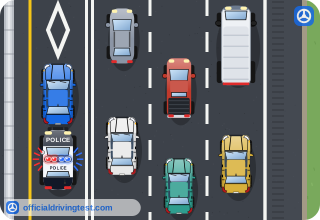
- A left-hand lane change out of the express lane
- Stopping in the express lane
- A right-hand lane change out of the express lane
- Crossing the double white line to the left
Show answer
Correct answer: A right-hand lane change out of the express lane
When safe, you may move right out of the express lane for an emergency or police vehicle with flashing lights.
Source: Utah Driver Handbook (2026 edition (new 2026 laws effective May 6, 2026)), page 40 · Open this page in the manual (Manual page 40)
-
The handbook lists times when the law requires you to slow down. Which lights on an authorized vehicle are named in that list?
- Flashing green, or green and white lights
- Flashing red, red and white, or red and blue lights
- Flashing amber, or amber and white lights only
- Flashing white or white and blue lights
Show answer
Correct answer: Flashing red, red and white, or red and blue lights
When you approach an authorized vehicle flashing red, red and white, or red and blue lights, you must slow down.
Source: Utah Driver Handbook (2026 edition (new 2026 laws effective May 6, 2026)), page 45 · Open this page in the manual (Manual page 45)
-
Which of these do the handbook's work zone warnings include?
- Rest areas and gas stations ahead
- Slow-moving road machinery
- Animals crossing
- School zone ahead
Show answer
Correct answer: Slow-moving road machinery
Work zone signs warn of workers ahead, reduced speed, detours, slow-moving road machinery, and surface changes.
Source: Utah Driver Handbook (2026 edition (new 2026 laws effective May 6, 2026)), page 49 · Open this page in the manual (Manual page 49)
-
What is the purpose of barriers in a work zone, according to the handbook?
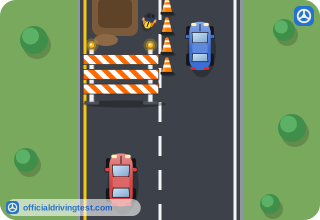
- To mark the places where you may park your vehicle
- To show where detours begin and end, and nothing else
- To mark the start of the speed limit
- To keep you from entering closed roads or other dangerous areas
Show answer
Correct answer: To keep you from entering closed roads or other dangerous areas
Barriers keep drivers out of closed roads or other areas with danger.
Source: Utah Driver Handbook (2026 edition (new 2026 laws effective May 6, 2026)), page 49 · Open this page in the manual (Manual page 49)
-
If there is a short-term signal in a work zone, where do you stop?
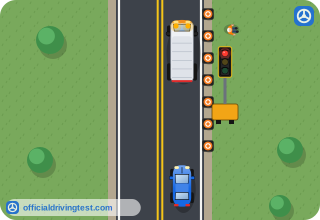
- At the white line, if there is one
- At the first cone you see
- Beside the signal
- Past the signal, so you can see cross traffic
Show answer
Correct answer: At the white line, if there is one
At a short-term work zone signal, stop at the white line when one is present.
Source: Utah Driver Handbook (2026 edition (new 2026 laws effective May 6, 2026)), page 49 · Open this page in the manual (Manual page 49)
-
What does the handbook tell you to do when you drive in work zones?
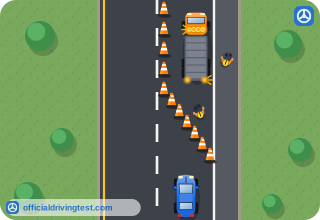
- Keep your speed and watch for workers
- Change lanes often to avoid delays
- Slow down and be ready to stop quickly
- Follow the vehicle ahead closely
Show answer
Correct answer: Slow down and be ready to stop quickly
In work zones you should slow down and be ready to stop quickly.
Source: Utah Driver Handbook (2026 edition (new 2026 laws effective May 6, 2026)), page 49 · Open this page in the manual (Manual page 49)
-
Which driving behavior does the handbook specifically say not to do in work zones?
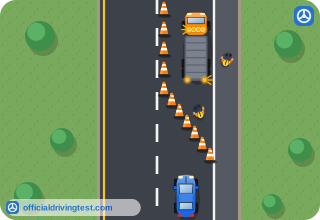
- Use your turn signals
- Tailgate
- Slow down
- Obey a flagger
Show answer
Correct answer: Tailgate
The handbook says not to tailgate in work zones.
Source: Utah Driver Handbook (2026 edition (new 2026 laws effective May 6, 2026)), page 49 · Open this page in the manual (Manual page 49)
-
What happens to fines for speeding in a work zone?
- They are the same as elsewhere
- They are cut in half
- They are waived for a first offense
- They are doubled
Show answer
Correct answer: They are doubled
The handbook says fines for speeding in a work zone are doubled.
Source: Utah Driver Handbook (2026 edition (new 2026 laws effective May 6, 2026)), page 49 · Open this page in the manual (Manual page 49)
-
An orange diamond sign shows a figure holding a flag. What is it called in the handbook?
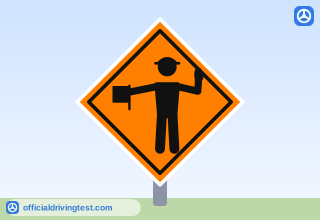
- Flagger Ahead
- Workers Ahead
- Detour
- One Lane Road Ahead
Show answer
Correct answer: Flagger Ahead
Flagger Ahead is the handbook’s label for an orange diamond sign that shows a figure holding a flag.
Source: Utah Driver Handbook (2026 edition (new 2026 laws effective May 6, 2026)), page 49 · Open this page in the manual (Manual page 49)
-
An orange diamond sign shows a figure digging with a shovel. What is it called in the handbook?
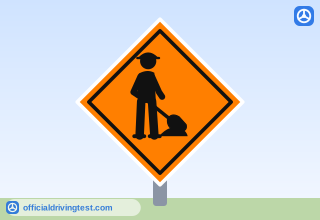
- Flagger Ahead
- Road Construction Ahead
- Workers Ahead
- Detour
Show answer
Correct answer: Workers Ahead
Workers Ahead is the handbook’s label for an orange diamond sign that shows a figure digging with a shovel.
Source: Utah Driver Handbook (2026 edition (new 2026 laws effective May 6, 2026)), page 49 · Open this page in the manual (Manual page 49)
-
A flagger directs traffic in a work zone. What must you do?
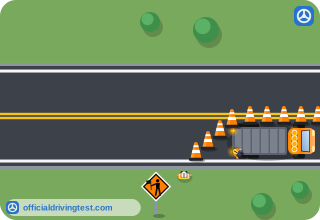
- Follow the traffic signal instead
- Do as the flagger directs
- Treat the flagger's directions as advice
- Obey the flagger only when no signs are posted
Show answer
Correct answer: Do as the flagger directs
The handbook says you must do as a flagger directs.
Source: Utah Driver Handbook (2026 edition (new 2026 laws effective May 6, 2026)), page 49 · Open this page in the manual (Manual page 49)
-
Which activity is included in a highway work zone, according to the handbook?
- Setting up a parade route
- Painting buildings beside the road
- Filming a movie beside the road
- Tree trimming
Show answer
Correct answer: Tree trimming
The handbook says a work zone includes underground and overhead utility work, tree trimming and surveying activities.
Source: Utah Driver Handbook (2026 edition (new 2026 laws effective May 6, 2026)), page 59 · Open this page in the manual (Manual page 59)
-
Who is responsible for knowing how to read and react to the directions in a highway work zone?
- Motorists and pedestrians
- Only the highway workers
- Only flaggers and law enforcement officials
- Only the construction company
Show answer
Correct answer: Motorists and pedestrians
Workers set up the directional signs and devices, but motorists and pedestrians are responsible for knowing how to read and react to them.
Source: Utah Driver Handbook (2026 edition (new 2026 laws effective May 6, 2026)), page 59 · Open this page in the manual (Manual page 59)
-
What does the handbook call the most critical steps in preventing crashes in highway work zones?
- Driving faster to clear the zone more quickly
- Staying close behind the vehicle ahead of you
- Paying attention and driving with care and courtesy
- Sounding your horn to warn the workers ahead
Show answer
Correct answer: Paying attention and driving with care and courtesy
Paying attention and driving cautiously and courteously are described as the most critical steps in preventing work zone crashes.
Source: Utah Driver Handbook (2026 edition (new 2026 laws effective May 6, 2026)), page 59 · Open this page in the manual (Manual page 59)
-
When should you slow down in a work zone?
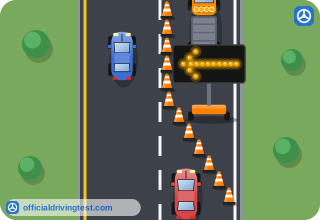
- Only when workers are visible
- Always, even if there are no workers
- Only when a flagger signals you
- Only when you are driving at night
Show answer
Correct answer: Always, even if there are no workers
The handbook says to always slow down in a work zone even if no workers are present, since narrow lanes and rough pavement can be dangerous.
Source: Utah Driver Handbook (2026 edition (new 2026 laws effective May 6, 2026)), page 59 · Open this page in the manual (Manual page 59)
-
What fine are the courts required to impose on a driver who speeds in a highway construction zone?
- The same as the regular fine for speeding
- At least three times the regular fine for speeding
- Half of the regular fine if no workers are present
- At least twice the amount of the regular fine for speeding
Show answer
Correct answer: At least twice the amount of the regular fine for speeding
Courts must fine a driver who speeds in a highway construction zone at least twice the regular fine for speeding.
Source: Utah Driver Handbook (2026 edition (new 2026 laws effective May 6, 2026)), page 59 · Open this page in the manual (Manual page 59)
-
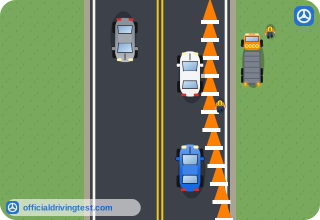
Which of these should you do in a work zone?
- Keep your usual following distance to avoid delays
- Change lanes often to find the fastest one
- Increase your following distance and be prepared to stop
- Stay close to the workers to see them better
Show answer
Correct answer: Increase your following distance and be prepared to stop
The handbook says to slow down in a work zone, increase your following distance and be prepared to stop.
Source: Utah Driver Handbook (2026 edition (new 2026 laws effective May 6, 2026)), page 59 · Open this page in the manual (Manual page 59)
-
Until when should you obey the posted work zone signs?
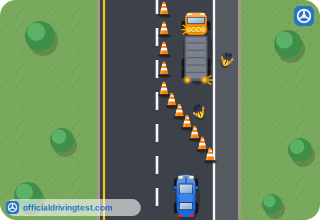
- Until you see “end road work”
- Until you pass the last worker you can see
- Until traffic ahead begins to speed up
- Until you leave the construction vehicles behind
Show answer
Correct answer: Until you see “end road work”
The handbook says to obey the posted work zone signs until you see "end road work."
Source: Utah Driver Handbook (2026 edition (new 2026 laws effective May 6, 2026)), page 59 · Open this page in the manual (Manual page 59)
-
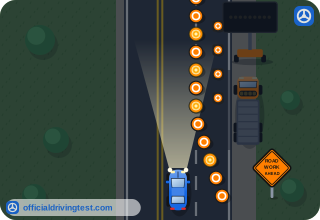
How should you treat a work zone at night when no workers are there?
- Drive as you would on a normal road
- Ignore the signs because no one is working
- Stay in the lane closest to the equipment
- Be careful anyway, as in any work zone
Show answer
Correct answer: Be careful anyway, as in any work zone
The handbook says to be careful when driving through a work zone at night even if no workers are there.
Source: Utah Driver Handbook (2026 edition (new 2026 laws effective May 6, 2026)), page 59 · Open this page in the manual (Manual page 59)
-
What does the handbook advise about work zones if it is possible?
- Pass through them during the busiest hours
- Use a different route to avoid them
- Drive through them as quickly as you can
- Follow the vehicle ahead closely through them
Show answer
Correct answer: Use a different route to avoid them
The handbook says to expect delays and plan to leave early, and to use a different route to avoid work zones if possible.
Source: Utah Driver Handbook (2026 edition (new 2026 laws effective May 6, 2026)), page 59 · Open this page in the manual (Manual page 59)
-
If you are convicted of a violation related to approaching an emergency vehicle and fail to complete a live classroom course on driving safety, how many hours long is that course?
- Two hours
- Six hours
- Eight hours
- Four hours
Show answer
Correct answer: Four hours
The handbook names a four-hour live classroom course whose non-completion can lead to suspension.
Source: Utah Driver Handbook (2026 edition (new 2026 laws effective May 6, 2026)), page 71 · Open this page in the manual (Manual page 71)
-
Police cars, fire engines, or ambulances approach using sirens or emergency lights. What must you do?
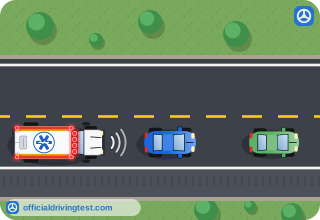
- Slow down and keep driving in your lane, staying to the right of the road
- Yield the right-of-way, drive at once to the right side of the road, and stop
- Pull over to the nearest edge of the road, either the left or the right side
- Speed up to clear the way, then pull over to the right when you are able
Show answer
Correct answer: Yield the right-of-way, drive at once to the right side of the road, and stop
When an emergency vehicle approaches using sirens or lights, you must yield and drive at once to the right side of the road and stop until it has passed.
Source: Utah Driver Handbook (2026 edition (new 2026 laws effective May 6, 2026)), page 77 · Open this page in the manual (Manual page 77)
-
Unless you are on official business, you may not follow within how many feet of a fire vehicle responding to an alarm?
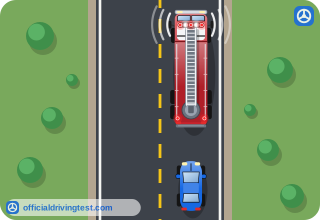
- 100 feet
- 200 feet
- 300 feet
- 500 feet
Show answer
Correct answer: 500 feet
Unless on official business, you must stay back at least 500 feet from a fire vehicle responding to an alarm.
Source: Utah Driver Handbook (2026 edition (new 2026 laws effective May 6, 2026)), page 77 · Open this page in the manual (Manual page 77)
-
Where may you not drive or park when a fire vehicle has stopped to answer an alarm?
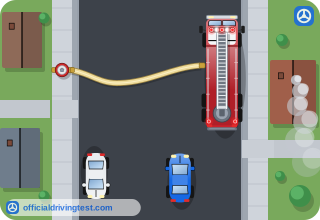
- On the same block where the fire vehicle has stopped
- Within 100 feet of the fire vehicle
- On the same side of the street as the fire vehicle
- Within sight of the fire vehicle
Show answer
Correct answer: On the same block where the fire vehicle has stopped
You may not drive or park on the block where a fire vehicle has stopped to answer an alarm.
Source: Utah Driver Handbook (2026 edition (new 2026 laws effective May 6, 2026)), page 77 · Open this page in the manual (Manual page 77)
-
What do move over laws require drivers to do when approaching a roadside incident?
- Stop and turn off the engine
- Speed up and pass quickly
- Slow down and change lanes
- Sound the horn and flash the headlights
Show answer
Correct answer: Slow down and change lanes
Move over laws require drivers to slow down and change lanes when approaching a roadside incident.
Source: Utah Driver Handbook (2026 edition (new 2026 laws effective May 6, 2026)), page 77 · Open this page in the manual (Manual page 77)
-
You approach a stationary vehicle beside the highway, not in an apparent legal parking area, with flashing hazard lights on. What must you do?
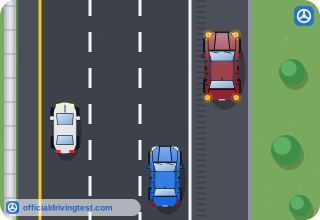
- Stop behind the vehicle until its hazard lights are turned off again
- Reduce speed, give as much space as practical, and if practical change lanes
- Keep your speed and sound the horn to warn the stationary vehicle’s driver
- Stay in the adjacent lane and pass the vehicle at the posted speed limit
Show answer
Correct answer: Reduce speed, give as much space as practical, and if practical change lanes
Drivers must reduce speed, give as much space as practical, and if practical and safe, move to a lane not adjacent to the stationary vehicle.
Source: Utah Driver Handbook (2026 edition (new 2026 laws effective May 6, 2026)), page 77 · Open this page in the manual (Manual page 77)
-
You are in the HOV lane and approach a stationary vehicle displaying amber lights. What must you do, if practical and safe?
- Stay in the HOV lane and speed up to pass the vehicle
- Stop in the HOV lane until the vehicle drives away
- Move onto the shoulder right beside the stationary vehicle
- Change lanes out of the HOV lane, away from the stationary vehicle
Show answer
Correct answer: Change lanes out of the HOV lane, away from the stationary vehicle
A driver in the HOV lane must, if practical and safe, move out of it into a lane not adjacent to the stationary vehicle.
Source: Utah Driver Handbook (2026 edition (new 2026 laws effective May 6, 2026)), page 77 · Open this page in the manual (Manual page 77)
-
What must you do if you are convicted for not following the move over law?
- Attend a four hour live classroom defensive driving course within 90 days
- Attend a two hour online safety course within 30 days of the conviction
- Retake the written knowledge test within 90 days of the conviction
- Pay a fine only, with no course required after the conviction
Show answer
Correct answer: Attend a four hour live classroom defensive driving course within 90 days
A conviction for not following the move over law requires a four hour live classroom defensive driving course within 90 days.
Source: Utah Driver Handbook (2026 edition (new 2026 laws effective May 6, 2026)), page 77 · Open this page in the manual (Manual page 77)
-
If you fail to attend the defensive driving class required after a move over law conviction, your license will be suspended for how long?
- 30 days
- 6 months
- 90 days
- One year
Show answer
Correct answer: 90 days
Failing to attend the required class results in a 90-day suspension.
Source: Utah Driver Handbook (2026 edition (new 2026 laws effective May 6, 2026)), page 77 · Open this page in the manual (Manual page 77)
-
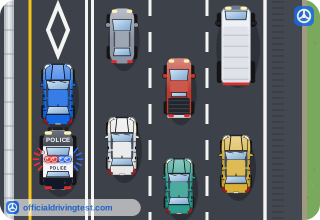
If the police pull you over, which side of the road should you move to, even when you are in the HOV lane?
- The left side
- The side with more shoulder
- The side nearest the officer's car
- The right side
Show answer
Correct answer: The right side
The handbook says to move to the right side of the road, even from the HOV lane, to a safe spot.
Source: Utah Driver Handbook (2026 edition (new 2026 laws effective May 6, 2026)), page 84 · Open this page in the manual (Manual page 84)
-
What should you do with your vehicle when the police pull you over?
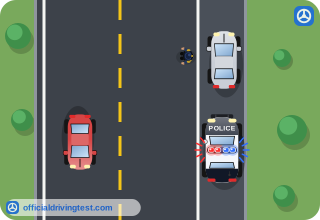
- Put it in park and turn off the engine
- Leave the engine running with the lights on
- Keep it in gear
- Put it in neutral and leave the engine running
Show answer
Correct answer: Put it in park and turn off the engine
During a traffic stop you should put the vehicle in park and turn off the engine.
Source: Utah Driver Handbook (2026 edition (new 2026 laws effective May 6, 2026)), page 84 · Open this page in the manual (Manual page 84)
-
During a police stop, when should you leave your vehicle?
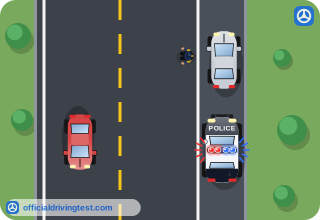
- As soon as you stop
- When the officer reaches your door
- Only if asked to get out
- After you turn off the engine
Show answer
Correct answer: Only if asked to get out
You should stay in the vehicle unless the officer asks you to get out.
Source: Utah Driver Handbook (2026 edition (new 2026 laws effective May 6, 2026)), page 84 · Open this page in the manual (Manual page 84)
-
Why should you roll down your window during a police stop?
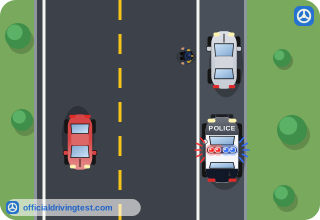
- So the officer can search the vehicle
- So you can hand over your keys
- So you and the officer can talk
- So your passengers can hear
Show answer
Correct answer: So you and the officer can talk
You roll down the window so that you and the officer can talk.
Source: Utah Driver Handbook (2026 edition (new 2026 laws effective May 6, 2026)), page 84 · Open this page in the manual (Manual page 84)
-
What should you do about safety belts during a police stop?
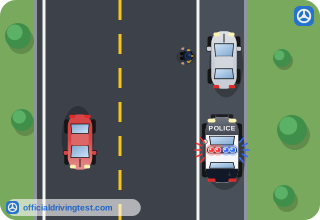
- Keep yours fastened and ask passengers to do the same
- Unfasten yours so you can reach documents
- Unfasten yours and tell passengers to keep theirs on
- Unfasten all belts once the engine is off
Show answer
Correct answer: Keep yours fastened and ask passengers to do the same
You remain calm and keep your safety belt fastened, and ask your passengers to do the same.
Source: Utah Driver Handbook (2026 edition (new 2026 laws effective May 6, 2026)), page 84 · Open this page in the manual (Manual page 84)
-
Where should you keep your hands during a police stop?
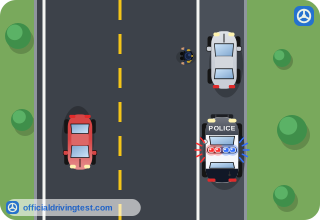
- On the dashboard
- In your lap
- Outside the window
- On the steering wheel
Show answer
Correct answer: On the steering wheel
The handbook says to keep your hands on the steering wheel.
Source: Utah Driver Handbook (2026 edition (new 2026 laws effective May 6, 2026)), page 84 · Open this page in the manual (Manual page 84)
-
If an officer asks for your documents, what should you do?
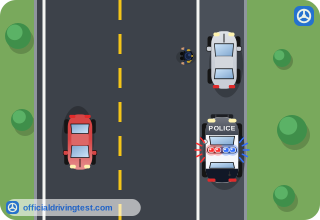
- Reach for them quickly with both hands off the wheel
- Keep one hand on the wheel and reach slowly for them
- Get out of the vehicle to find them
- Lean over to search the glove box at once
Show answer
Correct answer: Keep one hand on the wheel and reach slowly for them
Keep one hand on the wheel and reach slowly for the documents.
Source: Utah Driver Handbook (2026 edition (new 2026 laws effective May 6, 2026)), page 84 · Open this page in the manual (Manual page 84)
-
Why should you never try to run from the police?
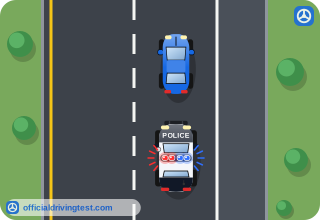
- Many fatal crashes result from police chases
- Officers cannot follow beyond the city limits
- It lowers the fine for the stop
- Vehicles are tracked by cameras
Show answer
Correct answer: Many fatal crashes result from police chases
The handbook warns that many fatal crashes result from police chases.
Source: Utah Driver Handbook (2026 edition (new 2026 laws effective May 6, 2026)), page 84 · Open this page in the manual (Manual page 84)
-
Who may use red or blue lights visible from the front of a vehicle?
- Only police vehicles, fire engines, and ambulances on duty
- Any vehicle driving at night or in poor weather
- Any vehicle whose owner has a front-mounted light bar
- Emergency, school, snow removal, or other authorized vehicles
Show answer
Correct answer: Emergency, school, snow removal, or other authorized vehicles
Red or blue lights visible from the front are limited to emergency, school, snow removal, or other authorized vehicles.
Source: Utah Driver Handbook (2026 edition (new 2026 laws effective May 6, 2026)), page 92 · Open this page in the manual (Manual page 92)
-
Which vehicles may be equipped with sirens, whistles, or bells?
- Emergency vehicles and snow removal vehicles
- Only authorized emergency vehicles
- Any commercial vehicle
- Any vehicle with a working horn
Show answer
Correct answer: Only authorized emergency vehicles
Sirens, whistles, and bells are limited to authorized emergency vehicles.
Source: Utah Driver Handbook (2026 edition (new 2026 laws effective May 6, 2026)), page 92 · Open this page in the manual (Manual page 92)