Texas: Pedestrian rights — Part 2 Practice Test
Questions in this part include: “Where might you expect to see in-roadway warning lights?”
Independent educational site · not affiliated with any government agency or DMV
Ready? Test yourself
- Instant feedback with an explanation
- Every answer cites its source in the manual
- Your best score is saved on this device
Questions are original and based on the official manual "Texas Driver Handbook" (Revised January 2026), Texas Department of Public Safety (DPS).
All 17 questions in this practice test
Take the test above first, then use this list to study. Tap “Show answer” to see the correct answer and explanation.
Show the questions and answersHide the questions
-
If a motorist sees a pedestrian crossing or attempting to cross the street, the driver should:

- Speed up to pass before the pedestrian steps out
- Slow down, use the horn if necessary, and be prepared to stop
- Flash the headlights and continue at the same speed
- Change lanes without slowing down
Show answer
Correct answer: Slow down, use the horn if necessary, and be prepared to stop
If a driver sees a pedestrian crossing or attempting to cross the street, the driver should slow down, use the horn if necessary, and be prepared to stop.
Source: Texas Driver Handbook (Revised January 2026), page 61
-
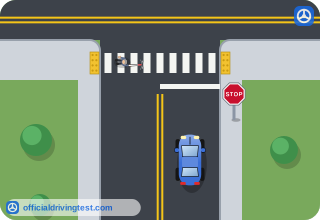
When a driver encounters a pedestrian guided by an assistance animal or carrying a white cane, what must the driver do?
- Honk to alert the pedestrian and proceed
- Take precautions and come to a full stop if needed to avoid injury
- Yield only if the pedestrian raises a hand
- Maintain normal speed since the pedestrian should yield
Show answer
Correct answer: Take precautions and come to a full stop if needed to avoid injury
A driver must take the necessary precautions to avoid injuring or endangering a pedestrian guided by an assistance animal or carrying a white cane, and must bring the vehicle to a full stop if injury or danger can only be avoided by that action.
Source: Texas Driver Handbook (Revised January 2026), page 61
-
According to the Texas Driver Handbook, motorists should especially watch for individuals who are blind:
- Only in school zones during school hours
- At bus stops and near schools for the blind
- Only on highways
- Only during nighttime hours
Show answer
Correct answer: At bus stops and near schools for the blind
Motorists should watch for individuals who are blind at bus stops, intersections, business areas, and near schools for the blind.
Source: Texas Driver Handbook (Revised January 2026), page 61
-
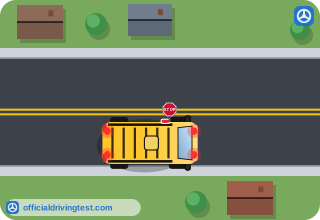
A school bus ahead of you is displaying alternately flashing red lights. What must you do?
- Slow down but continue past if no children are visible
- Stop only if you are behind the bus, not if approaching from the opposite direction
- Pass quickly before the doors open
- Stop, whether you are approaching from either direction
Show answer
Correct answer: Stop, whether you are approaching from either direction
If you approach a school bus from either direction and it is displaying alternately flashing red lights, you must stop.
Source: Texas Driver Handbook (Revised January 2026), page 23
-
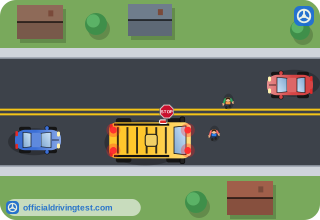
You have stopped for a school bus with flashing red lights. When may you legally proceed?
- As soon as you see the students begin to board the bus
- Immediately, since stopping once is all that the law requires of you
- When the bus moves, the driver signals you to go, or the lights stop flashing
- As soon as 10 seconds have passed since you came to a full stop
Show answer
Correct answer: When the bus moves, the driver signals you to go, or the lights stop flashing
Do not pass the school bus until it has resumed motion, you are signaled by the driver to proceed, or the red lights are no longer flashing.
Source: Texas Driver Handbook (Revised January 2026), page 23
-
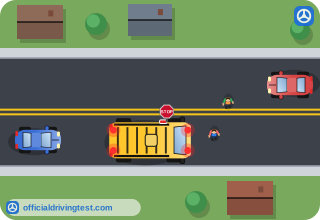
In which situation is it NOT necessary to stop for a school bus with flashing red lights?
- When you are passing the bus on a different road
- Whenever you are running late
- Whenever the bus is more than 100 feet away
- Whenever there is only one other car on the road
Show answer
Correct answer: When you are passing the bus on a different road
It is not necessary to stop when passing a school bus on a different road, or when it is stopped in a loading zone on a controlled-access highway where pedestrians are not permitted to cross.
Source: Texas Driver Handbook (Revised January 2026), page 23
-
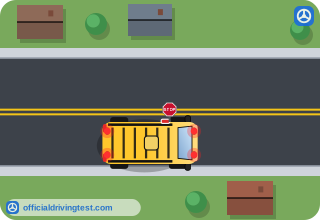
What is the fine for a first conviction of failing to yield the right-of-way to a school bus with flashing red lights?
- A fine of $500 to $1,250
- A fine of $50 to $100
- A fine of $5,000 to $10,000
- No fine, only a warning letter
Show answer
Correct answer: A fine of $500 to $1,250
A first conviction for failing to yield the right-of-way to a school bus displaying flashing red lights carries a fine of $500 to $1,250.
Source: Texas Driver Handbook (Revised January 2026), page 23
-
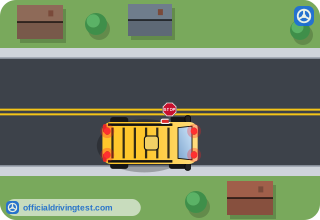
What penalty applies to a second conviction (within 5 years) for failing to yield to a school bus?
- A written warning only, with no fine or license suspension
- Automatic and permanent revocation of your driver license
- A fine of $100 to $200 and license suspension for 30 days
- A $1,000 to $2,000 fine and possible suspension for up to six months
Show answer
Correct answer: A $1,000 to $2,000 fine and possible suspension for up to six months
A second conviction and every conviction after (within 5 years) carries a fine of not less than $1,000 or more than $2,000, and possible suspension of the driver license for up to six months.
Source: Texas Driver Handbook (Revised January 2026), page 23
-
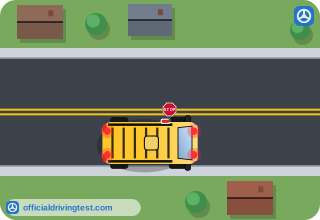
A driver causes serious bodily injury to someone while passing a stopped school bus. What is the penalty?
- Community service only, with no fine and no jail time
- A fine of up to $4,000 and/or up to one year in jail
- A verbal warning only, with no fine or jail time
- A $50 traffic ticket, like any other moving violation
Show answer
Correct answer: A fine of up to $4,000 and/or up to one year in jail
A person who causes serious bodily injury to another while passing a stopped school bus commits a Class A misdemeanor, punishable by a fine of up to $4,000 and/or up to one year in jail.
Source: Texas Driver Handbook (Revised January 2026), page 23
-
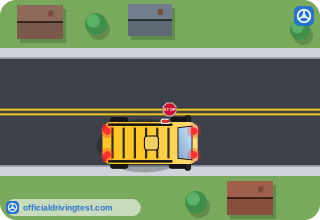
A driver with a prior conviction for passing a stopped school bus and causing serious bodily injury does it again. What is the penalty?
- A state jail felony with 180 days to 2 years of confinement
- A Class C misdemeanor with a $50 fine and no jail time
- No additional penalty beyond the one for the first offense
- A civil fine only, with no possibility of jail time
Show answer
Correct answer: A state jail felony with 180 days to 2 years of confinement
A person who causes serious bodily injury when passing a stopped school bus and has a previous conviction for the same offense commits a state jail felony, punishable by 180 days to 2 years confinement and a possible fine of up to $10,000.
Source: Texas Driver Handbook (Revised January 2026), page 23
-
At an uncontrolled intersection with no traffic signs or signals for pedestrians to enter the crosswalk, drivers must:

- Proceed since there are no signals to obey
- Sound the horn and continue driving
- Give the right-of-way to pedestrians
- Only yield if the pedestrian is running
Show answer
Correct answer: Give the right-of-way to pedestrians
Drivers must give the right-of-way to pedestrians at an uncontrolled intersection, where there are no traffic signs or signals for the pedestrian to enter the crosswalk.
Source: Texas Driver Handbook (Revised January 2026), page 23
-
A pedestrian at a crosswalk has a WALK signal displayed. What must you do?
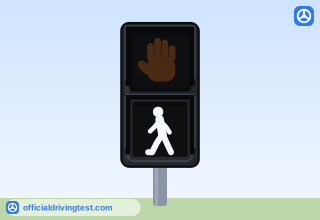
- Honk to alert the pedestrian to hurry
- Only yield if the pedestrian is a child
- Give the pedestrian the right-of-way
- Proceed if your light is green
Show answer
Correct answer: Give the pedestrian the right-of-way
If the pedestrian has a WALK signal, drivers must give the pedestrian the right-of-way.
Source: Texas Driver Handbook (Revised January 2026), page 23
-
There is no pedestrian control signal at a crosswalk, and a pedestrian enters just as your light turns green. What should you do?
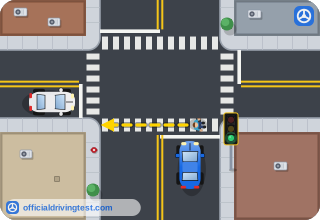
- Still give the pedestrian the right-of-way
- Proceed immediately since your light is green
- Honk and drive through the crosswalk
- Only slow down without stopping
Show answer
Correct answer: Still give the pedestrian the right-of-way
If there is not a pedestrian control signal, give the pedestrian the right-of-way on a green light, and if the light changes after the pedestrian has entered the crosswalk, still give the pedestrian the right-of-way.
Source: Texas Driver Handbook (Revised January 2026), page 23
-
When is a "Yield Here to Pedestrians" sign used?
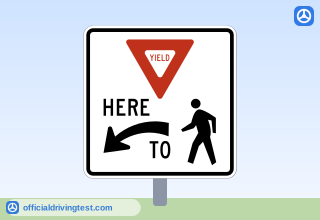
- Only where school buses stop to load and unload children
- Before a marked crosswalk across an uncontrolled multi-lane road
- Only at railroad crossings that have no gates or lights
- Only on one-lane rural roads with no marked crosswalks
Show answer
Correct answer: Before a marked crosswalk across an uncontrolled multi-lane road
The "Yield Here to Pedestrians" sign is used when yield lines are placed in advance of a marked crosswalk that crosses an uncontrolled multi-lane roadway.
Source: Texas Driver Handbook (Revised January 2026), page 23
-
Where are "In-Street Pedestrian Crossing" signs placed?
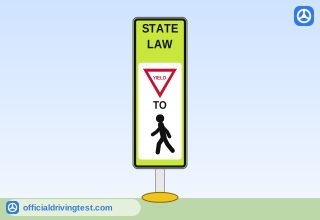
- In the road: on the center line, a lane line, or a median island
- Only on the right-hand side of the road, before the crosswalk
- Only on the left-hand side of the road, before the crosswalk
- Only above the roadway at the crosswalk, never in the road
Show answer
Correct answer: In the road: on the center line, a lane line, or a median island
"In-Street Pedestrian Crossing" signs are placed in the road at the crosswalk location, on the center line, a lane line, or a median island, and are not posted on the left- or right-hand side of the road. "Overhead Pedestrian Crossing" signs, by contrast, are placed over the roadway at the crosswalk.
Source: Texas Driver Handbook (Revised January 2026), page 23
-
What is a pedestrian hybrid beacon?
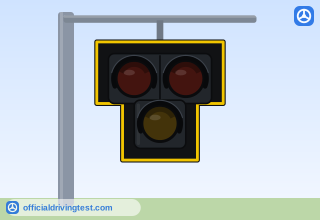
- A pedestrian-activated warning device used only at marked crosswalks
- A regular traffic light that is used at every busy intersection
- A warning sign that is used only for bicycle crossings
- A device that only warns drivers, never pedestrians
Show answer
Correct answer: A pedestrian-activated warning device used only at marked crosswalks
A pedestrian hybrid beacon is a special type of pedestrian-activated warning device used with signs and pavement markings to warn and control traffic where pedestrians cross a street, and it is only installed at a marked crosswalk.
Source: Texas Driver Handbook (Revised January 2026), page 24
-
Where might you expect to see in-roadway warning lights?
- At midblock crossings and school crosswalks
- Only inside parking garages
- Only on interstate highways
- Only at fully signalized intersections
Show answer
Correct answer: At midblock crossings and school crosswalks
In-roadway lights warn roadway users of a condition they may not see and are typically placed at midblock crossings, school crosswalks, marked crosswalks on uncontrolled approaches, or in advance of roundabouts.
Source: Texas Driver Handbook (Revised January 2026), page 24