Rhode Island: Licensing basics — Laws You Must Know and Organ Donation Practice Test
Questions in this part include: “According to the manual, what opportunity do you have when you apply for your license?” · “What does the manual say about the cost of donating organs or tissue?”
Independent educational site · not affiliated with any government agency or DMV
Ready? Test yourself
- Instant feedback with an explanation
- Every answer cites its source in the manual
- Your best score is saved on this device
- Keyboard: press 1 to 4 to answer and Enter for the next question
Questions are original and based on the official manual "Rhode Island Driver’s Manual" (April 2024), Rhode Island Division of Motor Vehicles (DMV).
All 16 questions in this practice test
Take the test above first, then use this list to study. Tap “Show answer” to see the correct answer and explanation.
Show the questions and answersHide the questions
-
According to the manual, what opportunity do you have when you apply for your license?
- To register as an organ donor
- To register for a defensive driving course
- To choose a custom license number
- To pay your registration early
Show answer
Correct answer: To register as an organ donor
The organ donation page says that when you apply for your license you can register as a donor.
Source: Rhode Island Driver’s Manual (April 2024), page 3
-
What does the manual say about buying or selling organs for transplantation in the United States?
- It is legal when the donor gives written consent
- It is legal only for tissue transplants
- It is illegal
- It is legal between registered donors
Show answer
Correct answer: It is illegal
The manual states that in the United States it is illegal to buy or sell organs for transplantation.
Source: Rhode Island Driver’s Manual (April 2024), page 3
-
If a law enforcement officer stops you, what are you required to display on request?
- Only your driver’s license
- Your license and a receipt for your most recent vehicle inspection
- Your driver’s license, vehicle registration card, and proof of insurance
- Your birth certificate and Social Security card
Show answer
Correct answer: Your driver’s license, vehicle registration card, and proof of insurance
On request you must show your license, registration card and proof of insurance.
Source: Rhode Island Driver’s Manual (April 2024), page 58
-
Upon request by a law enforcement officer, what else are you required to do for the purpose of being identified?
- Recite your license number from memory
- Write your name in the officer’s presence
- Sign your name on the vehicle’s window
- Give a fingerprint at the roadside
Show answer
Correct answer: Write your name in the officer’s presence
An officer may ask you to write your name in his or her presence so that you can be identified.
Source: Rhode Island Driver’s Manual (April 2024), page 58
-
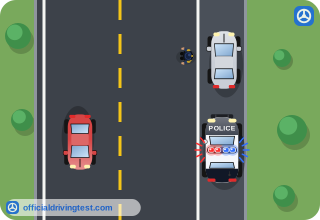
A law enforcement officer asks you to exit your vehicle. What must you do?
- Stay inside with the doors locked
- Exit only if you are given a written order
- Exit only if another officer is present
- Exit the vehicle
Show answer
Correct answer: Exit the vehicle
The manual says that if an officer requests that you exit your vehicle, you must do so.
Source: Rhode Island Driver’s Manual (April 2024), page 58
-
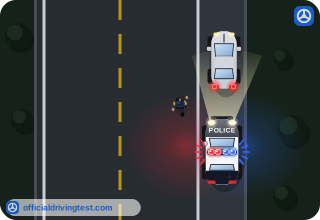
If a law enforcement officer stops you at night, what is a motorist required to do?
- Turn off all of the vehicle’s lights
- Turn on the hazard flashers and step out
- Keep the interior lights off to avoid glare
- Turn on the vehicle’s interior lights
Show answer
Correct answer: Turn on the vehicle’s interior lights
If an officer stops you at night, you must turn on the vehicle's interior lights.
Source: Rhode Island Driver’s Manual (April 2024), page 58
-
According to the list of laws you must know, for whose safety are you responsible as a driver?
- Only the front-seat passengers
- All of the occupants in your vehicle
- Only passengers under 18
- Only yourself
Show answer
Correct answer: All of the occupants in your vehicle
The manual states that a driver is responsible for the safety of all occupants in the vehicle.
Source: Rhode Island Driver’s Manual (April 2024), page 58
-
What is needed if you are under 18 years old and want to be an organ donor?
- A court order
- A doctor's note
- Parental consent
- Nothing, since any age may register on their own
Show answer
Correct answer: Parental consent
The manual says anyone under 18 needs parental consent to donate.
Source: Rhode Island Driver’s Manual (April 2024), page 69
-
Who can be a potential organ donor, according to the manual?
- Anyone, regardless of race or medical history
- Only people with no history of illness
- Only people younger than fifty years old
- Only people with certain blood types
Show answer
Correct answer: Anyone, regardless of race or medical history
The manual says anyone can be a potential donor, regardless of race or medical history.
Source: Rhode Island Driver’s Manual (April 2024), page 69
-
What does the manual say about the cost of donating organs or tissue?
- The donor pays only the hospital fees
- The donor's family pays the surgery costs
- It costs nothing
- The donor pays a one-time DMV fee
Show answer
Correct answer: It costs nothing
The manual states that it costs nothing to donate.
Source: Rhode Island Driver’s Manual (April 2024), page 69
-
If you are sick or injured and admitted to the hospital, what is the first priority of any health care provider?
- To check your donor designation
- To save your life
- To contact your family
- To find a matching recipient
Show answer
Correct answer: To save your life
The manual says a donor designation does not change care: the first priority of any health care provider is to save your life.
Source: Rhode Island Driver’s Manual (April 2024), page 69
-
Which factors does the manual name as deciding who receives a transplant?
- Age, income, and occupation of the recipient
- Race, religion, and place of residence
- Whether the person is also a registered donor
- Blood type, body size, critical need, wait time
Show answer
Correct answer: Blood type, body size, critical need, wait time
The manual says transplants go by factors such as matched blood type, body size, critical need and how long someone has waited.
Source: Rhode Island Driver’s Manual (April 2024), page 69
-
What does the manual say about organ donation and funeral or burial arrangements?
- Donation delays them by several weeks
- Donation requires a closed casket
- Donation limits them to cremation
- Donation does not interfere with them
Show answer
Correct answer: Donation does not interfere with them
The manual states that donation does not interfere with funeral or burial arrangements.
Source: Rhode Island Driver’s Manual (April 2024), page 69
-
What does the manual say is the most important way to make your donation wishes known?
- Sign a donor card and leave it with your doctor
- Ask the DMV to put the donor designation on your license
- Ask the Community College of Rhode Island to record them
- Write your wishes on your vehicle registration
Show answer
Correct answer: Ask the DMV to put the donor designation on your license
The manual says that, most importantly, you should ask the DMV to put the donor designation on your license.
Source: Rhode Island Driver’s Manual (April 2024), page 69
-
Where does the manual say you can get an organ donor card?
- From the Rhode Island State Police
- From the Community College of Rhode Island
- From the New England Organ Bank
- From the Department of Revenue
Show answer
Correct answer: From the New England Organ Bank
The manual says you can get a donor card from the New England Organ Bank.
Source: Rhode Island Driver’s Manual (April 2024), page 69
-
In addition to any other method, what does the manual say you should be sure to do if you decide to donate?
- Tell your family about your decision
- Notify your insurance company
- Notify your employer
- Register with the Community College of Rhode Island
Show answer
Correct answer: Tell your family about your decision
The manual says that along with a license designation or donor card, you should be sure to tell your family.
Source: Rhode Island Driver’s Manual (April 2024), page 69