Pennsylvania: Road signs — Part 3 Practice Test
Regulatory, warning, and guide signs and what to do when you see them. — Part 3
Independent educational site · not affiliated with any government agency or DMV
Ready? Test yourself
- Instant feedback with an explanation
- Every answer cites its source in the manual
- Your best score is saved on this device
Questions are original and based on the official manual "Pennsylvania Driver's Manual" (Pub 95), Pennsylvania Department of Transportation (PennDOT), Bureau of Driver Licensing.
All 18 questions in this practice test
Take the test above first, then use this list to study. Tap “Show answer” to see the correct answer and explanation.
Show the questions and answersHide the questions
-
An ADVISORY SPEED sign posted below a curve warning sign showing "25 MPH" tells you:
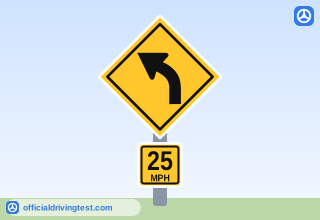
- the highest speed you should use around that curve
- the minimum speed required through the curve
- the legal speed limit for the entire highway
- the speed limit only for trucks
Show answer
Correct answer: the highest speed you should use around that curve
An advisory speed sign shows the highest speed you should travel around the curve, such as 25 mph for a sharp left curve.
Source: Pennsylvania Driver's Manual (Pub 95), page 14 · Open this page in the manual (Manual page 14)
-
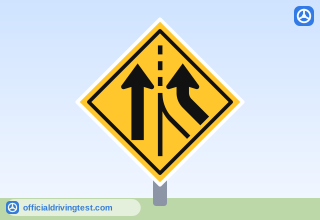
An ADDED LANE sign means merging is not necessary because:
- the entering traffic must come to a complete stop first
- the ramp is closed
- the entering traffic uses a new lane added to the roadway
- the major roadway will narrow ahead
Show answer
Correct answer: the entering traffic uses a new lane added to the roadway
An ADDED LANE sign means merging is not necessary because the entering traffic uses a new lane that has been added to the roadway.
Source: Pennsylvania Driver's Manual (Pub 95), page 14 · Open this page in the manual (Manual page 14)
-
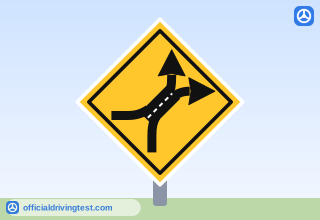
A WEAVE AREA sign warns that:
- the road ahead is closed for construction
- you are approaching the start of a divided highway
- a passing lane is beginning
- you will merge while some traffic exits across your path
Show answer
Correct answer: you will merge while some traffic exits across your path
A WEAVE AREA sign is used to warn that you will be merging with another roadway as some traffic is exiting and crossing your path.
Source: Pennsylvania Driver's Manual (Pub 95), page 14 · Open this page in the manual (Manual page 14)
-
A DIVIDED HIGHWAY BEGINS sign warns that the highway ahead becomes a divided highway. What should you do?
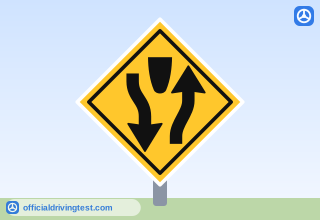
- Keep to the right of the divider or median
- Move to the left of the divider or median
- Straddle the median for better visibility
- Stop before entering the divided section
Show answer
Correct answer: Keep to the right of the divider or median
As the highway becomes divided, keep to the right of the divider or median.
Source: Pennsylvania Driver's Manual (Pub 95), page 15 · Open this page in the manual (Manual page 15)
-
A DIVIDED HIGHWAY ENDS sign warns that you will soon be on a roadway with two-way traffic. What should you do?
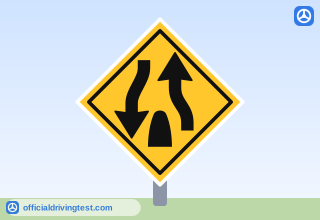
- Keep to the left of the centerline
- Keep to the right of the centerline and watch for oncoming traffic
- Continue in either lane since the road is still divided
- Stop and wait for a signal before proceeding
Show answer
Correct answer: Keep to the right of the centerline and watch for oncoming traffic
When the divided highway ends, keep to the right of the centerline and watch for oncoming traffic.
Source: Pennsylvania Driver's Manual (Pub 95), page 15 · Open this page in the manual (Manual page 15)
-
A TWO-WAY TRAFFIC AHEAD sign warns that a one-way street or roadway ends ahead, and you will be traveling on a road with:
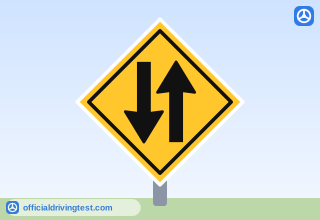
- a single lane shared in both directions
- a divided highway with a median
- two lanes moving in opposite directions
- no marked lanes at all
Show answer
Correct answer: two lanes moving in opposite directions
The one-way street or roadway ends ahead; you will then be traveling on a road with two lanes of traffic moving in opposite directions.
Source: Pennsylvania Driver's Manual (Pub 95), page 15 · Open this page in the manual (Manual page 15)
-
A LANE ENDS MERGE LEFT sign tells drivers that:
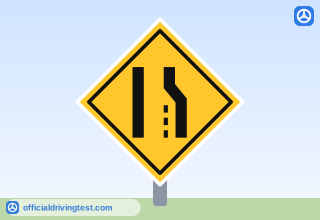
- the left lane on a multi-lane road will end ahead and traffic must merge right
- all lanes end ahead at a dead end
- a new lane is being added on the left
- one lane on a multi-lane roadway will end ahead and traffic in the right lane must merge left
Show answer
Correct answer: one lane on a multi-lane roadway will end ahead and traffic in the right lane must merge left
This sign tells you one lane on a multi-lane roadway will end ahead, and in this example the traffic in the right lane must merge left.
Source: Pennsylvania Driver's Manual (Pub 95), page 15 · Open this page in the manual (Manual page 15)
-
What is the purpose of intersection-type warning signs, such as the T-intersection or Y-intersection signs?
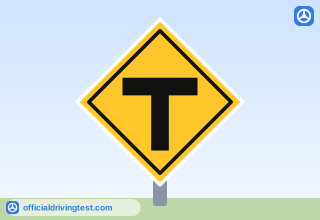
- To show in advance how the roads join each other
- To indicate the posted speed limit at the intersection
- To show which lane is reserved for left turns only
- To indicate that the intersection has a traffic signal
Show answer
Correct answer: To show in advance how the roads join each other
These signs let you know in advance how the roads join and warn of possible problems with the movements of other vehicles.
Source: Pennsylvania Driver's Manual (Pub 95), page 15 · Open this page in the manual (Manual page 15)
-
A TWO DIRECTION LARGE ARROW sign placed at the far side of a T-intersection tells you:
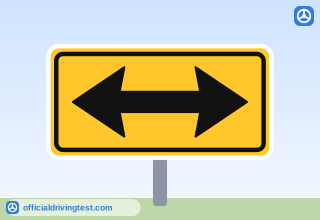
- you may continue straight through the intersection
- you can only go left or right at the intersection
- the intersection is closed ahead
- you must yield to all cross traffic
Show answer
Correct answer: you can only go left or right at the intersection
This sign tells you that you can only go left or right at a T-intersection, because the road you are on does not continue straight through.
Source: Pennsylvania Driver's Manual (Pub 95), page 15 · Open this page in the manual (Manual page 15)
-
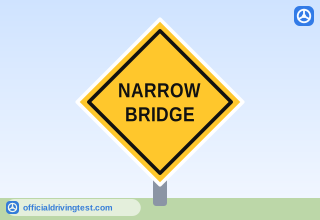
A NARROW BRIDGE OR UNDERPASS AHEAD sign warns that:
- the bridge or underpass is closed to all traffic
- the bridge is for pedestrians only
- each lane narrows and there is generally no shoulder
- a toll is required to cross
Show answer
Correct answer: each lane narrows and there is generally no shoulder
Each lane on the bridge or underpass becomes narrower, and there generally is no shoulder, so you need to slow down and stay in your lane.
Source: Pennsylvania Driver's Manual (Pub 95), page 15 · Open this page in the manual (Manual page 15)
-
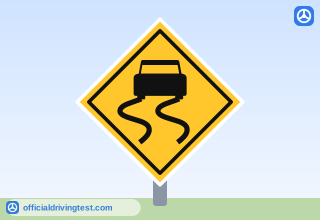
In wet weather, when you see a SLIPPERY WHEN WET sign, what should you do?
- Accelerate quickly through the area to reduce exposure time
- Brake hard well before the sign to test traction
- Ignore it unless it is actively raining
- Slow down, increase following distance and turn very slowly
Show answer
Correct answer: Slow down, increase following distance and turn very slowly
In wet weather, reduce your speed, increase your following distance, avoid quick acceleration or braking, and make turns at a very slow speed.
Source: Pennsylvania Driver's Manual (Pub 95), page 15 · Open this page in the manual (Manual page 15)
-
A DEER CROSSING sign is posted:
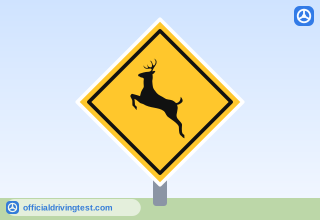
- in areas where deer often cross and deer crashes have occurred
- in every rural area, regardless of deer activity or crashes
- only near state game lands
- only during hunting season
Show answer
Correct answer: in areas where deer often cross and deer crashes have occurred
This sign is posted in areas where deer frequently cross and crashes with deer have occurred.
Source: Pennsylvania Driver's Manual (Pub 95), page 16 · Open this page in the manual (Manual page 16)
-
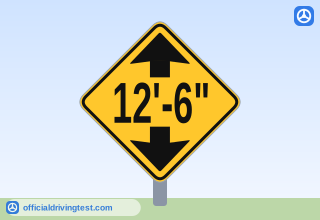
A LOW CLEARANCE sign, posted at an underpass, tunnel or parking garage entrance, means:
- only trucks are prohibited from entering the structure
- do not enter if your vehicle is taller than the posted height
- the structure is closed for repairs
- you must reduce speed to 10 mph before entering
Show answer
Correct answer: do not enter if your vehicle is taller than the posted height
Do not enter a low clearance area if your vehicle is taller than the height listed on the sign.
Source: Pennsylvania Driver's Manual (Pub 95), page 16 · Open this page in the manual (Manual page 16)
-
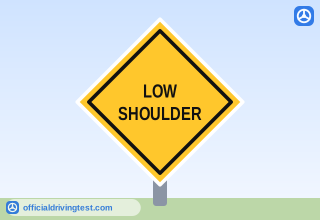
A LOW SHOULDER sign is used where the shoulder is:
- level with the road at all points
- unpaved but level with the road
- as much as three inches below the level of the road
- more than one foot below the level of the road
Show answer
Correct answer: as much as three inches below the level of the road
The LOW SHOULDER sign is used where the shoulder is as much as three inches below the level of the road.
Source: Pennsylvania Driver's Manual (Pub 95), page 16 · Open this page in the manual (Manual page 16)
-
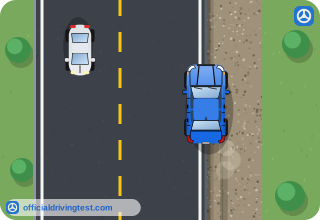
If one of your wheels drops off the roadway onto a low or soft shoulder, what should you do?
- Slam on the brakes immediately to stop before losing control
- Steer sharply back onto the roadway right away
- Accelerate to regain traction before correcting
- Do not slam on the brakes or steer sharply to get back on the road
Show answer
Correct answer: Do not slam on the brakes or steer sharply to get back on the road
If a wheel drops off onto a low or soft shoulder, do not slam on the brakes or steer sharply — you can easily lose control of your vehicle.
Source: Pennsylvania Driver's Manual (Pub 95), page 16 · Open this page in the manual (Manual page 16)
-
A HILL/DOWNGRADE sign warns of a steep hill ahead. What should you do?
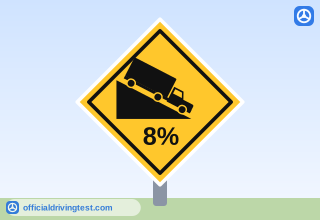
- Slow down and be ready to shift to a lower gear
- Speed up to maintain momentum up the next hill
- Ride the brakes continuously down the entire hill
- Shift into neutral to coast down the hill
Show answer
Correct answer: Slow down and be ready to shift to a lower gear
Slow down and be ready to shift to a lower gear to control your speed and save wear and tear on your brakes.
Source: Pennsylvania Driver's Manual (Pub 95), page 16 · Open this page in the manual (Manual page 16)
-
A TRAFFIC SIGNAL AHEAD sign warns you that:
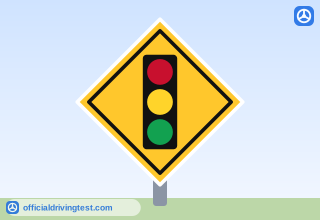
- you must stop immediately at the sign
- a traffic signal ahead may be hidden by a curve or hill
- the traffic signal ahead is malfunctioning or turned off
- a railroad crossing signal is ahead
Show answer
Correct answer: a traffic signal ahead may be hidden by a curve or hill
A traffic signal is present at the intersection ahead; you may not be able to see it because of a curve or hill, and vehicles may be stopped ahead.
Source: Pennsylvania Driver's Manual (Pub 95), page 16 · Open this page in the manual (Manual page 16)
-
A STOP SIGN AHEAD sign warns that:
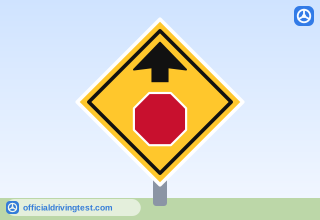
- you must stop at the location of this sign itself
- the intersection ahead has no traffic control at all
- a STOP sign is ahead, though you may not be able to see it
- a yield sign, not a stop sign, is actually ahead
Show answer
Correct answer: a STOP sign is ahead, though you may not be able to see it
A STOP sign is present at the intersection ahead which you may not be able to see; slow down in preparation to stop.
Source: Pennsylvania Driver's Manual (Pub 95), page 16 · Open this page in the manual (Manual page 16)