Oregon: Speed and following distance — Part 5 Practice Test
Questions in this part include: “What should you do as you come out of a curve?” · “Defensive driving means knowing how to adjust your driving to allow for which of these?”
Independent educational site · not affiliated with any government agency or DMV
Ready? Test yourself
- Instant feedback with an explanation
- Every answer cites its source in the manual
- Your best score is saved on this device
Questions are original and based on the official manual "Oregon Driver Manual" (2026-2027), Oregon Driver and Motor Vehicle Services (DMV).
All 17 questions in this practice test
Take the test above first, then use this list to study. Tap “Show answer” to see the correct answer and explanation.
Show the questions and answersHide the questions
-
What should you do as you come out of a curve?
- Brake firmly until you are almost stopped
- Speed up sharply to make up for lost time
- Move to the center line to straighten your path
- Increase your speed gradually
Show answer
Correct answer: Increase your speed gradually
The manual says to increase your speed gradually as you come out of a curve.
Source: Oregon Driver Manual (2026-2027), page 30 · Open this page in the manual (Manual page 30)
-
What should you watch for that may be hidden around a curve?
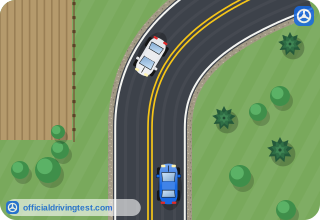
- People riding bicycles, pedestrians, or slow-moving vehicles
- Railroad crossings that have no warning signs or signals
- Traffic lights that have been turned off by the city
- Toll booths that have been closed for the night
Show answer
Correct answer: People riding bicycles, pedestrians, or slow-moving vehicles
The manual says to be alert for bicyclists, pedestrians, or slow-moving vehicles hidden around the curve.
Source: Oregon Driver Manual (2026-2027), page 30 · Open this page in the manual (Manual page 30)
-
You are near a school hours speed limit sign and are unsure whether it is a school day. What should you do?
- Drive the speed you think is safe
- Slow down to 15 mph
- Slow down to 20 mph
- Drive at the residential limit of 25 mph
Show answer
Correct answer: Slow down to 20 mph
If you are unsure whether it is a school day, the manual says to slow down to 20 mph.
Source: Oregon Driver Manual (2026-2027), page 49 · Open this page in the manual (Manual page 49)
-
When following a person riding a motorcycle, how much distance should you leave?
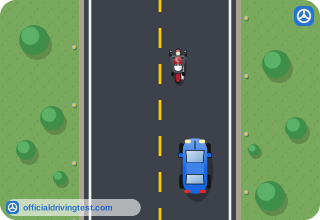
- The same distance you would leave behind another car
- More distance than you would leave behind another car
- Less distance, so the rider can see you in the mirrors
- Only a few feet, since motorcycles are small
Show answer
Correct answer: More distance than you would leave behind another car
The manual says to allow more distance behind a motorcycle than behind another car.
Source: Oregon Driver Manual (2026-2027), page 52 · Open this page in the manual (Manual page 52)
-
Weather and road conditions may affect people riding motorcycles and mopeds more than other vehicles. What should you do?
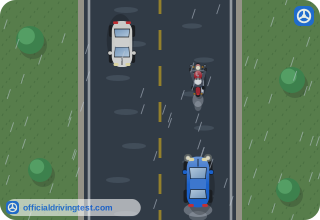
- Pass them as soon as possible
- Increase your following distance
- Stay in their blind spot
- Follow closely so they can see you
Show answer
Correct answer: Increase your following distance
The manual says to increase your following distance when conditions may affect motorcycles and mopeds.
Source: Oregon Driver Manual (2026-2027), page 52 · Open this page in the manual (Manual page 52)
-
Which areas around your vehicle must you be able to see?
- The front, sides, and rear
- The front and left side only
- The front and right side only
- The front and rear only
Show answer
Correct answer: The front, sides, and rear
The manual says you must be able to see what is to the front, sides, and rear of your vehicle.
Source: Oregon Driver Manual (2026-2027), page 73 · Open this page in the manual (Manual page 73)
-
Why should you avoid placing stickers or other objects on your vehicle’s windows?
- They can make the glass crack in cold weather
- They can make the engine run hotter
- They can limit your view of the road
- They can block the signal from your turn lights
Show answer
Correct answer: They can limit your view of the road
The manual warns that stickers or objects on the windows can limit your view of the road.
Source: Oregon Driver Manual (2026-2027), page 73 · Open this page in the manual (Manual page 73)
-
What is a defensive driver always aware of?
- Only the vehicles directly behind and beside them
- Their surroundings and possible escape routes
- Only the posted speed limit and signs
- The exact time of sunset each day
Show answer
Correct answer: Their surroundings and possible escape routes
A defensive driver is always aware of their surroundings and possible escape routes.
Source: Oregon Driver Manual (2026-2027), page 73 · Open this page in the manual (Manual page 73)
-
Defensive driving means knowing how to adjust your driving to allow for which of these?
- The color and style of your vehicle and tires
- The age and make of the vehicle in front of you
- The number of passengers riding behind you
- Your own physical, mental, and emotional condition
Show answer
Correct answer: Your own physical, mental, and emotional condition
The manual lists your own physical, mental, and emotional condition among the things to adjust your driving for.
Source: Oregon Driver Manual (2026-2027), page 73 · Open this page in the manual (Manual page 73)
-
What do hazardous conditions require?
- Faster speeds and shorter following distances
- Normal speeds and increased following distances
- Slower speeds and increased following distances
- Slower speeds and the same following distance
Show answer
Correct answer: Slower speeds and increased following distances
The manual says hazardous conditions require slower speeds and increased following distances.
Source: Oregon Driver Manual (2026-2027), page 76 · Open this page in the manual (Manual page 76)
-
According to the manual, when does driving become hazardous?
- Only when you are driving at night in the countryside
- When visibility is reduced or the road is wet, snowy, or icy
- Only when the road surface is covered with ice
- Only when traffic is heavy on the road you are using
Show answer
Correct answer: When visibility is reduced or the road is wet, snowy, or icy
Driving becomes hazardous when visibility is reduced or when the road surface is wet or covered with snow or ice.
Source: Oregon Driver Manual (2026-2027), page 76 · Open this page in the manual (Manual page 76)
-
Why is your reaction slower at night?
- Your headlights are brighter than daylight
- You can only see as far as your headlights
- Other drivers use their horns more often at night
- Road signs are not reflective at night
Show answer
Correct answer: You can only see as far as your headlights
At night your reaction is slower because you can only see as far as your headlights.
Source: Oregon Driver Manual (2026-2027), page 77 · Open this page in the manual (Manual page 77)
-
How can you be less blinded by the headlights of oncoming vehicles at night?
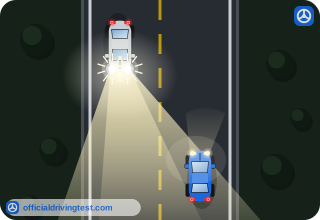
- Look directly into the oncoming lights so your eyes adjust to them
- Turn on your high beams so that the other driver will dim their lights
- Look at the center line of the road and ignore the other vehicle
- Look a little to the right of the oncoming lights, at the road edge or fog line
Show answer
Correct answer: Look a little to the right of the oncoming lights, at the road edge or fog line
Looking a little to the right of oncoming lights and watching the road edge or fog line helps you be less blinded by glare.
Source: Oregon Driver Manual (2026-2027), page 77 · Open this page in the manual (Manual page 77)
-
Why should you be careful when passing at dawn or dusk?
- The sun always blinds the passing driver
- Road markings are not visible at dawn or dusk
- Oncoming vehicles may not have their headlights on
- Passing is always illegal at those times
Show answer
Correct answer: Oncoming vehicles may not have their headlights on
At dawn or dusk oncoming vehicles may not have their headlights on, and you may not see them until it is too late.
Source: Oregon Driver Manual (2026-2027), page 77 · Open this page in the manual (Manual page 77)
-
What should you do as visibility decreases?
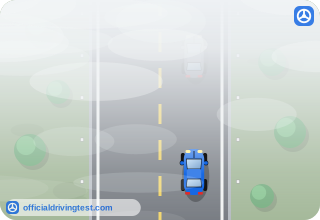
- Slow down
- Speed up to leave the area
- Stay at the same speed
- Follow closer to the vehicle ahead
Show answer
Correct answer: Slow down
The manual says to slow down as visibility decreases.
Source: Oregon Driver Manual (2026-2027), page 77 · Open this page in the manual (Manual page 77)
-
How should you apply the brakes when roads are wet?
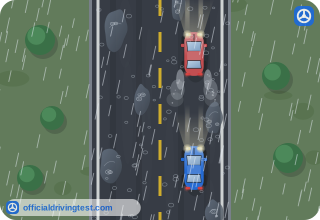
- Later and more firmly than usual
- Sooner and more gently than usual
- At the same time as usual
- Only by pumping them quickly
Show answer
Correct answer: Sooner and more gently than usual
When roads are wet, apply the brakes sooner and more gently than usual.
Source: Oregon Driver Manual (2026-2027), page 77 · Open this page in the manual (Manual page 77)
-
What does rain do to the distance needed to stop your vehicle?
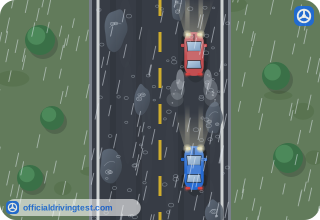
- It decreases the braking distance
- It does not change the braking distance
- It only changes it at night
- It increases the braking distance
Show answer
Correct answer: It increases the braking distance
Rain impairs your ability to see ahead and increases the braking distance needed to stop.
Source: Oregon Driver Manual (2026-2027), page 77 · Open this page in the manual (Manual page 77)