Oregon: Speed and following distance — Part 4 Practice Test
Questions in this part include: “Which of these can affect how far it takes you to stop a vehicle?” · “Why should you scan ahead for trouble spots as far as you can see?”
Independent educational site · not affiliated with any government agency or DMV
Ready? Test yourself
- Instant feedback with an explanation
- Every answer cites its source in the manual
- Your best score is saved on this device
Questions are original and based on the official manual "Oregon Driver Manual" (2026-2027), Oregon Driver and Motor Vehicle Services (DMV).
All 17 questions in this practice test
Take the test above first, then use this list to study. Tap “Show answer” to see the correct answer and explanation.
Show the questions and answersHide the questions
-
A vehicle behind you is following too closely and there is a right lane. What should you do?
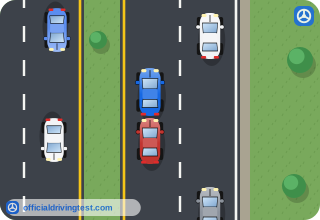
- Move over to the left lane
- Brake hard to make the driver back off
- Move over to the right
- Speed up to leave the driver behind
Show answer
Correct answer: Move over to the right
If a vehicle behind you is following too closely and there is a right lane, move over to the right.
Source: Oregon Driver Manual (2026-2027), page 28 · Open this page in the manual (Manual page 28)
-
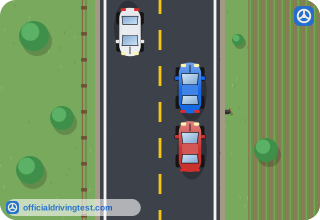
A vehicle is following you too closely and you cannot move over. What should you do?
- Speed up to get away from it
- Slowly reduce your speed
- Brake hard to make the driver back off
- Stop in your lane
Show answer
Correct answer: Slowly reduce your speed
Slowly reducing your speed may encourage the vehicle to pass you or to stop tailgating.
Source: Oregon Driver Manual (2026-2027), page 29 · Open this page in the manual (Manual page 29)
-
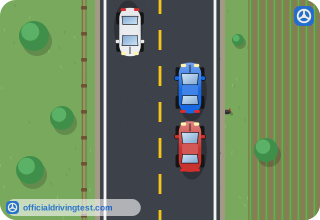
A driver behind you is following too closely. Which action does the manual say never to use to discourage tailgating?
- Moving over to the right
- Slowly reducing your speed
- Braking hard
- Keeping a steady speed
Show answer
Correct answer: Braking hard
Braking hard to discourage tailgating is dangerous because you could get hit from behind.
Source: Oregon Driver Manual (2026-2027), page 29 · Open this page in the manual (Manual page 29)
-
Which of these can affect how far it takes you to stop a vehicle?
- The braking ability of your vehicle
- The color of the paint on your vehicle
- The model year of the vehicle you drive
- The size of the fuel tank in your vehicle
Show answer
Correct answer: The braking ability of your vehicle
Stopping distance depends on road and weather conditions, vehicle weight, reaction time and the braking ability of your vehicle.
Source: Oregon Driver Manual (2026-2027), page 29 · Open this page in the manual (Manual page 29)
-
How does driving faster affect your stopping distance, even in ideal conditions?
- It stays the same on dry roads
- The distance gets shorter
- The distance gets greater
- It changes only in bad weather
Show answer
Correct answer: The distance gets greater
The faster you drive, the greater your stopping distance, even in ideal conditions.
Source: Oregon Driver Manual (2026-2027), page 29 · Open this page in the manual (Manual page 29)
-
At 60 mph, the distance from recognizing a hazard and applying the brakes to a full stop is greater than the length of what?
- A city block
- A football field
- A school bus
- A freeway on-ramp
Show answer
Correct answer: A football field
The manual says that at 60 mph the stopping distance is greater than the length of a football field.
Source: Oregon Driver Manual (2026-2027), page 29 · Open this page in the manual (Manual page 29)
-
According to the manual's stopping-distance chart, how far does a vehicle travel from the point the driver recognizes a hazard until it stops when going 20 mph?
- 123 feet
- 189 feet
- 90 feet
- 69 feet
Show answer
Correct answer: 69 feet
The chart shows 69 feet for 20 mph.
Source: Oregon Driver Manual (2026-2027), page 29 · Open this page in the manual (Manual page 29)
-
According to the manual's stopping-distance chart, how far does a vehicle travel from the point the driver recognizes a hazard until it stops when going 30 mph?
- 69 feet
- 123 feet
- 189 feet
- 150 feet
Show answer
Correct answer: 123 feet
The chart shows 123 feet for 30 mph.
Source: Oregon Driver Manual (2026-2027), page 29 · Open this page in the manual (Manual page 29)
-
According to the manual's stopping-distance chart, how far does a vehicle travel from the point the driver recognizes a hazard until it stops when going 40 mph?
- 123 feet
- 268 feet
- 220 feet
- 189 feet
Show answer
Correct answer: 189 feet
The chart shows 189 feet for 40 mph.
Source: Oregon Driver Manual (2026-2027), page 29 · Open this page in the manual (Manual page 29)
-
According to the manual's stopping-distance chart, how far does a vehicle travel from the point the driver recognizes a hazard until it stops when going 50 mph?
- 268 feet
- 189 feet
- 359 feet
- 300 feet
Show answer
Correct answer: 268 feet
The chart shows 268 feet for 50 mph.
Source: Oregon Driver Manual (2026-2027), page 29 · Open this page in the manual (Manual page 29)
-
According to the manual's stopping-distance chart, how far does a vehicle travel from the point the driver recognizes a hazard until it stops when going 60 mph?
- 268 feet
- 420 feet
- 359 feet
- 300 feet
Show answer
Correct answer: 359 feet
The chart shows 359 feet for 60 mph.
Source: Oregon Driver Manual (2026-2027), page 29 · Open this page in the manual (Manual page 29)
-
What does scanning mean when you look ahead while driving?
- Looking only at the vehicle directly in front of you on the road
- Checking your mirrors every few seconds while you drive ahead
- Reading each road sign as soon as it comes into your view
- Taking in the entire scene, including the sides of the road
Show answer
Correct answer: Taking in the entire scene, including the sides of the road
Scanning means taking in the entire scene, including the sides of the road.
Source: Oregon Driver Manual (2026-2027), page 30 · Open this page in the manual (Manual page 30)
-
Why should you scan ahead for trouble spots as far as you can see?
- To avoid the need for last-minute moves
- To be able to drive closer to the vehicle ahead
- To avoid using your turn signals
- To keep your speed above that of other traffic
Show answer
Correct answer: To avoid the need for last-minute moves
Scanning ahead helps you avoid last-minute moves.
Source: Oregon Driver Manual (2026-2027), page 30 · Open this page in the manual (Manual page 30)
-
Which of these is a clue that a driver ahead may be going to slow down or stop?
- The driver’s headlights being turned off
- A window being opened
- Brake lights coming on
- The vehicle moving slightly to the left of its lane
Show answer
Correct answer: Brake lights coming on
The manual lists brake lights coming on, blinking turn signals, and a bicyclist or pedestrian ahead as clues.
Source: Oregon Driver Manual (2026-2027), page 30 · Open this page in the manual (Manual page 30)
-
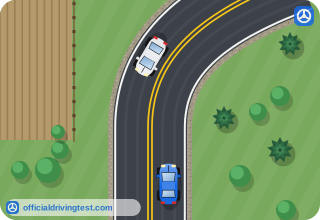
What should you do before you enter a curve?
- Speed up
- Slow down
- Move to the center line
- Shift to the shoulder
Show answer
Correct answer: Slow down
The manual says to slow down before you enter a curve.
Source: Oregon Driver Manual (2026-2027), page 30 · Open this page in the manual (Manual page 30)
-
How can you use a curve sign that has a speed shown below it?
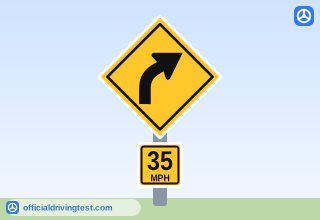
- As the minimum speed you must keep through the curve
- As the speed at which other traffic is allowed to pass you
- As a guide to your speed through the curve
- As a speed you must exceed to stay with the traffic flow
Show answer
Correct answer: As a guide to your speed through the curve
The manual says to use the speed shown below a curve sign as a guide, if posted.
Source: Oregon Driver Manual (2026-2027), page 30 · Open this page in the manual (Manual page 30)
-
Where should you position your vehicle while driving through a curve?
- Right on the center line, so you can see farther around the curve
- In the middle of your lane, to the right of the center line
- Along the right edge of your lane, away from oncoming vehicles
- In the left part of your lane to cut the curve more gently
Show answer
Correct answer: In the middle of your lane, to the right of the center line
In a curve, stay to the right of the center line and in the middle of your lane.
Source: Oregon Driver Manual (2026-2027), page 30 · Open this page in the manual (Manual page 30)