Oregon: Speed and following distance — Part 3 Practice Test
Questions in this part include: “After traffic starts to move from a stop, what should you do?” · “To keep as much space as possible between you and oncoming vehicles, where is it generally safest to drive in your lane?”
Independent educational site · not affiliated with any government agency or DMV
Ready? Test yourself
- Instant feedback with an explanation
- Every answer cites its source in the manual
- Your best score is saved on this device
Questions are original and based on the official manual "Oregon Driver Manual" (2026-2027), Oregon Driver and Motor Vehicle Services (DMV).
All 18 questions in this practice test
Take the test above first, then use this list to study. Tap “Show answer” to see the correct answer and explanation.
Show the questions and answersHide the questions
-
When stopping behind another vehicle, what should you be able to see?
- The brake lights of the vehicle that is two cars ahead
- The license plate of the vehicle in front
- Where the rear tires of the vehicle in front meet the road
- The bumper of the vehicle behind you
Show answer
Correct answer: Where the rear tires of the vehicle in front meet the road
Make sure you can see where the rear tires of the vehicle in front meet the road.
Source: Oregon Driver Manual (2026-2027), page 27 · Open this page in the manual (Manual page 27)
-
After traffic starts to move from a stop, what should you do?
- Return to a safe following distance
- Stay close to the vehicle ahead to keep traffic moving
- Speed up to the speed limit right away
- Leave only the distance you left when stopped
Show answer
Correct answer: Return to a safe following distance
After traffic starts to move, return to a safe following distance.
Source: Oregon Driver Manual (2026-2027), page 27 · Open this page in the manual (Manual page 27)
-
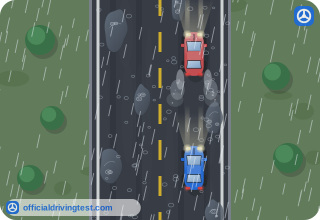
Why should you increase your following distance on wet or slippery roads?
- Other drivers cannot see your brake lights
- Your speed limit is lower in the rain
- You will use more fuel
- You need more distance to stop your vehicle
Show answer
Correct answer: You need more distance to stop your vehicle
On wet or slippery roads you need more distance to stop your vehicle.
Source: Oregon Driver Manual (2026-2027), page 27 · Open this page in the manual (Manual page 27)
-
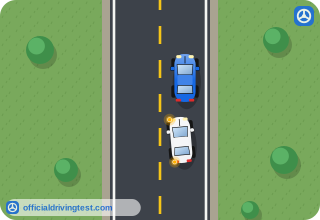
When the driver behind you wants to pass, what should you do?
- Speed up so that the driver behind you cannot easily pass you
- Slow down to allow room in front of you for the passing vehicle
- Move onto the shoulder and stop
- Stay at the same speed and hold your lane
Show answer
Correct answer: Slow down to allow room in front of you for the passing vehicle
You should increase your following distance by slowing down so the passing vehicle has room to complete the pass.
Source: Oregon Driver Manual (2026-2027), page 27 · Open this page in the manual (Manual page 27)
-
Why should you increase your following distance when following people riding bicycles or motorcycles?
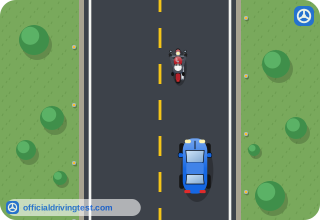
- You need extra room if the rider loses control or stops suddenly
- They are not allowed to use the same lane as your vehicle
- They cannot hear your horn
- Their brake lights are hard to see
Show answer
Correct answer: You need extra room if the rider loses control or stops suddenly
The manual says you need extra room in case the rider loses control or stops suddenly.
Source: Oregon Driver Manual (2026-2027), page 27 · Open this page in the manual (Manual page 27)
-
Why should you increase your following distance when you are directly behind a large vehicle?
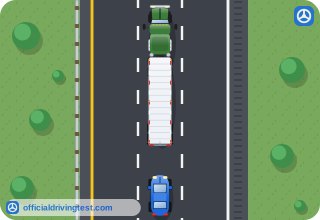
- Its driver must always stop suddenly without any warning
- Its exhaust makes the road slippery
- Its driver may not see you, and it blocks your view ahead
- It must travel below the speed limit
Show answer
Correct answer: Its driver may not see you, and it blocks your view ahead
Drivers of large vehicles may not be able to see you directly behind them, and these vehicles also block your view of the road ahead.
Source: Oregon Driver Manual (2026-2027), page 27 · Open this page in the manual (Manual page 27)
-
Why should you increase your following distance when you have a heavy load or are pulling a trailer?
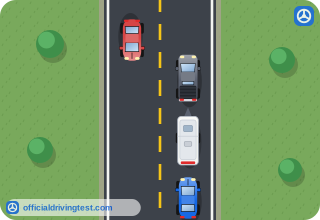
- The load always blocks your side mirrors
- The extra weight increases your stopping distance
- The trailer makes your vehicle faster
- Other drivers are not allowed to pass you
Show answer
Correct answer: The extra weight increases your stopping distance
The extra weight of a heavy load or trailer increases your stopping distance.
Source: Oregon Driver Manual (2026-2027), page 27 · Open this page in the manual (Manual page 27)
-
What should you do with your following distance in bad weather or darkness?
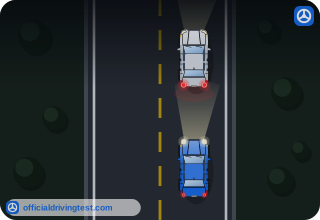
- Keep it the same, since all drivers slow down
- Decrease it so you can see the taillights ahead
- Match the distance you use in daylight
- Increase it to make up for decreased visibility
Show answer
Correct answer: Increase it to make up for decreased visibility
In bad weather or darkness, increase your following distance to make up for decreased visibility.
Source: Oregon Driver Manual (2026-2027), page 27 · Open this page in the manual (Manual page 27)
-
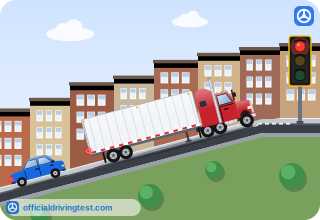
Why should you leave extra following room when you are stopped on a hill?
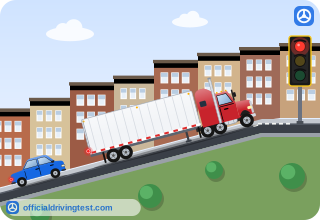
- The vehicle ahead may roll back when it starts to move
- Brake lights are harder to see when you are on a hill, especially at night
- The road surface on a hill is always slippery, so stopping takes longer
- Traffic signals on hills change more slowly than on level roads
Show answer
Correct answer: The vehicle ahead may roll back when it starts to move
When stopped on a hill, the vehicle ahead may roll back as it starts to move, so you need extra room.
Source: Oregon Driver Manual (2026-2027), page 28 · Open this page in the manual (Manual page 28)
-
Why does the manual recommend extra following room when you are learning to drive?
- Learner drivers must stay at least three car lengths behind other vehicles by law
- Your vehicle takes longer to stop when you hold a learner permit than a license
- The extra room gives you time to make critical decisions as you learn
- The extra room lets your instructor reach the brake pedal if needed
Show answer
Correct answer: The extra room gives you time to make critical decisions as you learn
The manual says the extra room provides time to make critical decisions while you are learning.
Source: Oregon Driver Manual (2026-2027), page 28 · Open this page in the manual (Manual page 28)
-
Why should you leave extra room ahead of you when approaching or in a work zone?
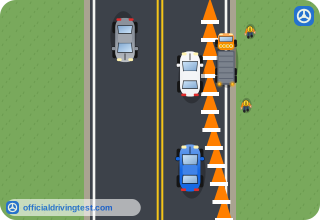
- Vehicles ahead are required to leave a gap in every lane
- Traffic may slow or stop unexpectedly in these areas
- Other drivers cannot see your brake lights there
- The posted speed always stays the same inside the work zone
Show answer
Correct answer: Traffic may slow or stop unexpectedly in these areas
Traffic in and near work zones may slow or stop unexpectedly, so you need more space.
Source: Oregon Driver Manual (2026-2027), page 28 · Open this page in the manual (Manual page 28)
-
You are driving alongside another vehicle on a multilane street and it may crowd your lane. What should you do, if possible?
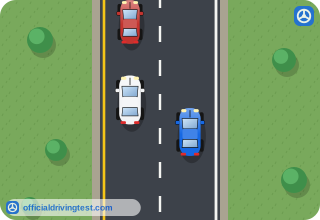
- Stay alongside the other vehicle and match its speed
- Sound your horn until the other driver moves over
- Brake hard and stop in your lane until it passes
- Drop back a little or move ahead of the other vehicle
Show answer
Correct answer: Drop back a little or move ahead of the other vehicle
To keep a space cushion to the side, drop back a little or move ahead of the other vehicle if possible.
Source: Oregon Driver Manual (2026-2027), page 28 · Open this page in the manual (Manual page 28)
-
To keep as much space as possible between you and oncoming vehicles, where is it generally safest to drive in your lane?
- Close to the center line
- In the center of your lane
- Along the right edge of your lane
- Along the left edge of your lane
Show answer
Correct answer: In the center of your lane
Driving in the center of your lane lets your vehicle move left or right to avoid a potential problem.
Source: Oregon Driver Manual (2026-2027), page 28 · Open this page in the manual (Manual page 28)
-
Vehicles are entering the freeway ahead of you and there is no one next to you. What does the manual say to do?
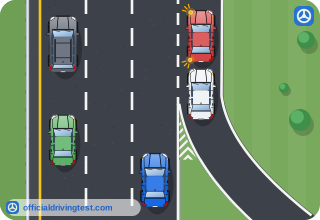
- Stay in your lane and sound your horn
- Move onto the shoulder
- Turn on your hazard lights
- Move over a lane
Show answer
Correct answer: Move over a lane
Moving over a lane makes room for vehicles entering the freeway.
Source: Oregon Driver Manual (2026-2027), page 28 · Open this page in the manual (Manual page 28)
-
How can you help other drivers who are signaling for a lane change make the move safely?
- Slow down or speed up a little, if needed
- Sound your horn to warn them you are there
- Move onto the shoulder to give them room
- Close the gap in front of you so they cannot cut in
Show answer
Correct answer: Slow down or speed up a little, if needed
The manual says to help drivers signaling for a lane change by slowing down or speeding up a little, if needed.
Source: Oregon Driver Manual (2026-2027), page 28 · Open this page in the manual (Manual page 28)
-
Why should you keep extra space between your vehicle and parked cars by moving away from them without leaving your lane?
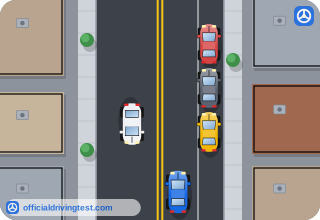
- Parked cars may suddenly drift out of their spaces and into your lane
- Parked cars are required to keep their lights on at all times of day
- A vehicle door may open in your path or someone may step out
- Parking meters can block your view of the road ahead of you
Show answer
Correct answer: A vehicle door may open in your path or someone may step out
A door may open in your path, or someone may step out of a vehicle or from between parked vehicles.
Source: Oregon Driver Manual (2026-2027), page 28 · Open this page in the manual (Manual page 28)
-
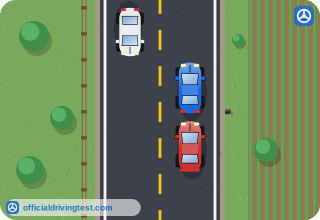
How can you warn the driver behind you in advance that you have to slow down or stop?
- Brake hard so the driver behind notices the change at once
- Flash your headlights at the driver behind you several times
- Turn on your hazard lights before you start to slow down
- Gently press the brake so your brake lights come on
Show answer
Correct answer: Gently press the brake so your brake lights come on
Signaling in advance by gently pressing the brake makes your brake lights alert the driver behind you.
Source: Oregon Driver Manual (2026-2027), page 28 · Open this page in the manual (Manual page 28)
-
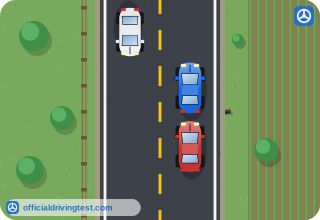
Which action helps keep the driver behind you at a safe distance?
- Keeping a steady speed
- Changing your speed often
- Driving in the left lane
- Driving close to the center line
Show answer
Correct answer: Keeping a steady speed
The manual says keeping a steady speed and signaling in advance helps keep the driver behind you at a safe distance.
Source: Oregon Driver Manual (2026-2027), page 28 · Open this page in the manual (Manual page 28)