Oregon: Speed and following distance — Part 2 Practice Test
Questions in this part include: “What does the basic rule require?” · “Where is racing illegal?”
Independent educational site · not affiliated with any government agency or DMV
Ready? Test yourself
- Instant feedback with an explanation
- Every answer cites its source in the manual
- Your best score is saved on this device
Questions are original and based on the official manual "Oregon Driver Manual" (2026-2027), Oregon Driver and Motor Vehicle Services (DMV).
All 18 questions in this practice test
Take the test above first, then use this list to study. Tap “Show answer” to see the correct answer and explanation.
Show the questions and answersHide the questions
-
In areas such as sharp curves, steep hills or construction zones, what do slower speeds from variable speed signs provide?
- More time to stop or maneuver safely and a larger space cushion
- A shorter trip time for drivers who use those roads often
- More room for passing on the left
- Faster response from traffic signals
Show answer
Correct answer: More time to stop or maneuver safely and a larger space cushion
Slower speeds there allow drivers more time to stop or maneuver safely and help provide a larger space cushion.
Source: Oregon Driver Manual (2026-2027), page 20 · Open this page in the manual (Manual page 20)
-
What does the basic rule require?
- Driving at the posted speed limit at all times, in any conditions
- Driving at the speed of the fastest traffic
- Driving at a speed that is reasonable and cautious for conditions
- Driving 5 mph below the limit on all roads
Show answer
Correct answer: Driving at a speed that is reasonable and cautious for conditions
The basic rule states you must drive at a speed that is reasonable and cautious for existing conditions.
Source: Oregon Driver Manual (2026-2027), page 20 · Open this page in the manual (Manual page 20)
-
Where and when does the basic rule apply?
- Only on roads with no posted speed limit
- On all roads at all times
- Only in bad weather
- Only in residential districts and business districts
Show answer
Correct answer: On all roads at all times
The basic rule applies on all roads at all times.
Source: Oregon Driver Manual (2026-2027), page 20 · Open this page in the manual (Manual page 20)
-
Which statement about the basic rule is correct?
- It allows you to drive a little over the limit when the road is clear
- It applies only on roads that have no posted limit
- It applies only when the weather is bad
- It does not allow you to drive over the speed limit
Show answer
Correct answer: It does not allow you to drive over the speed limit
The manual says the basic rule does not allow you to drive over the speed limit.
Source: Oregon Driver Manual (2026-2027), page 21 · Open this page in the manual (Manual page 21)
-
Can you violate the basic rule while driving slower than the speed limit?
- No, driving under the limit always complies
- Yes, but only on interstate highways
- Yes, if your speed is unsafe for existing conditions
- No, unless you are driving in a school speed zone
Show answer
Correct answer: Yes, if your speed is unsafe for existing conditions
Driving at a speed unsafe for existing conditions, even if slower than the limit, violates the basic rule.
Source: Oregon Driver Manual (2026-2027), page 21 · Open this page in the manual (Manual page 21)
-
If you drive slower than the normal speed of traffic and are not preparing to turn left, where must you drive?
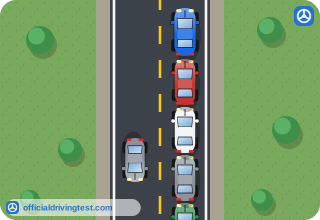
- In the right lane or as close as possible to the right edge of the road
- In the left lane with your hazard lights flashing at all times
- In the center of the road
- On the shoulder at all times
Show answer
Correct answer: In the right lane or as close as possible to the right edge of the road
Slower drivers must use the right lane or drive as closely as possible to the right curb or edge, unless preparing for a left turn.
Source: Oregon Driver Manual (2026-2027), page 21 · Open this page in the manual (Manual page 21)
-
What should you do if you drive slower than the designated speed and traffic builds up behind you?
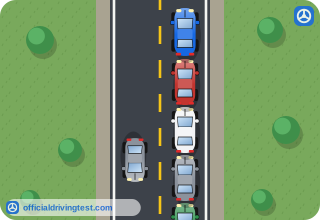
- Speed up until you are driving at the posted speed limit
- Stay in your lane and sound your horn
- Stop in the lane until traffic clears
- Pull off the road at the first safe area and let the traffic pass
Show answer
Correct answer: Pull off the road at the first safe area and let the traffic pass
The manual says to pull off at the first safe area and let the traffic behind you pass.
Source: Oregon Driver Manual (2026-2027), page 21 · Open this page in the manual (Manual page 21)
-
Where is racing illegal?
- Only on interstate highways
- On any road
- Only on roads with a center line
- Only in business districts
Show answer
Correct answer: On any road
It is illegal to race on any road.
Source: Oregon Driver Manual (2026-2027), page 21 · Open this page in the manual (Manual page 21)
-
Which of these can be racing?
- Any acceleration or speed contest or the making of a speed record
- Only a contest with a prize for the winner
- Only a contest between two vehicles that are side by side
- Only driving faster than the posted speed limit
Show answer
Correct answer: Any acceleration or speed contest or the making of a speed record
Racing can be any acceleration or speed contest or the making of a speed record.
Source: Oregon Driver Manual (2026-2027), page 21 · Open this page in the manual (Manual page 21)
-
Where should you try to keep a space cushion?
- Ahead of you only
- Behind you only
- Ahead and behind you, but not to the sides
- Ahead, to each side and behind you
Show answer
Correct answer: Ahead, to each side and behind you
The manual says to keep a cushion of space ahead, to each side and behind you.
Source: Oregon Driver Manual (2026-2027), page 26 · Open this page in the manual (Manual page 26)
-
What is the only way you can be sure you have enough time to react when another driver makes an unexpected or quick movement?
- Drive slightly faster than the traffic that is around you
- Keep your horn ready at all times
- Leave plenty of space between your vehicle and vehicles around you
- Drive in the left lane
Show answer
Correct answer: Leave plenty of space between your vehicle and vehicles around you
The only way to be sure you have enough time to react is by leaving plenty of space around your vehicle, which becomes a space cushion.
Source: Oregon Driver Manual (2026-2027), page 26 · Open this page in the manual (Manual page 26)
-
What happens as the speed you are traveling gets higher?
- You have less time to spot hazards and react to conditions
- You have more time to judge the speed of other traffic
- Your stopping distance becomes shorter
- You need a shorter following distance
Show answer
Correct answer: You have less time to spot hazards and react to conditions
The higher the speed, the less time you have to spot hazards, judge the speed of other traffic and react to conditions.
Source: Oregon Driver Manual (2026-2027), page 26 · Open this page in the manual (Manual page 26)
-
Why should you always maintain a safe following distance from the vehicle in front of you?
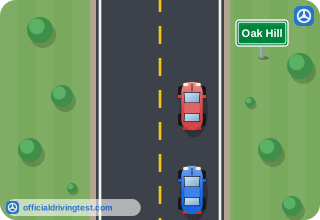
- You will use less fuel when driving on long trips
- You can pass the vehicle ahead more quickly
- The other driver will see you in the mirror
- You get a better view of the road and more time to react
Show answer
Correct answer: You get a better view of the road and more time to react
A safe following distance gives you a better view of the road and more time to react.
Source: Oregon Driver Manual (2026-2027), page 26 · Open this page in the manual (Manual page 26)
-
How is a safe following distance defined?
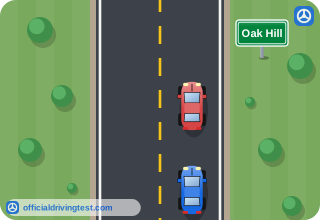
- 1-2 seconds
- 2-4 seconds
- 5-6 seconds
- 1 car length for every 10 mph
Show answer
Correct answer: 2-4 seconds
The manual defines a safe following distance as 2-4 seconds.
Source: Oregon Driver Manual (2026-2027), page 26 · Open this page in the manual (Manual page 26)
-
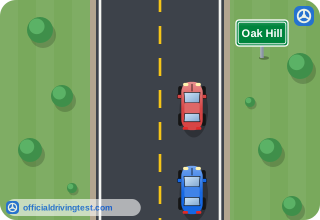
For speeds greater than 30 mph, how long should your safe following distance be?
- 4 seconds or more
- 1 second
- 3 seconds exactly
- 1 second for every 10 mph
Show answer
Correct answer: 4 seconds or more
For speeds greater than 30 mph, the safe following distance should be 4 seconds or more.
Source: Oregon Driver Manual (2026-2027), page 26 · Open this page in the manual (Manual page 26)
-
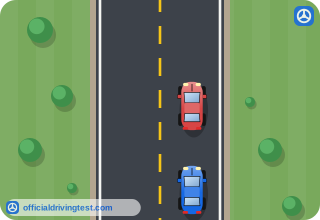
How can you determine if you are following too closely?
- Count the seconds it takes the vehicle ahead to stop
- Measure the distance in car lengths between your hood and the vehicle ahead
- Count the seconds from when the vehicle ahead passes a sign until you reach it
- Compare your speed with the speed limit
Show answer
Correct answer: Count the seconds from when the vehicle ahead passes a sign until you reach it
Watch for the rear of the vehicle ahead to pass something like a sign or pole, then count the seconds it takes you to reach the same spot.
Source: Oregon Driver Manual (2026-2027), page 27 · Open this page in the manual (Manual page 27)
-
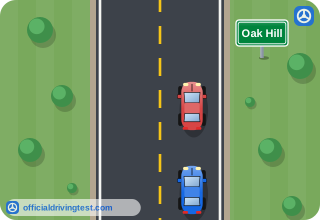
When are you following too closely, using the counting method?
- If you pass the mark after counting four seconds
- If you pass the mark before counting at least two seconds
- If you can no longer see the vehicle ahead
- If you pass the mark after counting five seconds
Show answer
Correct answer: If you pass the mark before counting at least two seconds
You are following too closely if you pass the mark before you finish counting at least two seconds.
Source: Oregon Driver Manual (2026-2027), page 27 · Open this page in the manual (Manual page 27)
-
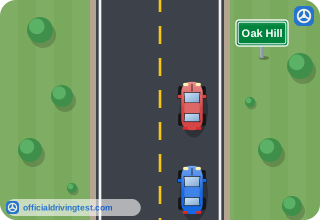
You find you are following too closely. What should you do to check your new following distance?
- Brake hard and count again at the same spot until two seconds
- Change lanes and stop counting
- Keep counting at the same spot until you pass it
- Add space and count again at another spot to check the new distance
Show answer
Correct answer: Add space and count again at another spot to check the new distance
Increase the space between you and the vehicle ahead and count again at another spot to check your new following distance.
Source: Oregon Driver Manual (2026-2027), page 27 · Open this page in the manual (Manual page 27)