Oregon: Speed and following distance — Part 1 Practice Test
Questions in this part include: “Unless a different speed is posted, what is the speed limit set in law for driving in alleys?” · “What does the manual say about speed limits on interstate highways?”
Independent educational site · not affiliated with any government agency or DMV
Ready? Test yourself
- Instant feedback with an explanation
- Every answer cites its source in the manual
- Your best score is saved on this device
Questions are original and based on the official manual "Oregon Driver Manual" (2026-2027), Oregon Driver and Motor Vehicle Services (DMV).
All 18 questions in this practice test
Take the test above first, then use this list to study. Tap “Show answer” to see the correct answer and explanation.
Show the questions and answersHide the questions
-
Unless a different speed is posted, what is the speed limit set in law for driving in alleys?
- 10 mph
- 20 mph
- 25 mph
- 15 mph
Show answer
Correct answer: 15 mph
The manual lists 15 miles per hour for alleys.
Source: Oregon Driver Manual (2026-2027), page 19 · Open this page in the manual (Manual page 19)
-
Unless a different speed is posted, what speed limit is set in law for narrow residential areas?
- 10 mph
- 15 mph
- 20 mph
- 25 mph
Show answer
Correct answer: 15 mph
Narrow residential areas are listed with the 15 miles per hour limit.
Source: Oregon Driver Manual (2026-2027), page 19 · Open this page in the manual (Manual page 19)
-
Unless a different speed is posted, what speed limit is set in law in any business district?
- 20 mph
- 15 mph
- 25 mph
- 30 mph
Show answer
Correct answer: 20 mph
Any business district is listed with the 20 miles per hour limit.
Source: Oregon Driver Manual (2026-2027), page 19 · Open this page in the manual (Manual page 19)
-
What speed limit applies within a school speed zone, as set in law?
- 15 mph
- 25 mph
- 20 mph
- 35 mph
Show answer
Correct answer: 20 mph
Within a school speed zone the limit set in law is 20 miles per hour.
Source: Oregon Driver Manual (2026-2027), page 19 · Open this page in the manual (Manual page 19)
-
Unless a different speed is posted, what speed limit is set in law in residential districts?
- 15 mph
- 25 mph
- 20 mph
- 35 mph
Show answer
Correct answer: 25 mph
Residential districts are listed with the 25 miles per hour limit.
Source: Oregon Driver Manual (2026-2027), page 19 · Open this page in the manual (Manual page 19)
-
Unless a different speed is posted, what speed limit is set in law in public parks?
- 15 mph
- 20 mph
- 35 mph
- 25 mph
Show answer
Correct answer: 25 mph
Public parks are listed with the 25 miles per hour limit.
Source: Oregon Driver Manual (2026-2027), page 19 · Open this page in the manual (Manual page 19)
-
What speed limit is set in law on ocean shores where vehicles are permitted, unless a different speed is posted?
- 15 mph
- 20 mph
- 25 mph
- 35 mph
Show answer
Correct answer: 25 mph
The manual lists 25 miles per hour on ocean shores if vehicles are permitted.
Source: Oregon Driver Manual (2026-2027), page 19 · Open this page in the manual (Manual page 19)
-
What speed limit is set in law on all roads and highways that do not meet any other definition, unless otherwise posted?
- 55 mph
- 45 mph
- 50 mph
- 65 mph
Show answer
Correct answer: 55 mph
The manual lists 55 miles per hour for all roads and highways not meeting any other definition unless otherwise posted.
Source: Oregon Driver Manual (2026-2027), page 19 · Open this page in the manual (Manual page 19)
-
What does the manual say about speed limits on interstate highways?
- They are 55 mph on every interstate
- They are always 65 mph
- They are the same as in residential districts
- They vary
Show answer
Correct answer: They vary
Interstate speed limits are not one fixed number; the manual says they will vary on interstate highways.
Source: Oregon Driver Manual (2026-2027), page 19 · Open this page in the manual (Manual page 19)
-
How does the manual define a speed limit?
- The speed at which most drivers usually travel on that road
- The maximum speed considered safe under ideal driving conditions
- The minimum speed required to keep traffic moving
- A recommended speed for all weather conditions
Show answer
Correct answer: The maximum speed considered safe under ideal driving conditions
A speed limit is the maximum speed considered safe for the area under ideal driving conditions.
Source: Oregon Driver Manual (2026-2027), page 19 · Open this page in the manual (Manual page 19)
-
The speed limits set in law for specific areas apply when no sign is posted. When do they stop applying?
- When a different speed is posted
- When the weather is clear
- When traffic is light
- When there are no other vehicles in sight
Show answer
Correct answer: When a different speed is posted
They apply whether posted or not, unless a different speed is posted.
Source: Oregon Driver Manual (2026-2027), page 19 · Open this page in the manual (Manual page 19)
-
What do variable advisory speed signs look like?
- They are black and white and say "speed limit"
- They are red and say "reduced speed"
- They are yellow and say "advisory speed"
- They are green and say "recommended speed"
Show answer
Correct answer: They are yellow and say "advisory speed"
Variable advisory speed signs are yellow and say "advisory speed".
Source: Oregon Driver Manual (2026-2027), page 20 · Open this page in the manual (Manual page 20)
-
What do variable advisory speed signs do?
- They set the legal minimum speed that every driver must keep on the road
- They recommend a speed based on conditions like heavy traffic or poor weather
- They show the speed limit for school zones
- They stay on all day to show the usual speed limit
Show answer
Correct answer: They recommend a speed based on conditions like heavy traffic or poor weather
These signs recommend a speed based on driving conditions and are turned on and off as needed.
Source: Oregon Driver Manual (2026-2027), page 20 · Open this page in the manual (Manual page 20)
-
Variable advisory speed signs are not speed limits. How may police enforce them?
- Like any other speed limit sign
- They cannot be enforced at all
- Only in school speed zones
- Through the basic rule law
Show answer
Correct answer: Through the basic rule law
The manual says these are not speed limits, but police may enforce them through the basic rule law.
Source: Oregon Driver Manual (2026-2027), page 20 · Open this page in the manual (Manual page 20)
-
What do variable speed limit signs look like?
- They are yellow and say "advisory speed"
- They are red and white and say "maximum speed"
- They are black and white and say "speed limit"
- They are orange and say "reduced speed"
Show answer
Correct answer: They are black and white and say "speed limit"
Variable speed limit signs are black and white and say "speed limit".
Source: Oregon Driver Manual (2026-2027), page 20 · Open this page in the manual (Manual page 20)
-
How may police enforce a variable speed limit sign?
- Like any other speed limit sign
- Only through the basic rule law
- Not at all, because it only gives advice
- Only when the weather is bad
Show answer
Correct answer: Like any other speed limit sign
Police may enforce variable speed limit signs like any other speed limit sign.
Source: Oregon Driver Manual (2026-2027), page 20 · Open this page in the manual (Manual page 20)
-
What do digital variable speed signs use to lower the speed limit when conditions require drivers to slow down?
- Radar units carried in police patrol vehicles
- Reports sent in by other drivers
- A timer set by the road crew
- Road, weather, traffic and visibility sensors
Show answer
Correct answer: Road, weather, traffic and visibility sensors
The digital signs use road, weather, traffic and visibility sensors to lower the speed limit when conditions require.
Source: Oregon Driver Manual (2026-2027), page 20 · Open this page in the manual (Manual page 20)
-
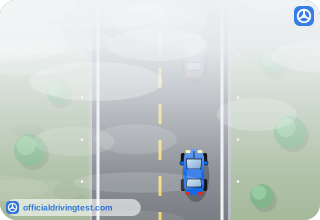
In poor weather such as fog, heavy rain or snow, why do variable speed signs lower the speed?
- Slower speeds let drivers save fuel in bad weather conditions
- Slower speeds give more time to react to hazards that are hard to see
- Slower speeds keep traffic out of the left lane
- Slower speeds make road signs easier to read at night
Show answer
Correct answer: Slower speeds give more time to react to hazards that are hard to see
The manual says slower speeds improve the line of sight by giving drivers more time to react to hazards that may be difficult to see.
Source: Oregon Driver Manual (2026-2027), page 20 · Open this page in the manual (Manual page 20)