Oregon: Seat belts and child safety Practice Test
Wearing safety belts, child seats and keeping passengers and animals safe in the vehicle.
Independent educational site · not affiliated with any government agency or DMV
Ready? Test yourself
- Instant feedback with an explanation
- Every answer cites its source in the manual
- Your best score is saved on this device
Questions are original and based on the official manual "Oregon Driver Manual" (2026-2027), Oregon Driver and Motor Vehicle Services (DMV).
All 9 questions in this practice test
Take the test above first, then use this list to study. Tap “Show answer” to see the correct answer and explanation.
Show the questions and answersHide the questions
-
Who must use safety belts in Oregon?
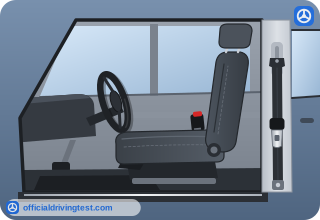
- All drivers and passengers in all available seating positions
- Only the driver and any passengers seated in the front seat
- Only drivers and passengers who are under 18 years of age
- Only drivers and passengers who are traveling on a freeway
Show answer
Correct answer: All drivers and passengers in all available seating positions
Safety belt use is mandatory for all drivers and passengers in all available seating positions.
Source: Oregon Driver Manual (2026-2027), page 73 · Open this page in the manual (Manual page 73)
-
What does a properly worn safety belt do?
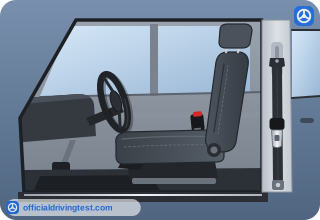
- Prevents a collision from happening altogether
- Shortens the distance needed to stop the vehicle
- Reduces the chance of injury in a collision
- Replaces the need for a child safety seat
Show answer
Correct answer: Reduces the chance of injury in a collision
The manual states that a properly worn safety belt reduces the chance of injury in a collision.
Source: Oregon Driver Manual (2026-2027), page 73 · Open this page in the manual (Manual page 73)
-
How should the lap and shoulder portions of a safety belt fit?
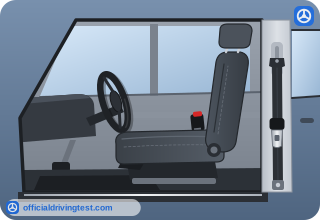
- With a few inches of slack for comfort
- With no slack in either portion
- Loose enough to move freely
- Loose in the lap portion and snug in the shoulder portion
Show answer
Correct answer: With no slack in either portion
The manual says not to leave slack in the lap or shoulder portion of the belt.
Source: Oregon Driver Manual (2026-2027), page 73 · Open this page in the manual (Manual page 73)
-
What does the manual say you must never do with the shoulder strap?
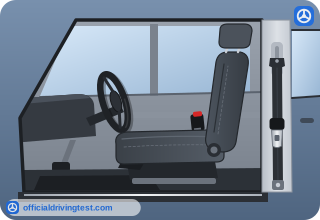
- Wearing it over your shoulder and across your chest
- Wearing it snug, with no slack left in it
- Wearing it together with the lap part of the belt
- Wearing it under your arm or behind your back
Show answer
Correct answer: Wearing it under your arm or behind your back
The manual says never to put the shoulder strap under your arm or behind your back.
Source: Oregon Driver Manual (2026-2027), page 73 · Open this page in the manual (Manual page 73)
-
Child passengers must be in approved child safety seats until they reach what age or height, and the adult belt fits correctly?
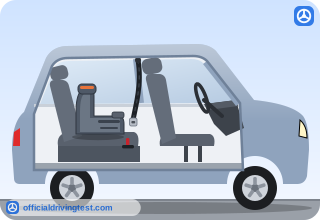
- 8 years of age or at least 4 feet 9 inches
- 5 years of age or at least 4 feet 3 inches
- 10 years of age or at least 5 feet 2 inches
- 12 years of age or at least 5 feet
Show answer
Correct answer: 8 years of age or at least 4 feet 9 inches
Children must stay in approved child safety seats until they are 8 years old or at least 4 feet 9 inches tall and the adult belt fits correctly.
Source: Oregon Driver Manual (2026-2027), page 74 · Open this page in the manual (Manual page 74)
-
Until what age must infants ride rear-facing?
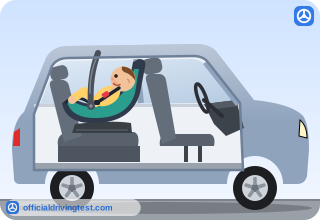
- One year of age
- Three years of age
- Two years of age
- Four years of age
Show answer
Correct answer: Two years of age
The manual says infants must ride rear-facing until they reach two years of age.
Source: Oregon Driver Manual (2026-2027), page 74 · Open this page in the manual (Manual page 74)
-
Oregon law prohibits anyone under what age from riding on the hood, fender, running board, or other external part of a vehicle, including a pickup bed?
- 16
- 21
- 14
- 18
Show answer
Correct answer: 18
Oregon law prohibits anyone under 18 years of age from riding on an external part of a vehicle, including a pickup bed.
Source: Oregon Driver Manual (2026-2027), page 84 · Open this page in the manual (Manual page 84)
-
Who should not ride in a pickup bed or on any external part of a vehicle?
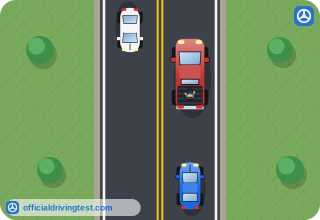
- Only children under 12
- Anyone, regardless of age
- Only passengers under 16
- Only people under 21
Show answer
Correct answer: Anyone, regardless of age
The manual says anyone, regardless of age, should not ride in a pickup bed or on any external part of the vehicle.
Source: Oregon Driver Manual (2026-2027), page 84 · Open this page in the manual (Manual page 84)
-
When may you carry a dog on an external part of a vehicle, such as a pickup bed?
- When the trip is shorter than one mile in total
- When the vehicle is driven under 25 mph
- When a framework or carrier keeps it from falling
- When the dog is trained to stay still
Show answer
Correct answer: When a framework or carrier keeps it from falling
A dog may be carried there only if it is protected by a framework, carrier, or other device to keep it from falling from the vehicle.
Source: Oregon Driver Manual (2026-2027), page 84 · Open this page in the manual (Manual page 84)