Oregon: Right-of-way and turning — Part 4 Practice Test
Right and left turns, U-turns, who yields at intersections, and how to drive through a roundabout. — Part 4
Independent educational site · not affiliated with any government agency or DMV
Ready? Test yourself
- Instant feedback with an explanation
- Every answer cites its source in the manual
- Your best score is saved on this device
Questions are original and based on the official manual "Oregon Driver Manual" (2026-2027), Oregon Driver and Motor Vehicle Services (DMV).
All 18 questions in this practice test
Take the test above first, then use this list to study. Tap “Show answer” to see the correct answer and explanation.
Show the questions and answersHide the questions
-
How should you indicate that you plan to exit a roundabout?
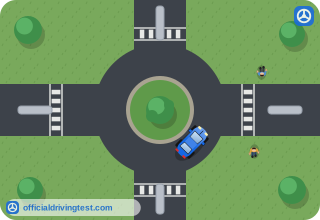
- With your left turn signal
- With your hazard lights
- With your horn
- With your right turn signal
Show answer
Correct answer: With your right turn signal
Indicate your plan to exit using your right turn signal.
Source: Oregon Driver Manual (2026-2027), page 43 · Open this page in the manual (Manual page 43)
-
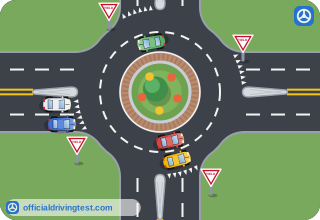
In a multi-lane roundabout, how should you choose your lane?
- Always enter in the lane nearest to the center island
- Follow lane signs and markings and use the lane for your exit
- Always enter in the right-hand lane, then change as needed
- Choose the lane that currently has the least traffic
Show answer
Correct answer: Follow lane signs and markings and use the lane for your exit
Before entering a multi-lane roundabout, watch exit and lane use signs and pavement markings and enter using the appropriate lane for your exit.
Source: Oregon Driver Manual (2026-2027), page 44 · Open this page in the manual (Manual page 44)
-
Once you are in a lane inside a multi-lane roundabout, what should you do?
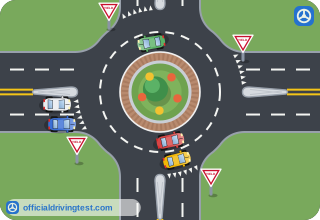
- Maintain your lane position until you exit
- Move to the inside lane to pass slower vehicles
- Change lanes as needed to follow other vehicles
- Move to the outside lane after every exit you pass
Show answer
Correct answer: Maintain your lane position until you exit
The manual says to maintain your lane position until you exit and avoid lane changes if possible.
Source: Oregon Driver Manual (2026-2027), page 44 · Open this page in the manual (Manual page 44)
-
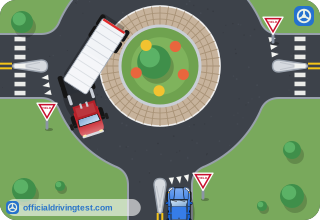
What does the manual say about passing vehicles inside a roundabout?
- Pass slower vehicles, but only on their left side
- Pass vehicles only if they are smaller than yours
- Do not overtake or pass any vehicle, especially large trucks
- Pass freely when the roundabout has more than one lane
Show answer
Correct answer: Do not overtake or pass any vehicle, especially large trucks
Do not attempt to overtake or pass any vehicles in the roundabout, especially large trucks and trailers.
Source: Oregon Driver Manual (2026-2027), page 44 · Open this page in the manual (Manual page 44)
-
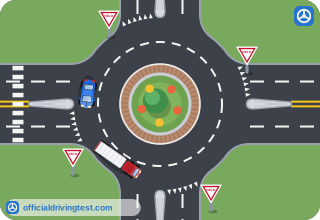
Why should you not drive beside a large truck in a roundabout?
- Trucks always travel faster than other vehicles
- Trucks may need to straddle both lanes
- Trucks always use the inside lane
- Trucks must stop at each exit
Show answer
Correct answer: Trucks may need to straddle both lanes
Trucks may need to straddle both lanes, and it is illegal to pass or drive beside a truck within the roundabout.
Source: Oregon Driver Manual (2026-2027), page 44 · Open this page in the manual (Manual page 44)
-
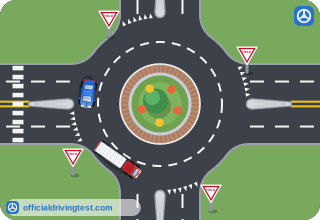
Within a roundabout, passing or driving beside a truck is
- Allowed if you stay in your lane
- Allowed if you signal
- Allowed if you are going slower than the truck
- Illegal
Show answer
Correct answer: Illegal
It is illegal to pass or drive beside a truck within the roundabout.
Source: Oregon Driver Manual (2026-2027), page 44 · Open this page in the manual (Manual page 44)
-
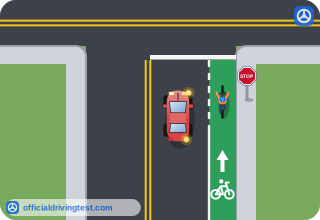
Before you turn across a bike lane or a sidewalk, what must you do about people riding bicycles in it?
- Sound your horn and turn first
- Turn ahead of them if you signal
- Yield to them
- Stop only if they are in a marked crosswalk
Show answer
Correct answer: Yield to them
You must yield to people riding bicycles in a bike lane or on a sidewalk before you turn across the lane or sidewalk.
Source: Oregon Driver Manual (2026-2027), page 50 · Open this page in the manual (Manual page 50)
-
How must you treat people riding bicycles at intersections?
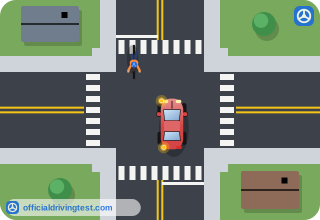
- Yield to them the same as you do for other types of vehicles
- Let them go first only when they are in a bike lane
- Treat them as pedestrians and yield only at crosswalks
- Pass them before the intersection so they do not slow you down
Show answer
Correct answer: Yield to them the same as you do for other types of vehicles
You must yield to people riding bicycles at intersections the same as you do for other vehicles.
Source: Oregon Driver Manual (2026-2027), page 50 · Open this page in the manual (Manual page 50)
-
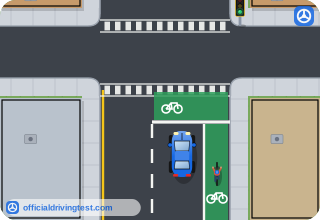
You are turning right on a green light at an intersection with a bike box. What must you do?
- Turn first, because bicyclists must wait for the next green
- Move into the bike lane early and then turn
- Stop in the box until all bicyclists have gone
- Signal and yield to people riding bicycles on the right
Show answer
Correct answer: Signal and yield to people riding bicycles on the right
When turning right on a green light you must signal and yield to people riding bicycles on the right.
Source: Oregon Driver Manual (2026-2027), page 51 · Open this page in the manual (Manual page 51)
-
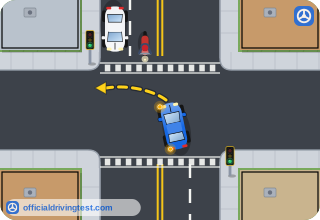
You want to turn and a motorcycle is approaching from the opposite direction. How must you treat it?
- Yield to it just as you would any other type of vehicle
- Turn first, because motorcycles can stop more quickly
- Turn first, because motorcycles must yield to cars
- Slow down and let it stop for you
Show answer
Correct answer: Yield to it just as you would any other type of vehicle
You must yield to an oncoming person riding a motorcycle just as you would any other type of vehicle.
Source: Oregon Driver Manual (2026-2027), page 52 · Open this page in the manual (Manual page 52)
-
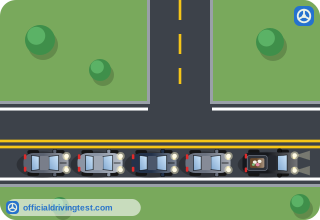
What may vehicles in a funeral procession do?
- They may park anywhere along the route
- They may pass on the right shoulder
- They need not yield to emergency vehicles
- They may enter intersections without stopping
Show answer
Correct answer: They may enter intersections without stopping
Funeral processions are exempt from certain rules: they may enter an intersection without stopping and need not obey traffic control devices.
Source: Oregon Driver Manual (2026-2027), page 57 · Open this page in the manual (Manual page 57)
-
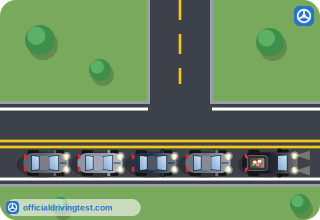
What must other vehicles do when they meet a funeral procession?
- Follow behind it for the whole route
- Pass it on the right when it is safe
- Yield right of way to it
- Stop and wait until it leaves the road
Show answer
Correct answer: Yield right of way to it
The manual says other vehicles must yield right of way to funeral processions.
Source: Oregon Driver Manual (2026-2027), page 57 · Open this page in the manual (Manual page 57)
-
If you are not a member of a funeral procession, what does the law say about joining it or driving between its vehicles?
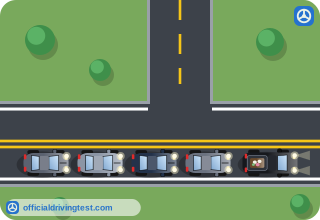
- It is against the law
- It is allowed if you use your hazard lights
- It is allowed on roads with a low speed limit
- It is allowed if you stay in the right lane
Show answer
Correct answer: It is against the law
The manual says it is against the law for non-members to join or drive between vehicles in a procession.
Source: Oregon Driver Manual (2026-2027), page 57 · Open this page in the manual (Manual page 57)
-
When you approach streetcar or train tracks at an intersection, where must you stay before crossing the tracks?
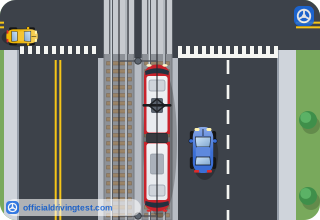
- Behind any stop line
- Just past the stop line so you can see both ways
- On the near rail if traffic ahead is stopped
- Beside the stop line in the next lane
Show answer
Correct answer: Behind any stop line
At an intersection, you stay behind any stop line before crossing the tracks.
Source: Oregon Driver Manual (2026-2027), page 65 · Open this page in the manual (Manual page 65)
-
When may you turn in front of a streetcar or train traveling in the same direction as you in an adjacent lane?
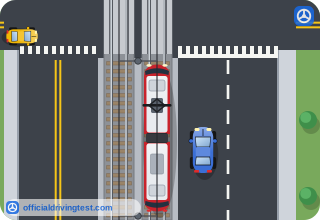
- Only if it is stopped
- Only if you signal first
- Never, even if it is stopped
- Only if it is traveling slower than you
Show answer
Correct answer: Never, even if it is stopped
You must never turn in front of a streetcar or train traveling in the same direction from an adjacent lane, even if it is stopped.
Source: Oregon Driver Manual (2026-2027), page 66 · Open this page in the manual (Manual page 66)
-
When may you turn in front of an approaching light rail train or streetcar?
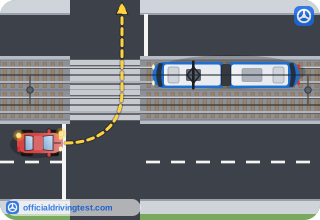
- Whenever you signal your turn
- Only when it is safe to do so
- Whenever the train is slowing for a stop
- Whenever the train is more than a block away
Show answer
Correct answer: Only when it is safe to do so
You never turn in front of an approaching light rail train or streetcar unless it is safe to do so.
Source: Oregon Driver Manual (2026-2027), page 66 · Open this page in the manual (Manual page 66)
-
What should you do before crossing streetcar or light rail tracks at an intersection?
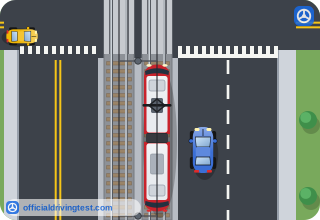
- Speed up to clear the tracks quickly
- Sound your horn and keep your speed
- Look only toward the nearest signal
- Slow down and look both ways
Show answer
Correct answer: Slow down and look both ways
The manual says to slow down and look both ways before crossing tracks at an intersection.
Source: Oregon Driver Manual (2026-2027), page 66 · Open this page in the manual (Manual page 66)
-
You will turn left over streetcar tracks where there is a left turn signal. What must you do?
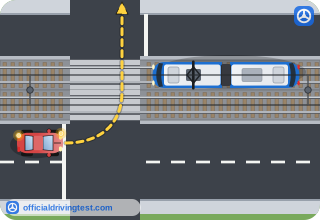
- Wait for a proper signal before you make the left turn
- Turn when no train is visible, even if the signal is red
- Turn as soon as a streetcar has passed
- Stop on the tracks until the signal changes
Show answer
Correct answer: Wait for a proper signal before you make the left turn
Where there is a left turn signal, you wait for a proper signal before turning left over the tracks.
Source: Oregon Driver Manual (2026-2027), page 66 · Open this page in the manual (Manual page 66)