Oregon: Right-of-way and turning — Part 3 Practice Test
Questions in this part include: “You have a green light. When should you not enter the intersection?” · “In which direction does traffic move around the center island of a roundabout?”
Independent educational site · not affiliated with any government agency or DMV
Ready? Test yourself
- Instant feedback with an explanation
- Every answer cites its source in the manual
- Your best score is saved on this device
Questions are original and based on the official manual "Oregon Driver Manual" (2026-2027), Oregon Driver and Motor Vehicle Services (DMV).
All 19 questions in this practice test
Take the test above first, then use this list to study. Tap “Show answer” to see the correct answer and explanation.
Show the questions and answersHide the questions
-
At an intersection with a stop sign, steady red signal or flashing red signal, where must you stop?
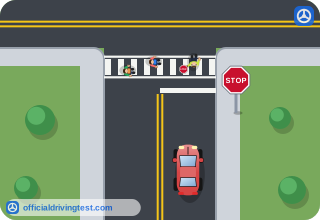
- Past the crosswalk, so you can see cross traffic
- In the center of the intersection, past the stop line
- Before the marked stop line or crosswalk, if there is one
- Wherever you can best see approaching cross traffic
Show answer
Correct answer: Before the marked stop line or crosswalk, if there is one
You must stop before the marked stop line or crosswalk, if there is one.
Source: Oregon Driver Manual (2026-2027), page 42 · Open this page in the manual (Manual page 42)
-
There is no stop line or crosswalk at a stop sign. Where must you stop?
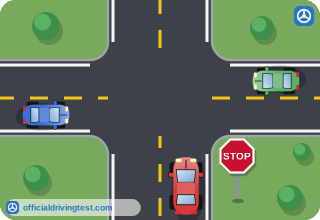
- At the near edge of the cross street's travel lane
- Just inside the intersection, past the unmarked crossing
- Before the unmarked crossing area at the intersection
- Only far enough back that you can see cross traffic
Show answer
Correct answer: Before the unmarked crossing area at the intersection
If there is no stop line or crosswalk, stop before the unmarked crossing area before entering the intersection.
Source: Oregon Driver Manual (2026-2027), page 42 · Open this page in the manual (Manual page 42)
-
When making an allowed turn at an intersection, to whom must you always yield?
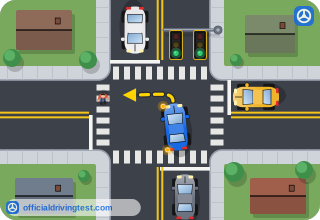
- Pedestrians, people riding bicycles and traffic in the intersection
- Only vehicles that are larger than the one you are driving
- Only pedestrians who are in a marked crosswalk ahead of you
- Only traffic that is approaching from the left side of you
Show answer
Correct answer: Pedestrians, people riding bicycles and traffic in the intersection
You must always yield to pedestrians, people riding bicycles and traffic in the intersection when making an allowed turn.
Source: Oregon Driver Manual (2026-2027), page 42 · Open this page in the manual (Manual page 42)
-
After stopping, you cannot see traffic coming from your left and right. What should you do?
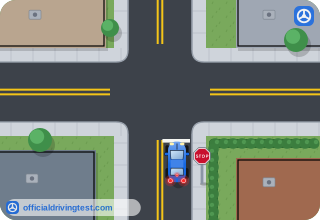
- Sound your horn and then go ahead
- Enter the intersection and look from inside it
- Back up a little and stop again to look
- Slightly pull forward and scan the area
Show answer
Correct answer: Slightly pull forward and scan the area
If you cannot see traffic after stopping, slightly pull forward and scan the area.
Source: Oregon Driver Manual (2026-2027), page 42 · Open this page in the manual (Manual page 42)
-
You have a green light. When should you not enter the intersection?
- When a pedestrian is on the far sidewalk
- When there is no room for your vehicle on the other side
- When the light has been green for more than ten seconds
- When you plan to continue straight
Show answer
Correct answer: When there is no room for your vehicle on the other side
Even with a green light, do not enter an intersection unless there is room for your vehicle on the other side.
Source: Oregon Driver Manual (2026-2027), page 42 · Open this page in the manual (Manual page 42)
-
At an intersection with stop signs in all four directions, who is commonly allowed to go first as a courtesy?
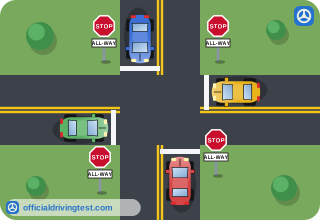
- The driver who stops first
- The driver on the widest road
- The driver who is going straight
- The driver in the largest vehicle
Show answer
Correct answer: The driver who stops first
At an all-way stop it is common courtesy to allow the driver who stops first to go first.
Source: Oregon Driver Manual (2026-2027), page 42 · Open this page in the manual (Manual page 42)
-
At an intersection with stop signs in all four directions, when in doubt about who goes first, you should yield to
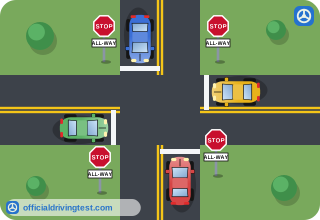
- The driver on your left
- The driver who is turning
- The driver on your right
- The driver who is going straight
Show answer
Correct answer: The driver on your right
When in doubt at an all-way stop, yield to the driver on your right.
Source: Oregon Driver Manual (2026-2027), page 42 · Open this page in the manual (Manual page 42)
-
At an intersection with two-way stop signs across from each other, who should yield the right of way?
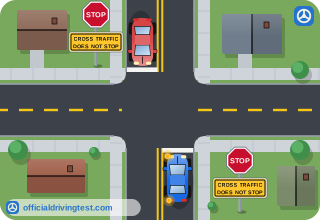
- The driver going straight should yield to the driver turning left
- The driver turning left should yield to oncoming traffic going straight
- The driver turning right should yield to everyone
- The driver who stops last should yield to the other
Show answer
Correct answer: The driver turning left should yield to oncoming traffic going straight
The driver turning left should yield to approaching or oncoming traffic going straight.
Source: Oregon Driver Manual (2026-2027), page 42 · Open this page in the manual (Manual page 42)
-
As you approach an intersection with no signs or signals, which way should you look first?
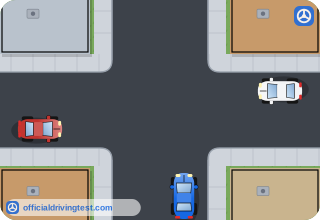
- To the right, to check for approaching vehicles
- Straight ahead, to check for pedestrians
- In your rearview mirror, to check for followers
- To the left, to make sure cross traffic is yielding
Show answer
Correct answer: To the left, to make sure cross traffic is yielding
First look to the left to make sure cross traffic is yielding right of way, then to the front and to the right.
Source: Oregon Driver Manual (2026-2027), page 42 · Open this page in the manual (Manual page 42)
-
At an intersection with no signs or signals, you must yield the right of way to any vehicle
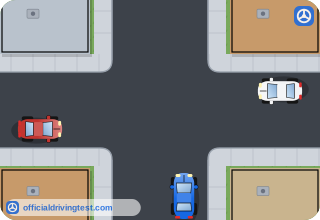
- Approaching from your left on the cross street
- That is traveling more slowly than you are
- That arrives at the intersection after you do
- In the intersection or approaching from your right
Show answer
Correct answer: In the intersection or approaching from your right
Yield the right of way to any vehicle in the intersection or approaching from your right.
Source: Oregon Driver Manual (2026-2027), page 42 · Open this page in the manual (Manual page 42)
-
You are on a road that ends at a T intersection with no signs or signals. What must you do?
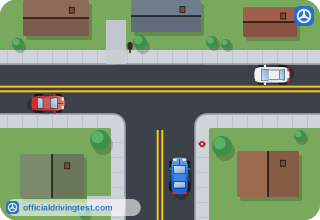
- Go first, because the other road has no stop sign
- Yield to drivers on the through road
- Yield only to traffic from your right
- Stop and then go first
Show answer
Correct answer: Yield to drivers on the through road
A driver on a road that ends at a T intersection with no signs or signals must yield to drivers on the through road.
Source: Oregon Driver Manual (2026-2027), page 42 · Open this page in the manual (Manual page 42)
-
In which direction does traffic move around the center island of a roundabout?
- Clockwise
- In either direction, whichever is shorter
- Counterclockwise
- Toward the left side of the island only
Show answer
Correct answer: Counterclockwise
Traffic moves in one direction, counterclockwise, around the center island.
Source: Oregon Driver Manual (2026-2027), page 43 · Open this page in the manual (Manual page 43)
-
A yellow diamond-shaped sign shows three black arrows chasing each other in a circle. What does it indicate?
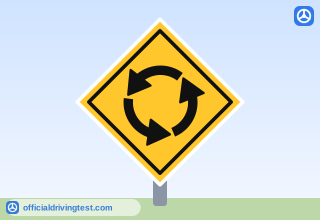
- A circular intersection is ahead
- A road that loops back is ahead
- A one-way street is ahead
- A railroad crossing is ahead
Show answer
Correct answer: A circular intersection is ahead
A warning sign with arrows in a circle pattern indicates a circular intersection is ahead.
Source: Oregon Driver Manual (2026-2027), page 43 · Open this page in the manual (Manual page 43)
-
As you approach a roundabout, what should you do?
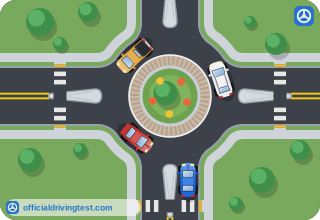
- Maintain your speed so you can merge with traffic
- Slow down and look for signs showing your exit
- Stop at the entrance to every roundabout, then go
- Move to the lane closest to the center island
Show answer
Correct answer: Slow down and look for signs showing your exit
On approach, slow down and look for signs to determine where your exit is located.
Source: Oregon Driver Manual (2026-2027), page 43 · Open this page in the manual (Manual page 43)
-
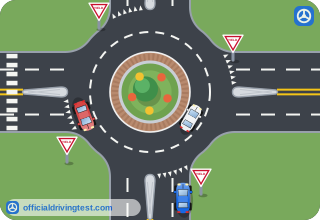
As you approach a roundabout, what do people riding bicycles do?
- Walk their bicycles across the crosswalk
- Stop and wait for all vehicles to pass
- Always ride in the lane next to the center island
- Merge into traffic or use the sidewalk
Show answer
Correct answer: Merge into traffic or use the sidewalk
People riding bicycles will either merge into traffic or use the sidewalk.
Source: Oregon Driver Manual (2026-2027), page 43 · Open this page in the manual (Manual page 43)
-
When approaching the crosswalk of a roundabout, you must stop for
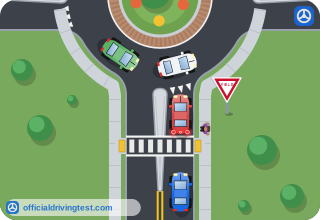
- Pedestrians using the crosswalk in your lane
- Only pedestrians who are crossing from the right
- Only pedestrians who have started to cross the whole road
- No one, because vehicles in a roundabout have priority
Show answer
Correct answer: Pedestrians using the crosswalk in your lane
When approaching the crosswalk, stop for pedestrians using the crosswalk in your lane.
Source: Oregon Driver Manual (2026-2027), page 43 · Open this page in the manual (Manual page 43)
-
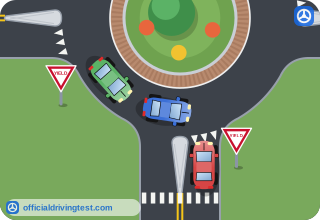
Before entering a roundabout, you must yield to
- Only vehicles that are already inside the roundabout
- Only vehicles that are entering from your right side
- Traffic inside the roundabout and traffic exiting it
- No one, if you are the first vehicle at the entrance
Show answer
Correct answer: Traffic inside the roundabout and traffic exiting it
Before you enter the roundabout, you must yield to traffic inside as well as exiting the roundabout.
Source: Oregon Driver Manual (2026-2027), page 43 · Open this page in the manual (Manual page 43)
-
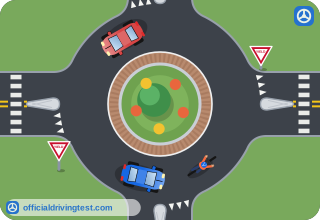
Inside a roundabout, how should you treat a person riding a bicycle who has merged into traffic?
- Ride beside the person to protect them
- Pass the person on the left
- Allow the person the full travel lane
- Sound your horn to warn the person to move over
Show answer
Correct answer: Allow the person the full travel lane
Allow people riding bicycles that have merged into traffic the full travel lane.
Source: Oregon Driver Manual (2026-2027), page 43 · Open this page in the manual (Manual page 43)
-
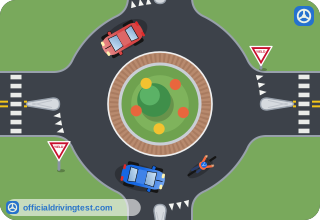
Within a roundabout, you come up behind a person riding a bicycle in the travel lane. What must you not do?
- Pass the person riding a bicycle
- Slow down behind the person
- Follow the person to your exit
- Use your signal before your exit
Show answer
Correct answer: Pass the person riding a bicycle
Do not pass a person riding a bicycle within the roundabout.
Source: Oregon Driver Manual (2026-2027), page 43 · Open this page in the manual (Manual page 43)