Oregon: Right-of-way and turning — Part 2 Practice Test
Questions in this part include: “You are turning left from a one-way road onto a one-way road. In which lane should you approach the turn?” · “While making a turn, what should you avoid doing?”
Independent educational site · not affiliated with any government agency or DMV
Ready? Test yourself
- Instant feedback with an explanation
- Every answer cites its source in the manual
- Your best score is saved on this device
Questions are original and based on the official manual "Oregon Driver Manual" (2026-2027), Oregon Driver and Motor Vehicle Services (DMV).
All 19 questions in this practice test
Take the test above first, then use this list to study. Tap “Show answer” to see the correct answer and explanation.
Show the questions and answersHide the questions
-
If a left turn lane is provided at an intersection, what must you do?
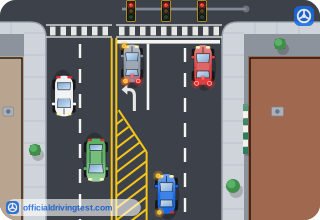
- Turn from the lane nearest the right curb
- Turn from that lane
- Use it only when traffic is heavy
- Turn from any lane that is open
Show answer
Correct answer: Turn from that lane
If a left turn lane is provided, you must turn from that lane.
Source: Oregon Driver Manual (2026-2027), page 39 · Open this page in the manual (Manual page 39)
-
You are turning left from a one-way road onto a one-way road. In which lane should you approach the turn?
- The traffic lane nearest the right curb
- The lane just to the right of the center line
- Any lane, because both roads are one-way
- The traffic lane nearest the left curb
Show answer
Correct answer: The traffic lane nearest the left curb
For a left turn from a one-way road to a one-way road, approach in the traffic lane nearest the left curb.
Source: Oregon Driver Manual (2026-2027), page 40 · Open this page in the manual (Manual page 40)
-
When turning left from a one-way road onto a one-way road, into which lane should you turn?
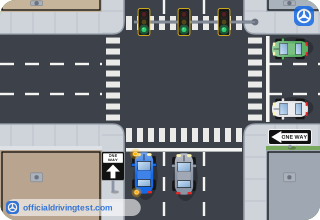
- The nearest left lane for traffic on the road you are entering
- The lane nearest the right curb of the road you are entering
- The center lane of the road you are entering
- Any lane, as long as you stay to the left of other vehicles
Show answer
Correct answer: The nearest left lane for traffic on the road you are entering
You turn into the nearest left lane for traffic on the road you are entering.
Source: Oregon Driver Manual (2026-2027), page 40 · Open this page in the manual (Manual page 40)
-
At a red light, you are turning left from a one-way road onto a one-way road. What does the manual say?
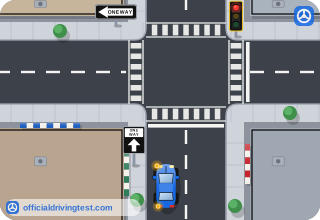
- You must wait for the light to turn green before you turn at all
- You may turn without stopping if you see no traffic coming
- You may turn after stopping and yielding to traffic and pedestrians
- You may turn only if a sign posted at the corner permits it
Show answer
Correct answer: You may turn after stopping and yielding to traffic and pedestrians
This turn may be made against a red light after stopping and yielding to traffic and pedestrians.
Source: Oregon Driver Manual (2026-2027), page 40 · Open this page in the manual (Manual page 40)
-
You are turning left or right from a two-way road onto a one-way road. In which lane should you approach the turn?
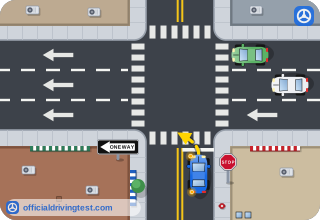
- The lane nearest the center line, whichever way you turn
- The lane farthest away from the direction you will turn
- The traffic lane nearest to the direction of the turn
- The right-hand lane, whichever way you are turning
Show answer
Correct answer: The traffic lane nearest to the direction of the turn
Approach in the traffic lane that is nearest to the direction of the turn.
Source: Oregon Driver Manual (2026-2027), page 40 · Open this page in the manual (Manual page 40)
-
When turning from a two-way road onto a one-way road, into which lane should you turn?
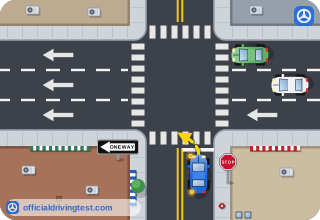
- The nearest lane for traffic on the road you are entering
- The lane that is farthest from the one you started in
- The lane just to the right of the center line of that road
- The middle lane of the road you are entering, if any
Show answer
Correct answer: The nearest lane for traffic on the road you are entering
You turn into the nearest lane for traffic on the road you are entering.
Source: Oregon Driver Manual (2026-2027), page 40 · Open this page in the manual (Manual page 40)
-
A red light is showing and you want to turn from a two-way road onto a one-way road. When may you turn?
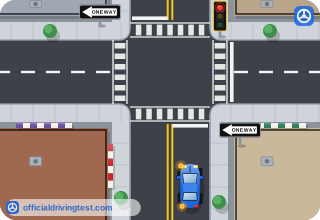
- Only after the light has changed back to green again
- Only if a sign posted there permits turns on red
- Only if you are turning left and no one is behind you
- After stopping and yielding to traffic and pedestrians
Show answer
Correct answer: After stopping and yielding to traffic and pedestrians
A turn from a two-way road to a one-way road may be made against a red light after stopping and yielding.
Source: Oregon Driver Manual (2026-2027), page 40 · Open this page in the manual (Manual page 40)
-
You are turning left from a one-way road onto a two-way road. In which lane should you approach the turn?
- The traffic lane nearest the right curb
- The traffic lane nearest the left curb
- The lane just to the right of the center line
- The center lane
Show answer
Correct answer: The traffic lane nearest the left curb
For a left turn from a one-way road to a two-way road, approach in the traffic lane nearest the left curb.
Source: Oregon Driver Manual (2026-2027), page 40 · Open this page in the manual (Manual page 40)
-
When turning left from a one-way road onto a two-way road, into which lane should you turn?
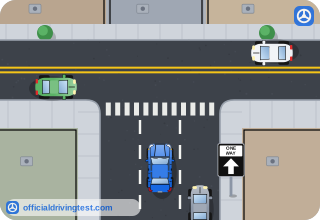
- The lane just to the right of the center line
- The lane just to the left of the center line
- The lane nearest the left curb
- The lane nearest the curb on either side
Show answer
Correct answer: The lane just to the right of the center line
You turn into the lane just to the right of the center line.
Source: Oregon Driver Manual (2026-2027), page 40 · Open this page in the manual (Manual page 40)
-
When may multiple lanes turn in the same direction at the same time?
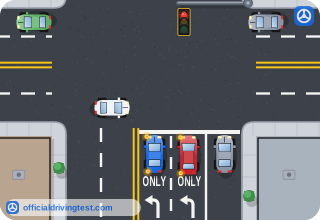
- Whenever traffic is light and both roads are clear
- Only when a police officer directs the traffic
- When lane use signs or pavement markings permit it
- Never, because only one lane may turn at a time
Show answer
Correct answer: When lane use signs or pavement markings permit it
Multiple lanes may turn in the same direction at the same time only where lane use control signs or pavement markings permit it.
Source: Oregon Driver Manual (2026-2027), page 40 · Open this page in the manual (Manual page 40)
-
You are in one of two dual turn lanes and turning onto a roadway that has more lanes than the lane you are turning from. What must you do?
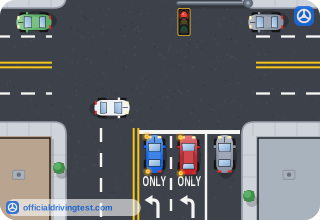
- Move to the outside lane as you complete the turn
- Follow the pavement markings and stay in your lane
- Move into the lane that is closest to the curb
- Choose the lane with the least traffic
Show answer
Correct answer: Follow the pavement markings and stay in your lane
Follow the pavement markings and stay in your lane when turning onto roadways with more lanes.
Source: Oregon Driver Manual (2026-2027), page 40 · Open this page in the manual (Manual page 40)
-
What is the general rule for turning?
- From the center lane into the farthest lane going in your new direction
- From the nearest lane into whichever new lane has the least traffic
- From the farthest lane so that you have more room to swing wide
- From the nearest lane in your direction to the nearest lane in the new direction
Show answer
Correct answer: From the nearest lane in your direction to the nearest lane in the new direction
The general rule is to turn from the nearest lane in your direction of travel to the nearest lane in the direction you want to go.
Source: Oregon Driver Manual (2026-2027), page 41 · Open this page in the manual (Manual page 41)
-
While making a turn, what should you avoid doing?
- Slowing down before you start the turn
- Looking over your shoulder first
- Using your turn signal early enough
- Swinging wide or changing lanes
Show answer
Correct answer: Swinging wide or changing lanes
You should avoid swinging wide or changing lanes while turning.
Source: Oregon Driver Manual (2026-2027), page 41 · Open this page in the manual (Manual page 41)
-
A U-turn at an intersection controlled by a traffic signal is prohibited unless
- No vehicles are approaching
- A sign permits the turn
- You are driving a small vehicle
- The light is green
Show answer
Correct answer: A sign permits the turn
U-turns are prohibited at intersections controlled by a traffic signal, unless a sign permits the turn.
Source: Oregon Driver Manual (2026-2027), page 41 · Open this page in the manual (Manual page 41)
-
Where are U-turns prohibited in a city?
- At intersections with no signs or signals
- At intersections with a stop sign
- Between intersections
- In a bicycle lane only
Show answer
Correct answer: Between intersections
U-turns are prohibited between intersections in a city.
Source: Oregon Driver Manual (2026-2027), page 41 · Open this page in the manual (Manual page 41)
-
Within city limits, a U-turn is prohibited at any location where your vehicle cannot be seen by traffic from either direction within what distance?
- 500 feet
- 100 feet
- 300 feet
- 1,000 feet
Show answer
Correct answer: 500 feet
Within city limits, U-turns are prohibited where your vehicle cannot be seen within 500 feet.
Source: Oregon Driver Manual (2026-2027), page 41 · Open this page in the manual (Manual page 41)
-
Outside city limits, a U-turn is prohibited at any location where your vehicle cannot be seen by traffic from either direction within what distance?
- 500 feet
- 1,000 feet
- 250 feet
- 2,000 feet
Show answer
Correct answer: 1,000 feet
Outside city limits, U-turns are prohibited where your vehicle cannot be seen within 1,000 feet.
Source: Oregon Driver Manual (2026-2027), page 41 · Open this page in the manual (Manual page 41)
-
May you make a U-turn at or on a railroad crossing?
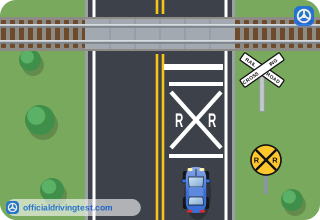
- Yes, if no train is in sight
- Yes, if you signal first
- Yes, but only in daylight
- No, it is prohibited
Show answer
Correct answer: No, it is prohibited
U-turns are prohibited at or on a railroad crossing.
Source: Oregon Driver Manual (2026-2027), page 41 · Open this page in the manual (Manual page 41)
-
What does a defensive driver never assume at an intersection?
- That a stop sign or signal will stop approaching traffic
- That a steady yellow signal warns it is about to turn red
- That the lane you are in is wide enough for your vehicle
- That a green arrow gives you the right of way for its turn
Show answer
Correct answer: That a stop sign or signal will stop approaching traffic
A defensive driver never assumes a stop sign or a traffic signal will stop approaching traffic.
Source: Oregon Driver Manual (2026-2027), page 42 · Open this page in the manual (Manual page 42)