Oregon: Right-of-way and turning — Part 1 Practice Test
Questions in this part include: “On which of these occasions may you drive on the left side of the road?” · “Before a right turn, where should you position your vehicle?”
Independent educational site · not affiliated with any government agency or DMV
Ready? Test yourself
- Instant feedback with an explanation
- Every answer cites its source in the manual
- Your best score is saved on this device
Questions are original and based on the official manual "Oregon Driver Manual" (2026-2027), Oregon Driver and Motor Vehicle Services (DMV).
All 19 questions in this practice test
Take the test above first, then use this list to study. Tap “Show answer” to see the correct answer and explanation.
Show the questions and answersHide the questions
-
On which of these occasions may you drive on the left side of the road?
- When passing another vehicle going in the same direction as you
- When you plan to turn right at the next intersection ahead
- When approaching a hill with oncoming traffic
- When the road ahead is wet or slippery
Show answer
Correct answer: When passing another vehicle going in the same direction as you
The manual lists passing another vehicle going in the same direction as an exception to driving on the right side of the road.
Source: Oregon Driver Manual (2026-2027), page 18 · Open this page in the manual (Manual page 18)
-
On a road with no center line where traffic moves in opposite directions, how much of the road must drivers give to oncoming traffic?
- At least one-third of the road
- Only the width of one lane
- At least half the road
- Whatever width is left after passing
Show answer
Correct answer: At least half the road
Drivers must give at least half the road to oncoming traffic when there is no center line.
Source: Oregon Driver Manual (2026-2027), page 18 · Open this page in the manual (Manual page 18)
-
What must you do if you have to drive to the left of the center line to go around a road hazard?
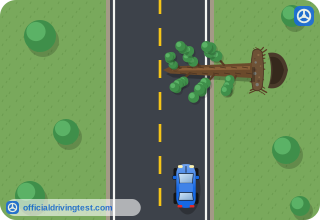
- Sound your horn and continue
- Yield to oncoming traffic
- Speed up to clear the hazard quickly
- Move back to the right only after the hazard has passed behind you
Show answer
Correct answer: Yield to oncoming traffic
The manual says that if you must drive to the left of the center line for any reason, you must yield to oncoming traffic.
Source: Oregon Driver Manual (2026-2027), page 18 · Open this page in the manual (Manual page 18)
-
What does yielding mean?
- Speeding up to get ahead of other vehicles before they reach the intersection
- Always coming to a full stop and waiting until the whole road is empty of traffic
- Moving to the right edge of the road and turning on your hazard lights
- Slowing down or stopping to allow another vehicle or pedestrian to continue safely
Show answer
Correct answer: Slowing down or stopping to allow another vehicle or pedestrian to continue safely
Yielding means you must slow down or stop to allow another vehicle or pedestrian to continue safely.
Source: Oregon Driver Manual (2026-2027), page 18 · Open this page in the manual (Manual page 18)
-
What must you do before you enter or cross a road from an alley, driveway or parking lot that is not controlled by signs or signals?
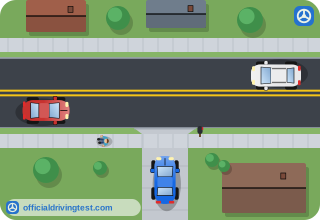
- Slow down and enter the road if no vehicle is in sight
- Stop only if a vehicle or pedestrian is approaching
- Stop, then yield to approaching vehicles and pedestrians
- Sound your horn and enter the road at a low speed
Show answer
Correct answer: Stop, then yield to approaching vehicles and pedestrians
You must stop before entering or crossing the road and then yield to approaching vehicles and pedestrians.
Source: Oregon Driver Manual (2026-2027), page 18 · Open this page in the manual (Manual page 18)
-
What does the manual say about changing lanes?
- Change lanes only when it is safe, and avoid frequent changes
- Change lanes often so that you stay ahead of traffic
- Move into the fastest lane whenever one is open
- Change lanes as soon as a gap opens
Show answer
Correct answer: Change lanes only when it is safe, and avoid frequent changes
The manual tells drivers to change lanes only when it is safe and to avoid frequent lane changes.
Source: Oregon Driver Manual (2026-2027), page 18 · Open this page in the manual (Manual page 18)
-
Where do the rules for turning apply?
- Only at intersections with traffic signals
- Only at intersections with a stop sign or yield sign
- At all locations, including driveways and alleys
- Only on roads with more than one lane
Show answer
Correct answer: At all locations, including driveways and alleys
The rules for turning apply at all locations, such as driveways and alleys, not just at intersections.
Source: Oregon Driver Manual (2026-2027), page 39 · Open this page in the manual (Manual page 39)
-
How should you make a turn?
- Quickly, to clear the intersection sooner
- At the speed of the traffic you are leaving
- Smoothly and at a lower speed
- Smoothly, with your speed held constant
Show answer
Correct answer: Smoothly and at a lower speed
The manual says to turn smoothly and at a lower speed.
Source: Oregon Driver Manual (2026-2027), page 39 · Open this page in the manual (Manual page 39)
-
What may you do when a bicycle lane runs beside your lane and you want to turn across it?
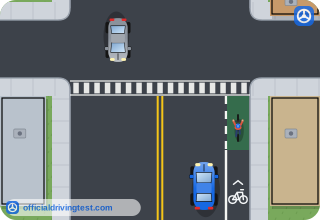
- Turn across it, but do not move into it before the turn
- Move into the bicycle lane early so you are positioned for the turn
- Never cross a bicycle lane, even to turn
- Move into the bicycle lane only when no rider is in sight
Show answer
Correct answer: Turn across it, but do not move into it before the turn
You may turn across a bicycle lane, but you may not move into it in preparation for a turn.
Source: Oregon Driver Manual (2026-2027), page 39 · Open this page in the manual (Manual page 39)
-
Before turning, how do you check for people riding bicycles in your blind spot?
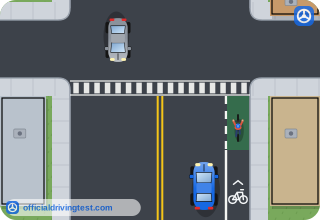
- Check only your mirrors before you start to turn
- Sound your horn and listen for any response
- Look only at the crosswalk ahead of you
- Look over your shoulder and check your mirrors
Show answer
Correct answer: Look over your shoulder and check your mirrors
Checking for riders in your blind spot includes looking over your shoulder and checking your mirrors.
Source: Oregon Driver Manual (2026-2027), page 39 · Open this page in the manual (Manual page 39)
-
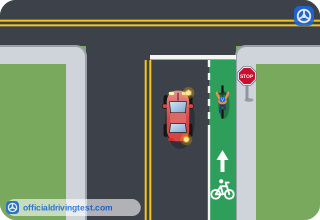
Before you turn across a bicycle lane or a sidewalk, you must yield to
- Only people riding bicycles who are signaling
- Riders in the bicycle lane or on the sidewalk
- Only people riding bicycles on a sidewalk ahead
- No one, because you are already in the intersection
Show answer
Correct answer: Riders in the bicycle lane or on the sidewalk
You must yield to people riding bicycles in a bicycle lane or on a sidewalk.
Source: Oregon Driver Manual (2026-2027), page 39 · Open this page in the manual (Manual page 39)
-
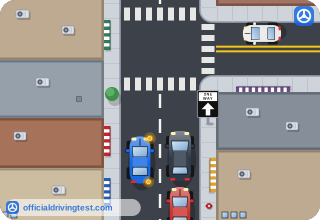
You are at an intersection and in the wrong lane to make your turn. What does the manual say to do?
- Go to the next intersection
- Change lanes quickly inside the intersection
- Stop and back up to the correct lane
- Turn from the lane you are in
Show answer
Correct answer: Go to the next intersection
It is safer to drive around the block than to risk a collision due to a last-minute lane or direction change.
Source: Oregon Driver Manual (2026-2027), page 39 · Open this page in the manual (Manual page 39)
-
Before a right turn, where should you position your vehicle?
- In the middle of the lane, away from the curb
- In the bicycle lane, if there is one
- As near as you can to the right curb or edge of the road
- Slightly toward the center line to give yourself room
Show answer
Correct answer: As near as you can to the right curb or edge of the road
For a right turn, get as near as you can to the right curb or edge of the road.
Source: Oregon Driver Manual (2026-2027), page 39 · Open this page in the manual (Manual page 39)
-
Just before entering the intersection to make a right turn, in what order should you look for traffic?
- Right, front, left and right again
- Left, front, right and left again
- Front, left, then right
- Left, then right, then straight ahead only
Show answer
Correct answer: Left, front, right and left again
The manual says to look to the left, to the front, to the right and to the left again.
Source: Oregon Driver Manual (2026-2027), page 39 · Open this page in the manual (Manual page 39)
-
On a two-way road, how should you approach a left turn?
- In the lane nearest the right-hand curb or edge
- Straddling the center line, ready to turn
- In the lane just to the left of the center line
- In the lane just to the right of the center line
Show answer
Correct answer: In the lane just to the right of the center line
For a left turn on a two-way road, approach with your vehicle in the lane just to the right of the center line.
Source: Oregon Driver Manual (2026-2027), page 39 · Open this page in the manual (Manual page 39)
-
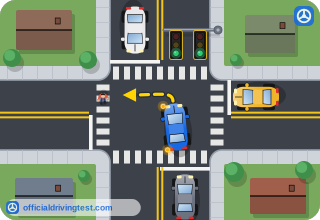
Before a left turn, to whom does Oregon law require you to yield the right of way?
- Only oncoming vehicles that are signaling
- Only the vehicles that arrived at the intersection first
- No one, once you are in the intersection
- Oncoming traffic, until it is safe to turn
Show answer
Correct answer: Oncoming traffic, until it is safe to turn
Oregon law requires a driver to yield the right of way to oncoming traffic until it is safe to turn.
Source: Oregon Driver Manual (2026-2027), page 39 · Open this page in the manual (Manual page 39)
-
When making a left turn at an intersection, where should you begin to turn?
- Well before you reach the intersection
- Just before the imaginary center point in the intersection
- After you pass the imaginary center point in the intersection
- At the near edge of the crosswalk
Show answer
Correct answer: Just before the imaginary center point in the intersection
The manual says to turn just before the imaginary center point in the intersection.
Source: Oregon Driver Manual (2026-2027), page 39 · Open this page in the manual (Manual page 39)
-
After a left turn onto a two-way street, where should you drive?
- In the lane nearest the left curb of the new street
- Just to the left of the center line of that street
- Just to the right of the center line of the new street
- In whichever lane is clearest of other traffic
Show answer
Correct answer: Just to the right of the center line of the new street
After the turn, drive just to the right of the center line of the street you are entering.
Source: Oregon Driver Manual (2026-2027), page 39 · Open this page in the manual (Manual page 39)
-
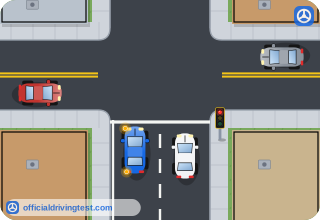
A left turn onto a two-way road against a red light is
- Illegal
- Allowed after stopping and yielding to traffic
- Allowed only at night
- Allowed only when no vehicle is visible
Show answer
Correct answer: Illegal
It is illegal to execute a left turn onto a two-way road against a red light.
Source: Oregon Driver Manual (2026-2027), page 39 · Open this page in the manual (Manual page 39)