Oregon: Railroad crossings, light rail and streetcars Practice Test
Crossing signs and signals, when you must stop at the tracks, and sharing the road with light rail and streetcars.
Independent educational site · not affiliated with any government agency or DMV
Ready? Test yourself
- Instant feedback with an explanation
- Every answer cites its source in the manual
- Your best score is saved on this device
Questions are original and based on the official manual "Oregon Driver Manual" (2026-2027), Oregon Driver and Motor Vehicle Services (DMV).
All 25 questions in this practice test
Take the test above first, then use this list to study. Tap “Show answer” to see the correct answer and explanation.
Show the questions and answersHide the questions
-
A round yellow sign shows a black X with the letters R and R. What does it warn you of?
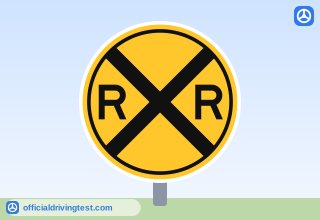
- A railroad crossing is ahead
- A light rail stop is ahead
- A school crossing is ahead
- A road closure is ahead
Show answer
Correct answer: A railroad crossing is ahead
A railroad advance sign warns you that a railroad crossing is ahead.
Source: Oregon Driver Manual (2026-2027), page 63 · Open this page in the manual (Manual page 63)
-
What kind of sign will a railroad crossbuck assembly include?
- A speed limit sign or a school zone sign
- A merge sign or a lane-use sign
- A yield sign or a stop sign
- A no-passing sign or a keep-right sign
Show answer
Correct answer: A yield sign or a stop sign
A railroad crossbuck assembly includes a yield or stop sign, and you must obey the posted sign.
Source: Oregon Driver Manual (2026-2027), page 63 · Open this page in the manual (Manual page 63)
-
If there is more than one track at a railroad crossing, how is the number of tracks shown?
- By extra flashing red lights on the gate
- By a sign below the crossbuck
- By a number painted on the pavement
- By the number of crossbucks on the post
Show answer
Correct answer: By a sign below the crossbuck
A sign below the crossbuck indicates the number of tracks.
Source: Oregon Driver Manual (2026-2027), page 63 · Open this page in the manual (Manual page 63)
-
What does a railroad crossing signal system include?
- Flashing yellow lights
- A green arrow signal
- A flashing white beacon
- Flashing red lights
Show answer
Correct answer: Flashing red lights
A crossing signal system includes flashing red lights and may have a gate with red flashing lights.
Source: Oregon Driver Manual (2026-2027), page 63 · Open this page in the manual (Manual page 63)
-
Which pavement marking is found at railroad crossings?
- A large X with the letters RR
- A row of triangles pointing toward you
- A solid red lane with the letters LRT
- A set of white chevrons across the lane
Show answer
Correct answer: A large X with the letters RR
Railroad crossings have pavement markings that include a large X with the letters RR.
Source: Oregon Driver Manual (2026-2027), page 63 · Open this page in the manual (Manual page 63)
-
When should you cross railroad tracks?
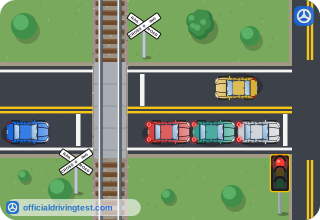
- Whenever you see that no train is coming from one direction
- Whenever the vehicle ahead of you has started across
- Only when you are sure you can completely clear the crossing
- Whenever you can cross faster than the speed limit
Show answer
Correct answer: Only when you are sure you can completely clear the crossing
You may cross only if you are sure you can completely clear the crossing.
Source: Oregon Driver Manual (2026-2027), page 63 · Open this page in the manual (Manual page 63)
-
What should you be aware of when a train at a crossing blocks your view?
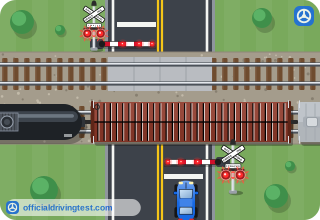
- No other train can be on the tracks at the same time
- One train may be blocking the view of another one
- The train will stop so you can cross behind it
- It is safe to cross as soon as it has passed
Show answer
Correct answer: One train may be blocking the view of another one
A train that blocks your view may be hiding another train.
Source: Oregon Driver Manual (2026-2027), page 63 · Open this page in the manual (Manual page 63)
-
What should you never do at a railroad crossing?
- Slow down
- Look and listen
- Wait behind the stop line
- Stop on the tracks
Show answer
Correct answer: Stop on the tracks
The manual says never to stop on the tracks.
Source: Oregon Driver Manual (2026-2027), page 63 · Open this page in the manual (Manual page 63)
-
A train is approaching a crossing and you think you could cross first. What does the manual say?
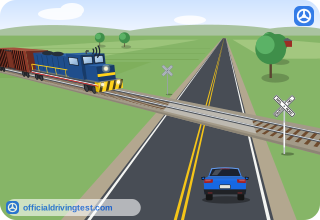
- Never try to beat a train at a crossing
- Cross quickly if the gate is still up
- Cross if the train looks far away
- Cross if you can do it without stopping
Show answer
Correct answer: Never try to beat a train at a crossing
The manual says never to try to beat a train at a crossing.
Source: Oregon Driver Manual (2026-2027), page 63 · Open this page in the manual (Manual page 63)
-
How close is a train you see approaching a crossing, compared with how it looks?
- Farther than it seems
- Exactly as close as it seems
- Closer than it seems
- Twice as far as it seems
Show answer
Correct answer: Closer than it seems
The train you see is closer than it seems.
Source: Oregon Driver Manual (2026-2027), page 63 · Open this page in the manual (Manual page 63)
-
What does the manual say about trains and stopping?
- Trains can stop as fast as cars can
- Trains cannot stop quickly
- Trains stop faster than buses do
- Trains can stop quickly if they sound the horn
Show answer
Correct answer: Trains cannot stop quickly
Trains cannot stop quickly, which is why you must not try to beat one.
Source: Oregon Driver Manual (2026-2027), page 63 · Open this page in the manual (Manual page 63)
-
Which vehicles must stop at railroad tracks?
- Only large trucks and vehicles that are towing a trailer
- Only vehicles that carry more than ten passengers at a time
- Only taxis, delivery vehicles and rental trucks on a route
- School buses, hazmat vehicles and some school activity vehicles
Show answer
Correct answer: School buses, hazmat vehicles and some school activity vehicles
All school buses, hazmat vehicles and some school activity vehicles must stop at railroad tracks, so be prepared to stop behind them.
Source: Oregon Driver Manual (2026-2027), page 63 · Open this page in the manual (Manual page 63)
-
If you must stop at a railroad crossing and there is no stop line, how far from the nearest rail must you stop?
- At least 15 feet
- At least 10 feet
- At least 20 feet
- At least 30 feet
Show answer
Correct answer: At least 15 feet
With no stop line, you stop at least 15 feet from the nearest rail.
Source: Oregon Driver Manual (2026-2027), page 64 · Open this page in the manual (Manual page 64)
-
What must you do when the flashing red lights at a railroad crossing are activated?
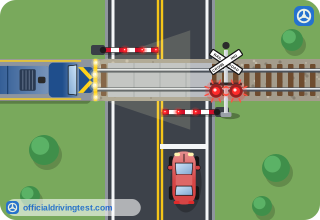
- Slow down and cross if no train is in sight
- Stop only if you can see a train coming
- Stop before the railroad tracks
- Sound your horn and cross with care
Show answer
Correct answer: Stop before the railroad tracks
Activated flashing red lights are one of the cases when you must stop before the tracks.
Source: Oregon Driver Manual (2026-2027), page 64 · Open this page in the manual (Manual page 64)
-
When must you stop before railroad tracks?
- Only when the approaching train is traveling faster than the cars around you
- When an approaching train is clearly visible or so close that crossing would be hazardous
- Only when you cannot see the road on the far side of the tracks
- Only when the crossing has more than one set of tracks to cross
Show answer
Correct answer: When an approaching train is clearly visible or so close that crossing would be hazardous
You must stop when an approaching train is clearly visible or so close to the crossing that trying to cross would be hazardous.
Source: Oregon Driver Manual (2026-2027), page 64 · Open this page in the manual (Manual page 64)
-
You come to a railroad crossing with a posted stop sign and you do not see a train. What must you do?
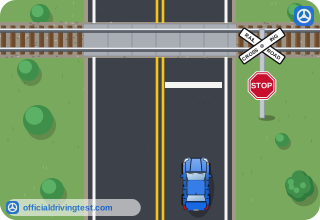
- Slow down and cross if the way is clear
- Stop only when a train is visible
- Stop only when the gate is lowered
- Stop before the tracks anyway
Show answer
Correct answer: Stop before the tracks anyway
You must stop before the tracks when a stop sign is posted, even if you do not see a train coming.
Source: Oregon Driver Manual (2026-2027), page 64 · Open this page in the manual (Manual page 64)
-
Which of these requires you to stop before railroad tracks?
- A flagger signals you to stop
- A railroad advance sign is posted beside the road
- A crossbuck shows the number of tracks below it
- A large X with the letters RR is painted on the pavement
Show answer
Correct answer: A flagger signals you to stop
A flagger's signal to stop is one of the cases when you must stop before the tracks.
Source: Oregon Driver Manual (2026-2027), page 64 · Open this page in the manual (Manual page 64)
-
When is it against the law to drive around or under a crossing gate?
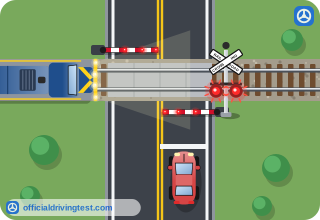
- Only while it is completely down across the road
- Only while a train is in sight of the crossing
- Whether it is down or being raised or lowered
- Only while it is being lowered for a train
Show answer
Correct answer: Whether it is down or being raised or lowered
The manual says it is against the law and extremely dangerous to drive around or under a gate while down or while being raised or lowered.
Source: Oregon Driver Manual (2026-2027), page 64 · Open this page in the manual (Manual page 64)
-
After you have stopped at a railroad crossing, when may you start across the tracks?
- As soon as the vehicle ahead of you starts across
- When you are sure you can do so safely
- As soon as you no longer hear a train horn
- After you have counted to ten slowly
Show answer
Correct answer: When you are sure you can do so safely
After stopping, you must not start across until you are sure you can do so safely.
Source: Oregon Driver Manual (2026-2027), page 64 · Open this page in the manual (Manual page 64)
-
At a crossing with multiple tracks, what should you look carefully for?
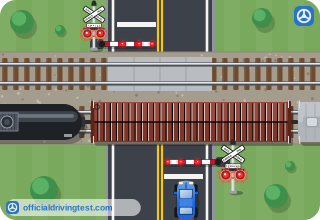
- A sign showing which track is currently in use
- Only trains coming from the direction of the flashing lights
- Only trains approaching from your right side
- A second train coming on another track from either direction
Show answer
Correct answer: A second train coming on another track from either direction
At crossings with multiple tracks, a second train may be coming on another track from either direction.
Source: Oregon Driver Manual (2026-2027), page 64 · Open this page in the manual (Manual page 64)
-
If your vehicle is stuck on the railroad tracks, what is the first thing you should do?
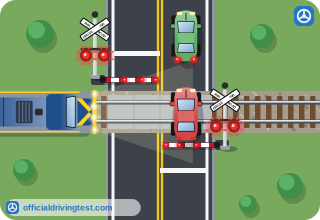
- Get out of the vehicle
- Try to restart the engine
- Turn on your hazard lights and stay inside
- Try to push the vehicle off the tracks
Show answer
Correct answer: Get out of the vehicle
Getting out of the vehicle is the first step when a vehicle is stuck on the tracks.
Source: Oregon Driver Manual (2026-2027), page 64 · Open this page in the manual (Manual page 64)
-
After you get out of a vehicle that is stuck on the railroad tracks, where should you go?
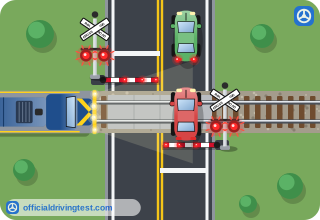
- Stay near the vehicle until you see a train
- Stand beside the tracks to signal an oncoming train
- Get away from the tracks, even if you do not see a train
- Wait on the crossing to warn other drivers
Show answer
Correct answer: Get away from the tracks, even if you do not see a train
You must get away from the tracks even if you do not see a train.
Source: Oregon Driver Manual (2026-2027), page 64 · Open this page in the manual (Manual page 64)
-
What is an Emergency Notification System (ENS) sign at a railroad crossing used for?
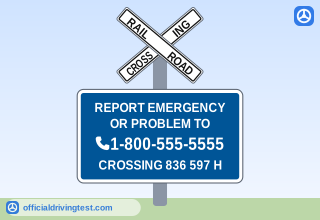
- To warn drivers how many tracks the crossing has and which track is in use right now
- To notify the railroads of an obstruction in the tracks so they can alert incoming trains
- To tell drivers the maximum speed limit for trains passing near the crossing area
- To signal to drivers that the crossing gate is about to close for an approaching train
Show answer
Correct answer: To notify the railroads of an obstruction in the tracks so they can alert incoming trains
The ENS sign lets you notify the railroads of the obstruction so they can alert incoming trains.
Source: Oregon Driver Manual (2026-2027), page 64 · Open this page in the manual (Manual page 64)
-
A train is approaching and your vehicle is stuck on the tracks. Which way should you move away from the tracks?
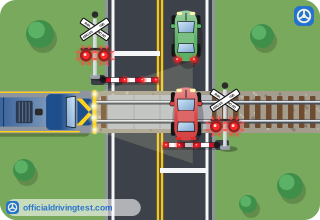
- At a 45 degree angle, in the direction opposite the train
- At a 90 degree angle to the tracks, toward the train
- Straight along the tracks, away from the train
- At a 45 degree angle, in the direction of the train
Show answer
Correct answer: At a 45 degree angle, in the direction of the train
Moving at a 45 degree angle in the direction of the train keeps you from being hit with debris.
Source: Oregon Driver Manual (2026-2027), page 64 · Open this page in the manual (Manual page 64)
-
What should you do when you see railroad crossing signs and signals?
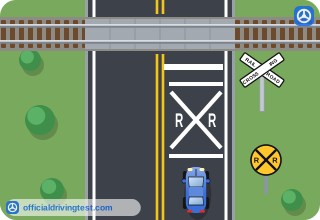
- Look, listen, and slow down because you may have to stop
- Keep your speed and watch only the signal lights
- Speed up so you can cross before the signals activate
- Change lanes to avoid the tracks and slow down only for a train
Show answer
Correct answer: Look, listen, and slow down because you may have to stop
Signs and signals mark railroad crossings, so you look, listen and slow down because you may have to stop.
Source: Oregon Driver Manual (2026-2027), page 63 · Open this page in the manual (Manual page 63)