Oregon: Pedestrians Practice Test
Stopping for people in crosswalks, marked and unmarked crosswalks, blind pedestrians and school zones.
Independent educational site · not affiliated with any government agency or DMV
Ready? Test yourself
- Instant feedback with an explanation
- Every answer cites its source in the manual
- Your best score is saved on this device
Questions are original and based on the official manual "Oregon Driver Manual" (2026-2027), Oregon Driver and Motor Vehicle Services (DMV).
All 21 questions in this practice test
Take the test above first, then use this list to study. Tap “Show answer” to see the correct answer and explanation.
Show the questions and answersHide the questions
-
Besides people walking, who does the manual's term pedestrian include?
- Only people who are crossing the road at a marked crosswalk
- People riding motorcycles or mopeds on the shoulder of the road
- People rolling with skateboards, scooters and wheelchairs
- Only people with a disability that limits their walking
Show answer
Correct answer: People rolling with skateboards, scooters and wheelchairs
The manual defines pedestrian as people walking as well as rolling with skateboards, scooters and wheelchairs.
Source: Oregon Driver Manual (2026-2027), page 46 · Open this page in the manual (Manual page 46)
-
At which crosswalks must you stop for pedestrians crossing the road?
- Only marked crosswalks with painted lines
- Any marked or unmarked crosswalk
- Only crosswalks that have a traffic signal or a stop sign
- Only crosswalks that are at intersections
Show answer
Correct answer: Any marked or unmarked crosswalk
You must stop for pedestrians crossing at any marked or unmarked crosswalk.
Source: Oregon Driver Manual (2026-2027), page 46 · Open this page in the manual (Manual page 46)
-
When does the manual consider a pedestrian to be crossing the road?
- Only when the pedestrian has stepped past the center of your lane of travel
- Only when the pedestrian's whole body is in the road and facing your vehicle
- Only after the pedestrian has stepped off the curb and is in a marked crosswalk
- When any part or extension of the pedestrian, such as a cane, moves onto the road
Show answer
Correct answer: When any part or extension of the pedestrian, such as a cane, moves onto the road
A pedestrian is crossing when any part or extension (cane, wheelchair, bicycle, etc.) moves onto the road.
Source: Oregon Driver Manual (2026-2027), page 46 · Open this page in the manual (Manual page 46)
-
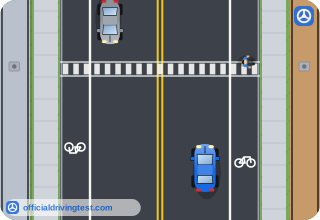
A pedestrian is crossing in a crosswalk in the bike lane next to your lane of travel. What must you do?
- Continue, because the pedestrian is not in your lane
- Slow down and pass if the pedestrian is far from your vehicle
- Stop and remain stopped for the pedestrian
- Sound your horn and continue when the pedestrian steps back
Show answer
Correct answer: Stop and remain stopped for the pedestrian
You must stop and remain stopped for a pedestrian in a lane next to your lane of travel, including a bike lane.
Source: Oregon Driver Manual (2026-2027), page 46 · Open this page in the manual (Manual page 46)
-
You are turning at an intersection that has a traffic signal. Before you begin to turn, how far must the pedestrian be from the lane you are turning into?
- Six feet or more
- Three feet or more
- Ten feet or more
- Twelve feet or more
Show answer
Correct answer: Six feet or more
At a signalized intersection the pedestrian must be six feet or more from the lane you are turning into before you begin to turn.
Source: Oregon Driver Manual (2026-2027), page 47 · Open this page in the manual (Manual page 47)
-
You are turning at an intersection that does not have a traffic signal. Before you begin to turn, where must the pedestrian be?
- Out of the lane you are turning into
- On the sidewalk or shoulder at the corner
- At least six feet from the lane you are turning into
- Past the lane you are turning into, plus the next lane
Show answer
Correct answer: Past the lane you are turning into, plus the next lane
Without a signal, the pedestrian must be past the lane you are turning into plus the next lane before you turn.
Source: Oregon Driver Manual (2026-2027), page 47 · Open this page in the manual (Manual page 47)
-
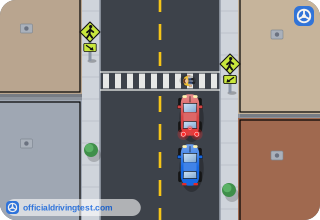
A vehicle ahead of you is stopped at a crosswalk. What should you do?
- Pass it on the left if the lane ahead of you is clear of traffic
- Not pass it, because the driver may be waiting for a pedestrian
- Pass it only if you do not see a pedestrian near the crosswalk
- Slow down and pass it on the right side of the road if you can
Show answer
Correct answer: Not pass it, because the driver may be waiting for a pedestrian
Passing a vehicle stopped at a crosswalk is against the law because the driver may be waiting for a pedestrian to cross.
Source: Oregon Driver Manual (2026-2027), page 47 · Open this page in the manual (Manual page 47)
-
When are you not required to stop for a pedestrian in a crosswalk?
- When the pedestrian is in a bike lane next to your lane of travel
- When the pedestrian is in a crosswalk on the other side of a safety island
- When the pedestrian is crossing an unmarked crosswalk at an intersection
- When the pedestrian is in the lane you are turning into at an intersection
Show answer
Correct answer: When the pedestrian is in a crosswalk on the other side of a safety island
You are not required to stop if the pedestrian is in a crosswalk on the other side of a safety island.
Source: Oregon Driver Manual (2026-2027), page 47 · Open this page in the manual (Manual page 47)
-
Where is there a crosswalk, even if it is not marked by painted lines?
- Only at intersections that have a traffic signal
- Only where a sidewalk meets the road
- Only on roads with a speed limit of 25 mph or less
- At every intersection
Show answer
Correct answer: At every intersection
There is a crosswalk at every intersection, even if painted lines do not mark it.
Source: Oregon Driver Manual (2026-2027), page 47 · Open this page in the manual (Manual page 47)
-
How can you determine where an unmarked crosswalk is?
- Imagine that a sidewalk or shoulder at the corner extends to the other side
- Use the area between the stop line and the center of the intersection
- Look for signs posted on both sides of the road
- Use the space between the two nearest corners of the intersection
Show answer
Correct answer: Imagine that a sidewalk or shoulder at the corner extends to the other side
The manual says to imagine that a sidewalk or shoulder at the corner extends to the other side of the road.
Source: Oregon Driver Manual (2026-2027), page 47 · Open this page in the manual (Manual page 47)
-
How wide is an unmarked crosswalk at the least?
- Three feet
- Ten feet
- Six feet
- Twelve feet
Show answer
Correct answer: Six feet
An unmarked crosswalk is at least six feet wide, even if there is no sidewalk or shoulder.
Source: Oregon Driver Manual (2026-2027), page 47 · Open this page in the manual (Manual page 47)
-
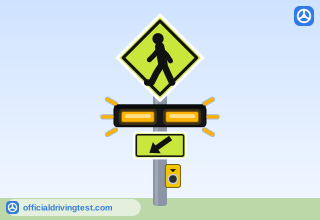
What may a flashing yellow light at a mid-block crosswalk indicate?
- A school speed zone begins just ahead of the crosswalk
- The crosswalk is closed to pedestrians until the light stops
- Drivers must yield only to traffic from the cross street
- A pedestrian is crossing or about to cross the road
Show answer
Correct answer: A pedestrian is crossing or about to cross the road
A mid-block crosswalk may have a flashing yellow light that shows a pedestrian is crossing or about to cross.
Source: Oregon Driver Manual (2026-2027), page 47 · Open this page in the manual (Manual page 47)
-
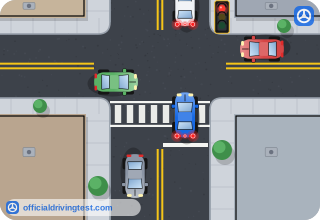
What is the problem with stopping with part of your vehicle overhanging a crosswalk?
- It keeps drivers behind you from seeing the traffic signal ahead
- It forces pedestrians to go around your vehicle and puts them in danger
- It makes pedestrians unsure whether your vehicle has really stopped
- It makes it harder for turning drivers to see the pedestrians crossing
Show answer
Correct answer: It forces pedestrians to go around your vehicle and puts them in danger
Blocking a crosswalk forces pedestrians to go around your vehicle and puts them in a dangerous situation.
Source: Oregon Driver Manual (2026-2027), page 47 · Open this page in the manual (Manual page 47)
-
You are entering or leaving a parking lot, alley or driveway and must cross a sidewalk. What must you do?
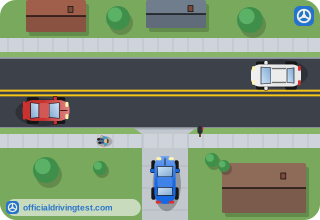
- Slow down and sound your horn before crossing the sidewalk
- Stop with your front wheels on the sidewalk so you can see traffic
- Stop before the sidewalk and yield to pedestrians and people riding bicycles
- Yield only to pedestrians, because people riding bicycles must use the road
Show answer
Correct answer: Stop before the sidewalk and yield to pedestrians and people riding bicycles
When you cross a sidewalk you must stop before reaching it and yield to both pedestrians and people riding bicycles.
Source: Oregon Driver Manual (2026-2027), page 47 · Open this page in the manual (Manual page 47)
-
A pedestrian who is blind is using a guide dog to cross the road and you have a green light. How long must you remain stopped?
- Until the person has crossed the entire road
- Until the person is past the center of the road
- Until the person has stepped off the curb
- Until your light turns yellow
Show answer
Correct answer: Until the person has crossed the entire road
You must remain stopped until the person has crossed the entire road, even if you have a green light.
Source: Oregon Driver Manual (2026-2027), page 48 · Open this page in the manual (Manual page 48)
-
When must you stop for a pedestrian who is carrying a white cane?
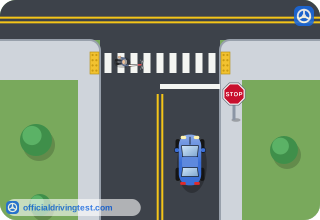
- If the person is about to cross or is crossing the road
- Only if the person is already inside a marked crosswalk
- Only if you have a red light or a stop sign
- Only if the person signals you to stop with the cane
Show answer
Correct answer: If the person is about to cross or is crossing the road
You must stop if a pedestrian with a white cane or guide dog is about to cross or is crossing the road.
Source: Oregon Driver Manual (2026-2027), page 48 · Open this page in the manual (Manual page 48)
-
What should you avoid in residential areas and places where children are likely to be, such as a park?
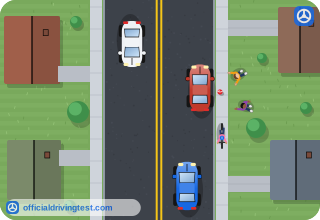
- Keeping a safe distance from the vehicle ahead of you
- Using your turn signals before every turn or lane change
- Driving too close to parked cars that may block your view
- Stopping for pedestrians who are waiting at marked crosswalks
Show answer
Correct answer: Driving too close to parked cars that may block your view
The manual says not to drive too close to parked cars that may block your view where children are likely to be.
Source: Oregon Driver Manual (2026-2027), page 48 · Open this page in the manual (Manual page 48)
-
Why should you be watchful when backing in or out of a driveway?
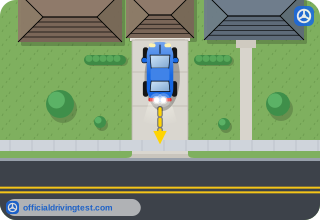
- Children are required to stay out of driveways, so they are easy to miss
- Children are unpredictable and may run or be playing behind your vehicle
- Children usually stay on the sidewalk but may drop their toys in the driveway
- Children cannot hear a vehicle that is backing up from far away
Show answer
Correct answer: Children are unpredictable and may run or be playing behind your vehicle
The manual warns that children are unpredictable and may run or be playing behind your vehicle.
Source: Oregon Driver Manual (2026-2027), page 48 · Open this page in the manual (Manual page 48)
-
When must you stop and yield at a school crosswalk, and for how long?
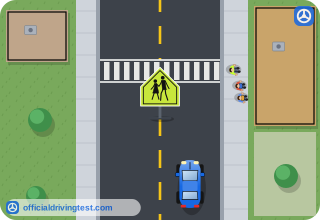
- When children enter the crosswalk, until the first child reaches the far curb
- Only when a crossing guard signals you, until the guard lowers the sign
- When children enter the crosswalk or a guard signals you, until it is clear
- When children enter the crosswalk, until they are past your lane of travel
Show answer
Correct answer: When children enter the crosswalk or a guard signals you, until it is clear
You must stop and yield when children enter the crosswalk or a school crossing guard signals you, and remain stopped until the children clear the crosswalk.
Source: Oregon Driver Manual (2026-2027), page 50 · Open this page in the manual (Manual page 50)
-
Why must you be careful where streetcars and trains stop?
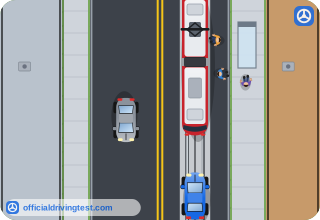
- Passengers are never allowed to cross the traffic lanes
- Streetcars wait there for traffic to pass before loading
- Passengers will run across lanes to catch the streetcar or train
- Drivers must stop in their lane at every streetcar stop
Show answer
Correct answer: Passengers will run across lanes to catch the streetcar or train
Passengers will run across lanes to catch the streetcar or train, so you must watch for people getting on or off.
Source: Oregon Driver Manual (2026-2027), page 66 · Open this page in the manual (Manual page 66)
-
Near streetcars and trains, what should you follow so people can cross the street safely?
- The streetcar operator's hand signals
- Pedestrian signals
- Only the lights for the vehicle lanes
- The signals of the train horn
Show answer
Correct answer: Pedestrian signals
The manual says to follow pedestrian signals and let people cross the street safely.
Source: Oregon Driver Manual (2026-2027), page 66 · Open this page in the manual (Manual page 66)