Oregon: Pavement markings — Part 2 Practice Test
Questions in this part include: “A dotted white line appears before an exit ramp or intersection. What does it tell you?” · “Are all Transit Only lanes painted red?”
Independent educational site · not affiliated with any government agency or DMV
Ready? Test yourself
- Instant feedback with an explanation
- Every answer cites its source in the manual
- Your best score is saved on this device
Questions are original and based on the official manual "Oregon Driver Manual" (2026-2027), Oregon Driver and Motor Vehicle Services (DMV).
All 19 questions in this practice test
Take the test above first, then use this list to study. Tap “Show answer” to see the correct answer and explanation.
Show the questions and answersHide the questions
-
A dotted white line appears before an exit ramp or intersection. What does it tell you?
- The lane you are in will not continue on the same route
- You must come to a full stop at the line and then proceed
- You must merge into traffic
- You may not change lanes
Show answer
Correct answer: The lane you are in will not continue on the same route
Before an exit ramp or intersection, it informs you that your lane will not continue on the same route, such as a right-turn only lane or an exit only lane.
Source: Oregon Driver Manual (2026-2027), page 24 · Open this page in the manual (Manual page 24)
-
A dotted white line appears at a freeway entrance ramp. What does it tell you?
- You must come to a stop and wait for a gap in traffic
- Your lane will not continue on the same route
- Lane changes are prohibited
- You are entering the freeway and must merge into traffic
Show answer
Correct answer: You are entering the freeway and must merge into traffic
At a freeway entrance ramp, the dotted white line informs you that you are entering the freeway and must merge into traffic.
Source: Oregon Driver Manual (2026-2027), page 24 · Open this page in the manual (Manual page 24)
-
What is a dotted white line within an intersection used for?
- To show where you must stop before entering the intersection
- To guide you through the intersection into the proper lane
- To separate opposing traffic
- To mark a crosswalk
Show answer
Correct answer: To guide you through the intersection into the proper lane
Within an intersection, a dotted white line helps guide you through into the proper lane.
Source: Oregon Driver Manual (2026-2027), page 24 · Open this page in the manual (Manual page 24)
-
What does a double solid white line mean?
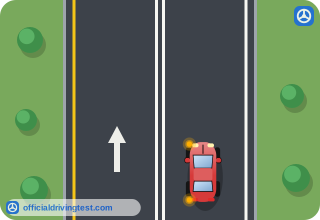
- You may not change lanes; stay in your lane
- You may change lanes only with caution
- You must stop before the lines
- The lane is reserved for buses
Show answer
Correct answer: You may not change lanes; stay in your lane
A double solid white line, usually with a sign prohibiting lane changes for a certain distance, means you may not change lanes.
Source: Oregon Driver Manual (2026-2027), page 24 · Open this page in the manual (Manual page 24)
-
What must you do when a pedestrian is in a marked crosswalk in your lane?
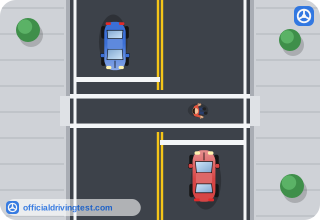
- Slow down and sound your horn
- Continue if you can pass behind the pedestrian
- Stop
- Continue if the pedestrian has stopped walking
Show answer
Correct answer: Stop
The manual says to stop when a pedestrian is in the crosswalk.
Source: Oregon Driver Manual (2026-2027), page 24 · Open this page in the manual (Manual page 24)
-
What does a stop line show?
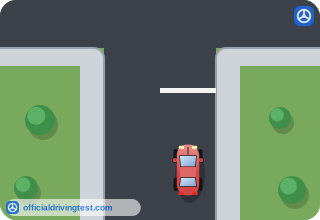
- The point at which you are required to yield
- The point at which you are required to stop
- The start of a bike lane
- The end of a no-passing zone
Show answer
Correct answer: The point at which you are required to stop
A stop line is a solid white line across your lane showing the point at which you are required to stop.
Source: Oregon Driver Manual (2026-2027), page 25 · Open this page in the manual (Manual page 25)
-
How is a bike lane identified?
- A wide solid yellow line with a bicycle symbol on it
- A row of triangles pointing toward you
- A double white line only
- A wide white line with a bicycle symbol or a bike lane sign
Show answer
Correct answer: A wide white line with a bicycle symbol or a bike lane sign
A bike lane is identified by a wide white line with a bicycle symbol or a bike lane sign.
Source: Oregon Driver Manual (2026-2027), page 25 · Open this page in the manual (Manual page 25)
-
What color may a bike lane be painted?
- Blue
- Yellow
- Green
- Orange
Show answer
Correct answer: Green
The manual says bike lanes may be painted green.
Source: Oregon Driver Manual (2026-2027), page 25 · Open this page in the manual (Manual page 25)
-
A row of triangles in your lane points toward your vehicle. What does it show?
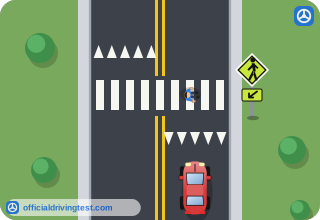
- The point at which you are required to yield
- The point at which you are required to stop
- A lane for transit vehicles only
- An area where you may not change lanes
Show answer
Correct answer: The point at which you are required to yield
A yield line is a row of triangles pointing toward your vehicle that shows where you are required to yield.
Source: Oregon Driver Manual (2026-2027), page 25 · Open this page in the manual (Manual page 25)
-
What may white chevrons on the pavement inform you of?
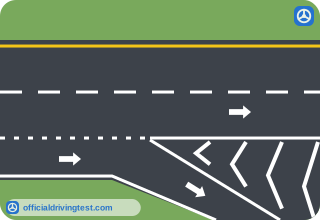
- A lane that ends a short distance ahead and requires traffic to merge
- A place where you may park
- A lane reserved for buses
- Fixed objects ahead, or other areas where vehicle use is not allowed
Show answer
Correct answer: Fixed objects ahead, or other areas where vehicle use is not allowed
White chevrons may be used to inform you of fixed objects in the road ahead or other areas where vehicle use is not allowed.
Source: Oregon Driver Manual (2026-2027), page 25 · Open this page in the manual (Manual page 25)
-
What are red pavement markings used to designate?
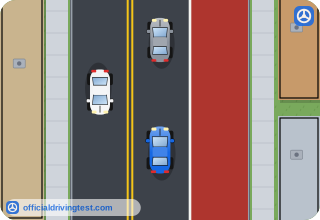
- Where drivers must stop for pedestrians who are crossing the road
- Where transit only vehicles, like buses or light rail trains, may travel
- Where parking is allowed for short periods
- Where passing is prohibited
Show answer
Correct answer: Where transit only vehicles, like buses or light rail trains, may travel
Red markings designate where transit only vehicles may travel continuously.
Source: Oregon Driver Manual (2026-2027), page 25 · Open this page in the manual (Manual page 25)
-
Are all Transit Only lanes painted red?
- No, so always look for signs or other markings on the road
- Yes, every Transit Only lane is red
- Yes, but red may fade, so also check for white lines
- No, and signs are never used for them
Show answer
Correct answer: No, so always look for signs or other markings on the road
Not all Transit Only lanes are red, so always look for signs or other markings on the road.
Source: Oregon Driver Manual (2026-2027), page 25 · Open this page in the manual (Manual page 25)
-
What does a solid red lane mean?
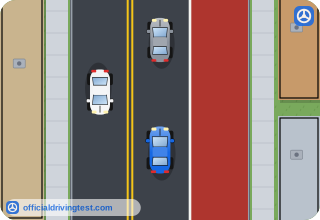
- It is a lane for emergency stopping
- It is a left turn lane for all vehicles
- It is a Transit Only lane, not for cars
- It is a parking lane
Show answer
Correct answer: It is a Transit Only lane, not for cars
A solid red lane is a Transit Only lane that is not for cars.
Source: Oregon Driver Manual (2026-2027), page 25 · Open this page in the manual (Manual page 25)
-
What do striped red lines show?
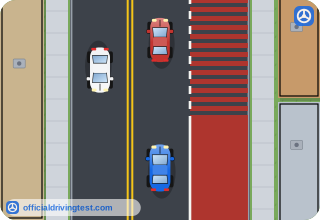
- Where you must stop for a train and wait for it to pass
- Where you may enter the Transit Only lane to turn or park
- Where you may pass a bus
- Where you must yield to people riding bicycles
Show answer
Correct answer: Where you may enter the Transit Only lane to turn or park
Striped red lines show where you may enter the Transit Only lane to turn, park or enter a driveway.
Source: Oregon Driver Manual (2026-2027), page 25 · Open this page in the manual (Manual page 25)
-
What should you do if you cannot safely return to your lane before entering a no-passing zone?
- Pass and return to your lane inside the no-passing zone
- Pass on the right
- Do not attempt to pass the vehicle
- Pass only if the vehicle ahead is traveling under the speed limit
Show answer
Correct answer: Do not attempt to pass the vehicle
The manual says not to attempt to pass if you cannot safely return to your lane before entering a no-passing zone.
Source: Oregon Driver Manual (2026-2027), page 32 · Open this page in the manual (Manual page 32)
-
When may you cross the center line in a no-passing zone?
- Only if no oncoming vehicle is in sight
- Only if the vehicle ahead is moving slower than the speed limit
- Only if you signal for at least five seconds
- Only if the right side is blocked or you are turning left
Show answer
Correct answer: Only if the right side is blocked or you are turning left
The manual says you may cross the center line in a no-passing zone only if the right side is blocked or you are turning left.
Source: Oregon Driver Manual (2026-2027), page 32 · Open this page in the manual (Manual page 32)
-
What does a bike box usually look like?
- A white painted box on the road with a green bicycle symbol
- A yellow painted box on the road with a black bicycle symbol
- A red painted box on the road with a white bicycle symbol
- A green painted box on the road with a white bicycle symbol
Show answer
Correct answer: A green painted box on the road with a white bicycle symbol
Most bike boxes are a green painted box on the road with a white bicycle symbol.
Source: Oregon Driver Manual (2026-2027), page 51 · Open this page in the manual (Manual page 51)
-
What does a sharrow indicate?
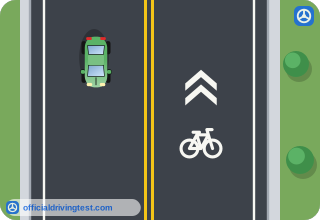
- Only people riding bicycles may use the lane at this point
- The lane is shared and people riding bicycles may be there
- A bike lane begins ahead on the right side of the road
- Drivers must not pass people riding bicycles in this lane
Show answer
Correct answer: The lane is shared and people riding bicycles may be there
A sharrow indicates that the lane is shared and people riding bicycles may be in the road.
Source: Oregon Driver Manual (2026-2027), page 51 · Open this page in the manual (Manual page 51)
-
How is a sharrow shown on the road?
- A bicycle symbol inside a solid white box
- Two parallel white lines with a bicycle symbol between them
- Two chevrons above a bicycle symbol painted on the road
- A green painted lane with a white bicycle symbol
Show answer
Correct answer: Two chevrons above a bicycle symbol painted on the road
A sharrow is indicated by two chevrons above a bicycle symbol painted on the road.
Source: Oregon Driver Manual (2026-2027), page 51 · Open this page in the manual (Manual page 51)