Oregon: Pavement markings — Part 1 Practice Test
Questions in this part include: “When may you disobey a pavement marking?” · “What does a solid yellow line mark?”
Independent educational site · not affiliated with any government agency or DMV
Ready? Test yourself
- Instant feedback with an explanation
- Every answer cites its source in the manual
- Your best score is saved on this device
Questions are original and based on the official manual "Oregon Driver Manual" (2026-2027), Oregon Driver and Motor Vehicle Services (DMV).
All 20 questions in this practice test
Take the test above first, then use this list to study. Tap “Show answer” to see the correct answer and explanation.
Show the questions and answersHide the questions
-
When may you disobey a pavement marking?
- When no other vehicles are anywhere near you on the road
- When the marking is faded
- When a police officer or road worker is redirecting traffic
- When you are driving slower than other traffic
Show answer
Correct answer: When a police officer or road worker is redirecting traffic
You must obey all pavement markings unless you see a police officer or road worker redirecting traffic.
Source: Oregon Driver Manual (2026-2027), page 22 · Open this page in the manual (Manual page 22)
-
What do yellow pavement markings separate?
- Lanes of traffic flowing in the same direction
- Traffic moving in opposite directions
- Bike lanes from sidewalks
- Parking spaces from travel lanes
Show answer
Correct answer: Traffic moving in opposite directions
Yellow markings separate traffic moving in opposite directions (center line) and mark the left edge of one-way roads and ramps, two-way left turn lanes and painted medians.
Source: Oregon Driver Manual (2026-2027), page 22 · Open this page in the manual (Manual page 22)
-
What do white pavement markings separate?
- Traffic moving in opposite directions
- Two-way left turn lanes from painted medians
- The left edge of one-way roads from ramps
- Lanes of traffic flowing in the same direction
Show answer
Correct answer: Lanes of traffic flowing in the same direction
White markings separate lanes of traffic flowing in the same direction and mark the right edge of travel lanes.
Source: Oregon Driver Manual (2026-2027), page 23 · Open this page in the manual (Manual page 23)
-
What does a solid yellow line mark?
- The right edge of one-way roads
- The border between lanes going the same direction
- The left edge of one-way roads and ramps
- The edge of a crosswalk
Show answer
Correct answer: The left edge of one-way roads and ramps
A solid yellow line marks the left edge of one-way roads and ramps.
Source: Oregon Driver Manual (2026-2027), page 22 · Open this page in the manual (Manual page 22)
-
A single broken yellow line runs down the center of a two-way road. What does it indicate?
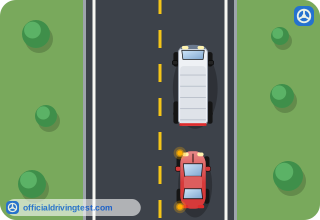
- Passing is allowed for both directions of travel
- Passing is not allowed for either direction
- Passing is allowed only for the direction with the broken line
- The road is one-way
Show answer
Correct answer: Passing is allowed for both directions of travel
A broken yellow center line indicates a two-way road where passing is allowed for both directions of travel.
Source: Oregon Driver Manual (2026-2027), page 22 · Open this page in the manual (Manual page 22)
-
The center of a road has a solid yellow line and a broken yellow line side by side. The broken line is on your side. What does this mean?
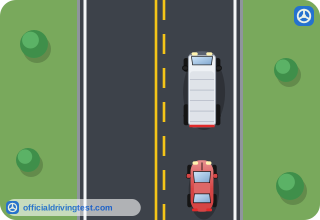
- You are not allowed to pass
- You may pass only on a curve
- You may pass only in bad weather
- You are allowed to pass
Show answer
Correct answer: You are allowed to pass
A broken yellow line on your side of the lane indicates you are allowed to pass.
Source: Oregon Driver Manual (2026-2027), page 22 · Open this page in the manual (Manual page 22)
-
The center of a road has a solid yellow line and a broken yellow line side by side. The solid line is on your side. What does this mean?
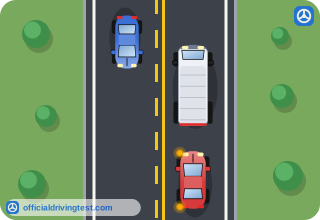
- You are allowed to pass
- You are not allowed to pass
- You may pass only if no vehicle is oncoming
- You may pass only at a speed under 25 mph
Show answer
Correct answer: You are not allowed to pass
A solid yellow line on your side of the lane indicates you are not allowed to pass.
Source: Oregon Driver Manual (2026-2027), page 22 · Open this page in the manual (Manual page 22)
-
What does a double solid yellow line indicate?
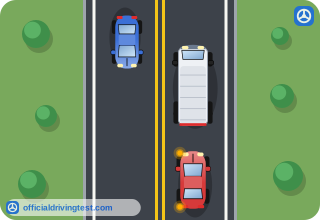
- Passing is not allowed for both directions of traffic
- Passing is allowed for both directions of traffic
- Passing is allowed only for the direction with more lanes
- The road is a one-way road
Show answer
Correct answer: Passing is not allowed for both directions of traffic
A double solid yellow line means passing is not allowed for both directions.
Source: Oregon Driver Manual (2026-2027), page 22 · Open this page in the manual (Manual page 22)
-
When may you turn left across double solid yellow lines to enter or exit a roadway?
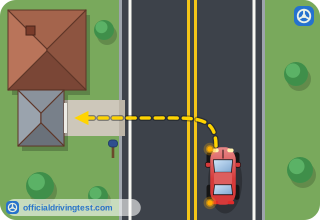
- Never, under any circumstances
- Only when no sign is posted
- After waiting for oncoming traffic to clear
- Only if you are driving slower than 15 mph
Show answer
Correct answer: After waiting for oncoming traffic to clear
You may turn left to enter or exit a roadway across double solid yellow lines after waiting for oncoming traffic to clear.
Source: Oregon Driver Manual (2026-2027), page 22 · Open this page in the manual (Manual page 22)
-
A two-way left turn lane has been provided. From which lane may you make a left turn?
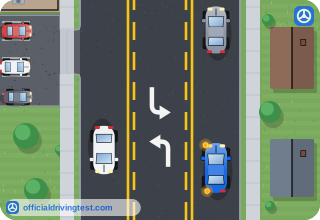
- From the lane next to it
- Only from the two-way left turn lane
- From any lane if traffic is light
- From the right lane
Show answer
Correct answer: Only from the two-way left turn lane
If a two-way left turn lane has been provided, you must not make a left turn from any other lane.
Source: Oregon Driver Manual (2026-2027), page 23 · Open this page in the manual (Manual page 23)
-
When should you enter a two-way left turn lane?
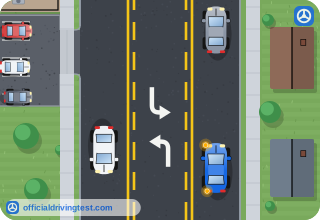
- Well before the turn, to travel along it
- As soon as you see it, to get ahead of traffic
- Only after crossing the intersection
- Just before you want to make the turn
Show answer
Correct answer: Just before you want to make the turn
The manual says it is illegal to travel in a two-way left turn lane, so you enter just before the turn.
Source: Oregon Driver Manual (2026-2027), page 23 · Open this page in the manual (Manual page 23)
-
A painted median has double solid yellow lines on both sides. When may you make a left turn across it?
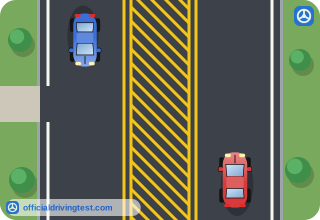
- Only when the median is wider than a car
- Never
- After waiting for oncoming traffic to clear
- Only if you signal for at least 5 seconds
Show answer
Correct answer: After waiting for oncoming traffic to clear
You may make a left turn across a painted median after waiting for oncoming traffic to clear.
Source: Oregon Driver Manual (2026-2027), page 23 · Open this page in the manual (Manual page 23)
-
A painted median has double solid yellow lines on both sides. May you use it as a turn lane or travel in it?
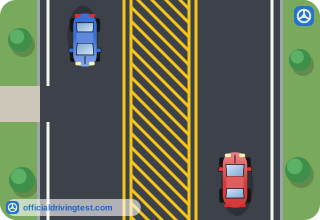
- No, it is illegal to use it as a turn lane or to travel in it
- Yes, but only while you wait for oncoming traffic to clear
- Yes, but only for 100 feet or less
- Yes, if no other vehicles are present
Show answer
Correct answer: No, it is illegal to use it as a turn lane or to travel in it
You may not use a painted median as a turn lane, and it is illegal to travel in a median with double yellow lines.
Source: Oregon Driver Manual (2026-2027), page 23 · Open this page in the manual (Manual page 23)
-
What do yellow diagonal stripes within a painted median tell you?
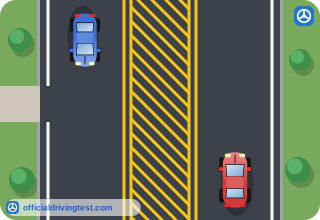
- A two-way left turn lane begins ahead of you in the median
- Passing is allowed on the left
- A bike lane begins ahead
- Fixed objects are ahead, or vehicle use is not allowed in the area
Show answer
Correct answer: Fixed objects are ahead, or vehicle use is not allowed in the area
Yellow diagonal stripes inform you of fixed objects in the road ahead or areas where vehicle use is not allowed.
Source: Oregon Driver Manual (2026-2027), page 23 · Open this page in the manual (Manual page 23)
-
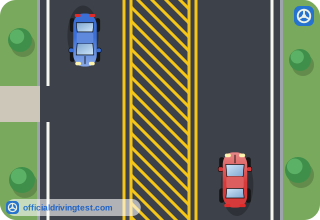
What does the manual say about driving in or turning across yellow diagonal stripes in a painted median?
- It is allowed to pass a slow vehicle
- It is illegal
- It is allowed after oncoming traffic clears
- It is allowed only to turn left
Show answer
Correct answer: It is illegal
It is illegal to drive in or make a turn across these stripes.
Source: Oregon Driver Manual (2026-2027), page 23 · Open this page in the manual (Manual page 23)
-
What is a solid white line along the edge of the road used for?
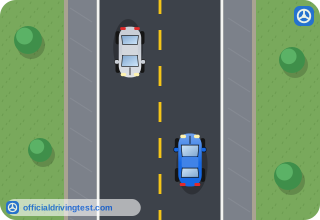
- As an edge or fog line to help drivers stay on the road
- To mark the center of a two-way road used by opposing traffic
- To show where passing is allowed
- To separate a bike lane from the sidewalk
Show answer
Correct answer: As an edge or fog line to help drivers stay on the road
A solid white line is used for an edge or fog line to help drivers stay on the road.
Source: Oregon Driver Manual (2026-2027), page 23 · Open this page in the manual (Manual page 23)
-
What is a wide solid white line used for?
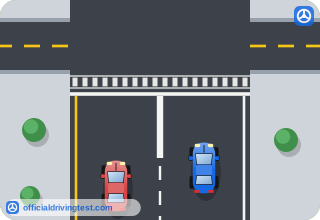
- To mark where passing is allowed on a two-lane road with traffic both ways
- To show where a crosswalk begins
- To direct traffic into specific lanes, such as turn lanes, and separate bike lanes
- To mark the left edge of a one-way road
Show answer
Correct answer: To direct traffic into specific lanes, such as turn lanes, and separate bike lanes
A wide solid white line directs traffic into specific lanes and separates bike lanes from other traffic lanes.
Source: Oregon Driver Manual (2026-2027), page 24 · Open this page in the manual (Manual page 24)
-
What does the manual say about crossing a wide solid white line?
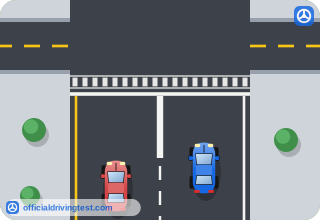
- It is never permitted
- It is permitted but discouraged
- It is permitted only to pass another vehicle
- It is permitted without any caution
Show answer
Correct answer: It is permitted but discouraged
Crossing a wide solid white line is permitted but discouraged.
Source: Oregon Driver Manual (2026-2027), page 24 · Open this page in the manual (Manual page 24)
-
What does a broken white line separate, and may you cross it?
- Opposing traffic; crossing is never permitted under any conditions
- A bike lane; crossing is permitted only to turn
- A crosswalk; crossing is permitted at any time
- Lanes going the same direction; crossing is permitted with caution
Show answer
Correct answer: Lanes going the same direction; crossing is permitted with caution
A broken white line separates lanes of traffic going in the same direction, and crossing it is permitted with caution.
Source: Oregon Driver Manual (2026-2027), page 24 · Open this page in the manual (Manual page 24)
-
How does a dotted white line differ from a broken white line?
- It is a wider line that is painted solid white
- It is red instead of white
- It has short dotted lines placed closer together
- It has two lines side by side
Show answer
Correct answer: It has short dotted lines placed closer together
A dotted white line is made of short dotted lines placed closer together than a broken line.
Source: Oregon Driver Manual (2026-2027), page 24 · Open this page in the manual (Manual page 24)