Oregon: Freeway driving Practice Test
Entering and leaving freeways, ramp meters, merging, lane use and what to do if you miss your exit.
Independent educational site · not affiliated with any government agency or DMV
Ready? Test yourself
- Instant feedback with an explanation
- Every answer cites its source in the manual
- Your best score is saved on this device
Questions are original and based on the official manual "Oregon Driver Manual" (2026-2027), Oregon Driver and Motor Vehicle Services (DMV).
All 27 questions in this practice test
Take the test above first, then use this list to study. Tap “Show answer” to see the correct answer and explanation.
Show the questions and answersHide the questions
-
Which of these is a reason traffic on freeways usually moves more efficiently?
- There are traffic signals at every exit
- Access is controlled
- Speed limits are not posted
- Most freeways have railroad crossings
Show answer
Correct answer: Access is controlled
The manual says freeway traffic moves more efficiently because access is controlled, with few sharp curves, no railroad crossings and no traffic signals.
Source: Oregon Driver Manual (2026-2027), page 34 · Open this page in the manual (Manual page 34)
-
Why does driving at a steady speed on a freeway help?
- You can follow other vehicles more closely
- You do not need to check your mirrors
- You can enter the freeway without yielding
- You will have less need to change lanes
Show answer
Correct answer: You will have less need to change lanes
The manual says that driving at a steady speed means you will have less need to change lanes.
Source: Oregon Driver Manual (2026-2027), page 34 · Open this page in the manual (Manual page 34)
-
What does weaving through freeway traffic do?
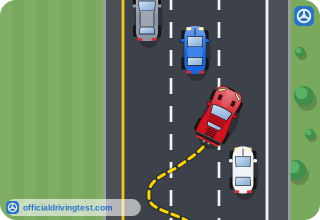
- It increases the risk of a collision and seldom saves time
- It reduces the risk of a collision and usually saves time
- It is required when traffic is heavy and moving slowly
- It helps vehicles that are merging to enter the freeway
Show answer
Correct answer: It increases the risk of a collision and seldom saves time
Weaving through traffic increases the risk of a collision and seldom saves time.
Source: Oregon Driver Manual (2026-2027), page 34 · Open this page in the manual (Manual page 34)
-
How fast should you drive on a freeway when the traffic around you is flowing faster than the posted speed?
- Do not exceed the posted speed just to stay with traffic
- Drive at the speed of the fastest vehicle in your lane
- Drive up to 10 mph above the posted speed to match the flow
- Drive at the average speed of the vehicles around you
Show answer
Correct answer: Do not exceed the posted speed just to stay with traffic
The manual says not to be lured into exceeding the posted speed to stay with the flow of traffic.
Source: Oregon Driver Manual (2026-2027), page 34 · Open this page in the manual (Manual page 34)
-
If you drive at a speed below the flow of traffic on a freeway, which lane must you use?
- The left lane
- The center lane
- The right lane
- Any lane you choose
Show answer
Correct answer: The right lane
If you drive below the flow of traffic, you must use the right lane.
Source: Oregon Driver Manual (2026-2027), page 34 · Open this page in the manual (Manual page 34)
-
What should you do when you watch for traffic trying to enter the freeway?
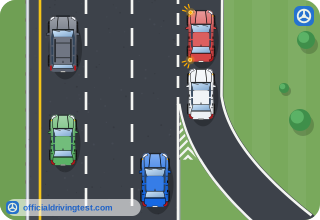
- Speed up to stay beside the merging vehicle at all times
- Adjust your speed to permit a safe, smooth merge
- Stop in your lane to let the merging vehicle enter first
- Sound your horn to warn the merging driver you are there
Show answer
Correct answer: Adjust your speed to permit a safe, smooth merge
The manual says to watch for traffic trying to enter and adjust your speed to permit a safe, smooth merge.
Source: Oregon Driver Manual (2026-2027), page 34 · Open this page in the manual (Manual page 34)
-
If you see freeway traffic slowing ahead, how can you alert the drivers behind you?
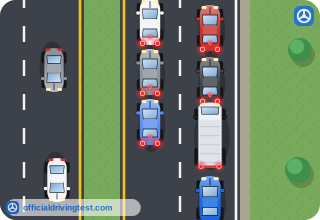
- Turn on your high beams for a few seconds
- Sound your horn two or three times in a row
- Brake hard once and then release the brakes
- Lightly tap your brake pedal several times
Show answer
Correct answer: Lightly tap your brake pedal several times
The manual says to lightly tap your brake pedal several times to alert drivers behind you.
Source: Oregon Driver Manual (2026-2027), page 34 · Open this page in the manual (Manual page 34)
-
When you enter a freeway, what should you do on the on-ramp?
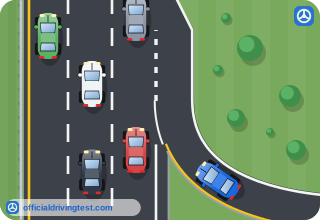
- Slow down or stop before you enter the freeway lanes
- Speed up and merge with the fast-moving traffic
- Stop at the end of the ramp and wait for a gap
- Turn on your hazard lights while you merge in
Show answer
Correct answer: Speed up and merge with the fast-moving traffic
On a freeway on-ramp you do the opposite of what you do at most busy roads: speed up and merge with fast-moving traffic.
Source: Oregon Driver Manual (2026-2027), page 34 · Open this page in the manual (Manual page 34)
-
When you merge onto a freeway, who must yield?
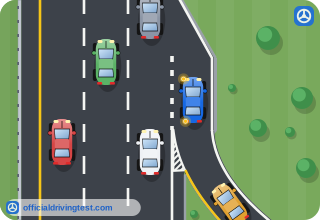
- Traffic already on the freeway must yield to you
- The vehicle that arrives first has the right of way
- The larger vehicle has the right of way
- You must yield to traffic already on the freeway
Show answer
Correct answer: You must yield to traffic already on the freeway
The manual says you must yield to traffic already on the freeway.
Source: Oregon Driver Manual (2026-2027), page 34 · Open this page in the manual (Manual page 34)
-
What should you do before merging onto a freeway?
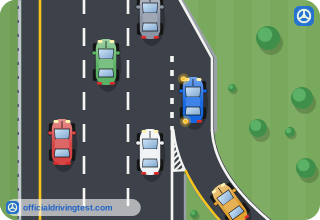
- Use your mirrors and check your blind spots
- Come to a full stop at the end of the ramp
- Flash your headlights at the traffic in the lane
- Turn on your hazard lights while you merge
Show answer
Correct answer: Use your mirrors and check your blind spots
The manual says to use your mirrors and check your blind spots before merging.
Source: Oregon Driver Manual (2026-2027), page 34 · Open this page in the manual (Manual page 34)
-
When entering a freeway, what should you do about your speed?
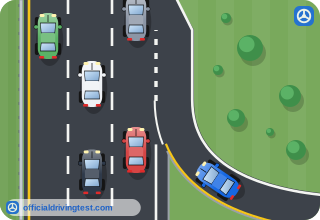
- Drive 10 mph below the traffic already on the freeway
- Stay at the speed of the on-ramp until you merge
- Adjust it to match traffic already on the freeway
- Stop to look for a gap
Show answer
Correct answer: Adjust it to match traffic already on the freeway
The manual says to adjust your speed to match traffic already on the freeway.
Source: Oregon Driver Manual (2026-2027), page 34 · Open this page in the manual (Manual page 34)
-
When you enter a freeway, what do drivers behind you expect you to do?
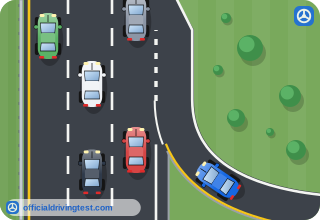
- Slow down and come to a stop
- Stay at the speed of the on-ramp
- Move quickly onto the freeway shoulder
- Speed up rather than slow down
Show answer
Correct answer: Speed up rather than slow down
The manual says drivers behind you expect you to speed up rather than slow down, so keep moving if at all possible.
Source: Oregon Driver Manual (2026-2027), page 34 · Open this page in the manual (Manual page 34)
-
What warns you if you start to enter a freeway the wrong way?
- A DO NOT ENTER or WRONG WAY sign
- A flashing red signal at the top of the ramp
- A ramp meter that shows a red light
- A yellow sign showing a curved arrow
Show answer
Correct answer: A DO NOT ENTER or WRONG WAY sign
A DO NOT ENTER or WRONG WAY sign warns you of your mistake.
Source: Oregon Driver Manual (2026-2027), page 34 · Open this page in the manual (Manual page 34)
-
If you start to enter a freeway the wrong way, what should you do first?
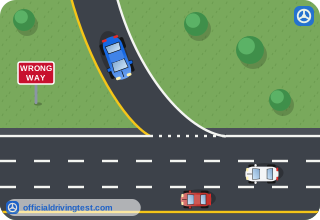
- Continue to the next exit and turn around at that exit
- Speed up to leave the ramp as quickly as you possibly can
- Immediately pull off to the side of the ramp and stop
- Make a U-turn across the ramp lanes without stopping first
Show answer
Correct answer: Immediately pull off to the side of the ramp and stop
The manual says to immediately pull off to the side of the ramp and stop, turn on your hazard lights, then cautiously turn around or back off the ramp.
Source: Oregon Driver Manual (2026-2027), page 34 · Open this page in the manual (Manual page 34)
-
If you start to enter a freeway the wrong way and have pulled off to the side of the ramp, what do you do to warn other vehicles?
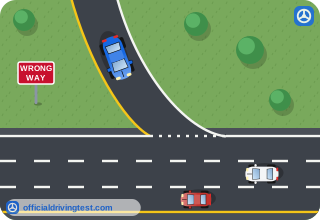
- Sound your horn continuously
- Turn on your hazard lights
- Turn on your high beams
- Get out and wave to the traffic
Show answer
Correct answer: Turn on your hazard lights
The manual says to turn on your hazard lights to warn other vehicles.
Source: Oregon Driver Manual (2026-2027), page 34 · Open this page in the manual (Manual page 34)
-
What do ramp meters look like, and when do they operate?
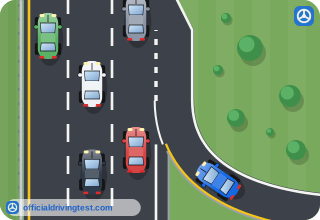
- They look like railroad gates and operate at all times of day
- They look like stop signs and operate only in bad weather
- They look like traffic signals but operate only at certain times
- They look like speed signs and operate only at night time
Show answer
Correct answer: They look like traffic signals but operate only at certain times
Ramp meters look like traffic signals but only operate during certain times of the day.
Source: Oregon Driver Manual (2026-2027), page 35 · Open this page in the manual (Manual page 35)
-
How many vehicles can proceed each time the green light comes on at a ramp meter?
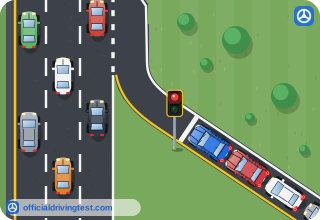
- Two
- One
- Three
- As many as the lane holds
Show answer
Correct answer: One
Only one vehicle can proceed each time the green light comes on.
Source: Oregon Driver Manual (2026-2027), page 35 · Open this page in the manual (Manual page 35)
-
How are ramp meters set up on a multi-lane on-ramp?
- One ramp meter serves all of the lanes
- Only the right lane has a ramp meter
- Ramp meters are used only on single-lane ramps
- Each lane has a ramp meter
Show answer
Correct answer: Each lane has a ramp meter
For multi-lane on-ramps, each lane has a ramp meter.
Source: Oregon Driver Manual (2026-2027), page 35 · Open this page in the manual (Manual page 35)
-
What should you do when the light at a ramp meter turns green?
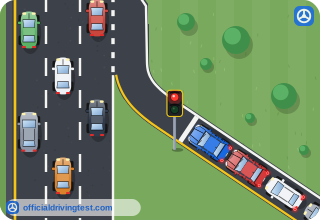
- Speed up to merge with traffic on the freeway
- Stop and wait for the traffic on the freeway to clear
- Proceed slowly and stop at the end of the ramp first
- Wait for the second green light before you proceed
Show answer
Correct answer: Speed up to merge with traffic on the freeway
When your ramp meter light turns green, speed up to merge with traffic on the freeway.
Source: Oregon Driver Manual (2026-2027), page 35 · Open this page in the manual (Manual page 35)
-
What should you do when a ramp meter is dark?
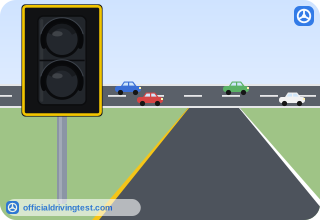
- Do not stop at it
- Stop and wait for it to turn on
- Stop for one full minute
- Wait for the vehicle ahead to go first
Show answer
Correct answer: Do not stop at it
Ramp meters appear dark when not in use, and you should not stop at a dark ramp meter.
Source: Oregon Driver Manual (2026-2027), page 35 · Open this page in the manual (Manual page 35)
-
When you leave a freeway, when should you turn on your signal?
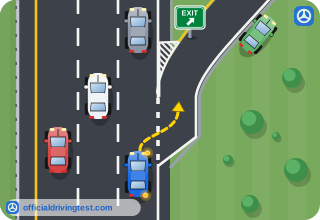
- Only once you are on the exit ramp
- Just as you reach the exit
- Well ahead of time
- After you slow down
Show answer
Correct answer: Well ahead of time
The manual says to turn on your signal well ahead of time when you leave a freeway.
Source: Oregon Driver Manual (2026-2027), page 35 · Open this page in the manual (Manual page 35)
-
When you leave a freeway, what should you do about your speed until you are off the freeway?
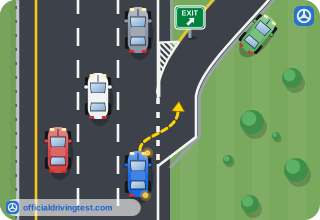
- Slow down on the main road before the exit
- Maintain your speed
- Speed up on the exit ramp
- Stop at the end of the exit ramp
Show answer
Correct answer: Maintain your speed
The manual says to maintain your speed until you are off the freeway, then slow to the posted advisory speed on the exit ramp.
Source: Oregon Driver Manual (2026-2027), page 35 · Open this page in the manual (Manual page 35)
-
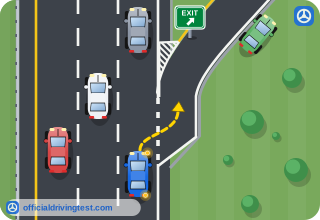
Once you are on a freeway exit ramp, what should you do?
- Stay at the freeway speed until the end of the ramp
- Stop on the ramp
- Speed up to merge with traffic
- Begin slowing to the posted advisory speed
Show answer
Correct answer: Begin slowing to the posted advisory speed
Once on the exit ramp, you begin slowing to the posted advisory speed.
Source: Oregon Driver Manual (2026-2027), page 35 · Open this page in the manual (Manual page 35)
-
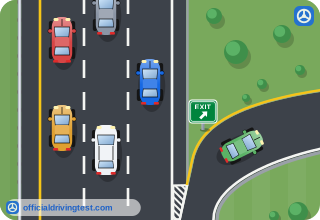
What should you do if you miss your freeway exit?
- Stop on the shoulder and back up
- Go to the next exit
- Make a U-turn at the next opening
- Slow down in the right lane until you can back up
Show answer
Correct answer: Go to the next exit
The manual says to go to the next exit and never stop or back up on a freeway.
Source: Oregon Driver Manual (2026-2027), page 35 · Open this page in the manual (Manual page 35)
-
When should the shoulder of a freeway be used?
- To pass slow traffic
- To rest when you are tired
- To wait for a gap in traffic when merging
- Only in an emergency
Show answer
Correct answer: Only in an emergency
The shoulder should only be used in an emergency.
Source: Oregon Driver Manual (2026-2027), page 35 · Open this page in the manual (Manual page 35)
-
If you have vehicle trouble on a freeway, where should you move your vehicle?
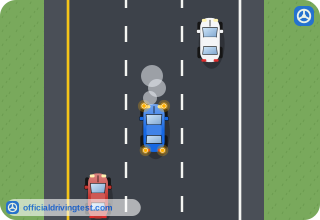
- To the right shoulder or emergency stopping area
- To the left shoulder next to the median of the freeway
- Into the left lane until the traffic has cleared out
- To the exit lane of the nearest off-ramp, then stop
Show answer
Correct answer: To the right shoulder or emergency stopping area
The manual says to move to the right shoulder or emergency stopping area and turn on your hazard lights.
Source: Oregon Driver Manual (2026-2027), page 35 · Open this page in the manual (Manual page 35)
-
If possible, where is it better to stay when your vehicle has trouble on a freeway?
- Walking along the freeway to find the nearest help
- Standing behind your vehicle in the lane to warn others
- In or near your vehicle on the side away from traffic
- Standing on the traffic side of your vehicle to watch
Show answer
Correct answer: In or near your vehicle on the side away from traffic
The manual says it is better to stay in or near your vehicle on the side away from traffic, because walking along a freeway is dangerous.
Source: Oregon Driver Manual (2026-2027), page 35 · Open this page in the manual (Manual page 35)