Oregon: Emergencies — Part 2 Practice Test
Questions in this part include: “If your brakes stop working, what may build up enough pressure to get them working again?” · “If your brakes fail, why should you shift to a lower gear?”
Independent educational site · not affiliated with any government agency or DMV
Ready? Test yourself
- Instant feedback with an explanation
- Every answer cites its source in the manual
- Your best score is saved on this device
Questions are original and based on the official manual "Oregon Driver Manual" (2026-2027), Oregon Driver and Motor Vehicle Services (DMV).
All 16 questions in this practice test
Take the test above first, then use this list to study. Tap “Show answer” to see the correct answer and explanation.
Show the questions and answersHide the questions
-
In most cases, what is safer than risking a head-on collision?
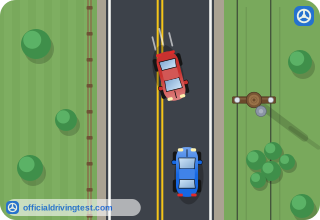
- Steering into the opposing lane
- Steering to the shoulder or ditch
- Braking hard in the middle of the road
- Turning on your hazard lights and not steering
Show answer
Correct answer: Steering to the shoulder or ditch
The manual says steering to the shoulder or ditch is, in most cases, safer than risking a head-on collision.
Source: Oregon Driver Manual (2026-2027), page 75 · Open this page in the manual (Manual page 75)
-
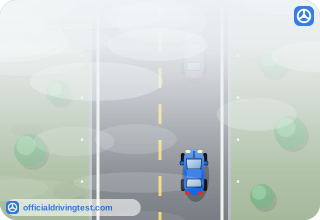
If you choose to pull off the road in low visibility, what should you do?
- Stop in the lane and turn off all of your lights to avoid glare
- Pull to the left side and use your high beams to be seen
- Pull as far to the right as you can and turn on your hazard lights
- Stop on the road itself and turn on your parking lights only
Show answer
Correct answer: Pull as far to the right as you can and turn on your hazard lights
The manual says to pull as far as you can to the right and turn on your hazard lights.
Source: Oregon Driver Manual (2026-2027), page 77 · Open this page in the manual (Manual page 77)
-
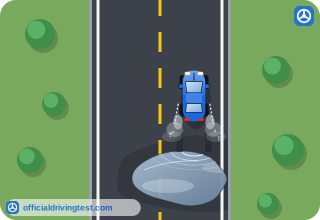
What should you do if your brakes get wet after driving through water?
- Stop your vehicle for an hour and wait for the brakes to dry out
- Press the brakes as hard as you can to squeeze the water out
- Gently apply the brakes while driving slowly until they respond
- Shift into neutral and coast until the brakes dry out
Show answer
Correct answer: Gently apply the brakes while driving slowly until they respond
The manual says to gently apply the brakes while driving slowly until they begin to respond, as soon as you can after driving through water.
Source: Oregon Driver Manual (2026-2027), page 78 · Open this page in the manual (Manual page 78)
-
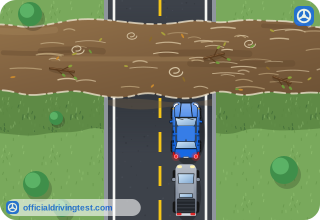
Why should you not drive through flooded areas?
- Water always damages the tires and wheel bearings
- High water may cause loss of control or engine stalling
- Flooded areas are always closed to all traffic by law
- Wet brakes can never be dried out once flooded
Show answer
Correct answer: High water may cause loss of control or engine stalling
High water may cause loss of control or engine stalling.
Source: Oregon Driver Manual (2026-2027), page 78 · Open this page in the manual (Manual page 78)
-
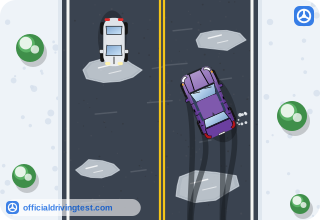
What causes skids?
- Driving with the headlights turned on
- Driving too fast for road conditions
- Driving with the windows rolled down
- Driving with a full tank of fuel
Show answer
Correct answer: Driving too fast for road conditions
Driving too fast for road conditions causes skids, which occur when the tires can no longer grip the road.
Source: Oregon Driver Manual (2026-2027), page 79 · Open this page in the manual (Manual page 79)
-
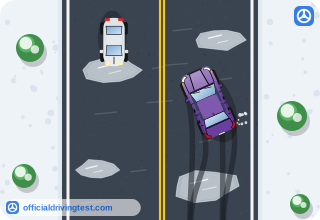
What should you do about the brakes if your vehicle begins to skid?
- Press them hard to slow down as quickly as possible
- Pump them quickly to regain control
- Apply them only with your left foot
- Stay off them until the vehicle slows
Show answer
Correct answer: Stay off them until the vehicle slows
The manual says to stay off the brakes because they will not be effective until the vehicle slows.
Source: Oregon Driver Manual (2026-2027), page 79 · Open this page in the manual (Manual page 79)
-
In which direction should you steer if your vehicle begins to skid?
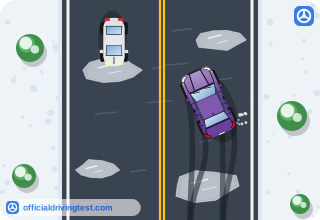
- In the direction you want the vehicle to go
- Away from the direction you want the vehicle to go
- Toward the nearest shoulder of the road
- Straight ahead no matter which way the vehicle slides
Show answer
Correct answer: In the direction you want the vehicle to go
The manual says to steer in the direction you want the vehicle to go.
Source: Oregon Driver Manual (2026-2027), page 79 · Open this page in the manual (Manual page 79)
-
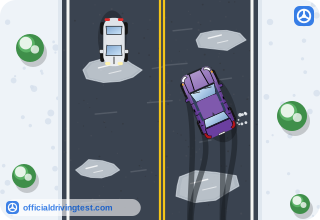
What should you do as soon as a skidding vehicle begins to straighten out?
- Brake firmly to stop the vehicle quickly
- Hold the wheel in the same position you used
- Turn the steering wheel back the other way
- Take both hands off the wheel for a moment
Show answer
Correct answer: Turn the steering wheel back the other way
If you do not turn the wheel back, the vehicle may swing around in the other direction and you could start a new skid.
Source: Oregon Driver Manual (2026-2027), page 79 · Open this page in the manual (Manual page 79)
-
How long should you continue to correct your steering during a skid?
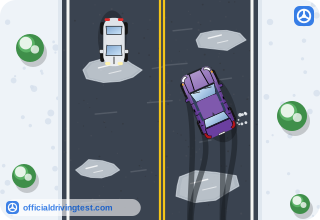
- Until the vehicle first stops sliding to either side
- Until the vehicle is moving down the road under your control
- For about three seconds after the vehicle starts to slide
- Until the brakes become effective again on the road
Show answer
Correct answer: Until the vehicle is moving down the road under your control
Continue to correct your steering, left and right, until the vehicle is again moving down the road under your control.
Source: Oregon Driver Manual (2026-2027), page 79 · Open this page in the manual (Manual page 79)
-
According to the manual, most equipment failures can be avoided with
- good maintenance
- an extra spare tire
- a newer vehicle
- frequent car washes
Show answer
Correct answer: good maintenance
Most equipment failures can be avoided with good maintenance.
Source: Oregon Driver Manual (2026-2027), page 84 · Open this page in the manual (Manual page 84)
-
What may you feel if a front tire blows?
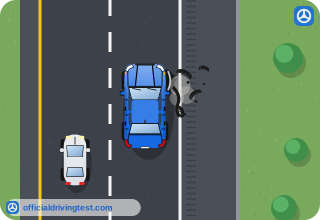
- The back of the vehicle swaying
- A strong pull to the side
- The steering wheel becoming very light
- The engine suddenly stalling
Show answer
Correct answer: A strong pull to the side
If a front tire blows, steering will be difficult and there may be a strong pull to the side.
Source: Oregon Driver Manual (2026-2027), page 84 · Open this page in the manual (Manual page 84)
-
What does a rear tire blowout cause?
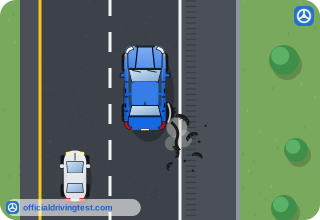
- A strong pull to the side of the road
- The steering wheel to lock up
- The brakes to stop working
- The back of the vehicle to sway
Show answer
Correct answer: The back of the vehicle to sway
A rear blowout causes the back of the vehicle to weave or sway.
Source: Oregon Driver Manual (2026-2027), page 84 · Open this page in the manual (Manual page 84)
-
What should you do if you have a blowout?
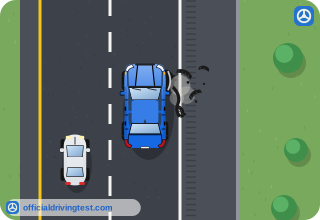
- Grip the steering wheel firmly and slow down gradually
- Brake hard right away and stop in your lane
- Let go of the wheel and let the car straighten
- Speed up to regain control, then pull off
Show answer
Correct answer: Grip the steering wheel firmly and slow down gradually
With a blowout, grip the steering wheel firmly, slow down gradually and pull off the road.
Source: Oregon Driver Manual (2026-2027), page 84 · Open this page in the manual (Manual page 84)
-
If your brakes stop working, what may build up enough pressure to get them working again?
- Shifting to neutral
- Turning off the engine
- Pumping the brakes
- Flashing your lights
Show answer
Correct answer: Pumping the brakes
Pumping the brakes may build up enough pressure to get them working again.
Source: Oregon Driver Manual (2026-2027), page 85 · Open this page in the manual (Manual page 85)
-
If your brakes fail, why should you shift to a lower gear?
- It turns on the brake lights
- It shuts off the fuel supply
- The engine can help slow you down
- It warns the drivers behind you
Show answer
Correct answer: The engine can help slow you down
Shifting to a lower gear lets the engine help slow you down.
Source: Oregon Driver Manual (2026-2027), page 85 · Open this page in the manual (Manual page 85)
-
If your brakes fail, how should you apply the parking brake?
- Slowly
- Hard at once
- Only after stopping
- Not at all
Show answer
Correct answer: Slowly
The manual says to slowly apply the parking brake.
Source: Oregon Driver Manual (2026-2027), page 85 · Open this page in the manual (Manual page 85)