Oklahoma: Parking rules — Part 2 Practice Test
Questions in this part include: “Which curb marking does the manual list as a reason you may not park parallel to the curb?” · “When you park on a hill, how close to the curb should you stop?”
Independent educational site · not affiliated with any government agency or DMV
Ready? Test yourself
- Instant feedback with an explanation
- Every answer cites its source in the manual
- Your best score is saved on this device
- Keyboard: press 1 to 4 to answer and Enter for the next question
Questions are original and based on the official manual "Oklahoma Driver Manual" (2025 (updated November 24, 2025)), Service Oklahoma.
All 21 questions in this practice test
Take the test above first, then use this list to study. Tap “Show answer” to see the correct answer and explanation.
Show the questions and answersHide the questions
-
Which curb marking does the manual list as a reason you may not park parallel to the curb?
- A yellow-painted curb
- A green-painted curb
- An unpainted curb
- A black-painted curb
Show answer
Correct answer: A yellow-painted curb
Along with signs that prohibit parking, a yellow-painted curb means you may not park there.
Source: Oklahoma Driver Manual (2025 (updated November 24, 2025)), page 47 · Open this page in the manual (Manual page 47)
-
When you begin to parallel park, how far out from the car in front should you be as you drive up even with it?
- About 6 inches
- About 5 feet
- About 8 feet
- About 2 feet
Show answer
Correct answer: About 2 feet
The manual has you stop even with the car in front and about 2 feet out from it.
Source: Oklahoma Driver Manual (2025 (updated November 24, 2025)), page 47 · Open this page in the manual (Manual page 47)
-
In parallel parking, after you are even with the car in front, what do you do with the front wheels?
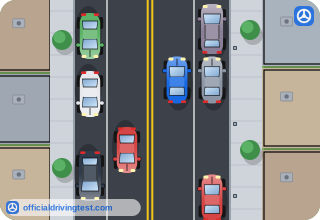
- Turn them all the way to the left and back quickly toward the curb
- Turn them all the way to the right and back slowly toward the curb
- Keep them straight and back up until you touch the curb
- Turn them halfway to the right and drive forward slowly
Show answer
Correct answer: Turn them all the way to the right and back slowly toward the curb
You turn the front wheels fully right and back slowly toward the curb.
Source: Oklahoma Driver Manual (2025 (updated November 24, 2025)), page 47 · Open this page in the manual (Manual page 47)
-
When do you turn the steering wheel all the way to the left while parallel parking?
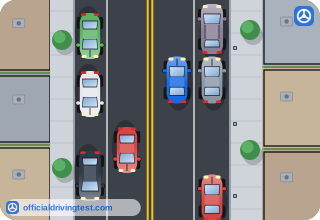
- When your front wheels are opposite the rear bumper of the car in front
- When your rear wheels touch the curb behind the car in front of you
- As soon as you start backing slowly toward the curb behind you
- When your car is about 2 feet out from the curb beside the space
Show answer
Correct answer: When your front wheels are opposite the rear bumper of the car in front
The quick left turn of the wheel happens when the front wheels reach the rear bumper of the car ahead.
Source: Oklahoma Driver Manual (2025 (updated November 24, 2025)), page 47 · Open this page in the manual (Manual page 47)
-
What is the final step of parallel parking?
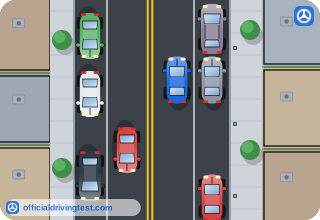
- Turn your wheels away from the curb and stop about 2 feet out from the car in front
- Turn your steering wheel all the way to the right and keep backing toward the curb
- Straighten your front wheels, drive into the final position and center your car in the space
- Set the parking brake and turn off the engine before straightening your front wheels
Show answer
Correct answer: Straighten your front wheels, drive into the final position and center your car in the space
You finish by straightening the front wheels and centering the car in the space.
Source: Oklahoma Driver Manual (2025 (updated November 24, 2025)), page 47 · Open this page in the manual (Manual page 47)
-
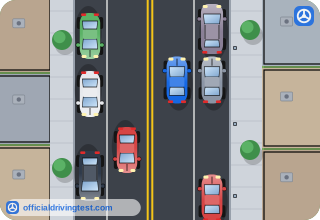
When parallel parking, what happens if you cut your wheels to the left too late?
- You stop too far from the curb
- You hit the curb
- You drive too close to the car ahead
- You drive into oncoming traffic
Show answer
Correct answer: You hit the curb
Turning the wheels left too late means the car will strike the curb.
Source: Oklahoma Driver Manual (2025 (updated November 24, 2025)), page 47 · Open this page in the manual (Manual page 47)
-
When parallel parking, what happens if you are too far out from the car in front?
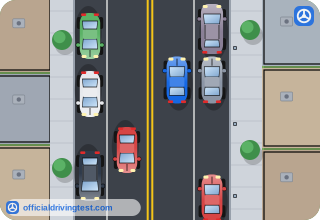
- You will drive too close to the car ahead of you
- You will hit the curb as you back into position
- You will end up blocking the car parked behind your space
- You will not be able to get close enough to the curb
Show answer
Correct answer: You will not be able to get close enough to the curb
Starting too far out leaves you unable to get close enough to the curb.
Source: Oklahoma Driver Manual (2025 (updated November 24, 2025)), page 47 · Open this page in the manual (Manual page 47)
-
When parallel parking, what happens if you cut your wheels to the right too soon?
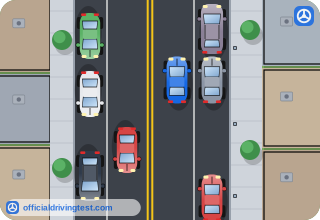
- You are left too far from the curb to park close enough
- You hit the curb behind you as you back into position
- You drive too close to the rear bumper of the car ahead of you
- You end up stopped partly in the lane of oncoming traffic
Show answer
Correct answer: You drive too close to the rear bumper of the car ahead of you
Turning right too soon, or starting too close, leaves you too close to the rear bumper of the car in front.
Source: Oklahoma Driver Manual (2025 (updated November 24, 2025)), page 47 · Open this page in the manual (Manual page 47)
-
Each time you drive out of or back into a parking space, what should you do?
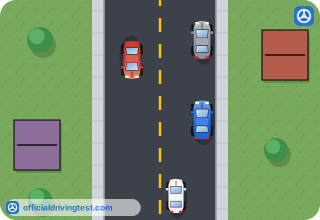
- Signal, watch for oncoming traffic and move slowly
- Honk, check your mirrors and move at normal speed
- Move quickly to avoid blocking traffic
- Use the emergency flashers and wait for a gap
Show answer
Correct answer: Signal, watch for oncoming traffic and move slowly
The manual says to signal, watch for oncoming traffic and move slowly each time.
Source: Oklahoma Driver Manual (2025 (updated November 24, 2025)), page 47 · Open this page in the manual (Manual page 47)
-
What can make a car parked on an incline roll?
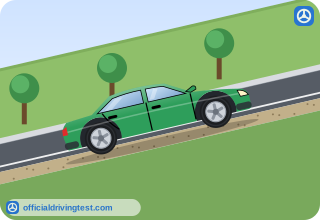
- Its engine has been turned off with the key removed
- Its headlights have been switched off
- Its windows have been rolled down
- Its parking brake is not set or not working properly
Show answer
Correct answer: Its parking brake is not set or not working properly
A car on an incline can roll if the parking brake is not set or is not working, or if it is not braced against the curb.
Source: Oklahoma Driver Manual (2025 (updated November 24, 2025)), page 47 · Open this page in the manual (Manual page 47)
-
When you park on a hill, how close to the curb should you stop?
- Within 12 inches
- Within six inches
- Within 24 inches
- Within 3 feet
Show answer
Correct answer: Within six inches
On a hill you parallel park but stop within six inches of the curb.
Source: Oklahoma Driver Manual (2025 (updated November 24, 2025)), page 47 · Open this page in the manual (Manual page 47)
-
When you park facing downhill, which way do you turn your wheels?
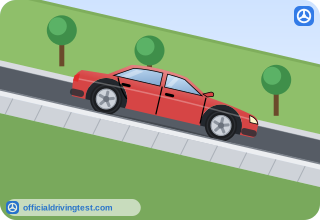
- Toward the curb
- Away from the curb
- Straight ahead
- Toward the center of the road
Show answer
Correct answer: Toward the curb
Facing downhill you turn the wheels toward the curb so the curb stops the car if it rolls.
Source: Oklahoma Driver Manual (2025 (updated November 24, 2025)), page 48 · Open this page in the manual (Manual page 48)
-
When you park facing downhill with a curb, what gear do you shift into?
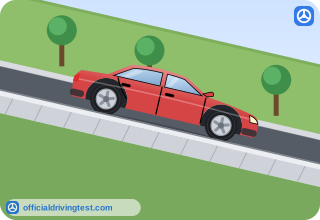
- Neutral or drive
- Low gear or neutral
- Reverse or "park"
- Second gear or drive
Show answer
Correct answer: Reverse or "park"
Downhill, you shift into reverse or park after the wheel touches the curb.
Source: Oklahoma Driver Manual (2025 (updated November 24, 2025)), page 48 · Open this page in the manual (Manual page 48)
-
How do you brace your car when you park facing uphill against a curb?
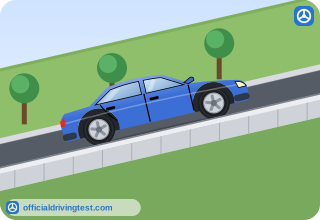
- Turn the wheels sharply toward the curb and drive forward slowly until the front tire touches it
- Turn the wheels sharply away from the curb and back up slowly until the rear of the tire is against the curb
- Turn the wheels toward the traffic lane and back up slowly until the front tire touches the curb
- Leave the wheels straight and stop within six inches of the curb with the parking brake set
Show answer
Correct answer: Turn the wheels sharply away from the curb and back up slowly until the rear of the tire is against the curb
Uphill with a curb, wheels go away from the curb and you back until the rear of the tire rests against it.
Source: Oklahoma Driver Manual (2025 (updated November 24, 2025)), page 48 · Open this page in the manual (Manual page 48)
-
When you park facing uphill against a curb, what gear do you shift into?
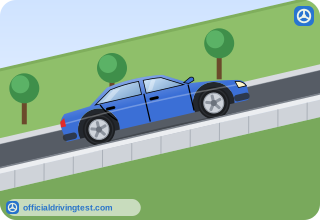
- Neutral or drive
- Second gear or neutral
- High gear or drive
- Low gear or "park"
Show answer
Correct answer: Low gear or "park"
After bracing against the curb uphill, you shift into low gear or park.
Source: Oklahoma Driver Manual (2025 (updated November 24, 2025)), page 48 · Open this page in the manual (Manual page 48)
-
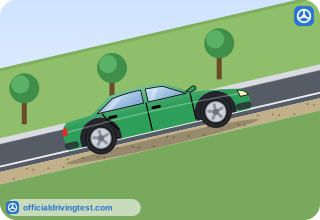
When you park facing uphill without a curb, which way do you turn your wheels?
- Sharply to the left
- Straight ahead
- Sharply to the right
- Only slightly to the left
Show answer
Correct answer: Sharply to the right
Without a curb you turn the wheels sharply right, so a rolling car moves away from traffic.
Source: Oklahoma Driver Manual (2025 (updated November 24, 2025)), page 48 · Open this page in the manual (Manual page 48)
-
If a car parked facing uphill without a curb should roll, where will it roll?
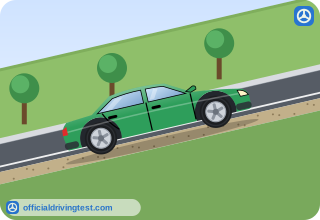
- Away from the traffic flow
- Into the traffic flow
- Straight down the middle of the road
- Toward the side of the road facing oncoming traffic
Show answer
Correct answer: Away from the traffic flow
With wheels turned sharply right, a rolling car goes away from the flow of traffic.
Source: Oklahoma Driver Manual (2025 (updated November 24, 2025)), page 48 · Open this page in the manual (Manual page 48)
-
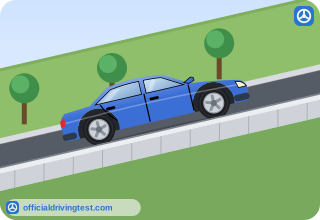
When you start on a hill from a parked position, what is the first step?
- Release the parking brake
- Signal
- Look in the rearview mirror
- Start the motor
Show answer
Correct answer: Start the motor
Starting on a hill begins with starting the motor, then shifting, signaling and checking before the brake is released.
Source: Oklahoma Driver Manual (2025 (updated November 24, 2025)), page 48 · Open this page in the manual (Manual page 48)
-
With a standard transmission on a hill, what should you do when you release the brake to keep the car from rolling?
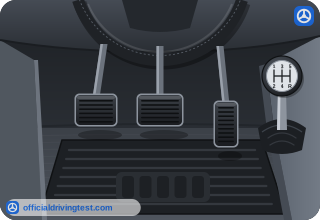
- Accelerate and release the clutch at the same time
- Release the clutch first, then accelerate
- Press the clutch down fully and let the car coast
- Release the clutch and the brake only after the engine stalls
Show answer
Correct answer: Accelerate and release the clutch at the same time
Applying gas while releasing the clutch keeps a standard-transmission car from rolling back.
Source: Oklahoma Driver Manual (2025 (updated November 24, 2025)), page 48 · Open this page in the manual (Manual page 48)
-
Where is the disabled parking permit hung?
- On the dashboard
- On the rear window
- From the mirror
- On the license plate
Show answer
Correct answer: From the mirror
The permit is hung from the mirror of the vehicle.
Source: Oklahoma Driver Manual (2025 (updated November 24, 2025)), page 49 · Open this page in the manual (Manual page 49)
-
Which statement about the parking permit issued to physically disabled residents is true?
- It is valid only in the county that issued it
- It is transferable and its holder may be the driver or a passenger
- It is valid only when the holder is the driver
- It is tied to one vehicle and cannot be moved to another
Show answer
Correct answer: It is transferable and its holder may be the driver or a passenger
The permit is transferable and can be used by a physically disabled driver or passenger of any vehicle.
Source: Oklahoma Driver Manual (2025 (updated November 24, 2025)), page 49 · Open this page in the manual (Manual page 49)