Ohio: Speed & following distance — Part 1 Practice Test
Questions in this part include: “According to the manual, when may a reasonable speed be slower than the posted speed limit?” · “What does the manual say driving safely means, in terms of your speed?”
Independent educational site · not affiliated with any government agency or DMV
Ready? Test yourself
- Instant feedback with an explanation
- Every answer cites its source in the manual
- Your best score is saved on this device
Questions are original and based on the official manual "Ohio Driver Manual" (HSY 7607 10/25 (October 2025)), Ohio Bureau of Motor Vehicles.
All 19 questions in this practice test
Take the test above first, then use this list to study. Tap “Show answer” to see the correct answer and explanation.
Show the questions and answersHide the questions
-
According to the manual, when may a reasonable speed be slower than the posted speed limit?
- In inclement weather, bad road conditions, or high traffic volumes
- Only when a police officer is directing traffic on the road ahead
- Never, because drivers must always drive exactly the posted speed limit
- Only when driving through a school zone while children are present
Show answer
Correct answer: In inclement weather, bad road conditions, or high traffic volumes
In less-than-ideal conditions, such as bad weather, poor road conditions or heavy traffic, a reasonable speed can be slower than the posted limit.
Source: Ohio Driver Manual (HSY 7607 10/25 (October 2025)), page 9
-
Regardless of the posted speed limit, Ohio law prohibits driving at a speed greater than what?
- A speed matching the flow of traffic around the vehicle
- A speed that allows the driver to stop in the distance available
- A speed set by the vehicle maker for safe handling
- A speed the driver has driven safely on that road before
Show answer
Correct answer: A speed that allows the driver to stop in the distance available
Ohio law prohibits a speed greater than what allows the driver to stop in the distance available, whatever the posted limit.
Source: Ohio Driver Manual (HSY 7607 10/25 (October 2025)), page 9
-
Speed limits are considered reasonable speeds based on the road’s design, dry weather without fog or other issues affecting visibility, and what else?
- The number of passengers in the vehicle
- The age of the driver
- The time of day the road is used
- The expected traffic volume
Show answer
Correct answer: The expected traffic volume
Speed limits are considered reasonable based on road design, expected traffic volume and dry, clear weather.
Source: Ohio Driver Manual (HSY 7607 10/25 (October 2025)), page 9
-
Generally, speed limits are based on the type of road (two-lane, divided highways, etc.) and what else?
- The road’s location
- The driver’s experience level
- The time of year
- The weight of the vehicle
Show answer
Correct answer: The road’s location
The manual says speed limits are generally based on the type of road and the road’s location.
Source: Ohio Driver Manual (HSY 7607 10/25 (October 2025)), page 9
-
Which of these is listed as a factor in how far it takes to bring a vehicle to a complete stop?
- The number of passengers aboard
- The color of the vehicle's paint
- The driver's years of experience
- The condition of the pavement
Show answer
Correct answer: The condition of the pavement
The manual lists the driver's reaction time, the vehicle's speed, the condition of its brakes and the condition of the pavement.
Source: Ohio Driver Manual (HSY 7607 10/25 (October 2025)), page 15
-
How far ahead of your car does the manual say you should ideally try to look to see what is occurring?
- 20 to 30 seconds
- 5 to 10 seconds
- 1 to 2 seconds
- 60 to 90 seconds
Show answer
Correct answer: 20 to 30 seconds
The manual says to ideally look at what is occurring 20 to 30 seconds in front of your car.
Source: Ohio Driver Manual (HSY 7607 10/25 (October 2025)), page 30
-
What does the manual say driving safely means, in terms of your speed?
- Always driving exactly at the posted speed limit
- Matching the speed of the fastest traffic nearby
- Adjusting your speed to roadway and traffic conditions
- Driving below the posted limit at all times
Show answer
Correct answer: Adjusting your speed to roadway and traffic conditions
Driving safely means adjusting your vehicle speed for roadway and traffic conditions, along with an adequate following interval and obeying speed limits.
Source: Ohio Driver Manual (HSY 7607 10/25 (October 2025)), page 30
-
What should you do before entering a curve?
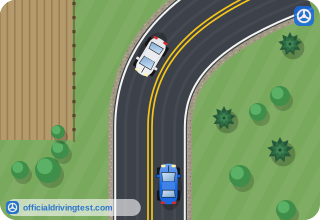
- Brake firmly once you are in the middle of the curve and then coast through
- Reduce speed to a safe speed that allows slight, constant acceleration through it
- Keep your speed up so you can take the curve quickly
- Coast through the whole curve without accelerating
Show answer
Correct answer: Reduce speed to a safe speed that allows slight, constant acceleration through it
Before entering a curve, you reduce speed to a safe speed that allows slight and constant acceleration through the curve.
Source: Ohio Driver Manual (HSY 7607 10/25 (October 2025)), page 30
-
You are approaching a curve and cannot see where it ends. What does the manual say to do?
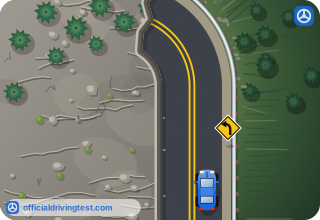
- Keep the same speed
- Speed up to get through sooner
- Move onto the shoulder
- Reduce your speed more
Show answer
Correct answer: Reduce your speed more
The manual says to reduce speed more when traction is poor, when following other vehicles, and when you cannot see the end of the curve.
Source: Ohio Driver Manual (HSY 7607 10/25 (October 2025)), page 30
-
When should you reduce your speed on a roadway that may become slippery?
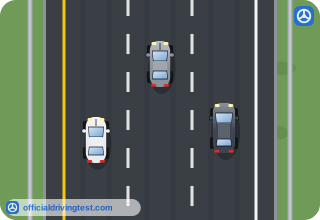
- Only after your tires begin to skid
- Only after the road is fully covered with ice
- At the first sign of rain, snow, sleet, or ice
- Only when the posted speed limit is lowered
Show answer
Correct answer: At the first sign of rain, snow, sleet, or ice
You should reduce speed at the first sign of rain, snow, sleet, or ice.
Source: Ohio Driver Manual (HSY 7607 10/25 (October 2025)), page 30
-
What happens when the roadway is slippery?

- It takes longer to stop and it is harder to turn without skidding
- It takes less distance to stop but harder to accelerate
- Your tires grip better because of the moisture
- Your stopping distance stays the same as on dry pavement
Show answer
Correct answer: It takes longer to stop and it is harder to turn without skidding
On a slippery road your tires do not grip as well, so it takes longer to stop and it is harder to turn without skidding.
Source: Ohio Driver Manual (HSY 7607 10/25 (October 2025)), page 30
-
What is hydroplaning?
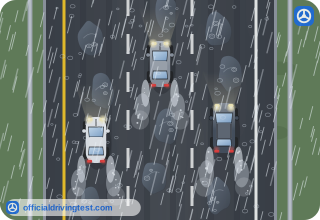
- Brakes overheating on a long downhill
- Rear wheels locking up on dry pavement
- Engine losing power in heavy rain
- Steering tires ride on top of pooled water
Show answer
Correct answer: Steering tires ride on top of pooled water
Hydroplaning occurs when the steering tires start to ride on top of pooled water, similar to the action of water skis.
Source: Ohio Driver Manual (HSY 7607 10/25 (October 2025)), page 30
-
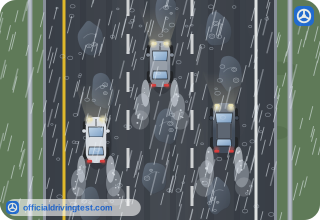
What is the best way to avoid traction loss from hydroplaning?
- Brake hard as soon as the road becomes wet
- Slow down in the rain or when water is pooled
- Accelerate to lift the tires above the water
- Steer sharply back and forth across the lane
Show answer
Correct answer: Slow down in the rain or when water is pooled
The best way to avoid losing traction from hydroplaning is to slow down when driving in the rain and when the road has pooled water or puddles.
Source: Ohio Driver Manual (HSY 7607 10/25 (October 2025)), page 30
-
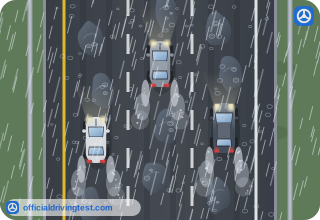
What should you do when your vehicle is hydroplaning?
- Slowly ease your foot off the gas pedal
- Brake as hard as you can
- Turn the steering wheel sharply
- Press the gas pedal to regain grip
Show answer
Correct answer: Slowly ease your foot off the gas pedal
When hydroplaning, you slowly ease your foot off the gas pedal.
Source: Ohio Driver Manual (HSY 7607 10/25 (October 2025)), page 30
-
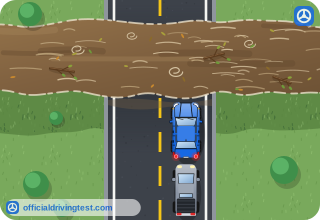
What should you do if you see a flooded roadway?
- Drive through slowly in a low gear
- Follow the vehicle ahead through the water
- Find another route to your destination
- Stop and wait in the water until it drops
Show answer
Correct answer: Find another route to your destination
The manual says not to drive through large bodies of standing water and to find another route if a road is flooded.
Source: Ohio Driver Manual (HSY 7607 10/25 (October 2025)), page 30
-
What is a "space cushion"?
- The padded space inside your vehicle around the driver's seat
- The space between your vehicle and others, giving you time to react
- The total width of the lane that you are currently driving in
- The distance between a stop line and the crosswalk ahead of it
Show answer
Correct answer: The space between your vehicle and others, giving you time to react
A space cushion is the space you allow between your vehicle and other roadway users, which gives you time to react.
Source: Ohio Driver Manual (HSY 7607 10/25 (October 2025)), page 31
-
What is stopping distance?
- The distance your vehicle travels from when you first touch the brake pedal until it stops
- The distance between your vehicle and the vehicle in front of you at any moment
- The distance that any vehicle needs to stop from any speed in any weather
- The distance your vehicle travels, in ideal conditions, from when you realize you must stop until it stops
Show answer
Correct answer: The distance your vehicle travels, in ideal conditions, from when you realize you must stop until it stops
Stopping distance is the distance your vehicle travels, in ideal conditions, from the time you realize you must stop until your vehicle stops.
Source: Ohio Driver Manual (HSY 7607 10/25 (October 2025)), page 31
-
What is perception time?
- The time it takes your foot to move from the gas pedal to the brake
- The time it takes your brakes to slow and stop the vehicle
- The time and distance it takes you to recognize the need to stop
- The time it takes your eyes to adjust to darkness
Show answer
Correct answer: The time and distance it takes you to recognize the need to stop
Perception time is the time and distance it takes you to recognize the need to stop.
Source: Ohio Driver Manual (HSY 7607 10/25 (October 2025)), page 31
-
What is the average perception time for an alert driver?
- 3/4 second to 1 second
- 3 to 4 seconds
- 1/4 second to 1/2 second
- 2 to 3 seconds
Show answer
Correct answer: 3/4 second to 1 second
The average perception time for an alert driver is 3/4 second to 1 second.
Source: Ohio Driver Manual (HSY 7607 10/25 (October 2025)), page 31