Ohio: Sharing the road — Part 3 Practice Test
Questions in this part include: “What is the "No Zone"?” · “Where should you avoid traveling when behind a large vehicle on steep hills or near truck weigh stations?”
Independent educational site · not affiliated with any government agency or DMV
Ready? Test yourself
- Instant feedback with an explanation
- Every answer cites its source in the manual
- Your best score is saved on this device
Questions are original and based on the official manual "Ohio Driver Manual" (HSY 7607 10/25 (October 2025)), Ohio Bureau of Motor Vehicles.
All 17 questions in this practice test
Take the test above first, then use this list to study. Tap “Show answer” to see the correct answer and explanation.
Show the questions and answersHide the questions
-
What is the "No Zone"?
- The area where a large truck or bus is not allowed to park at all
- The area around a school where passing other vehicles is not allowed
- The area around large trucks or buses where vehicles disappear from view
- The area beside a crosswalk where vehicles may not stop or stand
Show answer
Correct answer: The area around large trucks or buses where vehicles disappear from view
The No Zone is the area around large trucks or buses where vehicles disappear from the driver's view, known as blind spots.
Source: Ohio Driver Manual (HSY 7607 10/25 (October 2025)), page 37
-
Where are the "No Zones" of a large truck or bus located?
- Only on the right side of the vehicle
- On the sides, rear, and front of the vehicle
- Only directly behind the vehicle
- Only on the left and right sides
Show answer
Correct answer: On the sides, rear, and front of the vehicle
The blind spots of a large vehicle are on its sides, rear, and front.
Source: Ohio Driver Manual (HSY 7607 10/25 (October 2025)), page 37
-
How does the size of a truck relate to the size of its blind spot?
- The larger the truck, the smaller the blind spot
- Blind spots are the same size on every truck
- Only the smallest trucks have large blind spots
- The larger the truck, the larger the blind spot
Show answer
Correct answer: The larger the truck, the larger the blind spot
The manual says that the larger the truck, the larger the blind spot.
Source: Ohio Driver Manual (HSY 7607 10/25 (October 2025)), page 37
-
How can you tell whether the driver of a large truck can see you?
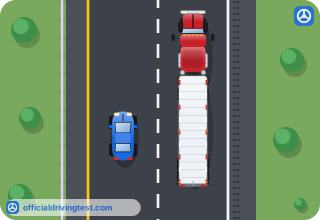
- If the driver's headlights are turned on, the driver can see you
- If the truck's turn signal is on, the driver must be able to see your vehicle
- If you cannot see the driver's face in the side-view mirror, the driver cannot see you
- If you can see the truck's front bumper, the driver can see you
Show answer
Correct answer: If you cannot see the driver's face in the side-view mirror, the driver cannot see you
If you cannot see the driver's face in the side-view mirror, the driver cannot see you.
Source: Ohio Driver Manual (HSY 7607 10/25 (October 2025)), page 37
-
What does the manual say about driving alongside a large vehicle?
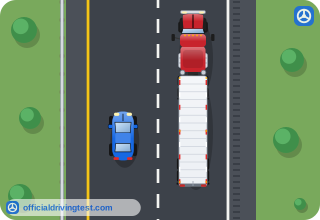
- Avoid it for any longer than required
- Stay beside it so the driver can see you
- Drive alongside it whenever passing is illegal
- Stay just behind its rear wheels for safety
Show answer
Correct answer: Avoid it for any longer than required
The manual says to avoid driving alongside a large vehicle for any longer than required under any circumstances.
Source: Ohio Driver Manual (HSY 7607 10/25 (October 2025)), page 37
-
A loaded truck with good tires and properly adjusted brakes is traveling at 55 mph in ideal conditions. What minimum distance does it need to stop?
- 135 feet
- 235 feet
- 535 feet
- 335 feet
Show answer
Correct answer: 335 feet
A loaded truck at 55 mph requires a minimum of 335 feet to stop, more than 1 1/2 times the stopping distance of a passenger vehicle.
Source: Ohio Driver Manual (HSY 7607 10/25 (October 2025)), page 37
-
Before pulling in front of a large vehicle you have passed, what should you look for in your rear-view mirror?
- The large vehicle's rear tires
- The whole front of the vehicle
- The large vehicle's turn signal
- The large vehicle's license plate
Show answer
Correct answer: The whole front of the vehicle
When passing a large vehicle, look for the whole front of the vehicle in your rear-view mirror before pulling in front of it and maintaining speed.
Source: Ohio Driver Manual (HSY 7607 10/25 (October 2025)), page 37
-
How far behind a large vehicle can its rear blind spots extend?
- Up to 200 feet
- Up to 20 feet
- Up to 50 feet
- Up to 500 feet
Show answer
Correct answer: Up to 200 feet
Large vehicles have huge blind spots directly behind them that extend up to 200 feet.
Source: Ohio Driver Manual (HSY 7607 10/25 (October 2025)), page 37
-
How should you position your vehicle behind a large vehicle?
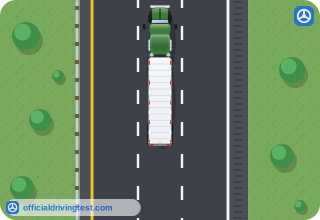
- Directly behind it, close to the bumper
- Directly behind it, below its rear window
- So the driver can see you in the side-view mirrors
- In the middle of the lane behind its trailer
Show answer
Correct answer: So the driver can see you in the side-view mirrors
Position your vehicle so that the driver can see you in the side-view mirrors.
Source: Ohio Driver Manual (HSY 7607 10/25 (October 2025)), page 37
-
Where should you avoid traveling when behind a large vehicle on steep hills or near truck weigh stations?
- The left lanes
- The right lanes
- The center lines
- The shoulders only
Show answer
Correct answer: The right lanes
The manual says to avoid the right lanes on steep hills behind a large vehicle or near truck weigh stations, where trucks may be re-entering faster traffic.
Source: Ohio Driver Manual (HSY 7607 10/25 (October 2025)), page 37
-
A fluorescent or reflective orange and red triangle on the rear of a vehicle means the vehicle is traveling at what speed?
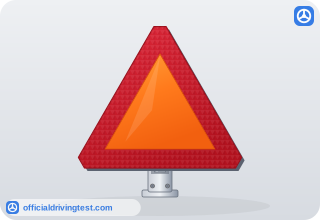
- Less than 10 mph
- Less than 45 mph
- More than 55 mph
- Less than 25 mph
Show answer
Correct answer: Less than 25 mph
A fluorescent or reflective orange and red triangle on the rear of a vehicle means it is traveling less than 25 mph.
Source: Ohio Driver Manual (HSY 7607 10/25 (October 2025)), page 38
-
Where must vehicles moving slower than the traffic flow travel?
- In the left lane so faster traffic can pass on the right
- In the center of the road with their hazard lights on
- In the right lane or as close as possible to the right curb
- On the road shoulder with their headlights turned on
Show answer
Correct answer: In the right lane or as close as possible to the right curb
Vehicles moving slower than the traffic flow must use the available right lane or stay as close as possible to the right-hand curb or edge of the highway.
Source: Ohio Driver Manual (HSY 7607 10/25 (October 2025)), page 38
-
When may you cross a solid yellow line to pass a slow-moving vehicle?
- If it goes under half the speed limit, you stay within the limit, and the oncoming lane has enough clear space
- Whenever the slow vehicle has its hazard lights on and you can see well ahead of it on the road
- If it is traveling slower than the posted limit and you can see past it clearly
- Whenever it is raining and the slow vehicle is traveling slowly in front of you
Show answer
Correct answer: If it goes under half the speed limit, you stay within the limit, and the oncoming lane has enough clear space
You may cross a solid yellow line to pass a slow-moving vehicle as long as it is traveling less than half the posted speed limit, you do not exceed the limit, and there is sufficient clear space in the oncoming lane.
Source: Ohio Driver Manual (HSY 7607 10/25 (October 2025)), page 38
-
What should you remember when passing farm machinery?
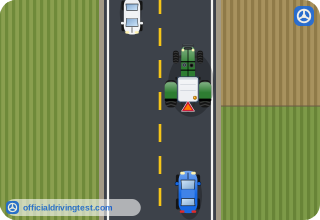
- The operator always signals before turning
- The machinery always travels faster than 25 mph
- The machinery is not allowed on state highways
- The operator cannot hear approaching vehicles
Show answer
Correct answer: The operator cannot hear approaching vehicles
Pass with caution and remember that the operator of farm machinery cannot hear approaching vehicles.
Source: Ohio Driver Manual (HSY 7607 10/25 (October 2025)), page 38
-
What must farm machinery display, and what light must it use at night?
- A green flashing light, and a red emblem in the daytime
- The slow-moving emblem, and a red flashing light at night
- The slow-moving emblem, and a white steady light at night
- A yellow flashing light, and no emblem at any time
Show answer
Correct answer: The slow-moving emblem, and a red flashing light at night
Farm machinery must display the slow-moving emblem and use a red flashing light at night.
Source: Ohio Driver Manual (HSY 7607 10/25 (October 2025)), page 38
-
What rights do animal-drawn vehicles and horseback riders have on the road?
- The same rights as a motor vehicle, and the same rules of the road
- Fewer rights than motor vehicles, and they may ignore some rules
- Right-of-way over all other vehicles on the roadway at all times
- No rights on the road, since they are not classed as vehicles
Show answer
Correct answer: The same rights as a motor vehicle, and the same rules of the road
Animal-drawn vehicles and horseback riders have the same rights as a motor vehicle and must follow the same rules of the road.
Source: Ohio Driver Manual (HSY 7607 10/25 (October 2025)), page 38
-
How are areas where animal-drawn vehicles and horseback riders are likely to be found marked?
- The pavement is painted red
- Traffic signals are added
- Warning signs are posted
- A flagger is always stationed there
Show answer
Correct answer: Warning signs are posted
Warning signs are posted in areas where animal-drawn vehicles and horseback riders are likely to be found.
Source: Ohio Driver Manual (HSY 7607 10/25 (October 2025)), page 38