Ohio: Sharing the road — Part 2 Practice Test
Questions in this part include: “How are bicycles treated on roadways, and which way must they ride?” · “If a bicyclist cannot signal, what other clues can you look for before the bicyclist changes lanes?”
Independent educational site · not affiliated with any government agency or DMV
Ready? Test yourself
- Instant feedback with an explanation
- Every answer cites its source in the manual
- Your best score is saved on this device
Questions are original and based on the official manual "Ohio Driver Manual" (HSY 7607 10/25 (October 2025)), Ohio Bureau of Motor Vehicles.
All 18 questions in this practice test
Take the test above first, then use this list to study. Tap “Show answer” to see the correct answer and explanation.
Show the questions and answersHide the questions
-
How are bicycles treated on roadways, and which way must they ride?
- As pedestrians, riding against the flow of traffic
- As vehicles, riding against the flow of traffic
- As pedestrians, riding with the flow of traffic
- As vehicles, riding with traffic and not against it
Show answer
Correct answer: As vehicles, riding with traffic and not against it
Bicycles are considered vehicles on roadways and must ride with, not against, other vehicular traffic.
Source: Ohio Driver Manual (HSY 7607 10/25 (October 2025)), page 35
-
What are bicyclists required to do regarding traffic signs, signals, and pavement markings?
- Obey only the ones on roads with bike lanes
- Obey all of them
- Obey only the ones posted on busy roads
- Follow them only when no motor vehicle is near
Show answer
Correct answer: Obey all of them
Bicyclists are required and expected to obey all traffic signs, signals, and pavement markings.
Source: Ohio Driver Manual (HSY 7607 10/25 (October 2025)), page 35
-
What rules of the road must bicyclists follow?
- The same rules as motorized vehicles
- Only the rules that apply to pedestrians
- Only a limited set of special bicycle rules
- No rules when riding in the daytime
Show answer
Correct answer: The same rules as motorized vehicles
Bicyclists are required and expected to follow the same rules of the road as motorized vehicles.
Source: Ohio Driver Manual (HSY 7607 10/25 (October 2025)), page 35
-
What should you do when approaching or passing a bicyclist?
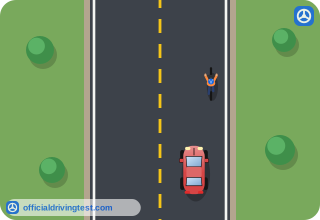
- Speed up so that you pass quickly
- Pass as closely as you can to save time
- Slow down
- Flash your high beams at the bicyclist
Show answer
Correct answer: Slow down
The manual says to slow down when approaching or passing a bicyclist.
Source: Ohio Driver Manual (HSY 7607 10/25 (October 2025)), page 35
-
When should you pass a bicyclist?
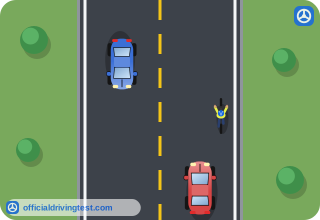
- Whenever the bicyclist is riding slowly
- Only when it can be done safely
- Whenever there is a dashed line on the road
- As soon as you come up behind the bicyclist
Show answer
Correct answer: Only when it can be done safely
The manual says to only pass a bicyclist when it can be done safely.
Source: Ohio Driver Manual (HSY 7607 10/25 (October 2025)), page 35
-
What minimum safety zone should you keep between your motor vehicle and a bicycle?
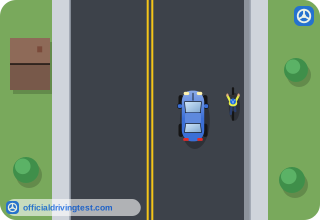
- At least one foot
- At least five feet
- At least ten feet
- At least three feet
Show answer
Correct answer: At least three feet
The manual says to maintain a safety zone of at least three feet between a motor vehicle and a bicycle.
Source: Ohio Driver Manual (HSY 7607 10/25 (October 2025)), page 35
-
What should you avoid doing in front of a bicyclist?
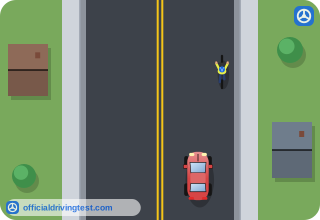
- Slowing down gradually and signaling well in advance of the turn
- Staying behind the bicyclist until it is safe for you to pass
- Turning sharply in front of a bicyclist or forcing one off the road
- Giving the bicyclist extra space on the side when you pass
Show answer
Correct answer: Turning sharply in front of a bicyclist or forcing one off the road
The manual says to avoid turning sharply in front of a bicyclist and not to force a bicyclist off the road.
Source: Ohio Driver Manual (HSY 7607 10/25 (October 2025)), page 35
-
When should you be particularly careful around bicyclists?
- When the roadway is wet or covered with sand or gravel
- When the roadway is dry and clear
- When the bicyclist is wearing bright clothing
- When there is no other traffic on the road
Show answer
Correct answer: When the roadway is wet or covered with sand or gravel
Wet roads or roads covered with sand or gravel affect bicycles much more than motor vehicles.
Source: Ohio Driver Manual (HSY 7607 10/25 (October 2025)), page 35
-
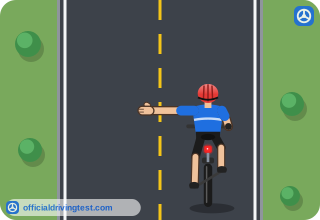
What does the manual suggest you do as a driver about bicycle hand signals?
- Ignore bicycle hand signals when driving
- Learn the bicycle hand signals
- Expect bicyclists to use car turn signals
- Honk when you see a bicyclist signal
Show answer
Correct answer: Learn the bicycle hand signals
The manual says to learn bicycle hand signals as a driver.
Source: Ohio Driver Manual (HSY 7607 10/25 (October 2025)), page 35
-
If a bicyclist cannot signal, what other clues can you look for before the bicyclist changes lanes?
- Turning the head or looking over the shoulder
- Ringing a bell or waving a hand in the air
- Speeding up to get ahead of nearby vehicles
- Riding closer to the curb or the roadway edge
Show answer
Correct answer: Turning the head or looking over the shoulder
If bicyclists cannot signal, look for other clues such as turning their head or looking over their shoulder before changing lanes.
Source: Ohio Driver Manual (HSY 7607 10/25 (October 2025)), page 35
-
Which of these is true about commercial vehicles compared with passenger vehicles?
- They are smaller and more maneuverable
- They stop in less distance
- They are larger and less maneuverable
- They have smaller blind spots
Show answer
Correct answer: They are larger and less maneuverable
Commercial vehicles are generally larger vehicles and less maneuverable than passenger vehicles.
Source: Ohio Driver Manual (HSY 7607 10/25 (October 2025)), page 36
-
How do the blind spots of commercial vehicles compare with those of passenger vehicles?
- They are the same size
- They are much larger
- They are much smaller
- They exist only on the right side
Show answer
Correct answer: They are much larger
Commercial vehicles have much larger blind spots than passenger vehicles.
Source: Ohio Driver Manual (HSY 7607 10/25 (October 2025)), page 36
-
Which of these is true of commercial vehicles?
- They have shorter stopping distances and need less room to turn
- They accelerate faster than passenger vehicles do and stop sooner
- They have shorter stopping distances but need more room to turn
- They need longer stopping and accelerating distances and more turning room
Show answer
Correct answer: They need longer stopping and accelerating distances and more turning room
Commercial vehicles have longer stopping and accelerating distances and need more room to turn.
Source: Ohio Driver Manual (HSY 7607 10/25 (October 2025)), page 36
-
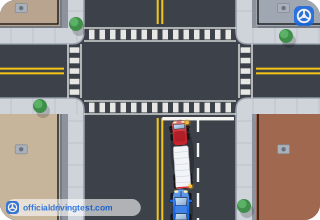
A truck or bus may make a wide right turn from the left lane. What should you not do?
- Stay behind the stop line at an intersection
- Let the large vehicle complete its turn first
- Squeeze between the large vehicle and the curb
- Wait to drive up into the lane after it turns
Show answer
Correct answer: Squeeze between the large vehicle and the curb
The manual says not to squeeze between the large vehicle and the curb, as it will cause a serious crash.
Source: Ohio Driver Manual (HSY 7607 10/25 (October 2025)), page 36
-
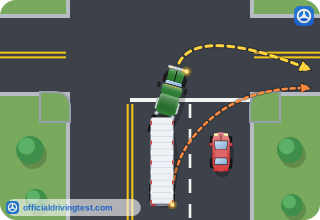
When should you drive up into the lane after a large vehicle makes a turn?
- After letting the large vehicle make its turn
- While the large vehicle is still turning
- Before the large vehicle starts its turn
- As soon as the signal is first turned on
Show answer
Correct answer: After letting the large vehicle make its turn
The manual says to let the large vehicle make its turn before driving up into the lane.
Source: Ohio Driver Manual (HSY 7607 10/25 (October 2025)), page 36
-
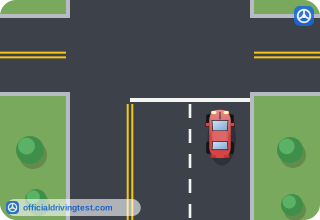
Why should you always stop behind intersection stop lines?
- They make sure traffic signals can easily see your vehicle
- They keep pedestrians from walking behind your vehicle
- They let you make faster right turns when the light changes
- They set you back and give larger vehicles more turning space
Show answer
Correct answer: They set you back and give larger vehicles more turning space
Stop lines set you farther back at an intersection to give larger vehicles more turning space.
Source: Ohio Driver Manual (HSY 7607 10/25 (October 2025)), page 36
-
You are unsure about the speed of an oncoming truck or bus. What should you do?
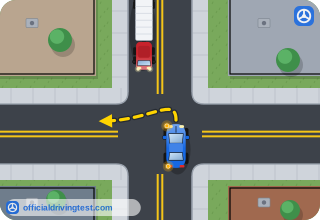
- Turn left quickly before it arrives
- Not turn left in its path
- Flash your headlights and turn left
- Turn left only if it has slowed down
Show answer
Correct answer: Not turn left in its path
When in doubt about the speed of an oncoming truck or bus, do not turn left in its path, because trucks and buses take longer to stop.
Source: Ohio Driver Manual (HSY 7607 10/25 (October 2025)), page 36
-
Which of these should you not do around a large vehicle?
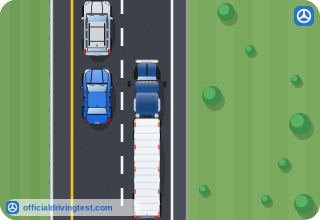
- Cut it off to reach an exit or beat it into a one-lane work zone
- Let it finish a wide turn before you move up into the lane
- Leave extra room when it turns at an intersection near you
- Stay behind the stop line at the intersection when it turns
Show answer
Correct answer: Cut it off to reach an exit or beat it into a one-lane work zone
The manual says not to cut off a large vehicle to reach an exit or turn, or to beat a truck into a single-lane construction zone.
Source: Ohio Driver Manual (HSY 7607 10/25 (October 2025)), page 36