Ohio: Seat belts & child safety Practice Test
Safety belts, child safety seats, booster seats and riding on the outside of a vehicle.
Independent educational site · not affiliated with any government agency or DMV
Ready? Test yourself
- Instant feedback with an explanation
- Every answer cites its source in the manual
- Your best score is saved on this device
Questions are original and based on the official manual "Ohio Driver Manual" (HSY 7607 10/25 (October 2025)), Ohio Bureau of Motor Vehicles.
All 24 questions in this practice test
Take the test above first, then use this list to study. Tap “Show answer” to see the correct answer and explanation.
Show the questions and answersHide the questions
-
How many seat belts should the front seat of the average motor vehicle have at a minimum?
- At least one
- At least three
- At least two
- At least four
Show answer
Correct answer: At least two
The manual lists at least two seat belts in the front seat.
Source: Ohio Driver Manual (HSY 7607 10/25 (October 2025)), page 4
-
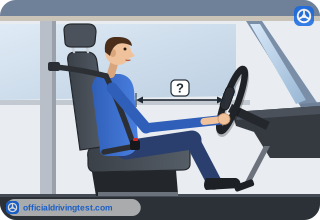
How much space should there be between your chest and the steering wheel for airbag deployment?
- At least 3 inches
- At least 10 inches
- At least 6 inches
- At least 15 inches
Show answer
Correct answer: At least 10 inches
The manual says there should be at least 10 inches between your chest and the steering wheel.
Source: Ohio Driver Manual (HSY 7607 10/25 (October 2025)), page 5
-
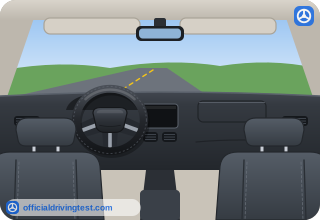
What are air bags described as in the manual?
- Supplemental restraints that work best with safety belts
- Replacements for safety belts in modern vehicles
- Restraints needed only by front-seat occupants under 18
- Devices that make safety belts optional in newer vehicles
Show answer
Correct answer: Supplemental restraints that work best with safety belts
The manual says air bags are supplemental restraints designed to work best in combination with safety belts.
Source: Ohio Driver Manual (HSY 7607 10/25 (October 2025)), page 6
-
Ohio’s mandatory safety belt usage law requires whom to wear safety belts in most passenger vehicles?
- Drivers only
- Only occupants under age 18
- Drivers and front-seat occupants
- Only rear-seat passengers
Show answer
Correct answer: Drivers and front-seat occupants
The manual says the law requires drivers and front-seat occupants of most passenger vehicles to wear safety belts.
Source: Ohio Driver Manual (HSY 7607 10/25 (October 2025)), page 6
-
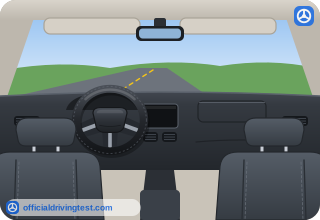
Should safety belts be worn if the vehicle is equipped with air bags?
- No, air bags make safety belts unnecessary in newer cars
- Yes, even if the vehicle has air bags
- Only on highways, where speeds are higher
- Only for passengers seated in the rear seat
Show answer
Correct answer: Yes, even if the vehicle has air bags
The manual says safety belts should be worn even if the vehicle is equipped with air bags.
Source: Ohio Driver Manual (HSY 7607 10/25 (October 2025)), page 6
-
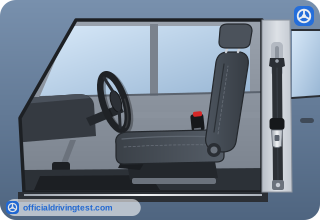
Across which parts of the body should the safety belt be worn?
- The stomach and the lower ribs
- The neck and the center of the waist
- The upper arms and lower back
- The bony areas (shoulders and hips)
Show answer
Correct answer: The bony areas (shoulders and hips)
The manual says the safety belt should be worn across bony areas, meaning the shoulders and hips.
Source: Ohio Driver Manual (HSY 7607 10/25 (October 2025)), page 6
-
How should a shoulder belt be worn?
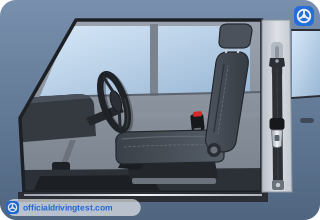
- Across the shoulder and chest with little slack
- Under the arm, away from the neck
- Behind the back with the lap belt fastened
- Loosely across the neck for comfort
Show answer
Correct answer: Across the shoulder and chest with little slack
The manual says a shoulder belt is worn across the shoulder and chest with minimal, if any, slack, never under the arm or behind the back.
Source: Ohio Driver Manual (HSY 7607 10/25 (October 2025)), page 6
-
How should the lap belt be adjusted after fastening?
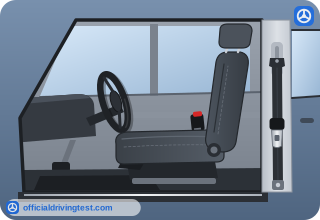
- Loose across your waist
- Snug across your stomach
- Snug and low across your hips
- Low across your thighs with slack
Show answer
Correct answer: Snug and low across your hips
The manual says to adjust the lap belt so it is snug and lies low across your hips.
Source: Ohio Driver Manual (HSY 7607 10/25 (October 2025)), page 6
-
What does Ohio law say about riding on the outside of a moving motor vehicle?
- Passengers may ride on the outside of the vehicle at speeds below 45 mph
- Adults may ride on the outside if they hold on with both hands
- No person shall hang onto or ride on the outside of any moving motor vehicle
- Riding on the outside is allowed on roads without a center line
Show answer
Correct answer: No person shall hang onto or ride on the outside of any moving motor vehicle
The law states no person shall hang onto or ride on the outside of any moving motor vehicle.
Source: Ohio Driver Manual (HSY 7607 10/25 (October 2025)), page 27
-
A truck driver may not knowingly permit a person under what age to ride in the unenclosed or unroofed cargo area when the vehicle is traveling faster than 25 mph?
- 16
- 12
- 14
- 18
Show answer
Correct answer: 16
The manual prohibits letting any person under age 16 ride in the unenclosed or unroofed cargo storage area above 25 mph, unless an exception applies.
Source: Ohio Driver Manual (HSY 7607 10/25 (October 2025)), page 27
-
Above what speed may a truck driver not knowingly permit a person under age 16 to ride in the unenclosed or unroofed cargo area?
- 15 mph
- 35 mph
- 45 mph
- 25 mph
Show answer
Correct answer: 25 mph
The prohibition applies when the vehicle is traveling faster than 25 mph.
Source: Ohio Driver Manual (HSY 7607 10/25 (October 2025)), page 27
-
Which is an exception allowing a person under 16 to ride in the cargo storage area of a truck traveling faster than 25 mph?
- The person holds on to the side of the cargo area
- The cargo area has a properly secured seat and safety belt
- The truck is traveling on a county road at night
- A parent or guardian rides in the cargo area too
Show answer
Correct answer: The cargo area has a properly secured seat and safety belt
One exception is a cargo area equipped with a properly secured seat and a safety belt that complies with federal standards.
Source: Ohio Driver Manual (HSY 7607 10/25 (October 2025)), page 27
-
Which passengers are exempt from the rule against riding in the unenclosed cargo area of a truck traveling faster than 25 mph?
- Workers doing highway or street maintenance for a public agency
- Workers making deliveries for a private business or farm
- Students riding in a group to a school or sports event
- Passengers who are at least 12 years old but under 16
Show answer
Correct answer: Workers doing highway or street maintenance for a public agency
Workers performing specialized highway or street maintenance or construction under a public agency are an exception.
Source: Ohio Driver Manual (HSY 7607 10/25 (October 2025)), page 27
-
An emergency exists that threatens the life of the driver or of a person in a truck's cargo storage area. How does this affect the rule on riding there at over 25 mph?
- It makes no difference to the rule
- It lowers the speed limit to 15 mph
- It is an exception to the rule
- It applies only to passengers under age 12
Show answer
Correct answer: It is an exception to the rule
An emergency threatening the life of the driver or the person being transported is one of the listed exceptions.
Source: Ohio Driver Manual (HSY 7607 10/25 (October 2025)), page 27
-
Ohio law requires that a child safety seat meet what standards?
- Standards set by the local police
- Federal motor safety standards
- Standards set by the insurance industry
- Standards set by the seat manufacturer only
Show answer
Correct answer: Federal motor safety standards
Ohio law requires a child safety seat that meets federal motor safety standards.
Source: Ohio Driver Manual (HSY 7607 10/25 (October 2025)), page 27
-
How should a child safety seat be installed and used in your vehicle?
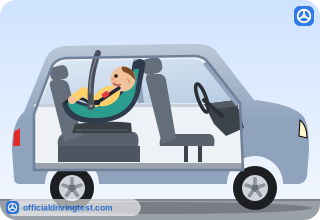
- Installed in any seat and used however the driver prefers
- Installed only by a licensed mechanic at a repair shop
- Installed in the front seat for easier supervision of the child
- Installed properly and used per the manufacturer's instructions
Show answer
Correct answer: Installed properly and used per the manufacturer's instructions
The manual says to install it properly and use it in accordance with the manufacturer's instructions.
Source: Ohio Driver Manual (HSY 7607 10/25 (October 2025)), page 27
-
Where should children age 12 and younger be properly restrained?
- In the front passenger seat
- In the cargo area
- In the back seat
- Anywhere in the vehicle
Show answer
Correct answer: In the back seat
The manual says all children age 12 and younger should be properly restrained in the back seat.
Source: Ohio Driver Manual (HSY 7607 10/25 (October 2025)), page 27
-
Where must a rear-facing child safety seat never be placed?
- In front of an active passenger airbag
- Behind the driver's seat
- In the center of the back seat
- Beside another child safety seat
Show answer
Correct answer: In front of an active passenger airbag
A rear-facing child safety seat must never be placed in front of an active passenger airbag.
Source: Ohio Driver Manual (HSY 7607 10/25 (October 2025)), page 27
-
A child is under age 4, weighs less than 40 pounds, or both. How must the child be restrained?
- In a booster seat
- With a safety belt only
- In an adult's lap with a safety belt
- In a child safety seat
Show answer
Correct answer: In a child safety seat
Infants and children under age 4 and/or under 40 pounds must be restrained in a child safety seat.
Source: Ohio Driver Manual (HSY 7607 10/25 (October 2025)), page 27
-
A child is age 5, weighs more than 40 pounds and is shorter than 4 feet 9 inches. How must the driver have the child restrained?
- In a rear-facing child safety seat
- In a booster seat
- With a safety belt only
- In the front seat with the airbag off
Show answer
Correct answer: In a booster seat
Children at least age 4 but less than age 8 must be in a booster seat unless 4-foot 9-inches or taller.
Source: Ohio Driver Manual (HSY 7607 10/25 (October 2025)), page 27
-
A child who is at least age 4 but less than age 8 does not need a booster seat if the child is at least how tall?
- 4 feet 9 inches
- 3 feet 6 inches
- 4 feet 3 inches
- 5 feet 2 inches
Show answer
Correct answer: 4 feet 9 inches
A booster seat is not required if the child is 4-foot 9-inches in height, or taller.
Source: Ohio Driver Manual (HSY 7607 10/25 (October 2025)), page 27
-
A 10-year-old child is being transported in a motor vehicle in Ohio. How must the child be restrained?
- In a rear-facing child safety seat
- In a booster seat
- With a safety belt
- The law does not require any restraint
Show answer
Correct answer: With a safety belt
Children age 8 up to age 15 must be restrained with a safety belt.
Source: Ohio Driver Manual (HSY 7607 10/25 (October 2025)), page 27
-
Which of these is exempt from Ohio's child restraint law?
- Family minivans
- Taxicabs
- Vehicles carrying more than three children
- Vehicles driven by a parent
Show answer
Correct answer: Taxicabs
Exemptions include public safety vehicles, taxicabs and vehicles not required by law to have safety belts at manufacture.
Source: Ohio Driver Manual (HSY 7607 10/25 (October 2025)), page 27
-
For new drivers under age 18, the number of occupants in the vehicle cannot exceed what?
- The number of seats in the front row
- The number of safety belts originally installed
- Four people, including the driver
- The number of passengers allowed by the vehicle’s owner
Show answer
Correct answer: The number of safety belts originally installed
The driver and all passengers must wear safety belts, and occupants cannot exceed the number of safety belts originally installed.
Source: Ohio Driver Manual (HSY 7607 10/25 (October 2025)), page 47